REVIEW 2 major objections 4 minor 2 cited by
This paper claims that generalized Oppenheimer-Snyder collapse into any static two-horizon exterior splits into three outcomes—singular, bouncing, soft-landing—determined by local conditions on the exterior metric.
Reviewed by Pith at T0; open to challenge. T0 means a machine referee read the full paper against a public rubric. the ladder, T0–T4 →
Generalized Oppenheimer-Snyder collapse into two-horizon exteriors splits into singular, bouncing, and soft-landing categories, with Reissner-Nordström showing the bounce and regular de Sitter-core black holes never doing so.
T0 review reviewed 2026-08-03 challenge →
load-bearing objection A coherent new classification of generalized homogeneous collapse, but the interior is not pressureless dust for non-Schwarzschild exteriors, so the central physical premise is wrong as written. the 2 major comments →
Classification of Oppenheimer-Snyder Collapse: Singular, Bouncing, and Soft-Landing Scenarios
The pith
A machine-rendered reading of the paper's core claim, the machinery that carries it, and where it could break.
The reading
Core claim
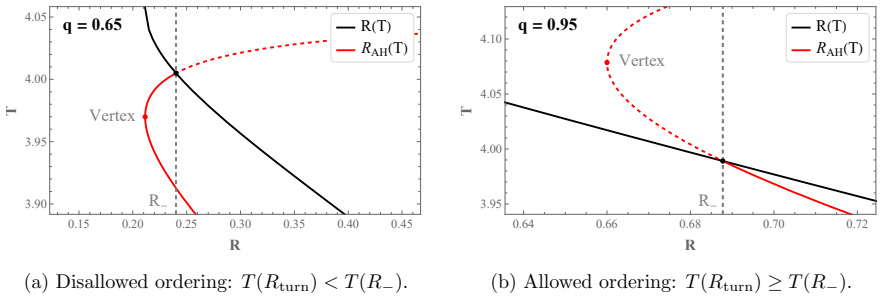
For the generalized Oppenheimer-Snyder collapse of a dust ball matched to a special static exterior ds²=-f dt² + dr²/f + r² dΩ², the surface radius obeys dR/dT=-√(1-f(R)) and the apparent-horizon radius is RAH(R)=R/√(1-f(R)). The paper shows that two local conditions on f (equivalently on the mass function m=R(1-f)/2) decide the outcome: a bounce when f(R*)=1 with f'(R*)<0, i.e. m(R*)=0 and m'(R*)>0, and a left vertex of the apparent horizon when Rf'(R)+2(1-f(R))=0, i.e. m'(R)R-3m(R)=0. For two horizons, consistency requires the vertex to be no earlier than the inner-horizon crossing; in Reissner-Nordström this gives |q| ≥ √3 m/2 and a bounce at R*=q²/(2m). Regular black holes with de Sitter
What carries the argument
The central object is the exterior metric function f(r) of the two-horizon black hole and its associated mass function m(r)=r(1-f(r))/2. From f alone the paper derives the collapsing surface's velocity dR/dT=-√(1-f(R)) and the apparent-horizon radius RAH(R)=R/√(1-f(R)); differentiating gives the exact signature conditions: bounce at f=1 with f'<0, apparent-horizon vertex at Rf'+2(1-f)=0, and inflection radius at f'=0. The argument's engine is expressing these in terms of m and combining the null energy condition with regularity at the center to prove that dRAH/dT is nonpositive, so no vertex can appear.
Load-bearing premise
The load-bearing premise is the trapped-region consistency condition of Sec. 4.1: the apparent-horizon turning point must occur no earlier than the surface's crossing of the inner horizon. The paper motivates this by causality but does not derive it from the field equations; if a vertex-before-crossing ordering can be realized consistently, the parameter constraint |q| ≥ √3 m/2 and the classification of 'consistent' vertices would shift.
What would settle it
Run a fully nonlinear simulation of pressureless dust collapse matched to a Reissner-Nordström exterior, scanning charge in 0<|q|<m, and look for the apparent-horizon trajectory. If for some |q|<√3 m/2 the apparent-horizon radius has a local minimum before the surface crosses the inner horizon and the spacetime remains free of pathology, the paper's consistency constraint fails. Alternatively, construct a two-horizon special-static exterior satisfying the null energy condition with a regular core whose apparent-horizon slope dRAH/dT turns positive, contradicting the paper's monotonicity theore
If this is right
- Every OS collapse into a static two-horizon exterior of the special static type ends as singular, bouncing, or soft-landing; no fourth late-time behavior appears in this framework.
- For Reissner-Nordström exteriors, physical consistency forces the charge to satisfy |q| ≥ √3 m/2; in that range the collapse bounces at R* = q²/(2m) and shows an apparent-horizon vertex.
- A bounce implies at least one apparent-horizon left vertex in asymptotically flat OS collapse, but a vertex can occur without a bounce.
- Two horizons alone do not produce the new features: regular black holes with de Sitter cores under the null energy condition collapse monotonically and soft-land.
- The paper argues that bouncing collapse implies matter accumulation and instability of the inner horizon, consistent with strong cosmic censorship, while cautioning that the classical bounce continuation inside the inner horizon may not survive in a realistic collapse.
Where Pith is reading between the lines
- A fully dynamical numerical simulation of charged dust collapse could test the trapped-region ordering: if an apparent-horizon minimum appears before the surface reaches the inner horizon for charges below √3 m/2, the consistency condition would need to be revised.
- The same local criteria could be applied to rotating or multi-horizon exteriors to see whether the three-way classification survives beyond spherical symmetry and the special static form.
- If the classification is right, observing the exterior metric's behavior near a core—through gravitational-wave ringdown or lensing—could distinguish a soft-landing regular collapse from a singular one.
- The theorem that Minkowski-core regular black holes violate the null energy condition is testable in principle by constraining the effective core equation of state; a detected Minkowski-core collapse would require NEC-violating matter.
Editorial analysis
A structured set of objections, weighed in public.
Referee Report
Summary. The paper studies the dynamics of a collapsing homogeneous fluid sphere matched, via Israel junction conditions, to static spherically symmetric exteriors of the special form ds² = -f(r)dt² + f(r)^{-1}dr² + r²dΩ². Starting from the surface equation ˙R² = 1 - f(R), it derives local conditions for two possible signatures: an apparent-horizon left vertex (dR_AH/dT = 0, equivalent to m'(R)R - 3m(R) = 0) and a surface bounce (f(R*)=1, f'(R*)<0). These criteria are applied to Reissner-Nordström, where all three special radii R*, R_infl, R_turn are computed and ordered, and to regular black holes with de Sitter cores, where NEC excludes both signatures and the surface approaches the center only asymptotically. The paper classifies the outcomes as singular, bouncing, and soft-landing collapse, and argues consistency with Penrose's strong cosmic censorship conjecture.
Significance. Within its own framework the paper is quite clean: the local criteria are derived in an explicit, parameter-free way in Eqs. (9)-(20), and the RN section is internally consistent, with the three radii satisfying the stated ordering (38). The NEC-based monotonicity argument for de Sitter-core regular black holes in Sec. 5.1, and the resulting new proof that Minkowski-core regular black holes violate the NEC, are elegant and would be a useful contribution. The main limitation is that, as written, the model is not literal Oppenheimer-Snyder dust collapse for non-Schwarzschild exteriors; it is a homogeneous perfect-fluid collapse with nonzero pressure. This reframing does not destroy the technical derivations, but it changes the physical claims and the title/abstract. If the dust identification is corrected, the classification of surface outcomes and horizon behavior is a valuable addition to the OS-type collapse literature.
major comments (2)
- [Sec. 2, Eqs. (3)-(5)] The interior is not pressureless dust for any non-Schwarzschild exterior. With H = -sqrt(1-f(R))/R, the perfect-fluid pressure of the FLRW interior is p = -(2Hdot+3H²)/(8π) = [R f'(R) - (1-f(R))]/(8π R²). For the RN exterior (23) this gives p = -q²/(8π R⁴) ≠ 0; the regular-core examples in Sec. 5 and Appendices A/B also have nonzero pressure. Thus the matched solutions are homogeneous perfect-fluid interiors with generically negative pressure, not Oppenheimer-Snyder dust. The surface equations remain valid for this perfect-fluid model, but the repeated interpretation as 'pressureless dust' and as 'OS collapse' is incorrect unless f is Schwarzschild. The paper should either explicitly restrict the dust claim to f = 1-2M/r or redefine the model as a generalized OS-type perfect-fluid collapse and compute/discuss the interior pressure profile.
- [Sec. 4.1, Eq. (28)] The trapped-region consistency condition T(R_turn) ≥ T(R_-), which is then translated to R_turn ≤ R_- and to the RN bound |q| ≥ √3 m/2 in (30), is asserted as a physical necessity but not derived from the Israel junction conditions, the field equations, or the definition of the apparent horizon. This condition is load-bearing: it decides which of the two orderings in Fig. 1 is deemed physical and sets the parameter range for the 'consistent' RN bounce-with-vertex scenario. The authors should either prove this condition from a global causal/trapped-region argument or explicitly present it as an extra selection rule/assumption, and discuss how the classification changes if vertex-before-crossing configurations are admitted.
minor comments (4)
- [Sec. 6, first paragraph of Conclusion] The sentence 'for regular black holes, which necessarily have two horizons, their OS collapse has no apparent-horizon left vertex, nor any bounce' is too broad. Section 5.2 shows that Minkowski-core regular black holes (which violate NEC) have at least one left vertex. The claim should be qualified to 'regular black holes satisfying the NEC' or 'with de Sitter cores', which is how the abstract correctly phrases it.
- [Sec. 5.1, just before Eq. (39)] The statement that NEC implies f(r) ≤ 1 for regular black holes with inequality saturated at the core and at infinity is cited to Ref. [14] but not derived in this paper. A short derivation or a precise theorem statement would make the no-bounce argument self-contained.
- [Fig. 2 and Sec. 4.2.1] At the bounce radius R*, one has f(R*)=1, so R_AH = R/sqrt(1-f(R)) diverges as R→R*+. The figure and the surrounding text do not indicate this divergence; the apparent-horizon trajectory has a vertical asymptote at the bounce rather than a smooth return. A brief note or a zoomed inset would prevent the reader from misreading the diagram.
- [Appendix A, action (50)] There is a typo in the field-strength definition: 'F_μν = ∂_μ A_ν − ∂_μ A_ν' should be '∂_μ A_ν − ∂_ν A_μ'.
Circularity Check
No significant circularity: all classification criteria are derived from the exterior metric function and are not fitted or self-referential.
full rationale
The derivation chain is self-contained. The surface equation Rdot^2=1-f(R), Eq. (5), follows from the stated Israel junction conditions for the FLRW interior, and the bounce and vertex criteria (12), (15), (17) are obtained by direct differentiation of this equation and of the apparent-horizon formula (7). The RN results (R*=q^2/2m, R_turn=2q^2/3m, R_infl=q^2/m) are explicit algebraic evaluations of those criteria for the RN metric (23), not fitted parameters later called predictions. The regular-black-hole no-vertex theorem is proven within the paper from the NEC inequality (40) and the regularity condition (42), and the Minkowski-core no-go result is a contradiction between that proven no-vertex statement and the vertex implied by the Minkowski-core expansion (48)-(49). Citations to [3], [6], and [14] are to prior derivations with stated assumptions (junction conditions, dust interior, NEC) and none of those assumptions contains the target classification, so they are not circular. The serious concern that non-Schwarzschild exteriors require a non-dust interior with nonzero pressure is a physical correctness issue, not a circularity of the derivation.
Axiom & Free-Parameter Ledger
axioms (6)
- domain assumption The exterior metric is restricted to the special static form ds^2 = -f(r)dt^2 + dr^2/f(r) + r^2 dOmega^2 (h=f).
- domain assumption The interior is a spatially flat (k=0) FLRW pressureless dust ball in Painleve-Gullstrand slicing.
- ad hoc to paper The trapped-region consistency condition T(R_turn) >= T(R_-) (Eq. 28) is physically necessary.
- domain assumption For regular black holes satisfying the NEC, the core must be de Sitter and f(r) <= 1, with equality at infinity and at the core.
- domain assumption Regular centers satisfy m(0)=0 and m(r)=O(r^3) as r->0.
- domain assumption The collapsing surface starts from a sufficiently large, asymptotically flat initial radius R0.
Cite this review
Pith. "Pith review of Classification of Oppenheimer-Snyder Collapse: Singular, Bouncing, and Soft-Landing Scenarios." pith.science (2026). https://pith.science/paper/6CBQT325
@misc{pith2026260204956,
  author       = {Pith},
  title        = {Pith review of: Classification of Oppenheimer-Snyder Collapse: Singular, Bouncing, and Soft-Landing Scenarios},
  year         = {2026},
  howpublished = {\url{https://pith.science/paper/6CBQT325}},
  note         = {Machine review of arXiv:2602.04956}
}
read the original abstract
We study Oppenheimer-Snyder (OS) gravitational collapse matched to a general static, spherically symmetric exterior spacetime. Unlike the Schwarzschild case, two new features can arise in black holes with two horizons: an apparent-horizon minimum, a temporary minimum in the apparent-horizon radius during collapse, and a bounce, where the star surface stops collapsing at a nonzero radius and reverses into expansion. We identify the conditions that lead to these two features. For two-horizon exteriors, trapped-region consistency requires that the apparent-horizon turning point occurs no earlier than the surface crossing of the inner horizon. As a concrete example, the OS collapse of the Reissner-Nordstr\"om (RN) spacetime shows both effects. In contrast, regular black holes with de Sitter cores show neither: their collapse is smooth and monotonic, and the surface approaches the center only as the proper time goes to infinity. These results naturally classify the OS collapses into three categories: singular, which ends at the center in finite time; bouncing, which reverses at a finite radius; and soft-landing, which reaches the center only asymptotically. We argue that these features are consistent with Penrose's strong cosmic censorship conjecture.
Figures


Forward citations
Cited by 2 Pith papers
-
Matter Maps to Geometry in Gravitational Collapse
An exact bidirectional algebraic map exists between the interior Friedmann density of a collapsing star and its exterior static spherically symmetric metric in generalized Oppenheimer-Snyder collapse.
-
Matter Maps to Geometry in Gravitational Collapse
Darmois–Israel junction conditions yield an exact bidirectional algebraic map from homogeneous interior density to exterior metric functions in generalized Oppenheimer–Snyder collapse.
Reference graph
Works this paper leans on
-
[1]
On continued gravitational contraction,
J.R. Oppenheimer and H. Snyder, “On continued gravitational contraction,” Phys. Rev. 56(1939) 455–459, doi:10.1103/PhysRev.56.455
-
[2]
Singular hypersurfaces and thin shells in general relativity,
W. Israel, “Singular hypersurfaces and thin shells in general relativity,” Nuovo Cim. B 44S10(1966) 1 [erratum: Nuovo Cim. B48(1967) 463], doi:10.1007/BF02710419
-
[3]
The upper bound of event horizon formation time in generalized Oppenheimer-Snyder collapse,
Z.C. Li, H. Khodabakhshi and H. L¨ u, “The upper bound of event horizon formation time in generalized Oppenheimer-Snyder collapse,” [arXiv:2512.24421 [gr-qc]], to appear in PLB
-
[4]
Nonsingular general relativistic gravitational collapse,
J. Bardeen, “Nonsingular general relativistic gravitational collapse,” in Proceedings of the International Conference GR5, Tbilisi, U.S.S.R. (1968), p. 174
1968
-
[5]
Formation and evaporation of non-singular black holes,
S.A. Hayward, “Formation and evaporation of non-singular black holes,” Phys. Rev. Lett. 96(2006) 031103, doi:10.1103/PhysRevLett.96.031103, [arXiv:gr-qc/0506126 [gr-qc]]
Pith/arXiv arXiv 2006
-
[6]
Gravitational collapse: generalizing Oppenheimer Snyder and a conjecture on horizon formation time,
H. Khodabakhshi, H. L¨ u and F. Shojai, “Gravitational collapse: generalizing Oppenheimer Snyder and a conjecture on horizon formation time,” Phys. Rev. D12(2025) 124057, doi:10.1103/PhysRevD.112.124057, [arXiv:2506.03702 [gr-qc]]
arXiv 2025
-
[7]
Penrose,Singularities of Spacetime, Theoretical Principles in Astro physics and Rela- tivity(A78-43851 19-90), Chicago University Press, Chicago, 1978
R. Penrose,Singularities of Spacetime, Theoretical Principles in Astro physics and Rela- tivity(A78-43851 19-90), Chicago University Press, Chicago, 1978
1978
-
[8]
Hawking, W
S.W. Hawking, W. Israel,General Relativity, an Einstein Centenary Survey,Cambridge University Press, Cambridge, 1979
1979
-
[9]
The question of cosmic censorship,
R. Penrose, “The question of cosmic censorship,” Gen. Rel. Grav.34(2002) 1141, doi:10.1023/A:1016346228772. 21
-
[10]
Relativistic equations for adiabatic, spherically sym- metric gravitational collapse,
C.W. Misner and D.H. Sharp, “Relativistic equations for adiabatic, spherically sym- metric gravitational collapse,” Phys. Rev.136(1964) B571–B576, doi:10.1103/Phys Rev.136.B571
doi:10.1103/phys 1964
-
[11]
Regular electric black holes from Einstein-Maxwell-scalar grav- ity,
Z.C. Li and H. L¨ u, “Regular electric black holes from Einstein-Maxwell-scalar grav- ity,” Phys. Rev. D110, no.10, 104046 (2024) doi:10.1103/PhysRevD.110.104046 [arXiv:2407.07952 [gr-qc]]
Pith/arXiv arXiv 2024
-
[12]
Generalized Oppenheimer-Snyder gravi- tational collapse into regular black holes,
F. Shojai, A. Sadeghi and R. Hassannejad, “Generalized Oppenheimer-Snyder gravi- tational collapse into regular black holes,” Class. Quantum Grav.39(2022) 085003, doi:10.1088/1361-6382/ac5924, [arXiv:2202.14024 [gr-qc]]
Pith/arXiv arXiv 2022
-
[13]
Internal structure of black holes,
E. Poisson and W. Israel, “Internal structure of black holes,” Phys. Rev. D41(1990) 1796–1809, doi:10.1103/PhysRevD.41.1796
-
[14]
Regular black holes from analyticf(F 2),
Z.C. Li and H. L¨ u, “Regular black holes from analyticf(F 2),” Eur. Phys. J. C83(2023) no.8, 755 doi:10.1140/epjc/s10052-023-11908-x [arXiv:2303.16924 [gr-qc]]
Pith/arXiv arXiv 2023
-
[15]
Foundations of the new field theory,
M. Born and L. Infeld, “Foundations of the new field theory,” Proc. Roy. Soc. Lond. A 144(1934) 425–451, doi:10.1098/rspa.1934.0059
arXiv 1934
-
[16]
Born-Infeld black holes in the presence of a cosmological constant,
T.K. Dey, “Born-Infeld black holes in the presence of a cosmological constant,” Phys. Lett. B595(2004) 484–490, doi:10.1016/j.physletb.2004.06.047, [arXiv:hep-th/0406169 [hep-th]]
Pith/arXiv arXiv 2004
-
[17]
H.S. Liu, Z.F. Mai, Y.Z. Li and H. L¨ u, “Quasi-topological electromagnetism: dark energy, dyonic black holes, stable photon spheres and hidden electromagnetic duality,” Sci. China Phys. Mech. Astron.63, 240411 (2020) doi:10.1007/s11433-019-1446-1 [arXiv:1907.10876 [hep-th]]
Pith/arXiv arXiv 2020
-
[18]
Regular black hole in general relativity coupled to nonlin- ear electrodynamics,
E. Ay´ on-Beato and A. Garc ´ ıa, “Regular black hole in general relativity coupled to nonlin- ear electrodynamics,” Phys. Rev. Lett.80(1998) 5056–5059, doi:10.1103/PhysRevLett. 80.5056, [arXiv:gr-qc/9911046 [gr-qc]]
Pith/arXiv arXiv 1998
-
[19]
New regular black hole solution from nonlinear electrody- namics,
E. Ay´ on-Beato and A. Garc ´ ıa, “New regular black hole solution from nonlinear electrody- namics,” Phys. Lett. B464(1999) 25–29, doi:10.1016/S0370-2693(99)01038-2, [arXiv:hep- th/9911174 [hep-th]]
arXiv 1999
-
[20]
Construction of regular black holes in general relativity,
Z.Y. Fan and X. Wang, “Construction of regular black holes in general relativity,” Phys. Rev. D94, no.12, 124027 (2016) doi:10.1103/PhysRevD.94.124027 [arXiv:1610.02636 [gr- qc]]. 22
Pith/arXiv arXiv 2016
-
[21]
Regular black holes from pure gravity,
P. Bueno, P.A. Cano and R.A. Hennigar, “Regular black holes from pure gravity,” Phys. Lett. B861(2025), 139260 doi:10.1016/j.physletb.2025.139260 [arXiv:2403.04827 [gr-qc]]. 23
arXiv 2025
This paper was first reviewed by deepseek-v4-flash on August 3, 2026.
discussion (0)
Sign in with ORCID, Apple, or X to comment. Anyone can read and Pith papers without signing in.