ACT DR6+Planck impact on inflation with non-zero vacuum expectation value and the post-inflationary behavior
Pith reviewed 2026-05-21 13:35 UTC · model grok-4.3
The pith
New CMB data favors a small non-zero vacuum expectation value for the inflaton, around 0.003 times the Planck mass, opening post-inflationary oscillon production.
A machine-rendered reading of the paper's core claim, the machinery that carries it, and where it could break.
Core claim
Combining the latest CMB power-spectrum measurements with the model potential that includes a non-zero VEV yields log10(M/M_Pl) = -2.5^{+1.1}_{-1.3} at 68 percent , consistent with M/M_Pl approximately 0.003. Lattice evolution of the inflaton for the first few e-folds confirms the formation of localized oscillon structures, while the addition of a y phi chi squared coupling brings the perturbative reheating predictions into agreement with the full temperature window allowed by polarization data.
What carries the argument
The inflationary potential with non-zero vacuum expectation value M in the large-field regime, which simultaneously sets the primordial scalar spectrum and governs the subsequent non-linear field dynamics that produce oscillons.
If this is right
- Lower values of M now fit the joint CMB dataset and remain compatible with BICEP/Keck polarization constraints.
- The post-inflationary lattice evolution produces quasi-spherical localized objects identified as oscillons.
- Oscillons in this regime can source gravitational waves whose amplitude lies inside future detector reach but whose frequency sits near the GHz band.
- A coupling of the form y phi chi squared allows the entire reheating temperature range to be realized for the smaller M values.
Where Pith is reading between the lines
- If oscillons form with appreciable abundance they could leave imprints on the gravitational-wave background or on the small-scale matter power spectrum that future surveys might detect.
- Models with comparably small VEVs should routinely include short lattice runs to check for oscillon or other non-linear relics before claiming full viability.
- The GHz frequency mismatch suggests that any gravitational-wave signal from this channel would require detectors operating well above current planned bands.
Load-bearing premise
The specific shape of the potential with non-zero VEV is assumed to describe both the generation of CMB fluctuations and the later non-linear evolution of the inflaton on the lattice.
What would settle it
A future CMB measurement returning a spectral index low enough to push the allowed M above 0.01 Planck units, or a lattice run at the reported best-fit M that shows no formation of localized oscillon structures, would remove the claimed compatibility.
Figures

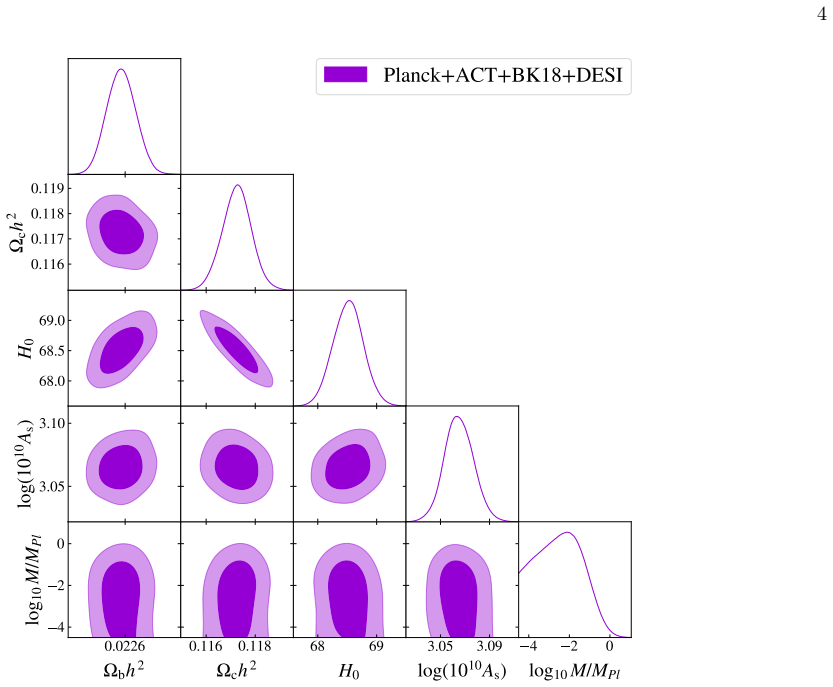


read the original abstract
The impact of the most recent cosmic microwave background (CMB) data from the Atacama Cosmology Telescope (ACT) is studied for a model of cosmic inflation which predicts a non-zero vacuum expectation value (VEV) $M$ for a large-field regime. Since lower values of $M$ are compatible with the higher spectral index $n_s$ provided by the ACT+Planck joint analysis, we establish new limits on this parameter while also considering further CMB data from the latest BICEP/Keck Array release for CMB polarization modes. We find $\log_{10}M/M_{Pl}=-2.5^{+1.1}_{-1.3}$ at 68\% confidence level, compatible with $M/M_{Pl}\simeq 0.003$, which is interesting for post-inflationary processes, such as preheating. We conduct a lattice simulation for the inflaton field for the first few e-folds, as the model is compatible with the production of relics such as oscillons, which are possible candidates as sources of gravitational waves and primordial black holes. We find that the model indeed produces localized, quasi-spherical structures compatible with oscillons, which might lead to signatures detectable by future experiments. However, in agreement with recent works, we find that although the abundance of gravitational waves that could be generated in this regime has an amplitude well within the sensitivities of these detectors, the frequency range is on the GHz limit, away from the expected frequencies. Finally, we estimate the impact of a coupling of the type $y\phi\chi^2$ to the inflaton, in the realization of perturbative reheating, directly impacting the predictions of the model, as lower values of $M$ are consistent with both the entire allowed temperature range, and the limits imposed by BICEP/Keck Array+Planck+ACT.
Editorial analysis
A structured set of objections, weighed in public.
Referee Report
Summary. The paper examines the impact of recent ACT DR6 + Planck CMB data (with BICEP/Keck polarization) on an inflationary model with non-zero VEV M in the large-field regime. It reports new constraints log_{10}(M/M_Pl) = -2.5^{+1.1}_{-1.3} (68% CL), notes compatibility with M/M_Pl ≃ 0.003 for post-inflationary processes, performs lattice simulations showing localized quasi-spherical structures interpreted as oscillons, discusses GHz-frequency gravitational waves, and considers a y ϕ χ² coupling for perturbative reheating.
Significance. If the central results hold, the work supplies updated observational limits on M using the latest CMB data and explores links to post-inflationary relics (oscillons, GWs, PBHs). Explicit credit is given for incorporating ACT DR6 data and attempting to connect the CMB posterior to lattice evolution and reheating, which are strengths when the parameter propagation is demonstrated.
major comments (2)
- [lattice simulation and post-inflationary discussion] Lattice simulation description: the text does not demonstrate that the value of M (or the initial field amplitude/velocity at the end of inflation) is taken from the reported CMB posterior log_{10} M/M_Pl = -2.5^{+1.1}_{-1.3}; without this propagation the claim that the observationally allowed regime produces oscillons rests on an unverified assumption that the same potential governs both epochs.
- [perturbative reheating section] Reheating analysis: the statement that lower M values are consistent with the full allowed temperature range and BICEP/Keck+Planck+ACT limits is presented without a quantitative mapping from the CMB likelihood through the y ϕ χ² coupling to the reheating temperature; this link is load-bearing for the final claim on model predictions.
minor comments (2)
- Figure captions for the lattice results should explicitly state the M value adopted in the run.
- Notation for the inflationary potential in the large-field regime could be introduced with a single equation reference in the introduction for clarity.
Simulated Author's Rebuttal
We thank the referee for their careful reading and constructive comments on our manuscript. We address the major comments point by point below.
read point-by-point responses
-
Referee: [lattice simulation and post-inflationary discussion] Lattice simulation description: the text does not demonstrate that the value of M (or the initial field amplitude/velocity at the end of inflation) is taken from the reported CMB posterior log_{10} M/M_Pl = -2.5^{+1.1}_{-1.3}; without this propagation the claim that the observationally allowed regime produces oscillons rests on an unverified assumption that the same potential governs both epochs.
Authors: We appreciate this observation. While the lattice simulations were carried out using a value of M consistent with the CMB constraints (specifically M/M_Pl ≈ 0.003, which is within the reported 68% CL range), we acknowledge that the manuscript would benefit from an explicit demonstration of how the initial conditions are derived from the posterior. In the revised manuscript, we will add text and possibly a table or figure illustrating the mapping from the CMB posterior to the field value and velocity at the onset of the lattice simulation. This will solidify the link between the inflationary constraints and the post-inflationary dynamics. revision: yes
-
Referee: [perturbative reheating section] Reheating analysis: the statement that lower M values are consistent with the full allowed temperature range and BICEP/Keck+Planck+ACT limits is presented without a quantitative mapping from the CMB likelihood through the y ϕ χ² coupling to the reheating temperature; this link is load-bearing for the final claim on model predictions.
Authors: We agree with the referee that a quantitative mapping is important for the robustness of the reheating claims. We will revise the manuscript to include a quantitative analysis showing the reheating temperature as a function of M for different values of the coupling y, and how this relates to the CMB posterior on M. This will provide the explicit connection from the likelihood to the reheating temperature and confirm the consistency with the allowed temperature range. revision: yes
Circularity Check
No circularity; CMB fit and lattice simulation are independent analyses
full rationale
The paper first constrains the inflaton VEV parameter M by fitting the large-field potential to the scalar spectral index ns from the ACT DR6 + Planck joint likelihood (plus BICEP/Keck polarization), obtaining the reported posterior log10(M/M_Pl) = -2.5^{+1.1}_{-1.3}. It then performs a separate lattice simulation of the inflaton field evolution for the first few e-folds after inflation to check for localized quasi-spherical structures. These steps rely on distinct inputs: the CMB power-spectrum data for the parameter posterior, and the classical field equations plus chosen initial conditions for the numerical evolution. No result is obtained by renaming a fitted quantity as a prediction, no self-citation supplies a load-bearing uniqueness theorem, and the oscillon finding is a direct numerical outcome rather than a re-derivation of the CMB constraint. The statement that small M is 'interesting for post-inflationary processes' follows from the data-allowed range but does not reduce the simulation output to the fit by construction.
Axiom & Free-Parameter Ledger
free parameters (2)
- M =
10^{-2.5} M_Pl
- y
axioms (2)
- standard math Slow-roll inflation and standard CMB power-spectrum calculation hold for the chosen potential.
- domain assumption Lattice discretization accurately captures non-linear inflaton dynamics leading to oscillon formation.
invented entities (1)
-
Oscillons
no independent evidence
Lean theorems connected to this paper
-
IndisputableMonolith/Cost/FunctionalEquation.leanwashburn_uniqueness_aczel unclear?
unclearRelation between the paper passage and the cited Recognition theorem.
The Witten-O’Raifeartaigh (WR) model is given by the potential V(ϕ)=Λ⁴ ln²(ϕ/M)
What do these tags mean?
- matches
- The paper's claim is directly supported by a theorem in the formal canon.
- supports
- The theorem supports part of the paper's argument, but the paper may add assumptions or extra steps.
- extends
- The paper goes beyond the formal theorem; the theorem is a base layer rather than the whole result.
- uses
- The paper appears to rely on the theorem as machinery.
- contradicts
- The paper's claim conflicts with a theorem or certificate in the canon.
- unclear
- Pith found a possible connection, but the passage is too broad, indirect, or ambiguous to say the theorem truly supports the claim.
Reference graph
Works this paper leans on
-
[1]
307683/2022-2 and FAPERJ grant 299312 (2023)
JSA is supported by CNPq No. 307683/2022-2 and FAPERJ grant 299312 (2023)
work page 2022
-
[2]
A. A. Starobinsky, Phys. Lett. B91, 99 (1980)
work page 1980
-
[3]
A. H. Guth, Phys. Rev. D23, 347 (1981)
work page 1981
-
[4]
A. D. Linde, Phys. Lett. B108, 389 (1982)
work page 1982
-
[5]
A. Albrecht, P. J. Steinhardt, M. S. Turner, and F. Wilczek, Phys. Rev. Lett.48, 1437 (1982)
work page 1982
-
[6]
L. F. Abbott, E. Farhi, and M. B. Wise, Phys. Lett. B 117, 29 (1982)
work page 1982
-
[7]
L. Kofman, A. D. Linde, and A. A. Starobinsky, Phys. Rev. Lett.73, 3195 (1994), arXiv:hep-th/9405187
work page internal anchor Pith review Pith/arXiv arXiv 1994
-
[8]
Towards the Theory of Reheating After Inflation
L. Kofman, A. D. Linde, and A. A. Starobinsky, Phys. Rev. D56, 3258 (1997), arXiv:hep-ph/9704452
work page internal anchor Pith review Pith/arXiv arXiv 1997
- [9]
-
[10]
E. J. Copeland, M. Gleiser, and H. R. Muller, Phys. Rev. D52, 1920 (1995), arXiv:hep-ph/9503217
work page internal anchor Pith review Pith/arXiv arXiv 1920
-
[11]
M. A. Amin and D. Shirokoff, Phys. Rev. D81, 085045 (2010), arXiv:1002.3380 [astro-ph.CO]
work page internal anchor Pith review Pith/arXiv arXiv 2010
-
[12]
M. A. Amin, R. Easther, H. Finkel, R. Flauger, and M. P. Hertzberg, Phys. Rev. Lett.108, 241302 (2012), arXiv:1106.3335 [astro-ph.CO]
work page internal anchor Pith review Pith/arXiv arXiv 2012
-
[13]
M. A. Amin, M. P. Hertzberg, D. I. Kaiser, and J. Karouby, Int. J. Mod. Phys. D24, 1530003 (2014), arXiv:1410.3808 [hep-ph]
work page internal anchor Pith review Pith/arXiv arXiv 2014
-
[14]
Gravitational waves from oscillons after inflation
S. Antusch, F. Cefala, and S. Orani, Phys. Rev. Lett. 118, 011303 (2017), [Erratum: Phys.Rev.Lett. 120, 219901 (2018)], arXiv:1607.01314 [astro-ph.CO]
work page internal anchor Pith review Pith/arXiv arXiv 2017
-
[15]
K. D. Lozanov and M. A. Amin, Phys. Rev. D97, 023533 (2018), arXiv:1710.06851 [astro-ph.CO]
work page internal anchor Pith review Pith/arXiv arXiv 2018
-
[16]
Primordial Black Holes from Inflaton Fragmentation into Oscillons
E. Cotner, A. Kusenko, and V. Takhistov, Phys. Rev. D 98, 083513 (2018), arXiv:1801.03321 [astro-ph.CO]
work page internal anchor Pith review Pith/arXiv arXiv 2018
-
[17]
S. Antusch, F. Cefal` a, and F. Torrent´ ı, JCAP10, 002, arXiv:1907.00611 [hep-ph]
- [18]
-
[19]
R. Mahbub and S. S. Mishra, Phys. Rev. D108, 063524 (2023), arXiv:2303.07503 [astro-ph.CO]
- [20]
-
[21]
S.-Y. Zhou, E. J. Copeland, R. Easther, H. Finkel, Z.-G. Mou, and P. M. Saffin, JHEP10, 026, arXiv:1304.6094 [astro-ph.CO]
work page internal anchor Pith review Pith/arXiv arXiv
-
[22]
Gravitational Waves from Oscillons with Cuspy Potentials
J. Liu, Z.-K. Guo, R.-G. Cai, and G. Shiu, Phys. Rev. Lett.120, 031301 (2018), arXiv:1707.09841 [astro- ph.CO]
work page internal anchor Pith review Pith/arXiv arXiv 2018
-
[23]
What can we learn from the stochastic gravitational wave background produced by oscillons?
S. Antusch, F. Cefala, and S. Orani, JCAP03, 032, arXiv:1712.03231 [astro-ph.CO]
work page internal anchor Pith review Pith/arXiv arXiv
-
[24]
K. D. Lozanov and M. A. Amin, Phys. Rev. D99, 123504 (2019), arXiv:1902.06736 [astro-ph.CO]
work page internal anchor Pith review Pith/arXiv arXiv 2019
-
[25]
T. Hiramatsu, E. I. Sfakianakis, and M. Yamaguchi, JHEP03, 021, arXiv:2011.12201 [hep-ph]
- [26]
- [27]
-
[28]
T. Louis and others (The Atacama Cosmology Tele- scope collaboration), Journal of Cosmology and As- troparticle Physics2025(11), 062
-
[29]
Planck 2018 results. X. Constraints on inflation
Y. Akramiet al.(Planck), Astron. Astrophys.641, A10 (2020), arXiv:1807.06211 [astro-ph.CO]
work page internal anchor Pith review Pith/arXiv arXiv 2020
-
[30]
A. G. Adameet al.(DESI), JCAP02, 021, arXiv:2404.03002 [astro-ph.CO]
work page internal anchor Pith review Pith/arXiv arXiv
-
[31]
DESI DR2 Results II: Measurements of Baryon Acoustic Oscillations and Cosmological Constraints
M. Abdul Karimet al.(DESI), Phys. Rev. D112, 083515 (2025), arXiv:2503.14738 [astro-ph.CO]
work page internal anchor Pith review Pith/arXiv arXiv 2025
-
[32]
D. S. Zharov, O. O. Sobol, and S. I. Vilchinskii, Phys. Rev. D112, 023544 (2025)
work page 2025
-
[33]
E. G. M. Ferreira, E. McDonough, L. Balkenhol, R. Kallosh, L. Knox, and A. Linde, Phys. Rev. D , (2025)
work page 2025
- [34]
-
[35]
The polynomial potential inflation in light of ACT observa- tions,
Z.-Z. Peng, Z.-C. Chen, and L. Liu, (2025), arXiv:2505.12816 [astro-ph.CO]
-
[36]
Curvature corrections to Starobinsky inflation can explain the ACT results,
A. Addazi, Y. Aldabergenov, and S. V. Ketov, Phys. Lett. B869, 139883 (2025), arXiv:2505.10305 [gr-qc]
-
[37]
The early universe isACT-ingwarm,
A. Berera, S. Brahma, Z. Qiu, R. O. Ramos, and G. S. Rodrigues, JCAP11, 059, arXiv:2504.02655 [hep-th]. 12
- [38]
-
[39]
Starobinsky like inflation and EGB Gravity in the light of ACT,
Yogesh, A. Mohammadi, Q. Wu, and T. Zhu, JCAP10, 010, arXiv:2505.05363 [astro-ph.CO]
-
[40]
L. Liu, Z. Yi, and Y. Gong, (2025), arXiv:2505.02407 [astro-ph.CO]
work page internal anchor Pith review Pith/arXiv arXiv 2025
-
[41]
Refined predictions for Starobinsky inflation and post-inflationary constraints in light of ACT,
M. Drees and Y. Xu, Phys. Lett. B867, 139612 (2025), arXiv:2504.20757 [astro-ph.CO]
-
[42]
ACT, SPT, and chaotic inflation,
R. Kallosh, A. Linde, and D. Roest, Phys. Rev. Lett. 135, 161001 (2025), arXiv:2503.21030 [hep-th]
- [43]
- [44]
-
[45]
A. Albrecht, S. Dimopoulos, W. Fischler, E. W. Kolb, S. Raby, and P. J. Steinhardt, Nucl. Phys. B229, 528 (1983)
work page 1983
- [46]
-
[47]
M. Artymowski and I. Ben-Dayan, Symmetry12, 806 (2020), arXiv:1908.07052 [hep-th]
- [48]
- [49]
-
[50]
M. Drewes and L. Ming, Phys. Rev. Lett.133, 031001 (2024), arXiv:2208.07609 [hep-ph]
-
[51]
Efficient Computation of CMB anisotropies in closed FRW models
A. Lewis, A. Challinor, and A. Lasenby, Astrophys. J. 538, 473 (2000), arXiv:astro-ph/9911177 [astro-ph]
work page internal anchor Pith review Pith/arXiv arXiv 2000
-
[52]
CMB power spectrum parameter degeneracies in the era of precision cosmology
C. Howlett, A. Lewis, A. Hall, and A. Challinor, JCAP 04, 027, arXiv:1201.3654 [astro-ph.CO]
work page internal anchor Pith review Pith/arXiv arXiv
-
[53]
J. Torrado and A. Lewis, Cobaya: Bayesian analysis in cosmology, Astrophysics Source Code Library, record ascl:1910.019 (2019), ascl:1910.019
work page 1910
-
[54]
Cobaya: Code for Bayesian Analysis of hierarchical physical models
J. Torrado and A. Lewis, JCAP05, 057, arXiv:2005.05290 [astro-ph.IM]
work page internal anchor Pith review Pith/arXiv arXiv 2005
-
[55]
Planck 2018 results. I. Overview and the cosmological legacy of Planck
N. Aghanimet al.(Planck), Astron. Astrophys.641, A1 (2020), arXiv:1807.06205 [astro-ph.CO]
work page internal anchor Pith review Pith/arXiv arXiv 2020
-
[56]
Planck 2018 results. VI. Cosmological parameters
N. Aghanimet al.(Planck), Astron. Astrophys.641, A6 (2020), [Erratum: Astron.Astrophys. 652, C4 (2021)], arXiv:1807.06209 [astro-ph.CO]
work page internal anchor Pith review Pith/arXiv arXiv 2020
- [57]
-
[58]
The Simons Observatory: Science goals and forecasts
P. Adeet al.(Simons Observatory), JCAP02, 056, arXiv:1808.07445 [astro-ph.CO]
work page internal anchor Pith review Pith/arXiv arXiv
-
[59]
T. Matsumuraet al., J. Low Temp. Phys.176, 733 (2014), arXiv:1311.2847 [astro-ph.IM]
work page internal anchor Pith review Pith/arXiv arXiv 2014
-
[60]
Probing Cosmic Infla- tion with the LiteBIRD Cosmic Microwave Background Polarization Survey,
E. Allyset al.(LiteBIRD), PTEP2023, 042F01 (2023), arXiv:2202.02773 [astro-ph.IM]
-
[61]
M. A. Amin, R. Easther, and H. Finkel, JCAP12, 001, arXiv:1009.2505 [astro-ph.CO]
work page internal anchor Pith review Pith/arXiv arXiv
-
[62]
G. N. Felder, J. Garcia-Bellido, P. B. Greene, L. Kofman, A. D. Linde, and I. Tkachev, Phys. Rev. Lett.87, 011601 (2001), arXiv:hep-ph/0012142
work page internal anchor Pith review Pith/arXiv arXiv 2001
-
[63]
Lattice study of classical inflaton decay
T. Prokopec and T. G. Roos, Phys. Rev. D55, 3768 (1997), arXiv:hep-ph/9610400
work page internal anchor Pith review Pith/arXiv arXiv 1997
-
[64]
E. J. Copeland, S. Pascoli, and A. Rajantie, Phys. Rev. D65, 103517 (2002), arXiv:hep-ph/0202031
work page internal anchor Pith review Pith/arXiv arXiv 2002
-
[65]
D. I. Podolsky, G. N. Felder, L. Kofman, and M. Peloso, Phys. Rev. D73, 023501 (2006), arXiv:hep-ph/0507096
work page internal anchor Pith review Pith/arXiv arXiv 2006
-
[66]
A Gravitational Wave Background from Reheating after Hybrid Inflation
J. Garcia-Bellido, D. G. Figueroa, and A. Sastre, Phys. Rev. D77, 043517 (2008), arXiv:0707.0839 [hep-ph]
work page internal anchor Pith review Pith/arXiv arXiv 2008
-
[67]
J. R. C. Cuissa and D. G. Figueroa, JCAP06, 002, arXiv:1812.03132 [astro-ph.CO]
work page internal anchor Pith review Pith/arXiv arXiv
- [68]
- [69]
- [70]
- [71]
- [72]
- [73]
-
[74]
G. Ballesteros, J. Iguaz Juan, P. D. Serpico, and M. Taoso, Phys. Rev. D111, 083521 (2025), arXiv:2406.09122 [astro-ph.CO]
-
[75]
Schmitz, JHEP01, 097, arXiv:2002.04615 [hep-ph]
K. Schmitz, JHEP01, 097, arXiv:2002.04615 [hep-ph]
-
[76]
Equation of state during (p)reheating with trilinear interactions
S. Antusch, K. Marschall, and F. Torrenti, JCAP11, 002, arXiv:2507.13465 [astro-ph.CO]
work page internal anchor Pith review Pith/arXiv arXiv
-
[77]
Constraints on \alpha-attractor inflation and reheating
Y. Ueno and K. Yamamoto, Phys. Rev. D93, 083524 (2016), arXiv:1602.07427 [astro-ph.CO]
work page internal anchor Pith review Pith/arXiv arXiv 2016
-
[78]
CMB constraints on the inflaton couplings and reheating temperature in $\alpha$-attractor inflation
M. Drewes, J. U. Kang, and U. R. Mun, JHEP11, 072, arXiv:1708.01197 [astro-ph.CO]
work page internal anchor Pith review Pith/arXiv arXiv
- [79]
- [80]
discussion (0)
Sign in with ORCID, Apple, or X to comment. Anyone can read and Pith papers without signing in.