REVIEW 4 major objections 5 minor 38 references
Node-wise frequency weighting plus an uncertainty-gated focal term lets hierarchical multi-label models detect rare descendant nodes they previously ignored, with recall gains up to fivefold and statistically significant F1 improvements.
Reviewed by Pith at T0; open to challenge. T0 means a machine referee read the full paper against a public rubric. the ladder, T0–T4 →
T0 review · deepseek-v4-flash
2026-08-03 03:03 UTC pith:R33QA6M2
load-bearing objection The imbalance-weighting branch is the real result; the focal/uncertainty branch is weak sauce that the paper’s own tables undercut. the 4 major comments →
Improving Detection of Rare Nodes in Hierarchical Multi-Label Learning
The pith
A machine-rendered reading of the paper's core claim, the machinery that carries it, and where it could break.
Core claim
The central claim is that the loss L_focal = (W0 + W(Y,f)) (U0 + U(Theta(X))^k) LMC, built on top of the C-HMCNN max-constraint loss, lets a hierarchical multi-label model learn rare descendant nodes it would otherwise ignore. W is a node-wise inverse-frequency weight, rescaled to a minimum gate W0 and applied only to positive annotations; U is an ensemble-derived uncertainty, with bBMA and GMU as the recommended candidates, gated by U0 and sharpened by exponent k. The paper reports recall gains up to a factor of five on gene-function benchmarks, statistically significant F1 improvements, and similar trends on text and image hierarchies; gains are largest exactly where rare-node detection is
What carries the argument
The carrying mechanism is a multiplicative reweighting of the C-HMCNN max-constraint loss. The imbalance branch computes, for each node, an inverse-frequency weight from the node's aggregate occurrence count (itself plus descendants), rescales these weights to a floor w0, and applies them only to positive annotations; this decouples emphasis from observation frequency, so a rare child node can be up-weighted without inflating its common parent. The focal branch multiplies in an uncertainty factor (U0 + U^k), where U is measured from a model ensemble without gradients, so the loss concentrates on nodes where the ensemble is unsure. The asymmetry of weighting only positive labels and the floor
Load-bearing premise
The load-bearing premise is that the ensemble uncertainty computed from the very models being trained stays a reliable, non-collapsing signal for which nodes need emphasis while that same signal is being used to modify the loss; the paper's own results show epistemic uncertainty variants underperform and focal gains appear clearly only with ten or more ensemble members.
What would settle it
On a fixed benchmark, compare imbalance-only training against the full focal loss at ensemble sizes 2, 5, 10, and 30. If recall and F1 gains never exceed the imbalance-only baseline beyond run-to-run noise, or if gains peak and then collapse as the ensemble grows, the uncertainty-gating branch is not doing the work and the imbalance branch alone would be the cause of the reported improvements.
If this is right
- Models trained with the combined loss begin predicting deep hierarchy nodes they never predicted before; rare-node recall rises by up to five times over unweighted and resampling baselines on gene-function datasets.
- Node-wise imbalance weighting at a floor of 0.25 delivers statistically significant F1 gains, and combining it with resampling pushes F1 higher on most gene-function datasets while also improving recall.
- The uncertainty-gated focal branch adds further F1 gains over imbalance weighting alone when the ensemble is large enough, experimentally ten members, while epistemic KL and JS uncertainty terms do not reliably help.
- The benefit concentrates in hard regimes: partially trained or noisy encoders and severely limited training data; with a fully pretrained encoder, rare-node gains remain but are offset by small degradations on common nodes.
- The same pattern transfers beyond gene annotation to a text hierarchy and two image hierarchies, suggesting the weighting is not tied to a particular input modality.
Where Pith is reading between the lines
- If the mechanism is right, the node-wise plus uncertainty-gated weighting should transfer to any hierarchical classifier with a coherent loss, not just the C-HMCNN base used here; wrapping a different hierarchical loss in the same two factors is a direct test.
- The precision-for-recall trade-off at low w0 is a tunable knob: screening applications that tolerate false positives could push w0 toward zero to maximize rare-node recall, while higher floors suit precision-sensitive tasks; a per-node or per-depth schedule might beat the single global floor.
- Because gains are largest in low-data and weak-encoder regimes, the uncertainty signal could double as an annotation-acquisition or active-learning cue, pointing at nodes where new labels would help most; the paper does not test this use.
Editorial analysis
A structured set of objections, weighed in public.
Referee Report
Summary. The paper proposes a weighted loss for hierarchical multi-label classification (HML) that combines a node-wise inverse-frequency imbalance weighting with a focal term driven by ensemble uncertainty. The imbalance branch (Eqs. 7–9) reweights positive annotations of rare nodes independently of observation frequency; the focal branch (Eqs. 10–17, used in Eq. 6) gates a focal exponent by ensemble-derived uncertainty measures (bBMA, GMU, epistemic JS/KL). The method is evaluated on 16 gene-product datasets (FUN and GO), a benthic imagery dataset, Enron, and Diatoms, with comparisons to C-HMCNN, LPROS, and HROS-PD. The imbalance weighting alone strongly improves recall and F1 (Table 1), and combining it with bBMA/GMU focal terms yields further F1 gains on several datasets (Tables 2, 4, 6), though the epistemic terms do not consistently help.
Significance. If the results hold, the node-wise imbalance weighting is a valuable and practical contribution to HML: it is simple, reproducible (code provided), evaluated with standard deviations across many benchmarks, and improves recall by up to roughly a factor of six on rare nodes that existing resampling methods miss. The focal branch is the more fragile half: only bBMA/GMU show benefits, gains are not universal (e.g., Seq), the uncertainty signal is computed from the very ensemble being trained, and benefits appear only at ensemble sizes of 10 or more. The paper is strongest as an empirical study of node-wise weighting; the combined-method claim needs to be recalibrated and supported with additional ablations.
major comments (4)
- [Abstract / §5.2 / Table 1] The abstract and conclusion attribute the 'up to factor five' recall improvements to the combined weighted loss, but Table 1 shows those gains are produced by imbalance weighting alone (w0=0.25) with no focal term. The focal experiments (Tables 2/4) use imbalance-only as the baseline, and the extra F1 gains are inconsistent: e.g., Seq bBMA F1 is 8.67±0.12 vs baseline 8.84±0.07 (Table 4), and Expr GO bBMA is 5.20±0.10 vs 5.28±0.08 (Table 6). Add a focal-only ablation and attribute the recall gains to the imbalance branch in the abstract and conclusion.
- [§3.2, Eq. (6)] The focal weight U(Θ(X)) is computed from the same ensemble that is being trained. Gradients through U are stopped, but the weighting still couples the ensemble members' objectives and can reduce diversity. The paper cites Lee et al. on ensemble-collapse risk but does not measure diversity or test a non-self-referential uncertainty source. Figure 3 shows no separation from baseline at ensemble size 5, consistent with an unreliable signal. Add diversity diagnostics over training and an experiment with a fixed/pretrained uncertainty estimator to break the feedback loop.
- [Appendix H / Appendix A] The global hyperparameters w0=0.25, u0=0.25, k=1 are chosen from 'preliminary testing' (Appendix A), but Appendix H shows the optimal w0 for Expr (FUN) is below 0.2 and that u0 and k have 'dampened' effects. Since w0 is the main performance lever (Figure 2, Table 1), the paper should provide per-dataset sensitivity analyses or a principled selection rule; otherwise the reported results depend on test-selected hyperparameters, and the claim that w0=0.25 is 'reasonable' is not supported by the Appendix H finding.
- [§5.3 / Tables 2, 4, 6] The significance criterion used throughout is an ad-hoc '>2σ' rule based on a small number of runs, applied across 16 datasets and multiple metrics without multiple-comparison correction. For example, Table 2 shows bBMA on Expr at 10.53±0.35 vs baseline 10.27±0.24, which is within 2σ under a pooled standard error, yet the text emphasizes statistically significant gains. Provide exact p-values or corrected confidence intervals, or temper the significance language.
minor comments (5)
- [Table 5 caption] The caption says 'compared for the FUN datasets' but the table reports GO results; should read 'GO datasets'.
- [§3.1, Eq. (8)] The quantities wmin and wmax are used before being defined; clarify that they are the min/max of the raw wi vector.
- [Eqs. (13)–(15)] The double subscript in µmax(2) is confusing; consider renaming to something like µmargin for readability.
- [Appendix F] The sentence 'switching toF1 appears to drop' appears to contain a typo; presumably 'switching to dropout'.
- [Tables 2, 4, 6] The terms 'Epistemic JS' and 'Epistemic KL' are used without definition in the table captions; add a sentence explaining these refer to Eq. (17) with JS or KL divergence.
Circularity Check
No significant circularity: the two loss branches are defined from explicit node-frequency and ensemble-output quantities, and the reported gains are measured on held-out external benchmarks against same-ensemble controls.
full rationale
The derivation chain is self-contained. The imbalance branch (Eqs. 7-9) is a conventional inverse-frequency weight computed from node counts f, and the focal branch (Eqs. 6, 10-17) is a confidence/uncertainty weight computed from the ensemble's predictive distribution, with gradients through U stopped (Sec. 3.2, citing Lee et al. 2015). Neither branch fits a constant to the evaluation quantity: recall, F1, and Bin. AP are measured on test partitions of FUN, GO, Enron, Diatom, and BenthicNet-E against baselines that include the same ensemble without the focal term (Tables 2, 4, 6), so the reported improvements are not forced by construction. The self-referential character of the focal term (U is computed from the models being trained) is a standard training-time feedback loop of the same type as focal loss, not a definitional equivalence between the input and the predicted outcome. The GMU candidate is cited to the authors' own Gillis et al. 2025b, but its formula is fully re-specified in Eqs. 13-15 and the equally successful bBMA candidate is defined in Eqs. 10-12, so the self-citation is not load-bearing. The paper's own results show that epistemic JS/KL terms and small-ensemble focal gains are weak and sometimes negative (e.g., Seq F1 8.67 vs 8.84 in Table 4; Fig. 3 overlap at ensemble size 5), and the authors explicitly state 'It is nonetheless surprising that epistemic uncertainty underperformed' and attribute focal gains to sufficient ensemble size; these are evidence-strength and robustness concerns, not circularity.
Axiom & Free-Parameter Ledger
free parameters (4)
- w0 (minimum imbalance weight) =
0.25
- u0 (uncertainty gate) =
0.25
- k (focal exponent) =
1
- Nclasses in weight definition =
number of nodes (e.g., 499)
axioms (3)
- domain assumption C-HMCNN max-constraint loss enforces the hierarchy correctly
- domain assumption Observed node frequencies f accurately reflect intrinsic rarity
- domain assumption Ensemble variance/KL divergence measures useful model uncertainty
invented entities (1)
-
bBMA uncertainty term (U_bBMA = 1 - |2µ-1|)
independent evidence
read the original abstract
In hierarchical multi-label classification, a persistent challenge is enabling model predictions to reach deeper levels of the hierarchy for more detailed or fine-grained classifications. This difficulty partly arises from the natural rarity of certain classes (or hierarchical nodes) and the hierarchical constraint that ensures child nodes are almost always less frequent than their parents. To address this, we propose a weighted loss objective for neural networks that combines node-wise imbalance weighting with focal weighting components, the latter leveraging modern quantification of ensemble uncertainties. By emphasizing rare nodes rather than rare observations (data points), and focusing on uncertain nodes for each model output distribution during training, we observe improvements in recall by up to a factor of five on benchmark datasets, along with statistically significant gains in $F_{1}$ score. We also show our approach aids convolutional networks on challenging tasks, as in situations with suboptimal encoders or limited data.
Figures



Reference graph
Works this paper leans on
-
[3]
Note that thisk is unique to the scheduler and should not be confused with thekapplied in focal weighting. 20 Published in Transactions on Machine Learning Research (02/2026) CELLCYCLE (FUN)CELLCYCLE (GO) DERISI (FUN)DERISI (GO)EISEN (FUN)EISEN (GO)EXPR (FUN)EXPR (GO) GASCH1 (FUN)GASCH1 (GO)GASCH2 (FUN)GASCH2 (GO) SEQ (FUN)SEQ (GO)SPO (FUN)SPO (GO) Datase...
2026
-
[7]
Although we had expected a jump inF1 score due to increased precision, which was indeed observed, surprisingly, the recall too was boosted as a result of this combination
21 Published in Transactions on Machine Learning Research (02/2026) As observed, the combined approach exceeds the previous best method (imbalance weighting with˜w0 = 0.25) across almost all gene product datasets. Although we had expected a jump inF1 score due to increased precision, which was indeed observed, surprisingly, the recall too was boosted as a...
2026
-
[9]
Zachary Daniels and Dimitris Metaxas
doi: 10.1109/ ACCESS.2024.3395118. Zachary Daniels and Dimitris Metaxas. Addressing imbalance in multi-label classification using structured hellinger forests.Proceedings of the AAAI Conference on Artificial Intelligence, 31(1), Feb
arXiv 2024
-
[18]
URL http://arxiv.org/abs/1703.04977
doi: 10.48550/arXiv.1703.04977. URL http://arxiv.org/abs/1703.04977. arXiv:1703.04977 [cs]. Bryan Klimt and Yiming Yang. The enron corpus: A new dataset for email classification research. In Jean-François Boulicaut, Floriana Esposito, Fosca Giannotti, and Dino Pedreschi (eds.),Machine Learning: ECML 2004, pp. 217–226, Berlin, Heidelberg,
-
[20]
doi: 10.1007/s11263-020-01316-z
ISSN 1573-1405. doi: 10.1007/s11263-020-01316-z. URLhttps://doi.org/10.1007/s11263-020-01316-z. Stefan Lee, Senthil Purushwalkam, Michael Cogswell, David Crandall, and Dhruv Batra. Why m heads are better than one: Training a diverse ensemble of deep networks,
-
[21]
Bin Liu, Konstantinos Blekas, and Grigorios Tsoumakas
doi: 10.1109/TPAMI.2018.2858826. Bin Liu, Konstantinos Blekas, and Grigorios Tsoumakas. Multi-label sampling based on local label imbalance. Pattern Recognition, 122:108294,
arXiv 2018
-
[22]
doi: https://doi.org/10.1016/j.patcog.2021.108294
ISSN 0031-3203. doi: https://doi.org/10.1016/j.patcog.2021.108294. URLhttps://www.sciencedirect.com/science/article/pii/S003132032100474X. Scott C. Lowe, Benjamin Misiuk, Isaac Xu, Shakhboz Abdulazizov, Amit R. Baroi, Alex C. Bastos, Merlin Best, Vicki Ferrini, Ariell Friedman, Deborah Hart, Ove Hoegh-Guldberg, Daniel Ierodiaconou, Julia Mackin-McLaughlin...
arXiv 2021
-
[23]
doi: 10.1038/s41597-025-04491-1
ISSN 2052-4463. doi: 10.1038/s41597-025-04491-1. URL https://doi.org/10. 1038/s41597-025-04491-1. Maja Pavlovic. Understanding model calibration – a gentle introduction and visual exploration of calibration and the expected calibration error (ece).arXiv,
-
[24]
URLhttps://arxiv.org/ abs/2501.19047
doi: arXiv:2501.19047. URLhttps://arxiv.org/ abs/2501.19047. Rodolfo M. Pereira, Yandre M.G. Costa, and Carlos N. Silla Jr. Toward hierarchical classification of imbalanced data using random resampling algorithms.Information Sciences, 578:344–363,
-
[26]
doi: 10.1109/ICTAI.2018.00128. Anthony Robins. Catastrophic forgetting, rehearsal and pseudorehearsal.Connection Science, 7(2):123–146,
arXiv 2018
-
[28]
URLhttps://arxiv.org/abs/2207.06237
doi: arXiv:2207.06237. URLhttps://arxiv.org/abs/2207.06237. Andreas Ruepp, Alfred Zollner, Dieter Maier, Kaj Albermann, Jean Hani, Martin Mokrejs, Igor Tetko, Ulrich Güldener, Gertrud Mannhaupt, Martin Münsterkötter, and H Werner Mewes. The funcat, a functional annotation scheme for systematic classification of proteins from whole genomes.Nucleic Acids Re...
-
[29]
ISSN 1362-4962. doi: 10.1093/nar/gkh894. Kajetan Schweighofer, Lukas Aichberger, Mykyta Ielanskyi, and Sepp Hochreiter. Introducing an improved information-theoretic measure of predictive uncertainty,
-
[30]
URLhttps://arxiv.org/abs/2311.08309. Daniel L. Silver, Qiang Yang, and Lianghao Li. Lifelong machine learning systems: Beyond learning algorithms. InAAAI Spring Symposium: Lifelong Machine Learning,
-
[31]
doi: https: //doi.org/10.1016/j.patcog.2021.107965
ISSN 0031-3203. doi: https: //doi.org/10.1016/j.patcog.2021.107965. URL https://www.sciencedirect.com/science/article/pii/ S0031320321001527. Jonatas Wehrmann, Ricardo Cerri, and Rodrigo Barros. Hierarchical multi-label classification networks. In Jennifer Dy and Andreas Krause (eds.),Proceedings of the 35th International Conference on Machine Learning, v...
arXiv 2021
-
[32]
doi: 10.1109/TCYB.2020.3027509. Zhinuo Zhou, Ge-Yi Fu, Yi Fang, Ye Yuan, Hong-Bin Shen, Chun-Sheng Wang, Xue-Wei Xu, Peng Zhou, and Xiaoyong Pan. Echoai: A deep-learning based model for classification of echinoderms in global oceans. Frontiers in Marine Science, 10,
arXiv 2020
-
[33]
doi: 10.3389/fmars.2023.1147690
ISSN 2296-7745. doi: 10.3389/fmars.2023.1147690. URLhttps: //www.frontiersin.org/journals/marine-science/articles/10.3389/fmars.2023.1147690. 16 Published in Transactions on Machine Learning Research (02/2026) A Hyperparameters A.1 Gene Product Modelling Our hyperparameters for all methods applied to the gene product datasets are identical to those retrie...
arXiv 2023
-
[34]
For focal weighting experiments, we use aU0 = 0.25(matching our applied imbalance minimum gate˜w0), and a setk= 1— an empirically derived value in preliminary testing
as a non-linear activation. For focal weighting experiments, we use aU0 = 0.25(matching our applied imbalance minimum gate˜w0), and a setk= 1— an empirically derived value in preliminary testing. Table 3:Hyperparameters for experiments ran on FUN and GO datasets.Input, Output, and Hidden refer to dimensional size. Dataset Input Output (FUN) Output (GO) Hi...
2000
-
[38]
and “Diatom” (Dimitrovski et al., 2011). Enron is a language dataset, consisting of emails, each of input size 1000, with 56 nodes, while Diatom 22 Published in Transactions on Machine Learning Research (02/2026) encompasses unicellular micro-algae processed image data, each of input size 371 with 398 nodes (Wehrmann et al., 2018). Our results are provide...
2011
-
[39]
No Weighting
We observe that the benefits of imbalance and focal loss appear to be definitive in Enron, while the benefits appear more muted in Diatom, with imbalance weighting alone performing slightly worse than the no weighting baseline, in terms of mean performance alone. Table 9:Focal Weighting Comparisons (Others). Different uncertainties for implementing focal ...
2055
-
[40]
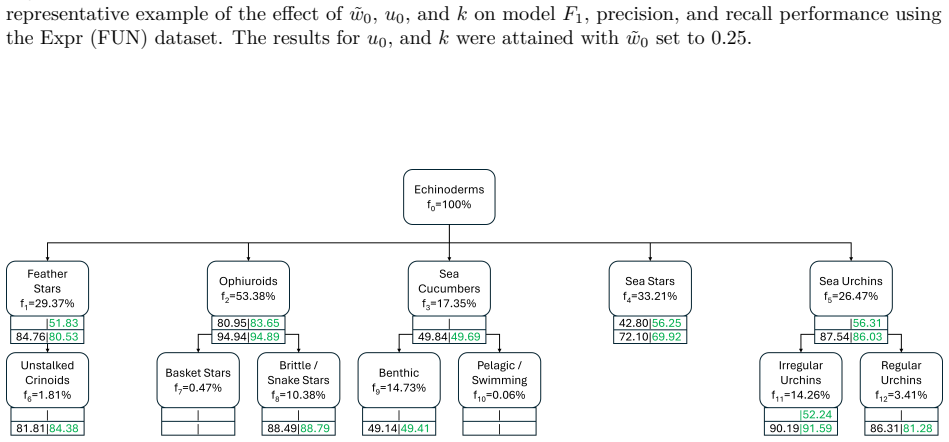
The results foru0, andkwere attained with˜w0 set to0.25
23 Published in Transactions on Machine Learning Research (02/2026) 0.0 0.2 0.4 0.6 0.8 1.0 1.2 1.4 5.0 7.5 10.0 12.5 15.0 17.5 20.0 (a)˜w0 0.0 0.2 0.4 0.6 0.8 1.0 1.2 1.4 6 8 10 12 14 16 (b)u 0 0.0 0.5 1.0 1.5 2.0 2.5 3.0 3.5 6 8 10 12 14 F1 Score Precision Recall (c)k Figure 6:Exploring Weighted and Focal Hyperparameters’ Effect on Performance.Plotted i...
2026
-
[128]
Expr” and “Seq
Given the common encoder, we opt for a multi-layer perceptron classifier component of the same design, consisting of three layers for our ensembles. Dimensional mapping occurs from the embedding dimension of the vision architectures used to the hidden dimension (equal to the embedding dimension), and then to a dimensional size of13, reflecting the number ...
2021
-
[1995]
URLhttps://doi.org/10.1080/09540099550039318
doi: 10.1080/09540099550039318. URLhttps://doi.org/10.1080/09540099550039318. Miguel Romero, Felipe Kenji Nakano, Jorge Finke, Camilo Rocha, and Celine Vens. Hierarchy exploitation to detect missing annotations on hierarchical multi-label classification.arXiv,
-
[2000]
ISSN 1061-4036. doi: 10.1038/75556. Yahia Battach, Abdulwahab Felemban, Faizan Farooq Khan, Yousef A. Radwan, Xiang Li, Fabio Marchese, Sara Beery, Burton H. Jones, Francesca Benzoni, and Mohamed Elhoseiny. Reefnet: A large scale, taxonomically enriched dataset and benchmark for hard coral classification.arXiv,
-
[2004]
ISBN 978-3-540-30115-8
Springer Berlin Heidelberg. ISBN 978-3-540-30115-8. Alina Kuznetsova, Hassan Rom, Neil Alldrin, Jasper Uijlings, Ivan Krasin, Jordi Pont-Tuset, Shahab Kamali, Stefan Popov, Matteo Malloci, Alexander Kolesnikov, Tom Duerig, and Vittorio Ferrari. The open images dataset v4.International Journal of Computer Vision, 128(7):1956–1981,
1956
-
[2006]
doi: 10.1109/IJCNN.2006.246893. Joana C. Costa, Tiago Roxo, Hugo Proença, and Pedro Ricardo Morais Inácio. How deep learning sees the world: A survey on adversarial attacks & defenses.IEEE Access, 12:61113–61136,
arXiv 2006
-
[2011]
doi: https://doi.org/10.1016/j.patcog
ISSN0031-3203. doi: https://doi.org/10.1016/j.patcog. 2011.03.026. URL https://www.sciencedirect.com/science/article/pii/S0031320311001300. Semi- Supervised Learning for Visual Content Analysis and Understanding. H. Martin Gillis, Isaac Xu, Benjamin Misiuk, Craig J. Brown, and Thomas Trappenberg. Last-layer committee machines for uncertainty estimations o...
Pith/arXiv arXiv 2011
-
[2012]
URLhttps://doi.org/10.1016/j.seares.2012.04.009
doi: 10.1016/j.seares.2012.04.009. URLhttps://doi.org/10.1016/j.seares.2012.04.009. Francisco Charte, Antonio J. Rivera, María J. del Jesus, and Francisco Herrera. Addressing imbalance in multilabel classification: Measures and random resampling algorithms.Neurocomputing, 163:3–16, 2015a. ISSN 0925-2312. doi: https://doi.org/10.1016/j.neucom.2014.08.091. ...
-
[2015]
URLhttps://doi.org/10.1371/journal.pone.0141039
doi: 10.1371/journal.pone.0141039. URLhttps://doi.org/10.1371/journal.pone.0141039. M Ashburner, C A Ball, J A Blake, D Botstein, H Butler, J M Cherry, A P Davis, K Dolinski, S S Dwight, J T Eppig, M A Harris, D P Hill, L Issel-Tarver, A Kasarskis, S Lewis, J C Matese, J E Richardson, M Ringwald, G M Rubin, and G Sherlock. Gene ontology: tool for the unif...
-
[2016]
14 Published in Transactions on Machine Learning Research (02/2026) E
doi: 10.1109/CVPR.2016.90. 14 Published in Transactions on Machine Learning Research (02/2026) E. Hellinger. Neue begründung der theorie quadratischer formen von unendlichvielen veränderlichen.Journal für die reine und angewandte Mathematik, 1909(136):210–271,
-
[2017]
URLhttps://ojs.aaai.org/index.php/AAAI/article/view/10908
doi: 10.1609/aaai.v31i1.10908. URLhttps://ojs.aaai.org/index.php/AAAI/article/view/10908. Ivica Dimitrovski, Dragi Kocev, Suzana Loskovska, and Sašo Džeroski. Hierarchical annotation of medical images.Pattern Recognition, 44(10):2436–2449,
-
[2018]
URLhttp://arxiv.org/abs/1803.08375
doi: arXiv:1803.08375. URLhttp://arxiv.org/abs/1803.08375. Franziska Althaus, Nicole Hill, Renata Ferrari, Luke Edwards, Rachel Przeslawski, Christine H. L. Schönberg, Rick Stuart-Smith, Neville Barrett, Graham Edgar, Jamie Colquhoun, Maggie Tran, Alan Jordan, Tony Rees, and Karen Gowlett-Holmes. A standardised vocabulary for identifying benthic biota and...
-
[2019]
URLhttp://arxiv.org/abs/1907.07174
doi: arXiv:1907.07174. URLhttp://arxiv.org/abs/1907.07174. Roberta Eleanor Hunt and Kim Steenstrup Pedersen. Rove-tree-11: The not-so-wild rover. a hierarchically structured image dataset for deep metric learning research. InComputer Vision – ACCV 2022, Lecture Notes in Computer Science, pp. 2967–2983, Switzerland,
Pith/arXiv arXiv 1907
-
[2020]
neurips.cc/paper_files/paper/2020/file/6dd4e10e3296fa63738371ec0d5df818-Paper.pdf
URLhttps://proceedings. neurips.cc/paper_files/paper/2020/file/6dd4e10e3296fa63738371ec0d5df818-Paper.pdf. Kaiming He, Xiangyu Zhang, Shaoqing Ren, and Jian Sun. Deep residual learning for image recognition. In Proceedings of the IEEE Conference on Computer Vision and Pattern Recognition (CVPR), pp. 770–778, June
2020
-
[2021]
doi: https://doi.org/10.1016/j.ins.2021.07.033
ISSN 0020-0255. doi: https://doi.org/10.1016/j.ins.2021.07.033. URL https://www.sciencedirect.com/science/article/ pii/S0020025521007234. 15 Published in Transactions on Machine Learning Research (02/2026) Rodolfo Miranda Pereira, Yandre Maldonado e Gomes da Costa, and Carlos Nascimento Silla. Dealing with imbalanceness in hierarchical multi-label dataset...
-
[2022]
doi: 10.1038/s41598-022-19939-2
ISSN 2045-2322. doi: 10.1038/s41598-022-19939-2. URLhttps://doi.org/10.1038/s41598-022-19939-2. Alex Kendall and Yarin Gal. What Uncertainties Do We Need in Bayesian Deep Learning for Computer Vision?arXiv, October
-
[2023]
16th Asian Conference on Computer Vision, ACCV 2022 ; Conference date: 04-12-2022 Through 08-12-2022
Springer. 16th Asian Conference on Computer Vision, ACCV 2022 ; Conference date: 04-12-2022 Through 08-12-2022. Kakani Katija, Eric Orenstein, Brian Schlining, Lonny Lundsten, Kevin Barnard, Giovanna Sainz, Oceane Boulais, Megan Cromwell, Erin Butler, Benjamin Woodward, and Katherine L. C. Bell. Fathomnet: A global image database for enabling artificial i...
2022
-
[2024]
URL https: //arxiv.org/abs/2412.08228. 13 Published in Transactions on Machine Learning Research (02/2026) Craig J Brown, Jessica A Sameoto, and Stephen J Smith. Multiple methods, maps, and management applications: Purpose made seafloor maps in support of ocean management.Journal of Sea Research, 72: 1–13,
Pith/arXiv arXiv 2026
-
[2025]
URLhttps: //arxiv.org/abs/2510.16822. Wei Bi and James T. Kwok. Multi-label classification on tree- and dag-structured hierarchies. InProceedings of the 28th International Conference on International Conference on Machine Learning, ICML’11, pp. 17–24, Madison, WI, USA,
discussion (0)
Sign in with ORCID, Apple, or X to comment. Anyone can read and Pith papers without signing in.