REVIEW 2 major objections 4 minor 2 cited by
The temperature where Dirac modes become localized in QCD matches the chiral crossover, at roughly 155–158 MeV.
Reviewed by Pith at T0; open to challenge. T0 means a machine referee read the full paper against a public rubric. the ladder, T0–T4 →
T0 review · deepseek-v4-flash
2026-08-03 00:55 UTC pith:ZABT2LLM
load-bearing objection This is the first direct bracketing of the Dirac-mode localization temperature in 2+1-flavor QCD at the physical point, and the measurement is done carefully; the continuum-limit coincidence with T_pc is an extrapolation, but an honest and defensible one. the 2 major comments →
Dirac mode localization in QCD near the crossover temperature
The pith
A machine-rendered reading of the paper's core claim, the machinery that carries it, and where it could break.
Core claim
The paper establishes, by direct observation rather than extrapolation, that the mobility edge separating localized from delocalized low Dirac eigenmodes appears in QCD at a temperature in the range 155 MeV ≤ T_loc ≤ 158 MeV. On N_t=8 lattices, the integrated unfolded level-spacing statistic I_{s0} crosses its critical value at T=158 MeV, indicating a mobility edge, and remains at its random-matrix value at T=155 MeV, indicating that all low modes are delocalized. The authors identify the localization temperature with the point where localized low modes first appear, and conclude that this 'geometric' critical temperature coincides with the pseudocritical temperature obtained from the chiral
What carries the argument
The central object is the mobility edge λ_c, the spectral point separating localized low Dirac eigenmodes from delocalized bulk modes, together with the integrated unfolded level spacing distribution I_{s0}(λ; N_s). The paper uses the critical value I_{s0}^{(crit)} = 0.1966(25) previously determined in QCD for the unitary class, so that the mobility edge at finite volume is identified as the point where I_{s0} crosses this critical value. This is a standard localization diagnostic: in delocalized regions the level spacings follow random-matrix statistics, in localized regions they follow Poisson statistics, and at the mobility edge the statistics are scale-invariant and critical.
Load-bearing premise
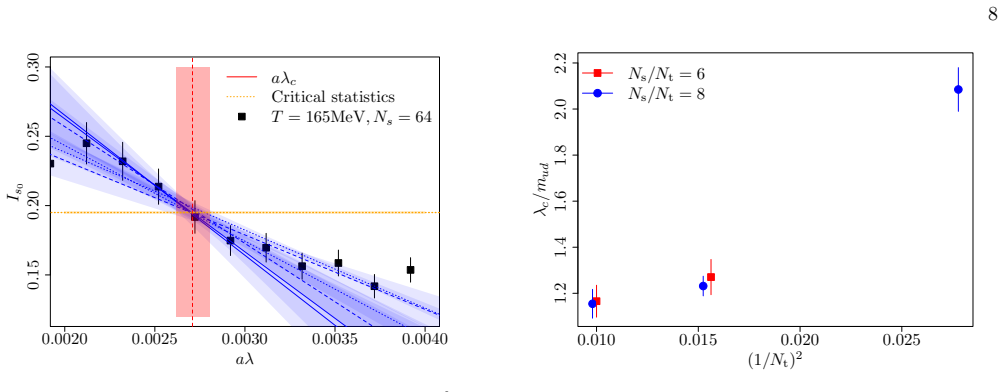
The conclusion that T_loc lies between 155 and 158 MeV relies on the assumption that a nonzero mobility edge measured at finite lattice spacing and finite spatial volume does not extrapolate to zero in the continuum and thermodynamic limits; the authors state this assumption explicitly in Sec. III C and support it only by a one-temperature consistency check at T=165 MeV and prior work.
What would settle it
A direct falsification would be produced by a continuum-extrapolated determination of T_loc: if λ_c/m_ud (or the position where I_{s0} crosses the critical value) decreased toward zero as the lattice spacing is reduced at fixed temperature T=158 MeV, then the mobility edge would vanish in the continuum limit and T_loc could move below 155 MeV. Alternatively, if on significantly larger spatial volumes at T=155 MeV a mobility edge were to appear, the lower bound of the bracket would fail.
If this is right
- If T_loc indeed coincides with the chiral crossover temperature, then the appearance of localized low Dirac modes provides a new, gauge-invariant marker for the QCD transition that does not rely on identifying an inflection point or a peak in a thermodynamic susceptibility.
- The smooth vanishing of the renormalized mobility edge as T approaches T_loc from above implies that the localized low-mode band opens continuously, consistent with the analytic crossover picture of the transition.
- The coincidence strengthens the proposal that the ordering of the Polyakov loop is the mechanism that both opens a spectral pseudogap and allows localization of low modes, linking deconfinement and chiral symmetry restoration through the same microscopic degrees of freedom.
- Because the mobility edge is a renormalization-group-invariant quantity when expressed in units of a bare quark mass, the result offers a clean continuum-accessible observable: the ratio λ_c/m_ud has a finite continuum limit above T_c.
- The bracketing result, 155 MeV ≤ T_loc ≤ 158 MeV, is robust against the ambiguities of defining a pseudocritical temperature in a crossover, and it narrows the wide range of previous estimates (≈130–170 MeV) from indirect extrapolations.
Where Pith is reading between the lines
- A direct test of the paper's conclusion would be a continuum extrapolation of T_loc itself: the present check at T=165 MeV over three lattice spacings is evidence for cutoff independence of λ_c, but not yet of the location of T_loc, so a future study could verify that T_loc does not shift toward lower temperatures as a→0.
- The authors' identification of T_loc with the chiral crossover temperature suggests that the same geometric transition could be studied in other gauge theories with different flavor content, predicting that T_loc tracks the deconfinement or chiral pseudo-critical temperature wherever those are separately defined.
- The proximity of T_loc to T_c offers a route to a transport-oriented observable: if localized low modes carry no current, their presence could imprint on quark-number or axial transport properties near the crossover, providing a measurable consequence beyond spectral statistics.
- The finite-volume behavior near T_loc, with I_{s0} not reaching the Poisson value at T=158 MeV on available volumes, hints that the localization length of the first localized modes is large near the transition; scaling that length divergence around T_loc could yield the critical exponent of the localization transition in QCD.
Editorial analysis
A structured set of objections, weighed in public.
Referee Report
Summary. The paper reports a lattice QCD calculation of the localization properties of low-lying Dirac eigenmodes at temperatures across the QCD crossover, using 2+1 flavors of stout-smeared rooted staggered fermions with the tree-level Symanzik-improved gauge action. On N_t=8 lattices with aspect ratios N_s/N_t=6, 8, 10, the authors measure the integrated unfolded level-spacing distribution I_s0 and locate the mobility edge λ_c as the point where I_s0 equals the critical value 0.1966(25) from Ref. [27]. They observe a mobility edge at T=158 MeV and above, and no mobility edge at T=155 MeV and below, yielding a localization temperature 155 MeV ≤ T_loc ≤ 158 MeV (Eq. 18). A linear extrapolation of λ_c(T) gives T_loc=156.7(3) MeV. The authors conclude that T_loc coincides with the pseudocritical temperature of the chiral crossover obtained from thermodynamic observables. The main evidence for cutoff independence is a one-temperature N_t=6,8,10 check at T=165 MeV; no continuum extrapolation of T_loc itself is attempted.
Significance. If the result survives continuum and thermodynamic limits, this is the first direct measurement of a localization temperature in QCD at the physical point, and it sharpens the connection between low-mode localization, deconfinement, and chiral restoration. The paper's strengths are the use of three aspect ratios, correlated fits with model averaging, the clean RMT-to-Poisson contrast in I_s0, and the explicit statement of the continuum-limit assumption. The claim is falsifiable: N_t=10 data at 155–158 MeV would test it. However, the headline coincidence with the continuum T_pc is not yet a measurement but an extrapolation.
major comments (2)
- [Sec. III C, Eq. (18)] The central bracket 155 MeV ≤ T_loc ≤ 158 MeV is obtained at N_t=8, and the conclusion that T_loc coincides with the continuum pseudocritical temperature rests on the explicit assumption (Sec. III C) that a nonzero mobility edge at finite lattice spacing does not extrapolate to zero in the continuum limit. The support offered is a single-temperature check at T=165 MeV (Fig. 4) and Ref. [43], which shares authorship. There are no N_t>8 data at the bracketing temperatures 155 and 158 MeV, so the continuum behavior of the mobility-edge onset is not directly constrained. Since T_pc=155(4) MeV quoted from Refs. [3,4] is a continuum quantity, the coincidence claim requires that the N_t=8 bracket survive a→0. A concrete test would be N_t=10 runs at T=155 and 158 MeV, or at least a two-point a^2 extrapolation of λ_c/m_ud in the immediate vicinity of the bracket. As it stands, Eq. (18) is a finit
- [Sec. III C, Fig. 5, Table I] The lower side of the bracket (absence of a mobility edge at T=155 MeV) is argued from I_s0 on the largest volume (Fig. 5) rather than from a finite-size scaling at the boundary temperatures. Ensembles at N_s=48, 64, 80 exist for both T≈155 and T≈158 MeV (Table I). The qualitative statement that I_s0 crosses the critical value at 158 MeV but not at 155 MeV is suggestive, but it does not rule out a volume-dependent shift of the crossing point that could move T_loc in the thermodynamic limit. A finite-size scaling of I_s0 at these two temperatures—e.g., demonstrating that the approach to the critical value is from above at 158 MeV and from below at 155 MeV—would close the thermodynamic-limit gap in Eq. (18). This is load-bearing because the bracket is defined by presence/absence at these two temperatures.
minor comments (4)
- [Abstract] The abstract at the head of the paper gives 150 MeV ≤ T_loc ≤ 160 MeV, while the abstract in the main text and Sec. III C quote 155 MeV ≤ T_loc ≤ 158 MeV. Please harmonize the two versions.
- [Eq. (14)] In Eq. (14), the model-averaging weight is exp(−χ²/2 + N_data − N_param). Since N_data=3 and N_param=2 are identical across the six fits, this factor is a constant and does not affect relative weights. Please clarify whether this is intentional or a typo for the standard AIC weight exp(−χ²/2 − N_param).
- [Sec. III B] The statement 'Using the critical value is advantageous as it reduces the finite-volume systematic effects' would benefit from a brief justification or reference; without it, the reader is left to accept this as an assertion.
- [Sec. III C] The first method is described as 'not plagued by any possible uncertainties (finite volume, finite lattice spacing, interpolation of data, etc.)'. This is too strong: the existence of a mobility edge is itself a thermodynamic-limit statement, as the preceding sentence acknowledges. Suggest softening the wording.
Circularity Check
No circularity: the T_loc bracket is a direct measurement using an independently calibrated critical-statistics value and an external thermodynamic comparison.
full rationale
The central result, Eq. (18), is obtained by directly detecting whether a mobility edge is present at T=155 MeV and T=158 MeV. The mobility edge is located by solving I_s0(λ_c)=I_s0^(crit) with I_s0^(crit)=0.1966(25), a fixed constant calibrated in Ref. [27] by a finite-size scaling study. That constant is not fitted to the target temperature T_loc in this paper; it is an external input from prior work, and its use is not a definitional reduction of the bracketing result. The paper does not use T_pc as an input to determine T_loc; the comparison with T_pc from Refs. [3,4] is an after-the-fact external benchmark, not part of the derivation. The continuum-limit interpretation relies on an explicitly stated assumption (Sec. III C: 'Here we implicitly assume that a nonzero λ_c at a != 0 does not extrapolate to zero in the continuum limit'), but this is a correctness/robustness limitation, not a circular step: the paper supports it with an in-paper N_t=6,8,10 check at T=165 MeV and cites prior numerical work. Even though several supporting references share authorship with the present paper, they are independent, externally falsifiable calibrations and numerical results, not the present paper's fitted outputs. No equation is defined in terms of the quantity it is used to predict, and no fitted parameter is renamed as a prediction. The result may be scrutinized on continuum-extrapolation and finite-volume grounds, but it does not reduce to its own inputs.
Axiom & Free-Parameter Ledger
free parameters (1)
- Linear-fit intercept T_loc (λ_c=0) =
156.7(3) MeV
axioms (6)
- domain assumption Unfolded level-spacing statistics of the staggered Dirac operator follow RMT for delocalized modes, Poisson for localized modes, and a universal critical distribution at the mobility edge.
- domain assumption The critical value I_s0^(crit)=0.1966(25) from Ref. [27] applies to the unitary class and to the staggered QCD spectrum.
- domain assumption On sufficiently large volumes, approximate taste-symmetry multiplets of staggered eigenvalues are washed out, so spectral statistics reflect localization rather than taste degeneracy.
- ad hoc to paper A nonzero mobility edge at finite lattice spacing and finite volume does not extrapolate to zero in the continuum and thermodynamic limits.
- domain assumption The QCD crossover is analytic, so the mobility edge is expected to vanish continuously at T_loc.
- domain assumption Temperature is set by β along the line of constant physics from Ref. [106], with physical quark masses and known scale.
read the original abstract
We study the localization properties of the low-lying Dirac eigenmodes in QCD near the crossover temperature, using stout-smeared staggered fermions and Symanzik-improved gauge action on the lattice. On $N_{\mathrm{t}}=8$ lattices we find that localized low modes, absent at low temperature, appear at a temperature $T_{\mathrm{loc}}$ in the range $150\,\mathrm{MeV}\le T_{\mathrm{loc}}\le 160\,\mathrm{MeV}$, well within the chiral crossover range as determined from the chiral condensate and from the light-quark susceptibility. Since with our choice of lattice action neither the chiral transition region nor the renormalized mobility edges change significantly above $N_{\mathrm{t}}=8$, our conclusion that $T_{\mathrm{loc}}$ is in the chiral crossover region is expected to remain valid in the continuum limit.
Figures



Forward citations
Cited by 2 Pith papers
-
Imprints of $U_A(1)$ chiral anomaly and disorder in the Dirac eigenspectrum of QCD at finite temperature
Lattice QCD calculations show intermediate statistics in Dirac eigenvalues near the chiral crossover that correlate with disorder via Polyakov loops, with Thouless conductance serving as a new probe for effective UA(1...
-
Imprints of $U_A(1)$ chiral anomaly and disorder in the Dirac eigenspectrum of QCD at finite temperature
Intermediate Dirac eigenvalue statistics at high temperature are tied to axial U(1) restoration and Polyakov-loop disorder, with a first-ever Thouless conductance for the QCD Dirac spectrum.
Reference graph
Works this paper leans on
-
[1]
Y. Aoki, G. Endr˝ odi, Z. Fodor, S. D. Katz, and K. K. Szab´ o, Nature443, 675 (2006), arXiv:hep-lat/0611014
Pith/arXiv arXiv 2006
-
[2]
Y. Aoki, Z. Fodor, S. D. Katz, and K. K. Szab´ o, Phys. Lett. B643, 46 (2006), arXiv:hep-lat/0609068
Pith/arXiv arXiv 2006
-
[3]
Y. Aoki, S. Bors´ anyi, S. D¨ urr, Z. Fodor, S. D. Katz, S. Krieg, and K. K. Szab´ o, J. High Energy Phys.06, 088 (2009), arXiv:0903.4155 [hep-lat]
Pith/arXiv arXiv 2009
-
[4]
S. Bors´ anyi, Z. Fodor, C. Hoelbling, S. D. Katz, S. Krieg, C. Ratti, and K. K. Szab´ o (Wuppertal- Budapest), J. High Energy Phys.09, 073 (2010), arXiv:1005.3508 [hep-lat]
Pith/arXiv arXiv 2010
-
[5]
A. Bazavov, T. Bhattacharya, M. Cheng, C. DeTar, H.-T. Ding, S. Gottlieb, R. Gupta, P. Hegde, U. M. Heller, F. Karsch, E. Laermann, L. Levkova, S. Mukher- jee, P. Petreczky, C. Schmidt, R. A. Soltz, W. Soeldner, R. Sugar, D. Toussaint, W. Unger, and P. Vranas, Phys. Rev. D85, 054503 (2012), arXiv:1111.1710 [hep-lat]
Pith/arXiv arXiv 2012
-
[6]
A. Bazavov, N. Brambilla, H.-T. Ding, P. Petreczky, H. P. Schadler, A. Vairo, and J. H. Weber, Phys. Rev. D93, 114502 (2016), arXiv:1603.06637 [hep-lat]
Pith/arXiv arXiv 2016
-
[7]
J. B. Kogut and L. Susskind, Phys. Rev. D11, 395 (1975)
1975
-
[8]
Banks, L
T. Banks, L. Susskind, and J. B. Kogut, Phys. Rev. D 13, 1043 (1976)
1976
-
[9]
Susskind, Phys
L. Susskind, Phys. Rev. D16, 3031 (1977)
1977
-
[10]
Banks, S
T. Banks, S. Raby, L. Susskind, J. B. Kogut, D. R. T. Jones, P. N. Scharbach, and D. K. Sinclair (Cornell- Oxford-Tel Aviv-Yeshiva), Phys. Rev. D15, 1111 (1977)
1977
- [11]
-
[12]
L. Y. Glozman, Int. J. Mod. Phys. A36, 2044031 (2021), arXiv:1907.01820 [hep-ph]
Pith/arXiv arXiv 2021
-
[13]
T. D. Cohen and L. Y. Glozman, Eur. Phys. J. A60, 171 (2024), arXiv:2311.07333 [hep-ph]
Pith/arXiv arXiv 2024
-
[14]
A. Alexandru and I. Horv´ ath, Phys. Rev. D92, 045038 (2015), arXiv:1502.07732 [hep-lat]
Pith/arXiv arXiv 2015
-
[15]
A. Alexandru and I. Horv´ ath, Phys. Rev. D100, 094507 (2019), arXiv:1906.08047 [hep-lat]
Pith/arXiv arXiv 2019
-
[16]
M. Cardinali, M. D’Elia, and A. Pasqui, arXiv:2107.02745 [hep-lat] (2021), unpublished
Pith/arXiv arXiv 2021
-
[17]
J. A. Mickley, C. Allton, R. Bignell, and D. B. Leinwe- ber, Phys. Rev. D111, 034508 (2025), arXiv:2411.19446 [hep-lat]
Pith/arXiv arXiv 2025
-
[18]
Y. Fujimoto, K. Fukushima, Y. Hidaka, and L. McLer- ran, Phys. Rev. D112, 074006 (2025), arXiv:2506.00237 [hep-ph]
Pith/arXiv arXiv 2025
-
[19]
M. G¨ ockeler, P. E. L. Rakow, A. Sch¨ afer, W. S¨ oldner, and T. Wettig, Phys. Rev. Lett.87, 042001 (2001), arXiv:hep-lat/0103031 [hep-lat]
Pith/arXiv arXiv 2001
-
[20]
C. Gattringer, M. G¨ ockeler, P. E. L. Rakow, S. Schae- fer, and A. Sch¨ afer, Nucl. Phys. B618, 205 (2001), arXiv:hep-lat/0105023
Pith/arXiv arXiv 2001
-
[21]
A. M. Garc ´ ıa-Garc ´ ıa and J. C. Osborn, Nucl. Phys. A770, 141 (2006), arXiv:hep-lat/0512025 [hep-lat]
Pith/arXiv arXiv 2006
-
[22]
A. M. Garc ´ ıa-Garc ´ ıa and J. C. Osborn, Phys. Rev. D 75, 034503 (2007), arXiv:hep-lat/0611019 [hep-lat]
Pith/arXiv arXiv 2007
-
[23]
R. V. Gavai, S. Gupta, and R. Lacaze, Phys. Rev. D77, 114506 (2008), arXiv:0803.0182 [hep-lat]
Pith/arXiv arXiv 2008
-
[24]
T. G. Kov´ acs, Phys. Rev. Lett.104, 031601 (2010), arXiv:0906.5373 [hep-lat]
Pith/arXiv arXiv 2010
-
[25]
T. G. Kov´ acs and F. Pittler, Phys. Rev. Lett.105, 192001 (2010), arXiv:1006.1205 [hep-lat]
Pith/arXiv arXiv 2010
-
[26]
T. G. Kov´ acs and F. Pittler, Phys. Rev. D86, 114515 (2012), arXiv:1208.3475 [hep-lat]
Pith/arXiv arXiv 2012
-
[27]
M. Giordano, T. G. Kov´ acs, and F. Pittler, Phys. Rev. Lett.112, 102002 (2014), arXiv:1312.1179 [hep-lat]
Pith/arXiv arXiv 2014
-
[28]
S. M. Nishigaki, M. Giordano, T. G. Kov´ acs, and F. Pit- tler, PoSLA TTICE2013, 018 (2014), arXiv:1312.3286 [hep-lat]
Pith/arXiv arXiv 2014
-
[29]
L. Ujfalusi, M. Giordano, F. Pittler, T. G. Kov´ acs, and I. Varga, Phys. Rev. D92, 094513 (2015), arXiv:1507.02162 [cond-mat.dis-nn]
Pith/arXiv arXiv 2015
-
[30]
G. Cossu and S. Hashimoto, J. High Energy Phys.06, 056 (2016), arXiv:1604.00768 [hep-lat]
Pith/arXiv arXiv 2016
-
[31]
M. Giordano, S. D. Katz, T. G. Kov´ acs, and F. Pittler, J. High Energy Phys.02, 055 (2017), arXiv:1611.03284 [hep-lat]
Pith/arXiv arXiv 2017
-
[32]
T. G. Kov´ acs and R. ´A. Vig, Phys. Rev. D97, 014502 (2018), arXiv:1706.03562 [hep-lat]
Pith/arXiv arXiv 2018
-
[33]
L. Holicki, E.-M. Ilgenfritz, and L. von Smekal, PoS LA TTICE2018, 180 (2018), arXiv:1810.01130 [hep- lat]
Pith/arXiv arXiv 2018
-
[34]
M. Giordano, J. High Energy Phys.05, 204 (2019), arXiv:1903.04983 [hep-lat]
Pith/arXiv arXiv 2019
-
[35]
R. ´A. Vig and T. G. Kov´ acs, Phys. Rev. D101, 094511 (2020), arXiv:2001.06872 [hep-lat]
Pith/arXiv arXiv 2020
-
[36]
C. Bonati, M. Cardinali, M. D’Elia, M. Giordano, and F. Mazziotti, Phys. Rev. D103, 034506 (2021), arXiv:2012.13246 [hep-lat]
Pith/arXiv arXiv 2021
-
[37]
G. Baranka and M. Giordano, Phys. Rev. D104, 054513 (2021), arXiv:2104.03779 [hep-lat]
Pith/arXiv arXiv 2021
-
[38]
T. G. Kov´ acs, PoSLA TTICE2021, 238 (2022), arXiv:2112.05454 [hep-lat]
Pith/arXiv arXiv 2022
-
[39]
M. Cardinali, M. D’Elia, F. Garosi, and M. Giordano, Phys. Rev. D105, 014506 (2022), arXiv:2110.10029 [hep-lat]
Pith/arXiv arXiv 2022
-
[40]
G. Baranka and M. Giordano, Phys. Rev. D106, 094508 (2022), arXiv:2210.00840 [hep-lat]
Pith/arXiv arXiv 2022
-
[41]
R. Kehr, D. Smith, and L. von Smekal, Phys. Rev. D 109, 074512 (2024), arXiv:2304.13617 [hep-lat]
Pith/arXiv arXiv 2024
-
[42]
G. Baranka and M. Giordano, Phys. Rev. D108, 114508 (2023), arXiv:2310.03542 [hep-lat]
Pith/arXiv arXiv 2023
-
[43]
C. Bonanno and M. Giordano, Phys. Rev. D109, 054510 (2024), arXiv:2312.02857 [hep-lat]
Pith/arXiv arXiv 2024
-
[44]
H. Pandey, R. Shanker, and S. Sharma, arXiv:2407.09253 [hep-lat] (2024), unpublished
Pith/arXiv arXiv 2024
-
[45]
G. Baranka, D. Berta, and M. Giordano, Phys. Rev. D 111, 074512 (2025), arXiv:2409.15011 [hep-lat]
Pith/arXiv arXiv 2025
-
[46]
C. Bonanno and M. Giordano, Phys. Rev. D111, 114515 (2025), arXiv:2503.18529 [hep-lat]
Pith/arXiv arXiv 2025
-
[47]
M. Giordano, T. G. Kov´ acs, and F. Pittler, Int. J. Mod. Phys.A29, 1445005 (2014), arXiv:1409.5210 [hep-lat]
Pith/arXiv arXiv 2014
-
[48]
M. Giordano and T. G. Kov´ acs, Universe7, 194 (2021), arXiv:2104.14388 [hep-lat]
arXiv 2021
-
[49]
P. W. Anderson, Phys. Rev.109, 1492 (1958)
1958
-
[50]
D. J. Thouless, Phys. Rep.13, 93 (1974)
1974
-
[51]
P. A. Lee and T. V. Ramakrishnan, Rev. Mod. Phys. 57, 287 (1985)
1985
-
[52]
Kramer and A
B. Kramer and A. MacKinnon, Rep. Prog. Phys.56, 11 1469 (1993)
1993
-
[53]
F. Evers and A. D. Mirlin, Rev. Mod. Phys.80, 1355 (2008), arXiv:0707.4378 [cond-mat.mes-hall]
Pith/arXiv arXiv 2008
-
[54]
M. Giordano, J. Phys. A54, 37LT01 (2021), arXiv:2009.00486 [hep-th]
Pith/arXiv arXiv 2021
-
[55]
M. Giordano, J. High Energy Phys.12(2022), 103, arXiv:2206.11109 [hep-th]
Pith/arXiv arXiv 2022
-
[56]
M. Ghanbarpour and L. von Smekal, Phys. Rev. D106, 054513 (2022), arXiv:2206.11697 [hep-lat]
Pith/arXiv arXiv 2022
-
[57]
Banks and A
T. Banks and A. Casher, Nucl. Phys.B169, 103 (1980)
1980
-
[58]
F. Bruckmann, T. G. Kov´ acs, and S. Schierenberg, Phys. Rev. D84, 034505 (2011), arXiv:1105.5336 [hep- lat]
Pith/arXiv arXiv 2011
-
[59]
M. Giordano, T. G. Kov´ acs, and F. Pittler, J. High En- ergy Phys.04, 112 (2015), arXiv:1502.02532 [hep-lat]
Pith/arXiv arXiv 2015
-
[60]
M. Giordano, T. G. Kov´ acs, and F. Pittler, J. High En- ergy Phys.06, 007 (2016), arXiv:1603.09548 [hep-lat]
Pith/arXiv arXiv 2016
-
[61]
M. Giordano, T. G. Kov´ acs, and F. Pittler, Phys. Rev. D95, 074503 (2017), arXiv:1612.05059 [hep-lat]
Pith/arXiv arXiv 2017
-
[62]
M. Giordano, Phys. Rev. D110, L091504 (2024), arXiv:2404.03546 [hep-lat]
Pith/arXiv arXiv 2024
-
[63]
Giordano, arXiv:2510.24381 [hep-lat] (2025), unpub- lished
M. Giordano, arXiv:2510.24381 [hep-lat] (2025), unpub- lished
arXiv 2025
-
[64]
Giordano, arXiv:2510.24392 [hep-lat] (2025), unpub- lished
M. Giordano, arXiv:2510.24392 [hep-lat] (2025), unpub- lished
arXiv 2025
-
[65]
R. G. Edwards, U. M. Heller, J. E. Kiskis, and R. Narayanan, Phys. Rev. D61, 074504 (2000), arXiv:hep-lat/9910041
Pith/arXiv arXiv 2000
-
[66]
A. Bazavov, T. Bhattacharya, M. I. Buchoff, M. Cheng, N. H. Christ, H.-T. Ding, R. Gupta, P. Hegde, C. Jung, F. Karsch, Z. Lin, R. D. Mawhinney, S. Mukher- jee, P. Petreczky, R. A. Soltz, P. M. Vranas, and H. Yin (HotQCD), Phys. Rev. D86, 094503 (2012), arXiv:1205.3535 [hep-lat]
Pith/arXiv arXiv 2012
-
[67]
M. I. Buchoffet al., Phys. Rev. D89, 054514 (2014), arXiv:1309.4149 [hep-lat]
Pith/arXiv arXiv 2014
-
[68]
G. Cossu, S. Aoki, H. Fukaya, S. Hashimoto, T. Kaneko, H. Matsufuru, and J.-I. Noaki, Phys. Rev. D87, 114514 (2013), [Erratum: Phys.Rev.D 88, 019901 (2013)], arXiv:1304.6145 [hep-lat]
Pith/arXiv arXiv 2013
-
[69]
V. Dick, F. Karsch, E. Laermann, S. Mukherjee, and S. Sharma, Phys. Rev. D91, 094504 (2015), arXiv:1502.06190 [hep-lat]
Pith/arXiv arXiv 2015
-
[70]
A. Tomiya, G. Cossu, S. Aoki, H. Fukaya, S. Hashimoto, T. Kaneko, and J. Noaki, Phys. Rev. D96, 034509 (2017), [Addendum: Phys.Rev.D 96, 079902 (2017)], arXiv:1612.01908 [hep-lat]
Pith/arXiv arXiv 2017
-
[71]
S. Aoki, Y. Aoki, G. Cossu, H. Fukaya, S. Hashimoto, T. Kaneko, C. Rohrhofer, and K. Suzuki (JLQCD), Phys. Rev. D103, 074506 (2021), arXiv:2011.01499 [hep-lat]
Pith/arXiv arXiv 2021
-
[72]
H.-T. Ding, S.-T. Li, S. Mukherjee, A. Tomiya, X.-D. Wang, and Y. Zhang, Phys. Rev. Lett.126, 082001 (2021), arXiv:2010.14836 [hep-lat]
Pith/arXiv arXiv 2021
-
[73]
O. Kaczmarek, L. Mazur, and S. Sharma, Phys. Rev. D 104, 094518 (2021), arXiv:2102.06136 [hep-lat]
Pith/arXiv arXiv 2021
-
[74]
R. ´A. Vig and T. G. Kov´ acs, Phys. Rev. D103, 114510 (2021), arXiv:2101.01498 [hep-lat]
Pith/arXiv arXiv 2021
-
[75]
X.-L. Meng, P. Sun, A. Alexandru, I. Horv´ ath, K.-F. Liu, G. Wang, and Y.-B. Yang (χQCD, CLQCD), J. High Energy Phys.12(2023), 101, arXiv:2305.09459 [hep-lat]
Pith/arXiv arXiv 2023
-
[76]
O. Kaczmarek, R. Shanker, and S. Sharma, Phys. Rev. D108, 094501 (2023), arXiv:2301.11610 [hep-lat]
Pith/arXiv arXiv 2023
-
[77]
A. Alexandru, C. Bonanno, M. D’Elia, and I. Horv´ ath, Phys. Rev. D110, 074515 (2024), arXiv:2404.12298 [hep-lat]
Pith/arXiv arXiv 2024
-
[78]
S. Aoki, Y. Aoki, H. Fukaya, S. Hashimoto, I. Kanamori, T. Kaneko, Y. Nakamura, C. Rohrhofer, K. Suzuki, and D. Ward (JLQCD collaboration), PoSLA TTICE2023, 185 (2024), arXiv:2401.14022 [hep-lat]
Pith/arXiv arXiv 2024
-
[79]
T. G. Kov´ acs, Phys. Rev. Lett.132, 131902 (2024), arXiv:2311.04208 [hep-lat]
Pith/arXiv arXiv 2024
-
[80]
A. Alexandru and I. Horv´ ath, Phys. Rev. Lett.127, 052303 (2021), arXiv:2103.05607 [hep-lat]
Pith/arXiv arXiv 2021
discussion (0)
Sign in with ORCID, Apple, or X to comment. Anyone can read and Pith papers without signing in.