Detection horizon for the neutrino burst from the stellar helium flash
Pith reviewed 2026-05-21 12:47 UTC · model grok-4.3
The pith
Next-generation neutrino detectors could detect the helium flash neutrino burst from low-mass stars out to nearly 3 parsecs.
A machine-rendered reading of the paper's core claim, the machinery that carries it, and where it could break.
Core claim
The helium flash produces a neutrino burst from fluorine-18 decay together with a distinct 1.7 MeV electron-capture line; standard stellar-evolution and detector-response models imply that next-generation observatories can reach a 3-sigma detection horizon of almost 3 parsecs, although no candidate stars currently lie close enough for such an observation.
What carries the argument
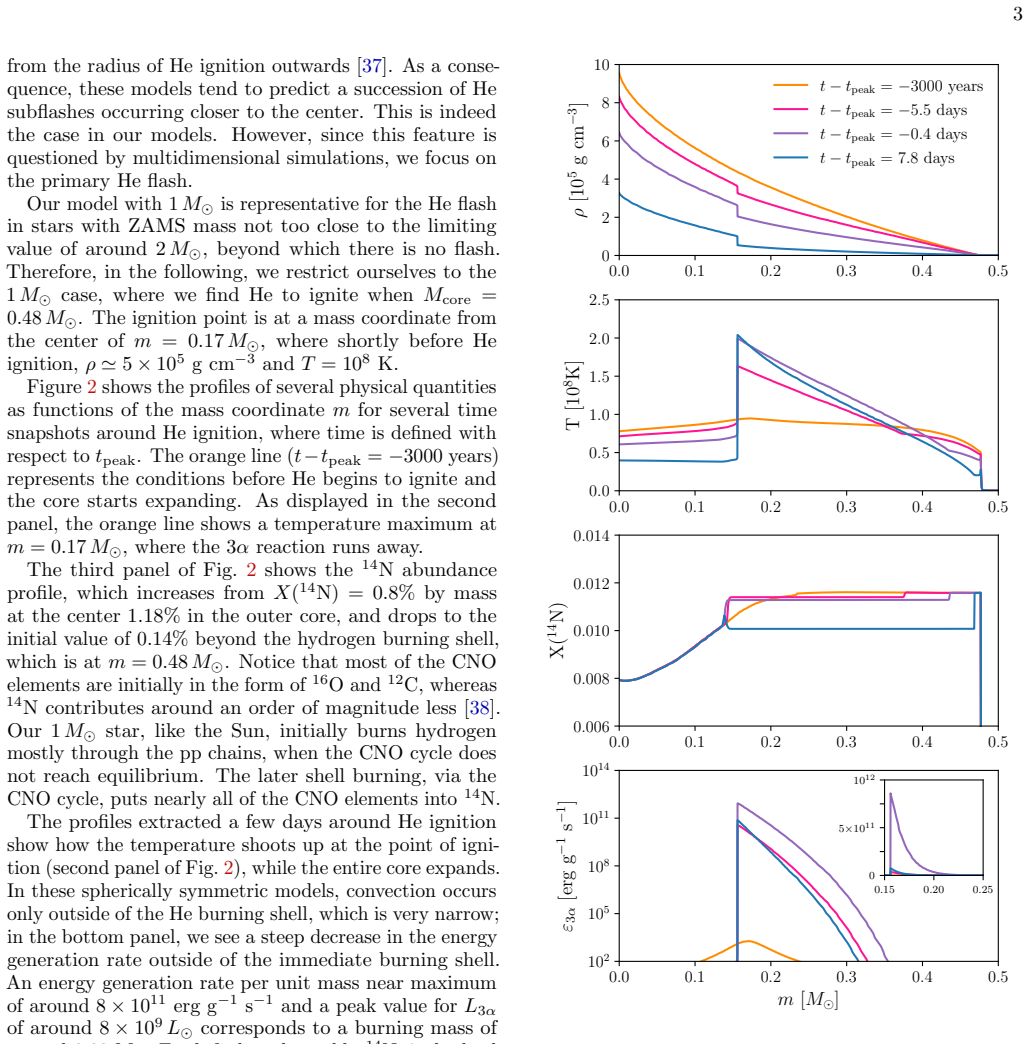
The neutrino emission generated by beta decay and electron capture on fluorine-18 synthesized via alpha capture on nitrogen-14 during the degenerate helium flash.
If this is right
- Helium flashes take place a few times each year throughout the Galaxy.
- No red-giant-branch stars suitable for observation lie within 10 parsecs.
- Asteroseismology therefore remains the primary method for studying the helium flash today.
- A future detection would directly constrain the thermonuclear runaway in degenerate helium cores.
Where Pith is reading between the lines
- Detection would test whether the predicted fluorine-18 yield matches actual core conditions at the tip of the red-giant branch.
- Systematic monitoring of nearby red giants could eventually bring a candidate inside the 3-parsec horizon.
- The same neutrino channel might later be used to time the flash relative to other observables such as luminosity spikes.
Load-bearing premise
Standard stellar-evolution calculations accurately predict the amount of fluorine-18 produced and the resulting neutrino yields and energies during the helium flash.
What would settle it
A Jinping-like detector records no excess events above background during the helium flash of a confirmed low-mass star located within 2 parsecs.
Figures



read the original abstract
Low-mass stars ($M\lesssim 2\,M_\odot$) ignite helium under degenerate conditions, eventually causing a nuclear run-away -- the helium flash. The alpha-capture process on $^{14}$N produces a large amount of $^{18}$F, whose subsequent decay spawns an intense $\nu_e$ burst (with average energy of $0.38$ MeV) lasting about a day. We show that, in addition, a strong $1.7$ MeV neutrino line is generated by electron capture on $^{18}$F. Detection is hindered by large backgrounds in state-of-the-art neutrino observatories, such as JUNO. In next-generation facilities, such as the Jinping neutrino experiment, the horizon for a detection with a local significance of $3 \sigma$ would be extended to almost $3$ pc. Although helium flashes occur a few times per year in our Galaxy, there are no stellar candidates approaching the tip of the red giant branch within $10$ pc. Hence, to date, asteroseismology remains the most promising tool for probing the most energetic thermonuclear event in the life of a low-mass star.
Editorial analysis
A structured set of objections, weighed in public.
Referee Report
Summary. The manuscript examines neutrino emission during the helium flash in low-mass stars (M ≲ 2 M_⊙), where alpha capture on 14N produces substantial 18F that decays to yield a ~1-day ν_e burst (average energy 0.38 MeV) plus a distinct 1.7 MeV electron-capture line. It argues that backgrounds preclude detection in current facilities such as JUNO, but that next-generation detectors like Jinping could reach a 3σ local significance out to nearly 3 pc. The paper notes the absence of suitable red-giant-branch-tip candidates within 10 pc and concludes that asteroseismology remains the more practical probe at present.
Significance. If the underlying 18F yields and detector response prove accurate, the work identifies a previously unexploited neutrino signature of the helium flash and quantifies how future low-background detectors could extend the observable volume. The ~3 pc horizon represents a concrete, falsifiable prediction that could be tested once Jinping data become available, although the immediate astrophysical payoff is limited by the scarcity of nearby targets.
major comments (2)
- [Abstract and §3] Abstract and §3 (Neutrino production): The 3 pc 3σ horizon for Jinping is derived from the integrated 18F yield computed in 1D stellar sequences. No sensitivity study is shown for the mixing-length parameter, overshooting, or 3D convective effects; because event counts scale linearly with yield, a 30–50 % downward revision (plausible under altered mixing) would shrink the horizon distance by ~15–25 %, directly affecting the central claim.
- [§4] §4 (Detection prospects): The background rate at 1.7 MeV and the Jinping detector response are taken as fixed inputs without quoted uncertainties or alternative background models. This assumption is load-bearing for the quoted significance and horizon distance.
minor comments (1)
- [Abstract] The abstract states the average neutrino energy as 0.38 MeV but does not clarify whether this refers to the continuum or includes the 1.7 MeV line contribution; a brief clarification would improve readability.
Simulated Author's Rebuttal
We thank the referee for their careful reading of the manuscript and for the constructive comments. We address each major point below and have revised the text to improve clarity and robustness where possible.
read point-by-point responses
-
Referee: [Abstract and §3] Abstract and §3 (Neutrino production): The 3 pc 3σ horizon for Jinping is derived from the integrated 18F yield computed in 1D stellar sequences. No sensitivity study is shown for the mixing-length parameter, overshooting, or 3D convective effects; because event counts scale linearly with yield, a 30–50 % downward revision (plausible under altered mixing) would shrink the horizon distance by ~15–25 %, directly affecting the central claim.
Authors: We agree that a dedicated sensitivity study would strengthen the central claim. Our 1D sequences employ standard mixing-length theory and moderate overshooting calibrated to reproduce observed red-giant-branch properties. Existing 3D hydrodynamic simulations of the helium flash (e.g., those examining convective mixing and dredge-up) indicate that 18F yields vary by at most ~25 % relative to 1D results under plausible changes in convective physics. We have added a new paragraph in §3 that quantifies this range, shows the corresponding shift in horizon distance (still ~2.4 pc for a 40 % yield reduction), and cites the relevant 3D literature. The abstract has been updated to note this uncertainty. revision: partial
-
Referee: [§4] §4 (Detection prospects): The background rate at 1.7 MeV and the Jinping detector response are taken as fixed inputs without quoted uncertainties or alternative background models. This assumption is load-bearing for the quoted significance and horizon distance.
Authors: We accept that explicit uncertainty ranges improve the presentation. In the revised §4 we now quote the background rate adopted from published Jinping projections together with a conservative factor-of-two variation, and we show how this propagates into the 3σ horizon (2.6–3.2 pc). We also reference ongoing work on Jinping background modeling at MeV energies and note that our assumptions are deliberately conservative relative to current low-background experiments. A brief table summarizing the effect of background and efficiency variations has been added. revision: yes
Circularity Check
No significant circularity; detection horizon is a forward calculation from standard models
full rationale
The paper computes 18F yields and the associated neutrino burst (including the 1.7 MeV EC line) from standard 1D stellar evolution sequences and nuclear rates, then folds the resulting spectrum with a Jinping detector response to obtain the 3σ horizon distance. This is a conventional forward prediction chain that does not redefine the input yields in terms of the output horizon, fit parameters to the target observable, or rely on self-citations for uniqueness. The abstract and context present the horizon as a derived quantity from independent stellar and detector models rather than a tautological restatement of fitted inputs.
Axiom & Free-Parameter Ledger
axioms (2)
- domain assumption Standard stellar evolution models accurately predict 18F production via alpha capture on 14N during the degenerate helium flash.
- domain assumption Background rates and energy resolution in JUNO and Jinping are known well enough to compute 3 sigma significance.
Lean theorems connected to this paper
-
IndisputableMonolith/Cost/FunctionalEquationwashburn_uniqueness_aczel unclear?
unclearRelation between the paper passage and the cited Recognition theorem.
We use spherically symmetric stellar models ... evolved with the Modules for Experiments in Stellar Astrophysics (MESA) code ... mesa 49, which captures all nuclear and weak processes
-
IndisputableMonolith/Foundation/RealityFromDistinctionreality_from_one_distinction unclear?
unclearRelation between the paper passage and the cited Recognition theorem.
the horizon for a detection with a local significance of 3 σ would be extended to almost 3 pc
What do these tags mean?
- matches
- The paper's claim is directly supported by a theorem in the formal canon.
- supports
- The theorem supports part of the paper's argument, but the paper may add assumptions or extra steps.
- extends
- The paper goes beyond the formal theorem; the theorem is a base layer rather than the whole result.
- uses
- The paper appears to rely on the theorem as machinery.
- contradicts
- The paper's claim conflicts with a theorem or certificate in the canon.
- unclear
- Pith found a possible connection, but the passage is too broad, indirect, or ambiguous to say the theorem truly supports the claim.
Reference graph
Works this paper leans on
-
[1]
Neutrinos and Dark Matter in Astro- and Parti- cle Physics (NDM),
as a function of ρ and T . As a standard output, both 5 −15 −10 −5 0 5 10 15 1043 1044 1045 1046 1047 1048 nν [s−1] Total β+decay EC tpeak tν EC peak −15 −10 −5 0 5 10 15 t − tpeak [days] 0.00 0.25 0.50 0.75 1.00 Fractional contribution FIG. 4. Evolution of 18F neutrino emission for our 1 M⊙ model.Top panel:Production by the two channels and their sum. Th...
-
[2]
Beta decay The weak decay 18F → 18O+e++νe is of the type 1+ → 0+, therefore an allowed pure Gamow-Teller transition. The Q value is 0.6339 MeV [57, 58], which is the maximum neutrino energy or the maximum positron kinetic energy. The maximum positron total energy, which is also the mass difference between the two nuclei, is E0 =Q+m e = 1.1449 MeV,(A1) wit...
-
[3]
Electron capture As for EC, we need to put the charged lepton in the initial state and multiply with the occupation number. Hence Eq. (A3) becomes dλEC =λ 0 30 E5 0 p2 edpep2 νdpν δ(E0 +E e −E ν) ×f e(pe)F(Z, E e),(A8) with the Fermi-Dirac distribution fe = [e(Ee−µe)/T + 1]−1 in terms of the electron chemical potential µe. The differ- ential neutrino spec...
-
[4]
Tabulated rates The MESA code does not evaluate the beta-decay and EC formulas derived in this appendix, instead it uses the tabulated rates from Oda et al. [ 41]. These are given for values of log10(Yeρ) in steps of 1 (i.e., one value per order of magnitude, and also a crude grid of temperatures). At T so low that there are no positrons in the medium, th...
-
[5]
P. Mart´ ınez-Mirav´ e and I. Tamborra, Neutrinos from stars in the Milky Way, Phys. Rev. D113, 023014 (2026), arXiv:2510.07399 [astro-ph.SR]
- [6]
- [7]
-
[8]
R. Davis, Jr., D. S. Harmer, and K. C. Hoffman, Search for Neutrinos from the Sun, Phys. Rev. Lett.20, 1205 (1968)
work page 1968
-
[9]
V. Antonelli, L. Miramonti, C. Pe˜ na-Garay, and A. M. Serenelli, Solar Neutrinos, Adv. High Energy Phys.2013, 351926 (2013), arXiv:1208.1356 [hep-ex]
work page internal anchor Pith review Pith/arXiv arXiv 2013
-
[10]
W. C. Haxton, R. G. H. Robertson, and A. M. Serenelli, Solar Neutrinos: Status and Prospects, Ann. Rev. Astron. Astrophys.51, 21 (2013), arXiv:1208.5723 [astro-ph.SR]
work page internal anchor Pith review Pith/arXiv arXiv 2013
-
[11]
Supernova Neutrinos: Production, Oscillations and Detection
A. Mirizzi, I. Tamborra, H.-T. Janka, N. Saviano, K. Schol- berg, R. Bollig, L. H¨ udepohl, and S. Chakraborty, Super- nova Neutrinos: Production, Oscillations and Detection, Riv. Nuovo Cim.39, 1 (2016), arXiv:1508.00785 [astro- ph.HE]
work page internal anchor Pith review Pith/arXiv arXiv 2016
- [12]
- [13]
-
[14]
Acharyaet al., Solar fusion III: New data and theory for hydrogen-burning stars, Rev
B. Acharyaet al., Solar fusion III: New data and theory for hydrogen-burning stars, Rev. Mod. Phys.97, 035002 (2025), arXiv:2405.06470 [astro-ph.SR]
- [15]
- [16]
-
[17]
Tamborra, Neutrinos from explosive transients at the dawn of multi-messenger astronomy, Nature Rev
I. Tamborra, Neutrinos from explosive transients at the dawn of multi-messenger astronomy, Nature Rev. Phys. 7, 285 (2025), arXiv:2412.09699 [astro-ph.HE]
-
[18]
What can be learned from a future supernova neutrino detection?
S. Horiuchi and J. P. Kneller, What can be learned from a future supernova neutrino detection?, J. Phys. G45, 043002 (2018), arXiv:1709.01515 [astro-ph.HE]
work page internal anchor Pith review Pith/arXiv arXiv 2018
-
[19]
K. M. Patton, C. Lunardini, R. J. Farmer, and F. X. Timmes, Neutrinos from beta processes in a presupernova: probing the isotopic evolution of a massive star, Astrophys. J.851, 6 (2017), arXiv:1709.01877 [astro-ph.HE]
work page internal anchor Pith review Pith/arXiv arXiv 2017
-
[20]
M. Mukhopadhyay, C. Lunardini, F. X. Timmes, and K. Zuber, Presupernova neutrinos: directional sensitivity and prospects for progenitor identification, Astrophys. J. 899, 153 (2020), arXiv:2004.02045 [astro-ph.HE]
-
[21]
E. Vitagliano, I. Tamborra, and G. G. Raffelt, Grand Unified Neutrino Spectrum at Earth: Sources and Spec- tral Components, Rev. Mod. Phys.92, 45006 (2020), arXiv:1910.11878 [astro-ph.HE]
-
[22]
A. M. Serenelli and M. Fukugita, Burst neutrinos from nitrogen flash, Astrophys. J. Lett.632, L33 (2005), arXiv:astro-ph/0505333
work page internal anchor Pith review Pith/arXiv arXiv 2005
-
[23]
A. V. Sweigart and P. G. Gross, Evolutionary sequences for red giant stars., Astrophys. J. Supp.36, 405 (1978)
work page 1978
-
[24]
Acoustic Signatures of the Helium Core Flash
L. Bildsten, B. Paxton, K. Moore, and P. J. Macias, Acoustic Signatures of the Helium Core Flash, Astrophys. 13 J. Lett.744, L6 (2012), arXiv:1111.6867 [astro-ph.SR]
work page internal anchor Pith review Pith/arXiv arXiv 2012
- [25]
-
[26]
D. Capelo and I. Lopes, Neutrinos and Asteroseismology of Stars over the Helium Flash, Astrophys. J.953, 165 (2023), arXiv:2308.08282 [astro-ph.SR]
-
[27]
Red Giant Branch stars: the theoretical framework
M. Salaris, S. Cassisi, and A. Weiss, Red giant branch stars: the theoretical framework, Publ. Astron. Soc. Pac. 114, 375 (2002), arXiv:astro-ph/0201387
work page internal anchor Pith review Pith/arXiv arXiv 2002
-
[28]
R. Kippenhahn, A. Weigert, and A. Weiss,Stellar struc- ture and evolution, Astronomy and Astrophysics Library (Springer, 2012)
work page 2012
-
[29]
D. S. P. Dearborn, J. C. Lattanzio, and P. P. Eggleton, 3D numerical experimentation on the core helium flash of low-mass red giants, Astrophys. J.639, 405 (2006), arXiv:astro-ph/0512049
work page internal anchor Pith review Pith/arXiv arXiv 2006
-
[30]
The core helium flash revisited: I. One and two-dimensional hydrodynamic simulations
M. Moc´ ak, E. M¨ uller, A. Weiss, and K. Kifonidis, The core helium flash revisited: I. One and two-dimensional hydrodynamic simulations, Astron. Astrophys.490, 265 (2008), arXiv:0805.1355 [astro-ph]
work page internal anchor Pith review Pith/arXiv arXiv 2008
-
[31]
The core helium flash revisited: II. Two and three-dimensional hydrodynamic simulations
M. Moc´ ak, E. M¨ uller, A. Weiss, and K. Kifonidis, The core helium flash revisited: II. Two and three-dimensional hydrodynamic simulations, Astron. Astrophys.501, 659 (2009), arXiv:0811.4083 [astro-ph]
work page internal anchor Pith review Pith/arXiv arXiv 2009
-
[32]
H.-C. Thomas, Sternentwicklung VIII. Der Helium-Flash bei einem Stern von 1. 3 Sonnenmassen, Zeitschrift f¨ ur Astrophysik67, 420 (1967)
work page 1967
-
[33]
A. M. Serenelli and A. Weiss, On constructing horizon- tal branch models, Astron. Astrophys.442, 1041 (2005), arXiv:astro-ph/0507430
work page internal anchor Pith review Pith/arXiv arXiv 2005
-
[34]
Modules for Experiments in Stellar Astrophysics (MESA)
B. Paxton, L. Bildsten, A. Dotter, F. Herwig, P. Lesaffre, and F. Timmes (MESA), Modules for Experiments in Stellar Astrophysics (MESA), Astrophys. J. Suppl.192, 3 (2011), arXiv:1009.1622 [astro-ph.SR]
work page internal anchor Pith review Pith/arXiv arXiv 2011
-
[35]
ApJ Supplement Series , author =
B. Paxtonet al., Modules for Experiments in Stellar Astrophysics (MESA): Planets, Oscillations, Rotation, and Massive Stars, Astrophys. J. Suppl.208, 4 (2013), arXiv:1301.0319 [astro-ph.SR]
work page internal anchor Pith review Pith/arXiv arXiv 2013
-
[36]
ApJ Supplement Series , author =
B. Paxtonet al., Modules for Experiments in Stellar As- trophysics (MESA): Binaries, Pulsations, and Explosions, Astrophys. J. Suppl.220, 15 (2015), arXiv:1506.03146 [astro-ph.SR]
work page internal anchor Pith review Pith/arXiv arXiv 2015
-
[37]
B. Paxtonet al., Modules for Experiments in Stellar Astrophysics (MESA): Pulsating Variable Stars, Rota- tion, Convective Boundaries, and Energy Conservation, Astrophys. J. Suppl.243, 10 (2019), arXiv:1903.01426 [astro-ph.SR]
work page internal anchor Pith review Pith/arXiv arXiv 2019
- [38]
- [39]
-
[40]
Herwig, The evolution of agb stars with convective over- shoot, Astron
F. Herwig, The evolution of agb stars with convective over- shoot, Astron. Astrophys.360, 952 (2000), arXiv:astro- ph/0007139
-
[41]
Hydrodynamic simulations of the core helium flash
M. Moc´ ak, E. M¨ uller, A. Weiss, and K. Kifonidis, Hydro- dynamic simulations of the core helium flash, inThe Art of Modeling Stars in the 21st Century, IAU Symposium, Vol. 252, edited by L. Deng and K. L. Chan (2008) pp. 215–221, arXiv:0904.4867 [astro-ph.SR]
work page internal anchor Pith review Pith/arXiv arXiv 2008
-
[42]
The chemical composition of the Sun
M. Asplund, N. Grevesse, A. J. Sauval, and P. Scott, The chemical composition of the Sun, Ann. Rev. Astron. Astrophys.47, 481 (2009), arXiv:0909.0948 [astro-ph.SR]
work page internal anchor Pith review Pith/arXiv arXiv 2009
-
[43]
Solar neutrino flux at keV energies
E. Vitagliano, J. Redondo, and G. G. Raffelt, So- lar neutrino flux at keV energies, JCAP12, 010, arXiv:1708.02248 [hep-ph]
work page internal anchor Pith review Pith/arXiv arXiv
-
[44]
E. Garc´ ıa-Tora˜ no, V. P. Medina, and M. R. Ibarra, The half-life of 18f, Applied Radiation and Isotopes68, 1561 (2010), proceedings of the 17th International Conference on Radionuclide Metrology and its Applications (ICRM 2009)
work page 2010
-
[45]
T. Oda, M. Hino, K. Muto, M. Takahara, and K. Sato, Rate Tables for the Weak Processes of sd-Shell Nuclei in Stellar Matter, Atomic Data and Nuclear Data Tables56, 231 (1994)
work page 1994
-
[46]
Navaset al.(Particle Data Group), Review of particle physics, Phys
S. Navaset al.(Particle Data Group), Review of particle physics, Phys. Rev. D110, 030001 (2024)
work page 2024
-
[47]
P. Mart´ ınez-Mirav´ e, I. Tamborra, and M. T´ ortola, The Sun and core-collapse supernovae are leading probes of the neutrino lifetime, JCAP05, 002, arXiv:2402.00116 [astro-ph.HE]
-
[48]
A. S. Dighe and A. Y. Smirnov, Identifying the neutrino mass spectrum from the neutrino burst from a supernova, Phys. Rev. D62, 033007 (2000), arXiv:hep-ph/9907423
work page internal anchor Pith review Pith/arXiv arXiv 2000
- [49]
-
[50]
Basilicoet al.(BOREXINO), Final results of Borexino on CNO solar neutrinos, Phys
D. Basilicoet al.(BOREXINO), Final results of Borexino on CNO solar neutrinos, Phys. Rev. D108, 102005 (2023), arXiv:2307.14636 [hep-ex]
-
[51]
F. Anet al.(JUNO), Neutrino Physics with JUNO, J. Phys. G43, 030401 (2016), arXiv:1507.05613 [physics.ins- det]
work page internal anchor Pith review Pith/arXiv arXiv 2016
-
[52]
Current Status and Future Prospects of the SNO+ Experiment
S. Andringaet al.(SNO+), Current Status and Fu- ture Prospects of the SNO+ Experiment, Adv. High Energy Phys.2016, 6194250 (2016), arXiv:1508.05759 [physics.ins-det]
work page internal anchor Pith review Pith/arXiv arXiv 2016
-
[53]
Askinset al.(Theia), THEIA: an advanced opti- cal neutrino detector, Eur
M. Askinset al.(Theia), THEIA: an advanced opti- cal neutrino detector, Eur. Phys. J. C80, 416 (2020), arXiv:1911.03501 [physics.ins-det]
-
[54]
J. F. Beacomet al.(Jinping), Physics prospects of the Jinping neutrino experiment, Chin. Phys. C41, 023002 (2017), arXiv:1602.01733 [physics.ins-det]
work page internal anchor Pith review Pith/arXiv arXiv 2017
-
[55]
G. ’t Hooft, Predictions for neutrino-electron cross- sections in Weinberg’s model of weak interactions, Phys. Lett. B37, 195 (1971)
work page 1971
-
[56]
M. Fukugita and T. Yanagida,Physics of Neutrinos and Applications to Astrophysics, Theoretical and Mathemat- ical Physics (Springer-Verlag, Berlin, Germany, 2003)
work page 2003
-
[57]
Abuslemeet al.(JUNO), Prediction of Energy Resolu- tion in the JUNO Experiment, Chin
A. Abuslemeet al.(JUNO), Prediction of Energy Resolu- tion in the JUNO Experiment, Chin. Phys. C49, 013003 (2025), arXiv:2405.17860 [hep-ex]
-
[58]
A. Abuslemeet al.(JUNO), JUNO sensitivity to 7Be, pep, and CNO solar neutrinos, JCAP10, 022, arXiv:2303.03910 [hep-ex]
-
[59]
Sensitivity of a low threshold directional detector to CNO-cycle solar neutrinos
R. Bonventre and G. D. Orebi Gann, Sensitivity of a low threshold directional detector to CNO-cycle solar neutri- nos, Eur. Phys. J. C78, 435 (2018), arXiv:1803.07109 [physics.ins-det]
work page internal anchor Pith review Pith/arXiv arXiv 2018
-
[60]
Albaneseet al.(SNO+), The SNO+ experiment, JINST16(08), P08059, arXiv:2104.11687 [physics.ins- det]
V. Albaneseet al.(SNO+), The SNO+ experiment, JINST16(08), P08059, arXiv:2104.11687 [physics.ins- det]. 14
-
[61]
Atomic and Nuclear data, Laboratoire National Henri Becquerel, http://www.lnhb.fr/home/nuclear-data/
-
[62]
D. R. Tilley, H. R. Weller, C. M. Cheves, and R. M. Chasteler, Energy levels of light nuclei A = 18–19, Nucl. Phys. A595, 1 (1995), for post-publication update see https://nucldata.tunl.duke.edu/nucldata/ourpubs /18 1995.pdf
work page 1995
-
[63]
G. M. Fuller, W. A. Fowler, and M. J. Newman, Stellar weak-interaction rates for sd-shell nuclei. I - Nuclear ma- trix element systematics with application to Al-26 and selected nuclei of importance to the supernova problem, Astrophys. J. Suppl.142, 447 (1980)
work page 1980
-
[64]
Prialnik,An Introduction to the Theory of Stellar Structure and Evolution(2009)
D. Prialnik,An Introduction to the Theory of Stellar Structure and Evolution(2009)
work page 2009
discussion (0)
Sign in with ORCID, Apple, or X to comment. Anyone can read and Pith papers without signing in.