GIST: Targeted Data Selection for Instruction Tuning via Coupled Optimization Geometry
Pith reviewed 2026-05-21 12:21 UTC · model grok-4.3
The pith
GIST selects influential examples for instruction tuning by projecting gradients into a low-dimensional subspace recovered via SVD from validation data to capture LoRA's cross-parameter couplings.
A machine-rendered reading of the paper's core claim, the machinery that carries it, and where it could break.
Core claim
GIST replaces axis-aligned scaling with robust subspace alignment: it recovers a task-specific subspace from validation gradients via SVD, projects training gradients into this coupled subspace, and scores examples by their alignment with the target directions. The method is motivated by the observation that LoRA optimization geometry exhibits non-trivial off-diagonal interactions that diagonal preconditioners cannot represent, while task-relevant update directions remain low-dimensional.
What carries the argument
Gradient Isometric Subspace Transformation (GIST), which recovers a task-specific low-dimensional subspace from validation gradients via SVD and scores examples by projection alignment within that subspace.
If this is right
- GIST achieves state-of-the-art selection quality with 0.29 percent storage and 25 percent computation relative to the prior baseline under the same selection budget.
- The approach directly demonstrates that LoRA induces optimization geometries with non-trivial off-diagonal parameter couplings.
- Task-relevant update directions can be isolated in a low-dimensional subspace extracted from validation gradients alone.
- The method remains applicable under fixed selection budgets without requiring full-model gradient storage.
Where Pith is reading between the lines
- The subspace construction may extend to other parameter-efficient adapters that similarly induce low-rank or coupled update structures.
- Dynamic recomputation of the SVD subspace at intervals during selection could further improve alignment as training progresses.
- The same projection technique might serve as a diagnostic tool to measure intrinsic task dimensionality across different fine-tuning regimes.
Load-bearing premise
The low-dimensional subspace recovered from validation gradients via SVD captures the task-relevant update directions even though LoRA induces strong cross-parameter couplings that invalidate axis-aligned approximations.
What would settle it
If data subsets chosen by GIST subspace scores yield downstream instruction-tuning performance no better than subsets chosen by random sampling or by standard diagonal optimizer statistics across multiple target tasks, the claimed advantage would be refuted.
Figures




read the original abstract
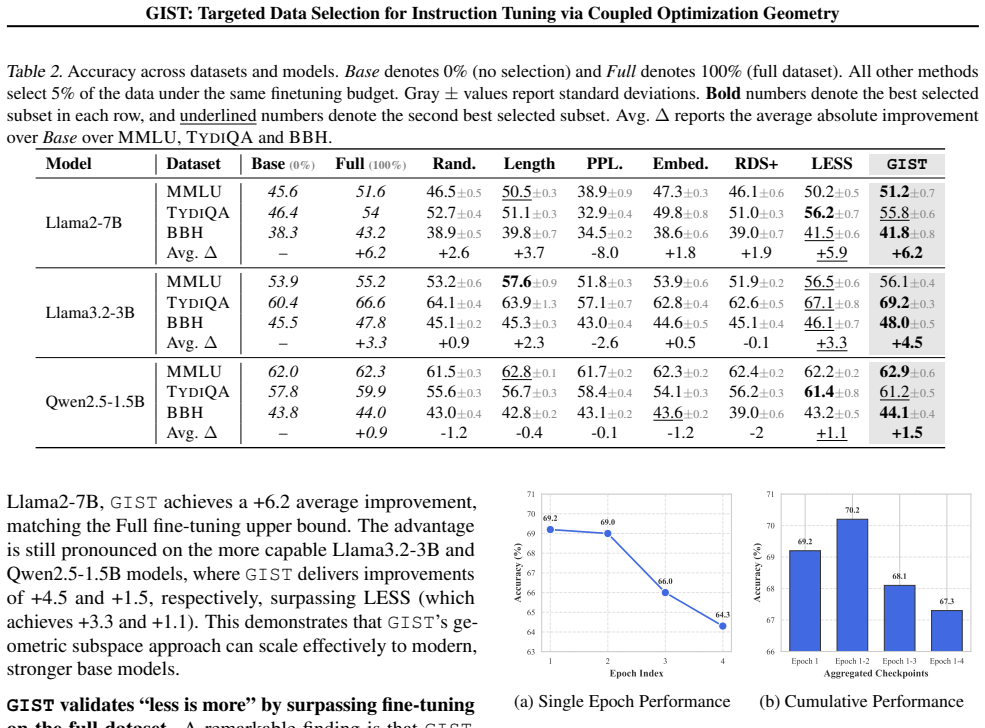
Targeted data selection has emerged as a crucial paradigm for efficient instruction tuning, aiming to identify a small yet influential subset of training examples for a specific target task. In practice, influence is often measured through the effect of an example on parameter updates. To make selection scalable, many approaches leverage optimizer statistics (e.g., Adam states) as an axis-aligned surrogate for update geometry (i.e., diagonal precondition), implicitly treating parameters as coordinate-wise independent. We show that this assumption breaks down in parameter-efficient fine-tuning (PEFT) methods such as LoRA. In this setting, the induced optimization geometry exhibits strong cross-parameter coupling with non-trivial off-diagonal interactions, while the task-relevant update directions are confined to a low-dimensional subspace. Motivated by this mismatch, we propose GIST (Gradient Isometric Subspace Transformation), a simple yet principled alternative that replaces axis-aligned scaling with robust subspace alignment. GIST recovers a task-specific subspace from validation gradients via singular value decomposition (SVD), projects training gradients into this coupled subspace, and scores examples by their alignment with target directions. Extensive experiments have demonstrated that GIST matches or outperforms the state-of-the-art baseline with only 0.29% of the storage and 25% of the computational time under the same selection budget.
Editorial analysis
A structured set of objections, weighed in public.
Referee Report
Summary. The manuscript proposes GIST for targeted data selection in instruction tuning. It argues that LoRA induces strong cross-parameter coupling in the optimization geometry, rendering axis-aligned surrogates (e.g., Adam states) inadequate. GIST recovers a low-dimensional task-specific subspace via SVD on validation gradients, projects training gradients into this subspace, and scores examples by alignment with target directions. The central empirical claim is that GIST matches or outperforms SOTA baselines while using only 0.29% of the storage and 25% of the computational time under identical selection budgets.
Significance. If the performance claims and the underlying geometry premise hold, the work is significant for scalable instruction tuning. It offers a principled, low-overhead alternative to diagonal surrogates that explicitly accounts for coupled update directions in PEFT, with substantial practical gains in storage and runtime. The approach could inform future data-selection methods that incorporate optimization geometry rather than coordinate-wise statistics.
major comments (3)
- [Abstract and method description] The load-bearing premise that LoRA induces strong off-diagonal coupling (making axis-aligned methods inadequate) is stated in the abstract and motivation but is not directly quantified. No measurement of off-diagonal magnitudes in the gradient covariance or approximate Hessian appears in the method or experiments sections, so the motivation for subspace projection over simpler surrogates remains ungrounded.
- [Method (subspace recovery procedure)] The SVD subspace recovery (method section) uses validation gradients without reported sensitivity analysis to validation-set size or distributional match to the target task. If the validation set is small or unrepresentative, the top singular vectors can reflect noise rather than coupled task directions, directly threatening the claimed performance edge over axis-aligned baselines.
- [Experiments section] Table or figure reporting the main results (experiments section) asserts matching SOTA at 0.29% storage / 25% time, but lacks error bars, multiple random seeds, or ablation on the SVD rank and number of validation examples; without these, it is unclear whether the gains are robust or driven by particular hyperparameter choices.
minor comments (2)
- [Method] The notation for the projection of training gradients onto the SVD subspace could be made explicit with a numbered equation rather than prose description.
- [Abstract] The abstract mentions 'extensive experiments' but does not name the concrete baselines or datasets; adding one sentence would improve clarity for readers.
Simulated Author's Rebuttal
We thank the referee for their constructive comments, which have helped us improve the clarity and robustness of our work. We address each major comment below and have incorporated revisions to strengthen the empirical grounding and experimental validation.
read point-by-point responses
-
Referee: [Abstract and method description] The load-bearing premise that LoRA induces strong off-diagonal coupling (making axis-aligned methods inadequate) is stated in the abstract and motivation but is not directly quantified. No measurement of off-diagonal magnitudes in the gradient covariance or approximate Hessian appears in the method or experiments sections, so the motivation for subspace projection over simpler surrogates remains ungrounded.
Authors: We agree that explicitly quantifying the off-diagonal coupling would provide stronger motivation for the subspace approach. In the revised version, we have added a new subsection in the method description that computes and visualizes the off-diagonal elements of the gradient covariance matrix for LoRA parameters on a representative task. This shows that off-diagonal terms are non-negligible and comparable in magnitude to diagonal terms, unlike in full fine-tuning where the geometry is more diagonal-dominant. This analysis directly supports the need for coupled subspace projection. revision: yes
-
Referee: [Method (subspace recovery procedure)] The SVD subspace recovery (method section) uses validation gradients without reported sensitivity analysis to validation-set size or distributional match to the target task. If the validation set is small or unrepresentative, the top singular vectors can reflect noise rather than coupled task directions, directly threatening the claimed performance edge over axis-aligned baselines.
Authors: We appreciate this point on robustness. We have performed a sensitivity analysis by varying the validation set size (from 50 to 500 examples) and report the resulting selection performance in a new appendix figure. The results show that performance stabilizes beyond 100 examples, with minimal degradation for smaller sets when using the same task distribution. For distributional match, the validation set is sampled from the same target task as the test set, as detailed in the experimental setup. We have clarified this in the revised method section. revision: yes
-
Referee: [Experiments section] Table or figure reporting the main results (experiments section) asserts matching SOTA at 0.29% storage / 25% time, but lacks error bars, multiple random seeds, or ablation on the SVD rank and number of validation examples; without these, it is unclear whether the gains are robust or driven by particular hyperparameter choices.
Authors: We acknowledge the importance of statistical robustness. In the revised manuscript, we have updated the main results table to include mean and standard deviation over 5 random seeds. Additionally, we include ablations on the SVD rank (varying k from 5 to 100) and the number of validation examples used for subspace recovery in a new supplementary figure, demonstrating that the performance gains are consistent across reasonable choices of these hyperparameters. revision: yes
Circularity Check
No significant circularity; GIST scoring is a novel construction independent of evaluation metrics
full rationale
The paper's core derivation defines GIST via SVD on validation gradients to obtain a coupled subspace, followed by projection of training gradients and alignment scoring. This procedure is explicitly constructed from the observed off-diagonal interactions in LoRA and does not reduce by the paper's equations to any quantity fitted on the same data used for final performance evaluation. No self-definitional loops, fitted inputs renamed as predictions, or load-bearing self-citations appear in the derivation chain. The method is presented as a direct response to the axis-aligned surrogate mismatch, with experimental validation against external baselines remaining falsifiable and non-tautological.
Axiom & Free-Parameter Ledger
axioms (2)
- standard math Singular value decomposition recovers the principal directions of variation in the validation gradient matrix.
- domain assumption Task-relevant update directions in LoRA lie in a low-dimensional subspace with cross-parameter coupling.
Lean theorems connected to this paper
-
IndisputableMonolith/Cost/FunctionalEquation.leanwashburn_uniqueness_aczel unclear?
unclearRelation between the paper passage and the cited Recognition theorem.
GIST recovers a task-specific subspace from validation gradients via singular value decomposition (SVD), projects training gradients into this coupled subspace, and scores examples by their alignment with target directions.
-
IndisputableMonolith/Foundation/AbsoluteFloorClosure.leanabsolute_floor_iff_bare_distinguishability unclear?
unclearRelation between the paper passage and the cited Recognition theorem.
Theorem 3.2 (LoRA induces off-diagonal curvature)... ∂²L / ∂Akj1 ∂Akj2 = (B:k ⊗ ej1)⊤ HW (B:k ⊗ ej2)
What do these tags mean?
- matches
- The paper's claim is directly supported by a theorem in the formal canon.
- supports
- The theorem supports part of the paper's argument, but the paper may add assumptions or extra steps.
- extends
- The paper goes beyond the formal theorem; the theorem is a base layer rather than the whole result.
- uses
- The paper appears to rely on the theorem as machinery.
- contradicts
- The paper's claim conflicts with a theorem or certificate in the canon.
- unclear
- Pith found a possible connection, but the passage is too broad, indirect, or ambiguous to say the theorem truly supports the claim.
Forward citations
Cited by 2 Pith papers
-
Let the Target Select for Itself: Data Selection via Target-Aligned Paths
Target-aligned data selection via normalized endpoint loss drop on a validation-induced reference path achieves competitive performance with reduced computational overhead.
-
One Algorithm, Two Goals: Dual Scoring for Parameter and Data Selection in LLM Fine-Tuning
DualSFT derives parameter masks and data subsets as row- and column-wise aggregations of one gradient interaction matrix under first- and second-order validation-improvement approximations.
Reference graph
Works this paper leans on
-
[1]
Ivison, H., Zhang, M., Brahman, F., Koh, P. W., and Dasigi, P. Large-scale data selection for instruction tuning.arXiv preprint arXiv:2503.01807,
-
[2]
Measur- ing the intrinsic dimension of objective landscapes
Li, C., Farkhoor, H., Liu, R., and Yosinski, J. Measur- ing the intrinsic dimension of objective landscapes. In International Conference on Learning Representations, 2018a. Li, H., Xu, Z., Taylor, G., Studer, C., and Goldstein, T. Visualizing the loss landscape of neural nets.Advances in neural information processing systems, 31, 2018b. Li, M., Zhang, Y ....
work page 2024
-
[3]
Marion, M., ¨Ust¨un, A., Pozzobon, L., Wang, A., Fadaee, M., and Hooker, S. When less is more: Investigating data pruning for pretraining llms at scale.arXiv preprint arXiv:2309.04564,
-
[4]
H., Ma, J., Zhao, V ., Luan, Y ., Hall, K., Chang, M.-W., et al
Ni, J., Qu, C., Lu, J., Dai, Z., Abrego, G. H., Ma, J., Zhao, V ., Luan, Y ., Hall, K., Chang, M.-W., et al. Large dual encoders are generalizable retrievers. InProceedings of the 2022 Conference on Empirical Methods in Natural Language Processing, pp. 9844–9855,
work page 2022
-
[5]
Eigenvalues of the Hessian in Deep Learning: Singularity and Beyond
Sagun, L., Bottou, L., and LeCun, Y . Eigenvalues of the hessian in deep learning: Singularity and beyond.arXiv preprint arXiv:1611.07476,
work page internal anchor Pith review Pith/arXiv arXiv
-
[6]
W., Chowdhery, A., Le, Q., Chi, E., Zhou, D., et al
Suzgun, M., Scales, N., Sch¨arli, N., Gehrmann, S., Tay, Y ., Chung, H. W., Chowdhery, A., Le, Q., Chi, E., Zhou, D., et al. Challenging big-bench tasks and whether chain-of- thought can solve them. InFindings of the Association for Computational Linguistics: ACL 2023, pp. 13003–13051,
work page 2023
-
[7]
URL https://qwenlm.github.io/ blog/qwen2.5/. Touvron, H., Martin, L., Stone, K., Albert, P., Almahairi, A., Babaei, Y ., Bashlykov, N., Batra, S., Bhargava, P., 10 GIST: Targeted Data Selection for Instruction Tuning via Coupled Optimization Geometry Bhosale, S., et al. Llama 2: Open foundation and fine- tuned chat models.arXiv preprint arXiv:2307.09288,
work page internal anchor Pith review Pith/arXiv arXiv
-
[8]
11 GIST: Targeted Data Selection for Instruction Tuning via Coupled Optimization Geometry A. Limitations and Future Work While GIST offers a principled geometric view, our current instantiation is intentionally simple—a minimal, proof-driven realization of the theory. Empirically, we find that applyingGIST early in training (after a lightweight warmup) is...
work page 2024
-
[9]
circumvent this bottleneck by projecting gradients into lower dimensions and approximating the Hessian inverse using optimizer statistics (e.g., Adam’s second moment). Critically, these methods rely on adiagonal approximationof the curvature. This implicitly assumes that model parameters are statistically independent and the optimization landscape is axis...
work page 2024
-
[10]
used in fine-tuning Large Language Models (LLMs) and discuss how its second-moment statistics are utilized to approximate the optimization landscape for data selection methods like LESS (Xia et al., 2024). D.1. Standard Adam Update Rule Let ℓ(z,θ) denote the loss function for a data sample z and model parameters θ∈R d. At each training step t, we compute ...
work page 2024
-
[11]
+o(η 2),(34) where theO(η 2)term collects the quadratic Taylor term and the remainder. Since Lval(θt) is independent of S, minimizing Lval(eθS) over S is, up to an S-independent constant and higher-order terms in η, equivalent to maximizing the first-order predicted decrease term g⊤ val,tH† val,tgS,t. Formally, ignoring O(η2) and o(η2) terms in (34), we o...
work page 2020
-
[12]
as the external encoder. For every candidate sample d and validation sample v, we compute their embeddings using GTR-Base and calculate the cosine similarity score. The final score for a candidatedis its maximum similarity to any example in the validation set. RDS+.We adopt theRDS+method proposed by Ivison et al. (2025). Unlike standard embedding approach...
work page 2025
-
[13]
Also we adopt the reported performance of LESS on Llama2-7B from the original paper. G. Training G.1. Training Datasets We use the same four preprocessed training datasets as in Wang et al. (2023). All are human-written or human-annotated; details are provided in Table 6.FLAN V2 andCOTare derived from existing NLP benchmarks, whereasDOLLYandOPEN ASSISTANT...
work page 2023
-
[14]
Rapid loss convergence in the first epoch creates a stable geometric basin.We observe consistent training dynamics across varying data scales (13.5k vs. 270k) and model architectures, where the loss drops precipitously within the initial phase (<0.5 epoch) before entering a bounded oscillatory regime. To verify the assumptions underlying Theorem 3.3, we a...
work page 2021
-
[15]
Tail ablation on Llama3.2-3B under the same 5% selection budget. While GIST consistently improves overBaseandRandom, selecting only the smallest principal direction (GIST-tail) can be unstable and may hurt task performance. Task Base RandomGIST GIST-tail MMLU 53.9 53.2±0.656.1±0.456.4±0.2 TYDIQA 60.4 64.1±0.469.2±0.363.1±1.5 BBH 45.5 45.1±0.248.0±0.538.5±...
work page 2011
-
[16]
she’s asleep, we should keep noisy
I. దూరంలKనూఉం:;. 2011 RSరతజనగణనగణVం6ాలపC6ారంఈ =ా > మం830 ఇళ2 YZ, 3687 జ[VRSYZ268 \]6ా M ర2లK(స^ _`ంaఉం:;. =ా > మంలKమగbా_`సంఖc1398, ఆడbా_`సంఖc2289. efడూcgh కjల1లసంఖc26 6ా=ాefడూcghYెగలసంఖc2944. =ా > మంkకlజనగణనలm6Aషo6pq584655[2].rిo6pq: 531077. Question:2011లK!ాత!ా$ేర'=ా > మంలKఎంతమం:;uీ^ wలjఉ[V-ర'? Assistant:2289 PC1 PC2 PC3 PC1: Review Sentiment Classificat...
work page 2011
discussion (0)
Sign in with ORCID, Apple, or X to comment. Anyone can read and Pith papers without signing in.