REVIEW 4 major objections 4 minor 1 cited by
Constraining the nuclear symmetry energy with electric dipole polarizability and neutron skin characteristics in \texorpdfstring{$^{208}\mathrm{Pb}$}{208Pb} within antisymmetrized molecular dynamics
T0 review · 4 major / 4 minor · reviewed 2026-08-02 · deepseek-v4-flash
Pith's one-line read Combined electric dipole polarizability and neutron-skin data for 208Pb, analyzed in the AMD model, favor a symmetry energy S0 ≈ 34 MeV and slope L ≈ 66–75 MeV, tightly constraining S(ρ) between 0.2ρ0 and 0.57ρ0.
desk verdict AMD constraints on 208Pb symmetry energy that are plausible and honestly presented, but the claimed precision outruns the model's demonstrated accuracy. read the letter →
The pith
A machine-rendered reading of the paper's core claim, the machinery that carries it, and where it could break.
The reading
What carries the argument
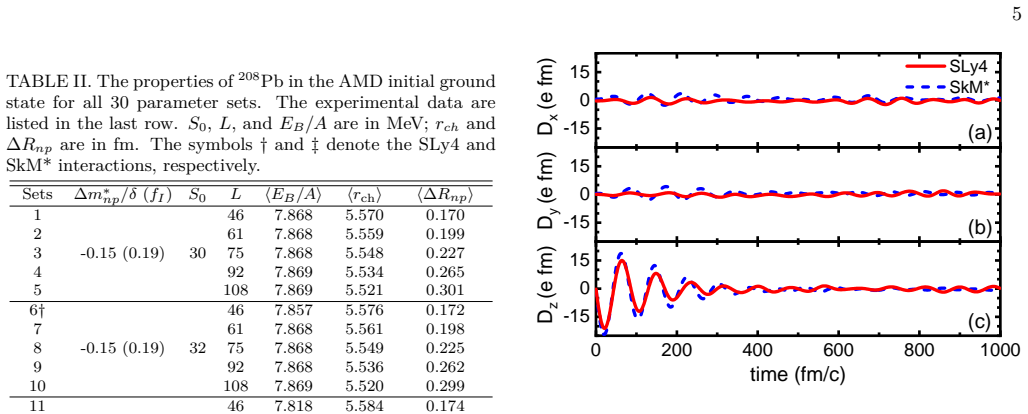
The load-bearing tool is the antisymmetrized molecular dynamics (AMD) model, in which the nuclear wave function is a Slater determinant of fixed-width Gaussian wave packets; the ground state is prepared by frictional cooling and the isovector dipole response is obtained by a small instantaneous E1 boost followed by time evolution under the time-dependent variational principle. A key supplement is an extra density-dependent term added to the Skyrme interaction, which lets the authors vary S0 and L independently while keeping the incompressibility and effective masses fixed. The paper's central identity is the correlation analysis showing a Pearson coefficient above 0.99 between 1/αD and S(ρ)
What would settle it
Run the same 30 parameter sets through an independent many-body method (for example RPA with the same Skyrme functionals, or AMD with a different wave-packet width or with two-body collisions enabled) for 208Pb: if the inferred S0 and L move outside 32–34 MeV and 66–75 MeV, or if a single set cannot simultaneously reproduce S(E) (χ²_r near 1), αD, and ΔRnp, the central constraint fails.
Extended reading notes
Core claim
The central claim is that, within the AMD model, the electric dipole polarizability and the neutron-skin thickness of 208Pb are simultaneously reproduced only by parameter sets with a relatively large symmetry energy at saturation, S0 ≈ 34 MeV, and a slope L in the narrow range 66–75 MeV (weakly dependent on the neutron-proton effective mass splitting). The paper further asserts that αD and ΔRnp are sensitive to the symmetry energy only in the subsaturation window 0.20–0.57ρ0, where the correlation coefficient between 1/αD and S(ρ) exceeds 0.99, allowing tight point-wise constraints on S(ρ). The authors also argue that the AMD model produces the measured dipole strength function without arti
Load-bearing premise
The entire extraction rests on the assumption that AMD's ground state and time evolution—with a fixed Gaussian width ν = 0.16 fm⁻², no two-body collisions, and a frictionally cooled initial state—produce quantitatively reliable αD and ΔRnp for 208Pb; the paper's own χ²_r = 14.17 for the dipole strength function shows the model does not yet reproduce the measured S(E) accurately.
Editorial extensions
If this is right
- If the combined constraint is right, the symmetry energy at subsaturation densities is pinned near S(0.2ρ0)≈10.5 MeV and S(0.57ρ0)≈23 MeV, narrowing predictions for neutron-star crust properties and heavy-ion collision observables.
- The result implies that a relatively stiff symmetry energy (L ≳ 66 MeV) is consistent with the PREX-II neutron-skin measurement for 208Pb.
- The AMD model's ability to generate the giant-dipole width without two-body collisions offers a microscopic Landau-damping mechanism that can be used in future transport-based studies of collective modes.
- The identified sensitive-density window of 0.2–0.57ρ0 gives a concrete target for future experiments and calculations aiming to constrain S(ρ).
- Within the model, ΔRnp is strongly correlated with L while αD depends on S0, L, and the effective-mass splitting, so the two observables are complementary rather than redundant.
Reading between the lines
- The internal tension the authors note—the best χ² fit to the full strength function favors S0=30, L=61, whereas the αD+ΔRnp combination favors S0≈34, L≈67–75—suggests that the energy-weighted integral αD and the line shape S(E) may sample different density regions or dynamics; a single parameter set that accurately fits both would be the decisive test.
- If the sensitive-density window is as narrow as claimed, the same AMD machinery could be applied to other nuclei such as 208Pb, 48Ca, or 68Ni to produce independent cross-checks; discrepancies would signal missing dynamics, for example two-body collisions or a density-dependent wave-packet width.
- The near-linear ΔRnp–αD correlation at fixed S0 and effective-mass splitting could serve as a calibration curve within AMD: measuring one observable for another nucleus would constrain the other through the computed slope.
- The Landau-damping picture implies that the GDR width is not an adjustable input in AMD; if this transfers to other resonances (quadrupole, monopole), the model becomes predictive for a broader set of collective states.
Editorial analysis
A structured set of objections, weighed in public.
Referee Report
Summary. The manuscript uses the antisymmetrized molecular dynamics (AMD) model to compute the electric dipole polarizability α_D and the neutron skin thickness ΔR_np of 208Pb for 30 Skyrme-like effective interactions that sample S0 ∈ {30,32,34} MeV, L ∈ {46,61,75,92,108} MeV, and two values of the isoscalar-isovector effective mass splitting. It reports that the combined RCNP α_D and PREX-II ΔR_np constraints favor S0 ≈ 34 MeV and L ≈ 66–75 MeV, that the observables are most sensitive to the symmetry energy in the density window 0.20–0.57 ρ0, and it quotes S(0.20ρ0) = 10.5 ± 0.63 MeV and S(0.57ρ0) = 23.1 ± 0.4 MeV. The paper also discusses the dynamical origin of the GDR width through Landau damping and derives an approximate dipole equation of motion in Appendix B.
Significance. If the result holds, this is a useful addition to the symmetry-energy literature because AMD treats the nuclear ground state and the collective dipole response in a fully antisymmetrized, microscopic framework, complementing existing RPA and BUU analyses. The paper is explicit about its parameter grid, reports the χ² for all 30 sets, and provides a transparent derivation of the dipole dynamics, which are strengths. The central claim, however, rests on a strength function that the authors themselves state is not accurately described (χ²_r = 14.17 for the best set), and the quoted constraints on S(ρ) do not include model systematic error. The abstract and the full text also give different central values and error bars, so the headline result is not yet presented in a reproducible, internally consistent way.
major comments (4)
- [Sec. III C, Eq. (20), Table III] The central extraction uses α_D as the 1/E-weighted integral of the computed strength function S(E). Table III shows that no parameter set reproduces the RCNP strength data at the quoted error level: the smallest reduced chi-square is χ²_r = 14.17 (set 2), and the text explicitly concedes that 'an accurate description of S(E) still needs more work.' A strength function that deviates from data by much more than the experimental errors can still integrate to a reasonable α_D, but the systematic error of this bias must be quantified before the quoted sub-MeV uncertainties on S(ρ) can be accepted. Please provide an explicit model-systematic estimate, for example by comparing the predicted and measured α_D, by reweighting the χ² over the 30 sets, or by demonstrating that a fitted renormalization/shift of S(E) changes the extracted S(ρ) by less than the quoted error.
- [Abstract vs. Sec. III D / Summary] The abstract states S0 ≈ 32–34 MeV, L = 64–87 MeV, S(0.2ρ0) = 10.18 ± 1.10 MeV, and S(0.57ρ0) = 22.31 ± 1.32 MeV, while the full text and Summary state S0 ≈ 34 MeV, L = 66–75 MeV, S(0.2ρ0) = 10.5 ± 0.63 MeV, and S(0.57ρ0) = 23.1 ± 0.4 MeV. These are not cosmetic differences: the central values differ by 0.3–0.8 MeV and the error bars differ by factors of 1.7–3.3. No statistical procedure is described for either set of numbers. The authors must decide on one final set, specify how the central values and error bars are obtained (e.g., from the spread of accepted sets, from χ² weighting, or from a Monte Carlo over experimental errors), and correct the abstract accordingly.
- [Sec. III D, Table I] The combined constraint sits at the boundary of, or between, the sampled grid points. S0 is only varied over {30, 32, 34} MeV and the favored value S0 ≈ 34 MeV is the maximum of the grid; L is sampled at {46, 61, 75, 92, 108} MeV and the favored range L = 66–75 MeV is an interpolation between L = 61 and L = 75. The claim that S0 ≈ 34 MeV is favored is therefore not a bounded inference from the calculation as presented. Please test the sensitivity by extending the grid (e.g., S0 = 36 MeV, L = 70 MeV) or by providing a quantitative interpolation/regression of α_D and ΔR_np as functions of S0 and L. Without this, the quoted 'favored' parameters and the resulting S(ρ) values are not robust against prior choices.
- [Sec. III D and Fig. 8] The extraction is a calibration rather than an independent test: the same 30 parameter sets that define the S(ρ) curves are used to select the sets that reproduce α_D and ΔR_np, and the S(ρ) values are then read off those selected sets. The Pearson correlation coefficient (>0.99) identifies the sensitive density window, but it does not validate the model mapping from S(ρ) to the observables. The quoted uncertainties (0.63 and 0.4 MeV) therefore reflect only the spread within the chosen interaction family, not the uncertainty in the AMD description of the ground state and dipole response (fixed wave-packet width ν=0.16 fm^-2, frictional cooling, no two-body collisions). Please state this limitation explicitly and, where possible, estimate the variation induced by these model choices (e.g., by repeating the analysis with a different ν or with collisions switched on).
minor comments (4)
- [Throughout] There are several typos and grammatical issues: 'diplole' (Abstract), 'eoevector' (Sec. II A), 'the the' (Sec. II B), and awkward phrases such as 'the values of symmetry energy at the starting and ending density region.' A language pass is needed.
- [Sec. II B] It is stated that the oscillation frequency is independent of ϵ for ϵ ≲ 72 MeV c^-1 e^-1, but no figure or numerical evidence is shown. Please provide the verification or state it as an auxiliary check.
- [Appendix A] The table of x3 and x′3 values is useful, but the columns would benefit from a statement of the exact units or normalization used in Eq. (10), since the density-dependent term uses ρ(ri) in fm^-3.
- [Data Availability] The data availability statement says the data are not publicly available. Given that the paper quotes quantitative extraction uncertainties, I recommend at least making the event-averaged S(E), α_D, and ΔR_np for the 30 sets available as supplementary material.
Circularity Check
No significant circularity: the αD–ΔRnp constraints are a dynamical calibration, and the reported S(E) tension shows the result is not forced.
full rationale
The paper's derivation chain is a model-based calibration rather than a circular reduction. αD is computed from the time-dependent AMD dipole response (Eqs. 13–20) and ΔRnp from the ground-state density profiles (Eqs. 21–22); neither observable is defined in terms of the final symmetry-energy values. The 30 effective interactions are generated by varying x3 and x3′ with K0, m_s*, and m_v* held fixed, and S(ρ) is then obtained from the same interaction via Eq. (12). Selecting parameter sets that reproduce the measured αD and ΔRnp and reading off S(ρ) at the sensitive-density window is the intended inversion, not an identity: the observables depend on the full dynamical calculation, not on S(ρ) substituted directly into the data. Moreover, the paper explicitly reports a tension between the S(E)-based χ² best set (S0=30, L=61, χ²_r=14.17) and the αD+ΔRnp-favored region (S0≈34, L=66–75), and concedes that “an accurate description of S(E) still needs more work.” That tension would be impossible if the central constraint were forced by construction. The self-citations to the AMD formalism and to earlier work by one of the authors are methodological provenance, not load-bearing circular support. The large reduced chi-square and unquantified model systematic error are correctness/reliability limitations, not circularity. No specific equation or fitting step reduces the claimed symmetry-energy constraints to the input data by definition, so no circular step can be exhibited.
Assumptions & free parameters
free parameters (4)
- T0 (zero-point kinetic energy correction) =
8.2 MeV (SLy4), 8.5 MeV (SkM*)
- Gaussian wave-packet width ν =
0.16 fm^-2
- Effective-interaction grid (S0, L) and fI =
S0∈{30,32,34} MeV, L∈{46,61,75,92,108} MeV, fI=0.19 or -0.26
- x3 and x'_3 (extended Skyrme couplings) =
Values in Table IV
assumptions (5)
- domain assumption Standard AMD Slater-determinant trial wave function and time-dependent variational principle provide a valid microscopic description of 208Pb ground state and E1 response.
- ad hoc to paper Goldhaber-Teller-like rigid displacement approximation in Appendix B, with ρn≈ρp≈ρ/2, is used to derive the dipole equation of motion.
- domain assumption The extended Skyrme interaction Eq. (11) with the chosen x3, x'_3 varies S0 and L while keeping K0, m*_s, m*_v fixed.
- domain assumption The PREX-II neutron skin and RCNP electric dipole polarizability measurements are accurate and can be used as constraints.
- domain assumption Pearson correlation between 1/α_D and S(ρ) identifies the density region probed by the observables.
Cite this review
Pith. "Pith review of Constraining the nuclear symmetry energy with electric dipole polarizability and neutron skin characteristics in \texorpdfstring{$^{208}\mathrm{Pb}$}{208Pb} within antisymmetrized molecular dynamics." pith.science (2026). https://pith.science/paper/S3L7OXOH
@misc{pith2026260219039,
  author       = {Pith},
  title        = {Pith review of: Constraining the nuclear symmetry energy with electric dipole polarizability and neutron skin characteristics in \texorpdfstring$^208\mathrmPb$208Pb within antisymmetrized molecular dynamics},
  year         = {2026},
  howpublished = {\url{https://pith.science/paper/S3L7OXOH}},
  note         = {Machine review of arXiv:2602.19039}
}
abstract
The electric dipole polarizability $\alpha_D$ and the neutron-skin thickness $\Delta R_{np}$ of $^{208}\mathrm{Pb}$ are two powerful and clean probes for constraining the symmetry energy at subsaturation densities. Within the framework of the antisymmetrized molecular dynamics (AMD) model, the width of the strength function and its dynamical origins are understood, and the $\alpha_D$ and $\Delta R_{np}$ data favor effective interaction parameter sets with $S_0\approx32$-34 MeV and $L=64$-87 MeV. In addition, our calculations show that the sensitive densities of $\alpha_D$ and $\Delta R_{np}$ range from 0.2$\rho_0$ to 0.57$\rho_0$, and the corresponding values of the symmetry energy at the lower and upper ends of this sensitive density region are $S(0.2\rho_0)=10.18\pm 1.10$ MeV and $S(0.57\rho_0)=22.31\pm 1.32$ MeV.
Figures


Figures from the paper (5 more)


Forward citations
Cited by 1 Pith paper
-
Revisiting neutron-skin thickness and dipole polarizability constraints on the symmetry energy in Antisymmetrized Molecular Dynamics
Unified AMD analysis constrains nuclear symmetry energy at 0.28 saturation density to 13.84 ± 1.31 MeV via combined neutron-skin and dipole polarizability data.
Reference graph
Works this paper leans on
-
[1]
NuPECC Long Range Plan 2024 for European Nuclear Physics (2025), arXiv:2503.15575 [nucl-ex]
arXiv 2024
-
[2]
US Department of Energy (USDOE), A New Era of Dis- covery: The 2023 Long Range Plan for Nuclear Science , Tech. Rep. (US Department of Energy (USDOE), 2023)
2023
-
[3]
used in the calculations. Sets m∗ s m∗ v S0 (MeV) L (MeV) x3 x′ 3 1 46 1.18 2 61 0.73 3 0.695 0.800 30 75 1.383 0.32 4 92 −0.19 5 108 −0.66 6 46 0.00 7 61 0.91 8 0.695 0.800 32 75 1.354 0.50 9 92 −0.01 10 108 −0.50 11 46 1.53 12 61 1.09 13 0.695 0.800 34 75 1.324 0.66 14 92 0.17 15 108 −0.32 16 46 0.00 17 61 −0.39 18 0.789 0.653 30 75 0.000 −0.77 19 92 −1...
-
[4]
M. B. Tsang, J. R. Stone, F. Camera, P. Danielewicz, S. Gandolfi, K. Hebeler, C. J. Horowitz, J. Lee, W. G. Lynch, Z. Kohley, R. Lemmon, P. Möller, T. Murakami, S. Riordan, X. Roca-Maza, F. Sammarruca, A. W. Steiner, I. Vidaña, and S. J. Yennello, Constraints on the symmetry energy and neutron skins from experiments and theory, Phys. Rev. C 86, 015803 (2012)
2012
-
[5]
Li, B.-J
B.-A. Li, B.-J. Cai, W.-J. Xie, and N.-B. Zhang, Progress in constraining nuclear symmetry energy using neutron star observables since gw170817, Universe 7, 182 (2021)
2021
-
[6]
Burgio, H.-J
G. Burgio, H.-J. Schulze, I. Vidaña, and J.-B. Wei, Neu- tron stars and the nuclear equation of state, Progress in Particle and Nuclear Physics 120, 103879 (2021)
2021
-
[7]
C. Y. Tsang, M. B. Tsang, W. G. Lynch, R. Kumar, and C. J. Horowitz, Determination of the equation of state from nuclear experiments and neutron star observations, Nature Astronomy 8, 328336 (2024)
2024
-
[8]
J. M. Lattimer and A. W. Steiner, Constraints on the symmetry energy using the mass-radius relation of neutron stars, The European Physical Journal A 50, 10.1140/epja/i2014-14040-y (2014)
Show all 68 references
-
[9]
Zhang, B.-A
N.-B. Zhang, B.-A. Li, and J. Xu, Combined constraints on the equation of state of dense neutron-rich matter from terrestrial nuclear experiments and observations of neutron stars, The Astrophysical Journal 859, 90 (2018)
2018
-
[10]
Zhang, M
Y. Zhang, M. Liu, C.-J. Xia, Z. Li, and S. K. Biswal, Constraints on the symmetry energy and its associated parameters from nuclei to neutron stars, Phys. Rev. C 101, 034303 (2020)
2020
-
[11]
M. B. Tsang, Y. Zhang, P. Danielewicz, M. Famiano, Z. Li, W. G. Lynch, and A. W. Steiner, Constraints on the density dependence of the symmetry energy, Phys. Rev. Lett. 102, 122701 (2009)
2009
-
[12]
L.-W. Chen, C. M. Ko, and B.-A. Li, Determination of the stiffness of the nuclear symmetry energy from isospin diffusion, Phys. Rev. Lett. 94, 032701 (2005)
2005
-
[13]
Zhang, M
Y. Zhang, M. Tsang, Z. Li, and H. Liu, Constraints on nucleon effective mass splitting with heavy ion collisions, Physics Letters B 732, 186 (2014)
2014
-
[14]
Li, L.-W
B.-A. Li, L.-W. Chen, and C. M. Ko, Recent progress and new challenges in isospin physics with heavy-ion re- actions, Physics Reports 464, 113 (2008)
2008
-
[15]
M. A. Famiano, T. Liu, W. G. Lynch, M. Mocko, A. M. Rogers, M. B. Tsang, M. S. Wallace, R. J. Charity, S. Ko- marov, D. G. Sarantites, L. G. Sobotka, and G. Verde, Neutron and proton transverse emission ratio measure- ments and the density dependence of the asymmetry term of t...
2006
-
[16]
J. Yang, Y. Zhang, N. Wang, and Z. Li, Influence of the treatment of initialization and mean-field potential on the neutron to proton yield ratios, Phys. Rev. C 104, 024605 (2021)
2021
-
[17]
Z. Y. Sun, M. B. Tsang, W. G. Lynch, G. Verde, F. Amor- ini, L. Andronenko, M. Andronenko, G. Cardella, M. Chatterje, P. Danielewicz, E. De Filippo, P. Dinh, E. Galichet, E. Geraci, H. Hua, E. La Guidara, G. Lanza- lone, H. Liu, F. Lu, S. Lukyanov, C. Maiolino, A. Pagano, S. P...
2010
-
[18]
Ciampi, J
C. Ciampi, J. D. Frankland, D. Gruyer, N. Le Neindre, 12 S. Mallik, R. Bougault, A. Chbihi, L. Baldesi, S. Bar- lini, E. Bonnet, B. Borderie, A. Camaiani, G. Casini, I. Dekhissi, D. Dell’Aquila, J. A. Dueñas, Q. Fable, F. Gramegna, C. Gouyet, M. Henri, B. Hong, S. Kim, A. Kord...
2025
-
[19]
Xiao, B.-A
Z. Xiao, B.-A. Li, L.-W. Chen, G.-C. Yong, and M. Zhang, Circumstantial evidence for a soft nuclear symmetry energy at suprasaturation densities, Physi- cal Review Letters 102, 10.1103/physrevlett.102.062502 (2009)
2009 doi
-
[20]
Cozma, The impact of energy conservation in trans- port models on the /+ multiplicity ratio in heavy-ion collisions and the symmetry energy, Physics Letters B 753, 166 (2016)
M. Cozma, The impact of energy conservation in trans- port models on the /+ multiplicity ratio in heavy-ion collisions and the symmetry energy, Physics Letters B 753, 166 (2016)
2016
-
[21]
Y. Liu, Y. Wang, Y. Cui, C.-J. Xia, Z. Li, Y. Chen, Q. Li, and Y. Zhang, Insights into the pion production mechanism and the symmetry energy at high density, Phys. Rev. C 103, 014616 (2021)
2021
-
[22]
B. T. Reed, F. J. Fattoyev, C. J. Horowitz, and J. Piekarewicz, Implications of prex-2 on the equation of state of neutron-rich matter, Phys. Rev. Lett. 126, 172503 (2021)
2021
-
[23]
Roca-Maza, M
X. Roca-Maza, M. Centelles, X. Viñas, and M. Warda, Neutron skin of 208Pb, nuclear symmetry energy, and the parity radius experiment, Phys. Rev. Lett. 106, 252501 (2011)
2011
-
[24]
Zhang and L.-W
Z. Zhang and L.-W. Chen, Constraining the symmetry energy at subsaturation densities using isotope binding energy difference and neutron skin thickness, Physics Let- ters B 726, 234238 (2013)
2013
-
[25]
Centelles, X
M. Centelles, X. Roca-Maza, X. Viñas, and M. Warda, Nuclear symmetry energy probed by neutron skin thick- ness of nuclei, Phys. Rev. Lett. 102, 122502 (2009)
2009
-
[26]
Yue, L.-W
T.-G. Yue, L.-W. Chen, Z. Zhang, and Y. Zhou, Con- straints on the symmetry energy from prex-ii in the mul- timessenger era, Phys. Rev. Res. 4, L022054 (2022)
2022
-
[27]
Roca-Maza and N
X. Roca-Maza and N. Paar, Nuclear equation of state from ground and collective excited state properties of nuclei, Progress in Particle and Nuclear Physics 101, 96 (2018)
2018
-
[28]
Trippa, G
L. Trippa, G. Colò, and E. Vigezzi, Giant dipole reso- nance as a quantitative constraint on the symmetry en- ergy, Phys. Rev. C 77, 061304 (2008)
2008
-
[29]
Roca-Maza, M
X. Roca-Maza, M. Brenna, G. Colò, M. Centelles, X. Viñas, B. K. Agrawal, N. Paar, D. Vretenar, and J. Piekarewicz, Electric dipole polarizability in 208pb: In- sights from the droplet model, Phys. Rev. C 88, 024316 (2013)
2013
-
[30]
G. Colò, U. Garg, and H. Sagawa, Symmetry energy from the nuclear collective motion: constraints from dipole, quadrupole, monopole and spin-dipole resonances, The European Physical Journal A 50, 10.1140/epja/i2014- 14026-9 (2014)
2014 doi
-
[31]
Zhang and L.-W
Z. Zhang and L.-W. Chen, Electric dipole polarizability in 208Pb as a probe of the symmetry energy and neutron matter around ρ0/3, Phys. Rev. C 92, 031301 (2015)
2015
-
[32]
Zheng, S
H. Zheng, S. Burrello, M. Colonna, and V. Baran, Dipole response in neutron-rich nuclei with new skyrme interac- tions, Phys. Rev. C 94, 014313 (2016)
2016
-
[33]
Xu and W.-T
J. Xu and W.-T. Qin, Nucleus giant resonances from an improved isospin-dependent boltzmann-uehling- uhlenbeck transport approach, Phys. Rev. C 102, 024306 (2020)
2020
-
[34]
Reinhard, X
P.-G. Reinhard, X. Roca-Maza, and W. Nazarewicz, In- formation content of the parity-violating asymmetry in 208Pb, Phys. Rev. Lett. 127, 232501 (2021)
2021
-
[35]
Klimkiewicz, N
A. Klimkiewicz, N. Paar, P. Adrich, M. Fallot, K. Boret- zky, T. Aumann, D. Cortina-Gil, U. D. Pramanik, T. W. Elze, H. Emling, H. Geissel, M. Hellström, K. L. Jones, J. V. Kratz, R. Kulessa, C. Nociforo, R. Palit, H. Simon, G. Surówka, K. Sümmerer, D. Vretenar, and W. Waluś (...
2007
-
[36]
Carbone, G
A. Carbone, G. Colò, A. Bracco, L.-G. Cao, P. F. Bor- tignon, F. Camera, and O. Wieland, Constraints on the symmetry energy and neutron skins from pygmy res- onances in 68Ni and 132Sn, Phys. Rev. C 81, 041301 (2010)
2010
-
[37]
Baran, B
V. Baran, B. Frecus, M. Colonna, and M. Di Toro, Pygmy dipole resonance: Collective features and symmetry en- ergy effects, Phys. Rev. C 85, 051601 (2012)
2012
-
[38]
Vretenar, Y
D. Vretenar, Y. F. Niu, N. Paar, and J. Meng, Low- energy isovector and isoscalar dipole response in neutron- rich nuclei, Phys. Rev. C 85, 044317 (2012)
2012
-
[39]
Roca-Maza, M
X. Roca-Maza, M. Brenna, B. K. Agrawal, P. F. Bor- tignon, G. Colò, L.-G. Cao, N. Paar, and D. Vretenar, Giant quadrupole resonances in 208pb, the nuclear sym- metry energy, and the neutron skin thickness, Phys. Rev. C 87, 034301 (2013)
2013
-
[40]
Reinhard and W
P.-G. Reinhard and W. Nazarewicz, Information content of a new observable: The case of the nuclear neutron skin, Phys. Rev. C 81, 051303 (2010)
2010
-
[41]
Piekarewicz, Symmetry energy constraints from giant resonances: A relativistic mean-field theory overview, The European Physical Journal A 50, 10.1140/epja/i2014-14025-x (2014)
J. Piekarewicz, Symmetry energy constraints from giant resonances: A relativistic mean-field theory overview, The European Physical Journal A 50, 10.1140/epja/i2014-14025-x (2014)
2014 doi
-
[42]
Roca-Maza, X
X. Roca-Maza, X. Vinas, M. Centelles, B. Agrawal, G. Colo, N. Paar, J. Piekarewicz, and D. Vretenar, Neu- tron skin thickness from the measured electric dipole po- larizability in ni 68, sn 120, and pb 208, Physical Review C 92, 064304 (2015)
2015
-
[43]
Chen, Private communication (2025)
L.-W. Chen, Private communication (2025)
2025
-
[44]
W. B. He, Y. G. Ma, X. G. Cao, X. Z. Cai, and G. Q. Zhang, Giant dipole resonance as a fingerprint of α clus- tering configurations in 12C and 16O, Phys. Rev. Lett. 113, 032506 (2014)
2014
-
[45]
W. B. He, Y. G. Ma, X. G. Cao, X. Z. Cai, and G. Q. Zhang, Dipole oscillation modes in light α-clustering nu- clei, Phys. Rev. C 94, 014301 (2016)
2016
-
[46]
H.-Y. Kong, J. Xu, L.-W. Chen, B.-A. Li, and Y.-G. Ma, Constraining simultaneously nuclear symmetry en- ergy and neutron-proton effective mass splitting with nu- cleus giant resonances using a dynamical approach, Phys. Rev. C 95, 034324 (2017)
2017
-
[47]
R. Wang, Z. Zhang, L.-W. Chen, C. M. Ko, and Y.-G. Ma, Constraining the in-medium nucleon-nucleon cross section from the width of nuclear giant dipole resonance, Physics Letters B 807, 135532 (2020)
2020
-
[48]
Y.-D. Song, R. Wang, Z. Zhang, and Y.-G. Ma, In- medium nucleon-nucleon cross sections from character- 13 istics of nuclear giant resonances and nuclear stopping power, Phys. Rev. C 108, 064603 (2023)
2023
-
[49]
C. Tao, Y. G. Ma, G. Q. Zhang, X. G. Cao, D. Q. Fang, and H. W. Wang, Pygmy and giant dipole reso- nances by coulomb excitation using a quantum molecular dynamics model, Physical Review C 87, 10.1103/phys- revc.87.014621 (2013)
2013 doi
-
[50]
J. Xu, J. Zhou, Z. Zhang, W.-J. Xie, and B.-A. Li, Con- straining isovector nuclear interactions with giant reso- nances within a bayesian approach, Physics Letters B 810, 135820 (2020)
2020
-
[51]
Zhang, Y.-J
Y.-X. Zhang, Y.-J. Wang, M. Colonna, P. Danielewicz, A. Ono, M. B. Tsang, H. Wolter, J. Xu, L.-W. Chen, D. Cozma, Z.-Q. Feng, S. Das Gupta, N. Ikeno, C.-M. Ko, B.-A. Li, Q.-F. Li, Z.-X. Li, S. Mallik, Y. Nara, T. Ogawa, A. Ohnishi, D. Oliinychenko, M. Papa, H. Pe- tersen, J. S...
2018
-
[52]
A. Ono, H. Horiuchi, T. Maruyama, and A. Ohnishi, Antisymmetrized version of molecular dynamics with two-nucleon collisions and its application to heavy ion reactions, Progress of Theoretical Physics 87, 1185 (1992) , https://academic.oup.com/ptp/article- pdf/87/5/1185/5272175...
1992
-
[53]
A. Ono, H. Horiuchi, T. Maruyama, and A. Ohnishi, Fragment formation studied with antisymmetrized ver- sion of molecular dynamics with two-nucleon collisions, Phys. Rev. Lett. 68, 2898 (1992)
1992
-
[54]
Ikeno and A
N. Ikeno and A. Ono, Collision integral with momentum- dependent potentials and its impact on pion production in heavy-ion collisions, Phys. Rev. C 108, 044601 (2023)
2023
-
[55]
Ikeno, A
N. Ikeno, A. Ono, Y. Nara, and A. Ohnishi, Probing neutron-proton dynamics by pions, Phys. Rev. C 93, 044612 (2016)
2016
-
[56]
Kanada-En’yo and M
Y. Kanada-En’yo and M. Kimura, Dipole resonances in light neutron-rich nuclei studied with time-dependent calculations of antisymmetrized molecular dynamics, Phys. Rev. C 72, 064301 (2005)
2005
-
[57]
Zhang and L.-W
Z. Zhang and L.-W. Chen, Isospin splitting of the nucleon effective mass from giant resonances in 208Pb, Phys. Rev. C 93, 034335 (2016)
2016
-
[58]
Adhikari, H
D. Adhikari, H. Albataineh, D. Androic, K. Aniol, D. S. Armstrong, T. A verett, C. Ayerbe Gayoso, S. Barcus, V. Bellini, R. S. Beminiwattha, J. F. Benesch, H. Bhatt, D. Bhatta Pathak, D. Bhetuwal, B. Blaikie, Q. Cam- pagna, A. Camsonne, G. D. Cates, Y. Chen, C. Clarke, J. C. C...
2021
-
[59]
Chabanat, P
E. Chabanat, P. Bonche, P. Haensel, J. Meyer, and R. Schaeffer, A skyrme parametrization from subnuclear to neutron star densities, Nuclear Physics A 627, 710 (1997)
1997
-
[60]
Tamii, I
A. Tamii, I. Poltoratska, P. von Neumann-Cosel, Y. Fu- jita, T. Adachi, C. A. Bertulani, J. Carter, M. Do- zono, H. Fujita, K. Fujita, K. Hatanaka, D. Ishikawa, M. Itoh, T. Kawabata, Y. Kalmykov, A. M. Krumbholz, E. Litvinova, H. Matsubara, K. Nakanishi, R. Neveling, H. Okamur...
2011
-
[61]
Qiu, L.-W
M. Qiu, L.-W. Chen, Z. Z. Li, Y. F. Niu, and Z. Zhang, Symmetry energy and neutron matter equation of state at ρ0/3 from the electric dipole polarizability in 48Ca, 68Ni, and 208Pb, Phys. Rev. C 112, 044312 (2025)
2025
-
[62]
N. Wang, L. Ou, and M. Liu, Nuclear symmetry energy from the fermi-energy difference in nuclei, Phys. Rev. C 87, 034327 (2013)
2013
-
[63]
Lynch and M
W. Lynch and M. Tsang, Decoding the density depen- dence of the nuclear symmetry energy, Physics Letters B 830, 137098 (2022)
2022
-
[64]
Morfouace, C
P. Morfouace, C. Tsang, Y. Zhang, W. Lynch, M. Tsang, D. Coupland, M. Youngs, Z. Chajecki, M. Famiano, T. Ghosh, G. Jhang, J. Lee, H. Liu, A. Sanetullaev, R. Showalter, and J. Winkelbauer, Constraining the sym- metry energy with heavy-ion collisions and bayesian anal- yses, Ph...
2019
-
[65]
Drischler, K
C. Drischler, K. Hebeler, and A. Schwenk, Asymmetric nuclear matter based on chiral two- and three-nucleon interactions, Phys. Rev. C 93, 054314 (2016)
2016
-
[66]
Ciampi, S
C. Ciampi, S. Mallik, F. Gulminelli, D. Gruyer, J. Frank- land, N. Le Neindre, R. Bougault, A. Chbihi, L. Baldesi, S. Barlini, B. Borderie, A. Camaiani, G. Casini, I. Dekhissi, J. Dueñas, Q. Fable, F. Gramegna, M. Henri, B. Hong, S. Kim, A. Kordyasz, T. Kozik, I. Lombardo, O. ...
2025
-
[67]
Chen, B.-J
L.-W. Chen, B.-J. Cai, C. M. Ko, B.-A. Li, C. Shen, and J. Xu, Higher-order effects on the incompressibility of isospin asymmetric nuclear matter, Phys. Rev. C 80, 014322 (2009)
2009
-
[68]
Xu, B.-A
C. Xu, B.-A. Li, and L.-W. Chen, Symmetry energy, its density slope, and neutron-proton effective mass splitting at normal density extracted from global nucleon optical potentials, Phys. Rev. C 82, 054607 (2010)
2010
Reviewed August 2, 2026 · model on record in the stance chip above.
Discussion (0). Sign in to comment.