REVIEW 4 major objections 5 minor 65 references
MultiPUFFIN claims that a physics-aware multimodal model can outperform a SMILES-only pretrained baseline on all nine thermophysical properties despite using roughly 2,000× fewer labelled molecules.
Reviewed by Pith at T0; open to challenge. T0 means a machine referee read the full paper against a public rubric. the ladder, T0–T4 →
T0 review · deepseek-v4-flash
2026-08-02 19:45 UTC pith:RDYHTNIP
load-bearing objection Real system paper with the strongest ablation work in the PUFFIN line, but the 'wins all nine' headline is not supported: the logP win is contaminated by a descriptor the paper itself admits leaks, and the pre-registered scope filters rest on assertion. the 4 major comments →
MultiPUFFIN: A Multimodal Domain-Constrained Foundation Model for Molecular Property Prediction of Small Molecules
The pith
A machine-rendered reading of the paper's core claim, the machinery that carries it, and where it could break.
Core claim
The paper's central claim is that a single multi-task model with domain-informed output heads and condition-aware refinement can outperform a separately fine-tuned SMILES-only foundation model on every one of nine thermophysical targets. The advantage is largest for temperature-dependent properties (vapor pressure, viscosity), where the SMILES-only model has no way to encode measurement temperature and its R² collapses, while MultiPUFFIN's Antoine and Andrade heads guarantee monotonic temperature behavior by construction. On the six temperature-independent properties the margin is positive but modest (about 0.04–0.16 in R²). The paper attributes the overall result to three mechanisms acting
What carries the argument
The load-bearing mechanism is the per-property head tournament. For each of the nine properties, four candidate output heads are trained jointly on the shared backbone: a primary thermophysical equation (e.g., Antoine for vapor pressure, Andrade for viscosity), a Joback group-contribution head, a fragment-count head, and a direct or alternative-physics head. Each domain-informed head predicts equation parameters from the fused embedding and evaluates the equation at the measurement temperature, making the correct temperature dependence a structural guarantee rather than a learned behavior; the winner per property is chosen on validation RMSE. Above the heads, five identity-initialized condit
Load-bearing premise
The headline number depends on the per-property G+ applicability filters having been fixed before the test set was ever scored; the paper asserts this pre-registration but provides no external proof, so the reader cannot exclude that the filters were selected with knowledge of the test composition.
What would settle it
Inspect the creation history of the per-property G+ filter definitions — a dated registry, code commit, or pre-registration document. Then recompute the reported R² on the full 8,877-molecule test set without any class exclusions. If the filters cannot be shown to predate test-set access, or if removing them drops the mean R² by more than the paper's own seed-to-seed uncertainty band (±0.03–0.05), the 0.784 headline is a selection-biased in-scope metric rather than a deployment metric.
If this is right
- Accurate multi-property prediction becomes possible with tens of thousands of labelled molecules rather than tens of millions, lowering the entry cost for chemical-engineering screening.
- Physically consistent temperature dependence (monotonic vapor pressure, monotonic viscosity) is guaranteed by construction, so the predicted curves can be handed to process simulators without post-hoc fitting or rejection of unphysical outputs.
- One shared backbone replaces nine separately fine-tuned models, and data-rich properties measurably improve data-scarce ones such as hydration free energy and heat capacity.
- The condition-module design is ready to absorb pH, polymorph, and test-method data when such measurements become available, so the same architecture can widen its scope without retraining from scratch.
Where Pith is reading between the lines
- The paper's 'wins all nine' headline leans on the temperature-dependent properties, where the comparison is asymmetric because MultiPUFFIN receives temperature as an input while the SMILES-only baseline does not; the six temperature-independent comparisons are a cleaner test of representation quality.
- The headline in-scope R²=0.784 assumes the per-property G+ filters were pre-registered before the test set was scored; the paper provides no externally verifiable record of that timing, so the honest deployment metric could be lower if the filters were shaped by test composition.
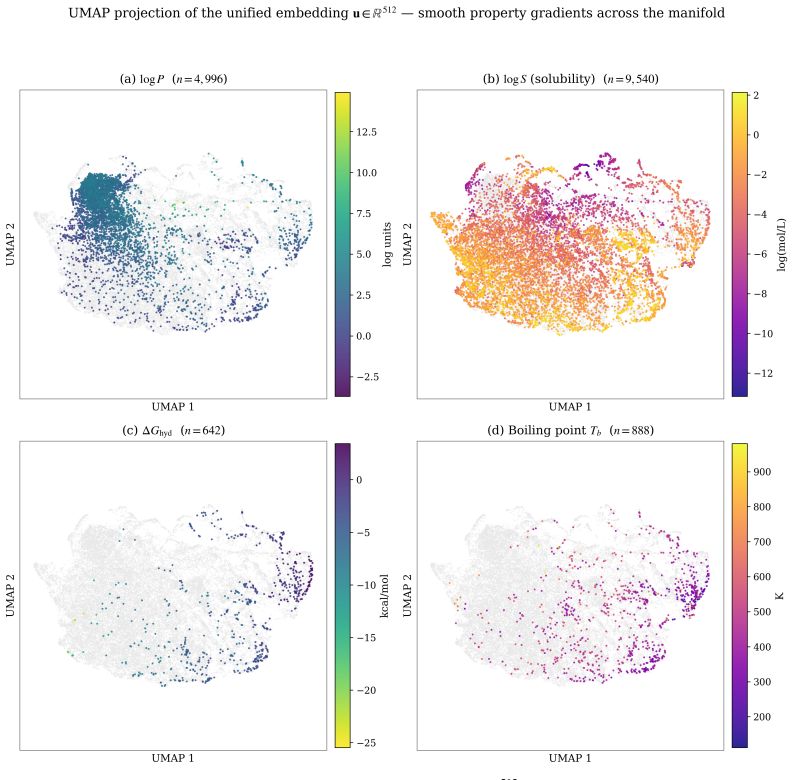
- The 512-dimensional fused embedding, shown to organise molecules by thermophysical similarity, is a plausible off-the-shelf feature representation for properties outside the nine; the paper does not test this, but it would be a direct way to reuse the model without retraining.
Editorial analysis
A structured set of objections, weighed in public.
Referee Report
Summary. The paper presents MultiPUFFIN, a multimodal foundation model that fuses SMILES strings, 2D molecular graphs, and 3D conformer geometries with auxiliary encoders for experimental conditions and molecular descriptors. The backbone is pretrained on 500,000 unlabeled PubChem molecules with three self-supervised objectives, then trained on 37,968 molecules for nine thermophysical properties. Domain-informed output heads (Antoine, Andrade, van 't Hoff, Born, Shomate, group contribution) are organized into a per-property four-head tournament, with condition-aware refinement modules and two cross-property coupling losses. On a scaffold-split test set, the paper reports an in-scope mean R² of 0.784 and claims to outperform fine-tuned ChemBERTa-2 on all nine properties despite using roughly 2,000× fewer labeled molecules. Systematic ablations examine architectural components, head choices, and equation-level alternatives, and the paper is unusually candid about limitations, including single-seed evaluation, descriptor leakage, and deployment-frequency caveats.
Significance. If the central claims hold, the work would be significant: a single physically constrained multimodal model that achieves strong accuracy across nine diverse thermophysical properties with orders-of magnitude less labeled data than a large SMILES-pretrained baseline, while providing thermodynamic consistency by construction. The manuscript's strengths include its systematic ablation studies (Section 3.5), the explicit documentation of negative results (Sections 2.12 and 3.10), the multi-source curated dataset, and the transparent treatment of known asymmetries. However, the headline in-scope R² depends on applicability-domain filters whose pre-registration is asserted but not externally verifiable, the logP result is acknowledged to benefit from descriptor leakage, and the single-seed/single-split evaluation leaves key comparative margins without uncertainty quantification. The central claim is plausible but not yet fully supported.
major comments (4)
- [§2.14, Table 3, Stage 4] The headline in-scope mean R²=0.784 is computed only after applying per-property G+ applicability-domain filters, and the filters are asserted to be 'pre-registered, frozen before the test set is ever scored' without any external registry, timestamped artifact, or code. Table 3 discloses per-class test counts, but this transparency cannot rule out that the filter definitions were influenced by test composition. Because the central claim is the joint accuracy-plus-scope statement, this is load-bearing. Please provide an externally verifiable registration (e.g., timestamped hash of the filter code) or, at minimum, report full-test metrics on all 8,877 molecules, per-class metrics, and a sensitivity analysis across filter strictness. If the full-test mean is close to 0.784 and the per-class results are consistent, the deployment claim is credible; if the gap is large, the headline is select
- [§2.8, §3.5.1, §3.9, Table 13] Descriptor 9 in the 13-dimensional descriptor vector is explicitly stated to be the Wildman–Crippen MolLogP estimate, i.e., a precomputed approximation of the logP target. Section 2.8 calls this 'a mild form of information leakage for the logP head' and instructs downstream users to account for the asymmetry when comparing against baselines without Crippen descriptors. However, Section 3.9 and Table 13 report the logP win (R² 0.821 vs 0.687) as one of the nine wins with no such adjustment, and no ablation with MolLogP masked is reported. The concern is reinforced by Table 8, where GCN-Only achieves better logP RMSE (0.714) than full MultiPUFFIN (0.906), suggesting the descriptor input dominates the logP result. Please either remove MolLogP from the descriptor vector, or add a MolLogP-masked ablation and re-state the headline as 'eight of nine' or 'all nine except logP' if the win does no
- [§3.10, Tables 7 and 13] All results come from a single random seed and a single scaffold split, and the main tables contain no confidence intervals or error bars. The paper itself acknowledges in Section 3.10 that the bootstrap R² uncertainty for the smallest test sets (HFE n=269, viscosity n=331, heat capacity n=297) is ±0.03–0.05 at the 95% level, and that several equation-level ablation deltas (e.g., Table 11: Wagner vs. Antoine, ΔR²≈+0.004) fall inside this band. The largest ChemBERTa-2 margins are likely robust, but the 'all nine properties' claim mixes properties with very different test sizes and uncertainty levels. Please add multi-seed results (at least 3 seeds) or bootstrap confidence intervals for the headline in-scope mean and the Table 13 comparison, and explicitly separate in-scope metrics (Table 7) from full-test metrics (Table 13) in all summary statements.
- [§3.9, Table 13] For vapor pressure and viscosity, the comparison against ChemBERTa-2 is asymmetric by design: MultiPUFFIN receives temperature as an explicit input, while a SMILES-only baseline cannot distinguish measurements at different temperatures. The paper states this limitation clearly, yet still counts these two properties in the 'wins all nine' headline and in the conclusion's 'beats nine separately fine-tuned baselines on all nine targets.' For the label-efficiency conclusion, the fair head-to-head is the six temperature-independent properties (mean R² 0.769 vs 0.658) plus heat capacity; the temperature-conditioned wins should be framed as a capability of the domain-informed architecture rather than as part of the same 'outperforms on all nine' claim. Please adjust the headline claims accordingly.
minor comments (5)
- [§2.2, Eq. (1)] The InfoNCE loss has a missing citation marker '[?]' in the displayed equation and surrounding text. Please add the proper reference.
- [§2.1 and Table 7/Figure 3] Hydration free energy units are written as 'k/mol' (e.g., 'measurements in k/mol at 298.15 K' and in Table 7). This should be 'kcal/mol' throughout.
- [§3.9, Table 13] The text states that MultiPUFFIN achieves R²=0.921 for heat capacity, but Table 13 reports R²=0.940 for heat capacity. Please reconcile the two values.
- [§3.10] The 'Unweighted mean R²' caveat is important, but the abstract and conclusion still report the unweighted mean 0.784 without an accompanying distribution or weighted variant. Consider reporting both unweighted and weighted means, or at least the per-property n values next to the headline.
- [Code and data availability] The paper states that code, weights, and data 'will be made publicly available upon publication.' For a paper whose central claims rest on pre-registered filters and reproducibility, the artifact should be available at submission or at least under a timestamped repository DOI; promising future availability is not sufficient to verify the pre-registration claim.
Circularity Check
The 'all nine' claim is partially circular: the logP head receives a precomputed logP estimator as input, and the reported logP win over ChemBERTa-2 is counted without the asymmetry adjustment the paper itself prescribes.
specific steps
-
fitted input called prediction
[Section 2.8 (Auxiliary input encoders); Section 3.9 / Table 13]
"One potential concern is that the inclusion of the Wildman–Crippen logP estimate (MolLogP, descriptor 9) in the descriptor vector may advantage the logP prediction task by providing a pre-computed approximation of the target value directly as input. This constitutes a mild form of information leakage for the logP head: the model can learn to use the Crippen estimate as a prior and then correct the residual from the structural representations. The effect is intentional; the descriptor encoder is designed to provide the model with the same coarse physicochemical priors that an experienced chemis"
The logP prediction is made from a descriptor vector containing MolLogP, a precomputed estimate of exactly the logP target; the paper calls this 'information leakage' and tells readers to adjust comparisons against baselines lacking Crippen descriptors. Table 13 nevertheless reports the logP R² win (0.821 vs 0.687) as one of the nine wins with no adjustment. The head-to-head margin is thus partly carried by the input estimator rather than by the multimodal/domain-informed architecture, so the 'all nine properties' claim is not established for logP.
full rationale
The main body of the derivation is self-contained: SSL pretraining on a disjoint PubChem corpus, hybrid scaffold/property-balanced splitting, the multimodal fusion, the four-head tournament, and the cross-property couplings are all evaluated with internal ablations (architectural, head, and equation-level) rather than by appeal to prior work. The PUFFIN/ExPUFFIN self-citations are architectural heritage, not load-bearing proof; the paper's own All-DirectHeads and Swapped-Equation ablations independently demonstrate the value of the domain-informed heads. The temperature-conditioning advantage over ChemBERTa-2 is openly acknowledged and is a real architectural capability, not a hidden fit. The one genuinely circular element is the logP task: the descriptor encoder injects a precomputed Wildman–Crippen logP value directly into the representation, the paper explicitly labels this 'information leakage' and demands an asymmetry correction, but the ChemBERTa-2 head-to-head table counts the logP win without applying that correction. That makes the 'wins all nine' headline partially constructed from the input feature. Separately, the G+ applicability-domain construction is a validity concern rather than a circular-derivation one: Table 3 reports test counts per excluded class while Section 2.14 claims the filters were frozen before test scoring; this is a selection-bias risk that should be weighed in deployment claims, but it is not an equation-level reduction. On balance the central architectural derivation is independent, but one of the nine claimed wins is confounded by construction, so a partial circularity score of 6 is appropriate.
Axiom & Free-Parameter Ledger
free parameters (8)
- Contrastive temperature τ =
0.07
- Coupling weights λ_FP, λ_BP =
1e-2, 5e-2
- Flash-point target partial pressure P*_FP =
3000 Pa
- G+ applicability-domain thresholds =
heavy-atom cutoffs >50 and ≤4; per-class exclusions
- Per-property tournament head selection =
e.g., Wagner for VP, Born for HFE, DirectHead for logP/Tm/Tf
- Uncertainty task weights s_p =
learned, values not reported
- Stage-3 learning rates α_A and α_B/C/D =
1e-6 and 5e-6
- Temperature-smoothness weight λ_smooth =
0 (disabled)
axioms (6)
- domain assumption The assigned physics equations (Antoine, Andrade, van 't Hoff, Born, Shomate, group additivity) are appropriate functional forms for their properties.
- domain assumption A single MMFF94-optimized ETKDGv3 conformer adequately represents the 3D ensemble when combined with the geometry gate.
- domain assumption Labels from eleven merged public sources are accurate and comparable enough for multi-task training.
- domain assumption The hybrid scaffold + coverage-balanced split produces a test set that measures structural generalization.
- ad hoc to paper The G+ filters were fixed before any test prediction was computed.
- domain assumption The Crippen MolLogP descriptor is a legitimate auxiliary input for the logP prediction head.
read the original abstract
MultiPUFFIN is a domain-informed multimodal foundation model for predicting thermophysical properties of small molecules, addressing a critical gap in chemical engineering, drug discovery, and materials science. Existing molecular foundation models pretrain on millions of molecules to learn general-purpose representations, but their standard MLP output layers impose no physical constraints, vapor pressure predictions may violate monotonic temperature dependence, and viscosity curves may lack the functional form required by process simulators. Domain-informed approaches that guarantee thermodynamic consistency have remained limited to single properties and small datasets, whereas multimodal foundation models have focused on biological activity rather than thermophysical properties. MultiPUFFIN fills this gap by fusing SMILES sequences, 2D molecular graphs, and 3D conformer geometries through bidirectional cross-modal attention and gated fusion, supplemented by auxiliary encoders for experimental conditions and molecular descriptors. The backbone is pretrained on 500,000 unlabelled PubChem molecules using three complementary self-supervised objectives. A condition-aware refinement stack of five conditioners (temperature, pH, pressure, polymorph, and measurement method) routes each property to a four-head tournament that selects the best-performing thermodynamically informed head for that property. MultiPUFFIN achieves a mean test R2 of 0.784 and outperforms fine-tuned ChemBERTa-2 on all nine properties despite training on roughly 2,000x fewer labeled molecules.
Figures




Reference graph
Works this paper leans on
-
[1]
C. Pang, H. H. Tong, L. Wei, Advanced deep learning methods for molecular property prediction, Quantitative Biology 11 (4) (2023) 395–404
2023
-
[2]
G. W. Thomson, The antoine equation for vapor-pressure data, Chemical Reviews 38 (1) (1946) 1–39
1946
-
[3]
E. N. d. C. Andrade, The viscosity of liquids, Nature 125 (1930) 309–310
1930
-
[4]
Nannoolal, J
Y . Nannoolal, J. Rarey, D. Ramjugernath, Estimation of pure component properties: Part 3. estimation of the vapor pressure of non-electrolyte organic compounds via group contributions and group interactions, Fluid Phase Equilibria 269 (1-2) (2008) 117–133
2008
-
[5]
M. Das, A. Ghosh, R. B. Sunoj, Advances in machine learning with chemical language models in molecular property and reaction outcome predictions, Journal of Computational Chemistry 45 (14) (2024) 1160–1176. 45
2024
-
[6]
K. T. Schütt, H. E. Sauceda, P.-J. Kindermans, A. Tkatchenko, K.-R. Müller, SchNet–a deep learning architecture for molecules and materials, The Journal of Chemical Physics 148 (24) (2018)
2018
-
[7]
Gasteiger, J
J. Gasteiger, J. Groß, S. Günnemann, Directional message passing for molecular graphs, International Confer- ence on Learning Representations (2020)
2020
-
[8]
F. H. Vermeire, W. H. Green, Transfer learning for solvation free energies: from quantum chemistry to experi- ments, Chemical Engineering Journal 418 (2021) 129307
2021
-
[9]
A. M. Schweidtmann, J. G. Rittig, A. König, M. Grohe, A. Mitsos, M. Dahmen, Graph neural networks for prediction of fuel ignition quality, Energy & Fuels 34 (9) (2020) 11395–11407
2020
-
[10]
J. G. Rittig, K. C. Felton, A. A. Lapkin, A. Mitsos, Gibbs–Duhem-informed neural networks for binary activity coefficient prediction, Digital Discovery 2 (2023) 1752–1767
2023
-
[11]
V . V . Santana, C. M. Rebello, L. P. Queiroz, A. M. Ribeiro, N. Shardt, I. B. R. Nogueira, PUFFIN: A path- unifying feed-forward interfaced network for vapor pressure prediction, Chemical Engineering Science 286 (2024) 119623
2024
-
[12]
C. M. Rebello, U. Di Caprio, J. Steen-Hansen, B. Rodrigues, E. A. Costa, A. R. dos Santos, F. Esposito, M. E. Leblebici, I. B. R. Nogueira, ExPUFFIN: Thermodynamic consistent viscosity prediction in an extended path- unifying feed-forward interfaced network, arXiv preprint arXiv:2512.06927 (2025)
arXiv 2025
-
[13]
J. Choi, Y . Nam, Y .-S. Choi, Y . Jung, A perspective on foundation models in chemistry, JACS Au 5 (4) (2025). doi:10.1021/jacsau.4c01160
-
[14]
I. Batatia, et al., Foundation models for atomistic simulation of chemistry and materials, Nature Reviews Chem- istry (2025).doi:10.1038/s41570-025-00793-5
-
[15]
S. Wang, Y . Guo, Y . Wang, H. Sun, J. Huang, SMILES-BERT: Large scale unsupervised pre-training for molec- ular property prediction, ACM International Conference on Bioinformatics, Computational Biology and Health Informatics (2019) 429–436
2019
-
[16]
W. Ahmad, E. Simon, S. Chithrananda, G. Grand, B. Ramsundar, ChemBERTa-2: Towards chemical foundation models, arXiv preprint arXiv:2209.01712 (2022)
Pith/arXiv arXiv 2022
-
[17]
H. Li, D. Zhao, J. Zeng, KPGT: Knowledge-guided pre-training of graph transformer for molecular property prediction, in: Proceedings of the 28th ACM SIGKDD Conference on Knowledge Discovery and Data Mining, 2022, pp. 857–867
2022
-
[18]
Y . Wang, J. Wang, Z. Cao, A. B. Farimani, Molecular contrastive learning of representations via graph neural networks, Nature Machine Intelligence 4 (2022) 279–287
2022
-
[19]
Méndez-Lucio, et al., MolE: A foundation model for molecular graphs using disentangled attention, Nature Communications 15 (2024) 9431
O. Méndez-Lucio, et al., MolE: A foundation model for molecular graphs using disentangled attention, Nature Communications 15 (2024) 9431
2024
-
[20]
G. Zhou, Z. Gao, Q. Ding, H. Zheng, H. Xu, Z. Wei, L. Zhang, G. Ke, Uni-Mol: A universal 3D molecular representation learning framework, International Conference on Learning Representations (2023)
2023
-
[21]
Lu, et al., Uni-Mol2: Exploring molecular pretraining model at scale, Advances in Neural Information Pro- cessing Systems 37 (2024)
S. Lu, et al., Uni-Mol2: Exploring molecular pretraining model at scale, Advances in Neural Information Pro- cessing Systems 37 (2024)
2024
-
[22]
Uni-Mol Team, Uni-Mol3: A multi-molecular foundation model for advancing organic reaction modeling, arXiv preprint arXiv:2508.00920 (2025)
Pith/arXiv arXiv 2025
-
[23]
S. Liu, W. Nie, C. Wang, J. Lu, Z. Qiao, L. Liu, J. Tang, C. Xiao, A. Anandkumar, Multi-modal molecule structure–text model for text-based retrieval and editing, Nature Machine Intelligence 5 (2023) 1447–1457. 46
2023
-
[24]
B. Su, D. Du, Z. Yang, Y . Zhou, J. Li, A. Rao, H. Sun, Z. Lu, J.-R. Wen, A molecular multimodal foundation model associating molecule graphs with natural language, arXiv preprint arXiv:2209.05481 (2022)
Pith/arXiv arXiv 2022
-
[25]
P. Liu, Y . Ren, J. Tao, Z. Ren, GIT-Mol: A multi-modal large language model for molecular science with graph, image, and text, Computers in Biology and Medicine 171 (2024) 108073
2024
-
[26]
Chen, et al., Pretraining graph transformer for molecular representation with fusion of multimodal informa- tion, Information Fusion 115 (2025) 102784
R. Chen, et al., Pretraining graph transformer for molecular representation with fusion of multimodal informa- tion, Information Fusion 115 (2025) 102784
2025
-
[27]
Y . Li, et al., Advancing molecular graph-text pre-training via fine-grained alignment, arXiv preprint arXiv:2409.14106 (2024)
Pith/arXiv arXiv 2024
-
[28]
Li, et al., MolPrompt: Improving multi-modal molecular pre-training with knowledge prompts, Bioinformat- ics 41 (9) (2025)
Y . Li, et al., MolPrompt: Improving multi-modal molecular pre-training with knowledge prompts, Bioinformat- ics 41 (9) (2025)
2025
-
[29]
Weininger, SMILES, a chemical language and information system
D. Weininger, SMILES, a chemical language and information system. 1. introduction to methodology and en- coding rules, Journal of Chemical Information and Computer Sciences 28 (1) (1988) 31–36
1988
-
[30]
Baltrušaitis, C
T. Baltrušaitis, C. Ahuja, L.-P. Morency, Multimodal machine learning: A survey and taxonomy, IEEE Transac- tions on Pattern Analysis and Machine Intelligence 41 (2) (2019) 423–443
2019
-
[31]
Li, et al., MoleculeFormer is a GCN-transformer architecture for molecular property prediction, Communica- tions Biology 8 (2025) 1668
J. Li, et al., MoleculeFormer is a GCN-transformer architecture for molecular property prediction, Communica- tions Biology 8 (2025) 1668
2025
-
[32]
M. C. Sorkun, A. Khetan, S. Er, AqSolDB, a curated reference set of aqueous solubility and 2D descriptors for a diverse set of compounds, Scientific Data 6 (2019) 143
2019
-
[33]
Z. Wu, B. Ramsundar, E. N. Feinberg, J. Gomes, C. Geniesse, A. S. Pappu, K. Leswing, V . Pande, MoleculeNet: A benchmark for molecular machine learning, Chemical Science 9 (2) (2018) 513–530
2018
-
[34]
Gaulton, A
A. Gaulton, A. Hersey, M. Nowotka, A. P. Bento, J. Chambers, D. Mendez, P. Mutowo, F. Atkinson, L. J. Bellis, E. Cibrián-Uhalte, et al., The ChEMBL database in 2017, Nucleic Acids Research 45 (D1) (2017) D945–D954
2017
-
[35]
D. L. Mobley, J. P. Guthrie, FreeSolv: A database of experimental and calculated hydration free energies, with input files, Journal of Computer-Aided Molecular Design 28 (7) (2014) 711–720
2014
-
[36]
Mansouri, C
K. Mansouri, C. M. Grulke, R. S. Judson, A. J. Williams, OPERA models for predicting physicochemical prop- erties and environmental fate endpoints, Journal of Cheminformatics 10 (2018) 10
2018
-
[37]
Frenkel, R
M. Frenkel, R. D. Chirico, V . Diky, X. Yan, Q. Dong, C. Muzny, ThermoML: An XML-based approach for storage and exchange of experimental and critically evaluated thermophysical and thermochemical property data. 1. Experimental data, Journal of Chemical & Engineering Data 50 (1) (2005) 42–50
2005
-
[38]
European Chemicals Agency, ECHA REACH registered substances database,https://echa.europa.eu/ information-on-chemicals/registered-substances, accessed: 2024 (2024)
2024
-
[39]
J.-C. Bradley, A. Lang, A. Williams, Open melting point data, Figshare (2014).doi:10.6084/m9.figshare. 1031637
-
[40]
Y . Sun, Z. Yin, L. Yin, Prediction of flash points of organic compounds using quantitative structure-property relationship (QSPR) methods, Journal of Hazardous Materials 371 (2019) 518–524
2019
-
[41]
ABB-ADD consortium, ABB-ADD liquid heat capacity dataset, curated liquid heat capacity data for organic compounds (2023)
2023
-
[42]
A. K. Chew, et al., Advancing material property prediction: using physics-informed machine learning models for viscosity, Journal of Cheminformatics 16 (2024) 31. 47
2024
-
[43]
S. Kim, J. Chen, T. Cheng, A. Gindulyte, J. He, S. He, Q. Li, B. A. Shoemaker, P. A. Thiessen, B. Yu, et al., PubChem 2023 update, Nucleic Acids Research 51 (D1) (2023) D1373–D1380
2023
-
[44]
RDKit community, RDKit: Open-source cheminformatics,https://www.rdkit.org(2024)
2024
-
[45]
Riniker, G
S. Riniker, G. A. Landrum, Better informed distance geometry: using what we know to improve conformation generation, Journal of Chemical Information and Modeling 55 (12) (2015) 2562–2574
2015
-
[46]
T. A. Halgren, Merck molecular force field. I. Basis, form, scope, parameterization, and performance of MMFF94, Journal of Computational Chemistry 17 (5-6) (1996) 490–519
1996
-
[47]
Devlin, M.-W
J. Devlin, M.-W. Chang, K. Lee, K. Toutanova, BERT: Pre-training of deep bidirectional transformers for lan- guage understanding, North American Chapter of the Association for Computational Linguistics (2019) 4171– 4186
2019
-
[48]
T. N. Kipf, M. Welling, Semi-supervised classification with graph convolutional networks, International Confer- ence on Learning Representations (2017)
2017
-
[49]
T. Cai, S. Luo, K. Xu, D. He, T.-Y . Liu, L. Wang, GraphNorm: A principled approach to accelerating graph neural network training, in: International Conference on Machine Learning, 2021, pp. 1204–1215
2021
-
[50]
Ioffe, C
S. Ioffe, C. Szegedy, Batch normalization: Accelerating deep network training by reducing internal covariate shift, International Conference on Machine Learning (2015) 448–456
2015
-
[51]
K. He, X. Zhang, S. Ren, J. Sun, Deep residual learning for image recognition, in: IEEE/CVF Conference on Computer Vision and Pattern Recognition, 2016, pp. 770–778
2016
-
[52]
Vaswani, N
A. Vaswani, N. Shazeer, N. Parmar, J. Uszkoreit, L. Jones, A. N. Gomez, Ł. Kaiser, I. Polosukhin, Attention is all you need, Advances in Neural Information Processing Systems 30 (2017)
2017
-
[53]
D. Hendrycks, K. Gimpel, Gaussian error linear units (GELUs), arXiv preprint arXiv:1606.08415 (2016)
Pith/arXiv arXiv 2016
-
[54]
Xiong, Y
R. Xiong, Y . Yang, D. He, K. Zheng, S. Zheng, C. Xing, H. Zhang, Y . Lan, L. Wang, T.-Y . Liu, On layer normalization in the Transformer architecture, International Conference on Machine Learning (2020) 10524– 10533
2020
-
[55]
Kendall, Y
A. Kendall, Y . Gal, R. Cipolla, Multi-task learning using uncertainty to weigh losses for scene geometry and semantics, IEEE/CVF Conference on Computer Vision and Pattern Recognition (2018) 7482–7491
2018
-
[56]
Loshchilov, F
I. Loshchilov, F. Hutter, Decoupled weight decay regularization, International Conference on Learning Repre- sentations (2019)
2019
-
[57]
Kazakov, J
A. Kazakov, J. W. Magee, R. D. Chirico, E. Paulechka, V . Diky, C. D. Muzny, K. Kroenlein, M. Frenkel, NIST/TRC web thermo tables: An online resource for critically evaluated thermodynamic property data, Journal of Research of the National Institute of Standards and Technology 119 (2014) 136–156
2014
-
[58]
Loshchilov, F
I. Loshchilov, F. Hutter, SGDR: Stochastic gradient descent with warm restarts, International Conference on Learning Representations (2017)
2017
-
[59]
Paszke, et al., PyTorch: An imperative style, high-performance deep learning library, Advances in Neural Information Processing Systems 32 (2019)
A. Paszke, et al., PyTorch: An imperative style, high-performance deep learning library, Advances in Neural Information Processing Systems 32 (2019)
2019
-
[60]
M. Fey, J. E. Lenssen, Fast graph representation learning with PyTorch Geometric, ICLR Workshop on Repre- sentation Learning on Graphs and Manifolds (2019)
2019
-
[61]
Karthikeyan, R
M. Karthikeyan, R. C. Glen, A. Bender, General melting point prediction based on a diverse compound data set and artificial neural networks, Journal of Chemical Information and Modeling 45 (3) (2005) 581–590. 48
2005
-
[62]
M. Crawshaw, Multi-task learning with deep neural networks: A survey, arXiv preprint arXiv:2009.09796 (2020)
Pith/arXiv arXiv 2009
-
[63]
Q. Li, Z. Han, X.-M. Wu, Deeper insights into graph convolutional networks for semi-supervised learning, in: Proceedings of the AAAI Conference on Artificial Intelligence, V ol. 32, 2018, pp. 3538–3545
2018
-
[64]
L. McInnes, J. Healy, J. Melville, UMAP: Uniform manifold approximation and projection for dimension re- duction, arXiv preprint arXiv:1802.03426 (2018)
Pith/arXiv arXiv 2018
-
[65]
J. S. Delaney, ESOL: Estimating aqueous solubility directly from molecular structure, Journal of Chemical Information and Computer Sciences 44 (3) (2004) 1000–1005. 49
2004
discussion (0)
Sign in with ORCID, Apple, or X to comment. Anyone can read and Pith papers without signing in.