REVIEW 4 major objections 6 minor 1 cited by
Noisy quantum circuits can be learned with polynomial samples and classical time, for any noise strength and any depth.
Reviewed by Pith at T0; open to challenge. T0 means a machine referee read the full paper against a public rubric. the ladder, T0–T4 →
T0 review · deepseek-v4-flash
2026-08-02 19:40 UTC pith:4LYCDZ43
load-bearing objection The core theorem overclaims: the path-counting lemma has an exponential-in-depth factor, so the main result is unsupported as stated. the 4 major comments →
Efficient Noisy Quantum State and Process Tomography
The pith
A machine-rendered reading of the paper's core claim, the machinery that carries it, and where it could break.
Core claim
The central claim is Theorem 2: for any process C of the form E^otimesn C_d ... E^otimesn C_1, each C_i a layer of two-qubit gates drawn from a local 2-design, and any observable O = sum_k c_k Q_k with M = poly(n), there is an algorithm that learns a function f from measurement data such that |f(rho_in) - Tr[O C(rho_in)]| <= epsilon with success probability >= 1 - delta, using 6^{O(l')} epsilon^{-2} log(1/delta) samples and O(n N_data) classical work, where l' is logarithmic in the inverse accuracy and the squared Frobenius norm of O. Because l' does not grow with n or with circuit depth, the complexity is poly(n, 1/epsilon). The truncation is shown to work for both unital and non-unital noi
What carries the argument
The machinery is the Pauli path integral: expand rho or C-dagger(O) as a sum over sequences of Pauli strings through each layer, with each non-identity step suppressed by a factor (1-gamma), and each random two-qubit gate suppressing cross terms by 1/15 on average. A truncation argument keeps only terminal Pauli strings of weight at most l'. The number of such strings, N_s = 2^{O(l')}, is derived by a volume argument: the total squared weight of the process is O(1), and each legal path carries variance at least (1/15)^l, so only few paths can survive. Local 2-design averaging supplies the orthogonality between different path contributions that makes the truncation rigorous.
Load-bearing premise
Everything rests on the claim that only 2^{O(l')} low-weight components of the evolved observable carry the signal, with l' depending only on accuracy and noise, not on circuit depth or qubit count; if legal path histories grow with depth, the polynomial guarantee collapses.
What would settle it
Simulate a noiseless random circuit (gamma = 0) with, say, n = 20 qubits and depth d = 100, choose a global Pauli observable, run the learning algorithm at epsilon = 0.1, and count the number of Pauli coefficients above 1/poly(n). If that count grows with d beyond 2^{O(l')}, or if the prediction error on a fresh entangled input exceeds epsilon, the depth-independence claim is refuted.
If this is right
- A 14-qubit noisy state example compresses from an 8 GB dense matrix to about 1 KB of sparse coefficients, making large-scale verification practical.
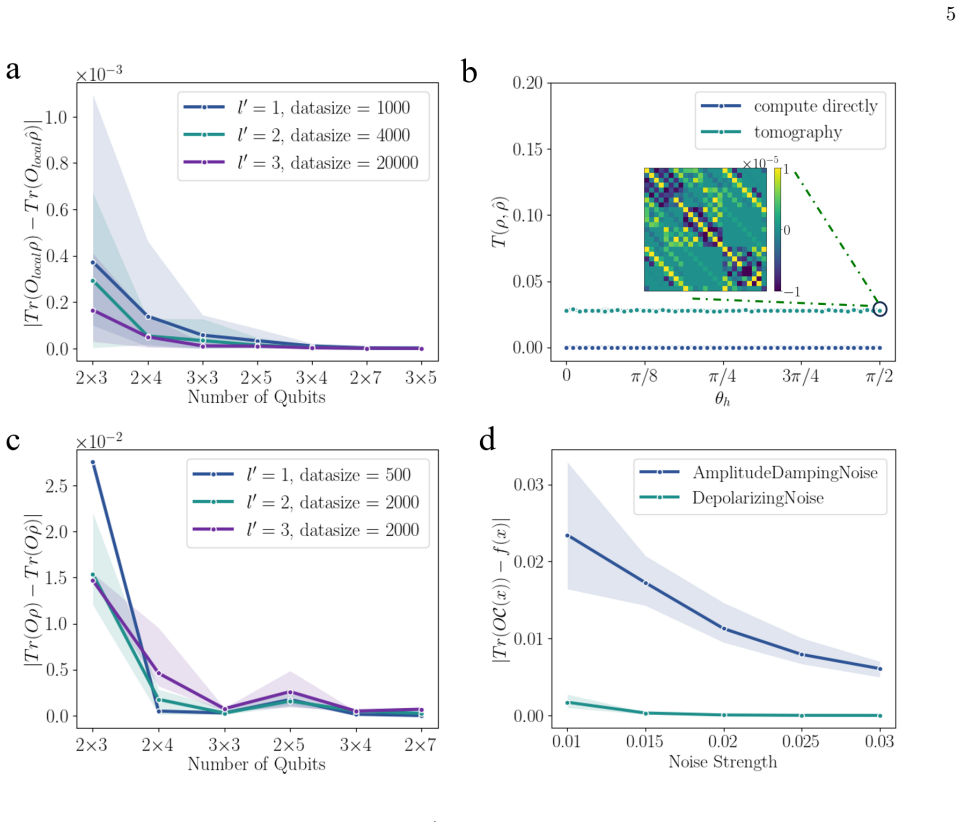
- The learned process model supports input-agnostic zero-noise extrapolation, recovering noise-free expectation values with reported errors near 0.02-0.04 in a 2D Ising simulation.
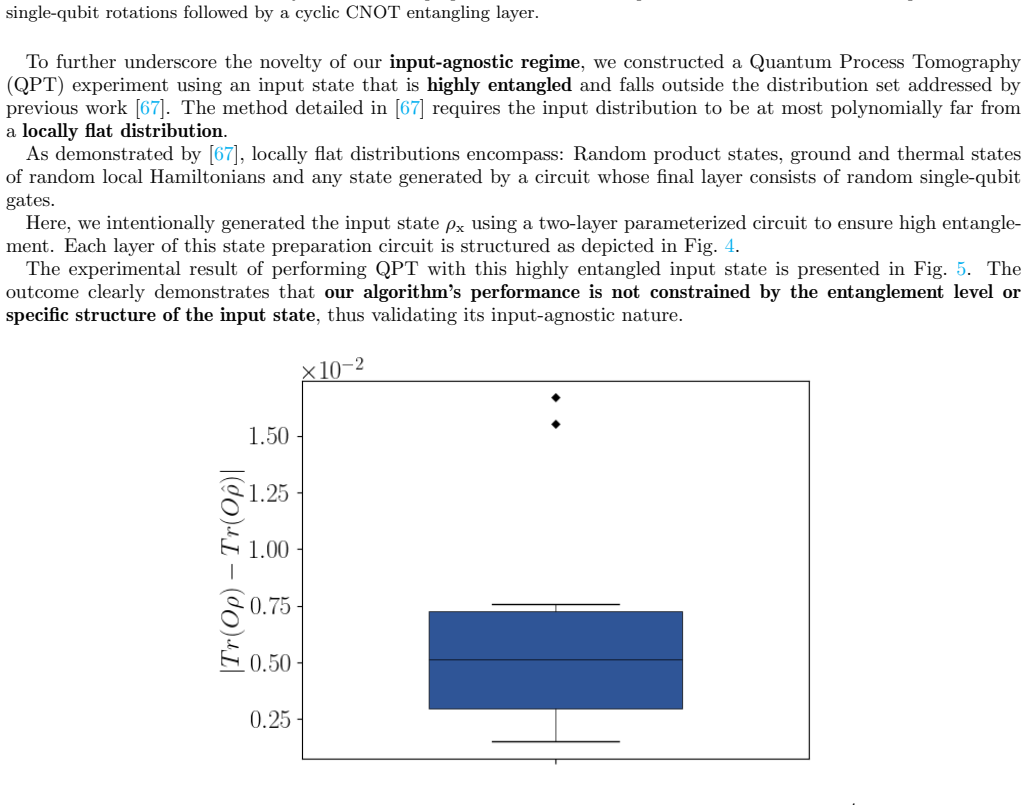
- Prediction works for arbitrary inputs, including highly entangled states, unlike methods that assume locally flat or product input distributions.
- The framework covers non-unital noise such as amplitude damping, not just depolarizing or Pauli noise.
- Sample complexity decreases smoothly with noise strength, so learning is easier for noisier circuits, with no sharp computational transition at gamma = 0.
Where Pith is reading between the lines
- The depth-independence claim leans on identifying legal path histories with distinct low-weight terminal operators; the paper's own bound gives N_s = O(1) 15^l with l = d + l'. If that identification fails, the sample complexity becomes 2^{O(d+l')}, i.e., exponential in depth.
- In the noiseless limit gamma = 0 with d = poly(n), the claim implies learning arbitrary-depth random circuits from poly(n,1/epsilon) samples, which sits uneasily with known exponential sample complexity for learning Haar-random states; a direct test on deep noiseless circuits would clarify which premise resolves the tension.
- A practical extension would measure the number of non-negligible Pauli coefficients as a function of circuit depth for fixed accuracy; growth with d would force the truncation threshold to depend on depth.
- Gate-dependent noise is explicitly left open; extending the contraction argument to non-i.i.d. noise would require a different mechanism to control path growth.
Editorial analysis
A structured set of objections, weighed in public.
Referee Report
Summary. The paper proposes average-case algorithms for quantum state tomography and quantum process tomography of noisy n-qubit circuits with i.i.d. single-qubit noise. The methods represent the noisy state or the Heisenberg-evolved observable through a Pauli-path integral, argue that only low-weight terminal Pauli operators contribute significantly, and estimate the corresponding coefficients from data generated by random single-qubit stabilizer product states. The main theorems (Theorems 1-4) claim sample and classical post-processing complexity polynomial in n and 1/epsilon for any noise strength gamma in [0,1), including the noiseless limit gamma=0, with no restriction on circuit depth. Numerical experiments on a 2D transverse-field Ising Trotter circuit and a quantum error mitigation application are also reported.
Significance. If the claimed results were correct, this would be a substantial advance: an input-agnostic QPT protocol that avoids the distributional assumptions of previous work, handles non-unital noise, and avoids the exponential classical post-processing of some existing methods. The Pauli-path framework is natural, the circuit model is clearly described, and the numerical benchmarks are a useful addition. However, the central theoretical engine, especially the bound on the number of legal Pauli paths and the truncation error analysis, contains a double-counting error that invalidates the claimed depth independence. The paper's main guarantees are therefore not established as written. The abstract and the formal theorems also disagree on whether the complexity is polynomial or quasi-polynomial, further undermining the central claim.
major comments (4)
- [Appendix E5, Lemma 7 (Eqs. E42-E44)] Lemma 7 claims N_s = 2^O(l'). The proof derives N_s = O(1) * 15^l and then substitutes l = d + l'. This gives 15^(d+l') = 2^O(d+l'), and no step in the proof removes the 15^d factor. If instead N_s is interpreted as the number of distinct terminal Pauli operators of weight at most l', its size is sum_{k<=l'} 3^k C(n,k) = n^O(l'), which is not 2^O(l') when l' grows with log n (the case for epsilon = 1/poly(n)). Since N_s enters the sample complexity in Theorem 4 and the runtime in Theorem 2, the claimed poly(n,1/epsilon) scaling independent of depth is not established. The noiseless deep-circuit limit is exactly the regime where this bound is essential: for gamma=0 and large depth the output state is nearly Haar random, and a low-weight Pauli truncation cannot be epsilon-accurate with polynomially many samples.
- [Appendix E2, Lemma 5 (Eqs. E18-E19)] The proof bounds each Pauli path by alpha^2_{s_d} (1/15)^{k/4} and then replaces the sum over all paths of total weight k > l with a sum over terminal Pauli operators |s_d| > l'. This omits the multiplicity of internal Pauli histories that share the same terminal operator. The truncation error must include the number of such histories; without it, the geometric-series bound in Eq. (E19) is unjustified. The same issue appears in the non-unital case (Lemma 6), where the claimed factorization counts only terminal weights and does not account for the number of paths ending at a given operator.
- [Appendix D2, Eq. (D8) and Lemma 2] The text asserts an equality between a truncation by terminal weight (|s_d| <= l') and a truncation by total Pauli-path weight (|s| <= l). These two sums are not equal: a Pauli path can have small terminal weight but large internal weight, so the approximation rho_hat in Eq. (D8) is not justified. Consequently, the l' scaling in Lemma 2 does not follow from the bound on total weight l. This also explains why Theorem 1 is stated without any circuit-depth dependence, which seems incompatible with the noiseless deep-circuit regime where the Pauli spectrum is spread over exponentially many high-weight operators.
- [Abstract and Theorem 2] The abstract states that the arbitrary-noise guarantee leads to quasi-polynomial complexity, while Theorem 2 claims poly(n,1/epsilon) for any noise strength. Section IV first quotes O(n^{log n}) for epsilon = 1/n and then says the bound can be tightened to 2^O(l'). These statements are mutually inconsistent. As written, the formal theorem overclaims even relative to the derived bounds, and the reader cannot tell which complexity statement is intended to be the main result.
minor comments (6)
- [Section III, Eq. (2)] The formula for l' contains apparent parenthesis inconsistencies. It should be checked whether the intended expression is log(2/(1-gamma)^2) in the denominator.
- [Throughout] The notation l vs l' is used inconsistently between the main text and appendices. For example, Algorithm 1 sets l' = [log(1/epsilon)] while Theorem 4 defines l' through a different formula. This makes it difficult to track which truncation threshold is being used.
- [Section V and Figure 2] The numerical section reports shaded areas over 10 trials but does not specify how many random circuit instances were used for the average-case theoretical claim. Please clarify the experimental protocol.
- [Appendix A, Tables II and III] The tables compare against prior work but do not state the circuit-depth dependence of the current method. Given that the formal theorem claims depth independence, the tables should list whether the complexity depends on d.
- [Theorem 1] The sample complexity expression O((1/epsilon)^{1/log[2/(1-gamma)]}) should specify the base of the logarithm and the behavior of the exponent as gamma approaches 1, since the formula is ambiguous.
- [Appendix F] The worst-case lower bound is not contradictory to the average-case claim, but the relationship between Theorem 5 and the new average-case results should be stated more precisely. Currently the appendix reads as a standalone hardness result without connecting it to the main theorems.
Circularity Check
No circularity found; the arbitrary-depth efficiency claim is mathematically unsupported, but not circular.
full rationale
I walked the derivation chain from the Pauli-path expansion (Appendix D/E) through the truncation lemmas (Lemmas 2, 4-6), the sample-complexity claim (Theorem 4), and the legal-path count (Lemma 7, Appendix E5). The decay estimates use standard local 2-design orthogonality facts and noise contraction properties; no Theorem's conclusion is used as an assumption to set l', epsilon, delta, or the sample size. The self-cited works (Refs. 53, 54) appear only in contextual comparisons and are not load-bearing for the main theorems. The real problem is a mathematical gap in Lemma 7: the proof derives N_s = O(1)*15^l = 2^{O(l)} and then writes 2^{O(l)} = 2^{O(l')} after setting l' = l - d, which is not a valid equality unless d = O(1). This makes the claimed depth-independent poly(n,1/epsilon) complexity unsupported, but it is an algebraic/combinatorial error, not a circular reduction: the conclusion is not equivalent to an input, a fitted value, or a self-citation. Under the hard rules, a missing factor or an invalid simplification is a correctness risk, not evidence of circularity. Therefore no circular step is identified and the circularity score is 0.
Axiom & Free-Parameter Ledger
axioms (3)
- domain assumption Each two-qubit gate in every layer is sampled uniformly from a local 2-design (Haar SU(4) in Definition 3).
- domain assumption The noise is i.i.d. single-qubit with uniform strength γ, applied identically after every layer, gate-independent.
- domain assumption For non-unital noise, the channel admits the decomposition E = E_depo^γ ∘ E' where E'† is Frobenius-contractive and support-non-expanding, and the leakage ν = |b_I|^2 is O(γ^2) for physical noise such as amplitude damping.
read the original abstract
Efficiently characterizing large quantum states and processes is a central yet notoriously challenging task in quantum information science, as conventional tomography methods typically require resources that grow exponentially with system size. Here, we introduce a structure-agnostic learning framework for noisy $n$-qubit quantum circuits under~i.i.d.~single-qubit noise. We first prove that quantum states with unital noise channels admit an efficient learnable representation in the logarithmic-depth regime. We then extend this framework to quantum process tomography under constant noise, deriving a unified protocol that applies to both unital and non-unital noisy channels and retains efficient guarantees for logarithmic-depth circuits. This process-learning formulation is input-agnostic and imposes no distributional assumptions on the input quantum states. We further study a more general regime with arbitrary noise strength. In this setting, low-weight Pauli propagation induces a terminal truncation whose threshold depends logarithmically on the inverse accuracy, leading to quasi-polynomial complexity and near-unit success probability in the average case. In contrast to the preceding two results, this arbitrary-noise guarantee does not impose any restriction on the circuit depth, and therefore covers arbitrary-depth circuits, including both the noiseless limit ($\gamma = 0$) and the strong-decoherence regime ($\gamma = \Theta(1)$). Numerical simulations of two-dimensional Hamiltonian dynamics further demonstrate the accuracy and robustness of the approach, including for structured circuits beyond the random-circuit setting assumed in the theoretical analysis. These results provide a scalable and practically relevant route toward characterizing large-scale noisy quantum devices, addressing a key bottleneck in the development of quantum technologies.
Figures




Forward citations
Cited by 1 Pith paper
-
SSP-QST: Spectral Subspace Purification for Photonic Quantum State Tomography
SSP-QST truncates eigenvalues of a least-squares tomography estimate below a Weyl-motivated noise floor, yielding rank-adaptive purification that beats the tested non-iterative baselines in Qiskit Aer simulations of l...
Reference graph
Works this paper leans on
-
[1]
Quantum supremacy using a programmable superconducting processor
Frank Arute, Kunal Arya, Ryan Babbush, Dave Bacon, Joseph C Bardin, Rami Barends, Rupak Biswas, Sergio Boixo, Fernando GSL Brandao, David A Buell, et al. Quantum supremacy using a programmable superconducting processor. Nature, 574(7779):505–510, 2019
2019
-
[2]
Phase transitions in random circuit sampling.Nature, 634(8033):328–333, 2024
Alexis Morvan, B Villalonga, X Mi, S Mandra, A Bengtsson, PV Klimov, Z Chen, S Hong, C Erickson, IK Drozdov, et al. Phase transitions in random circuit sampling.Nature, 634(8033):328–333, 2024
2024
-
[3]
Quantum computational advantage using photons.Science, 370(6523):1460–1463, 2020
Han-Sen Zhong, Hui Wang, Yu-Hao Deng, Ming-Cheng Chen, Li-Chao Peng, Yi-Han Luo, Jian Qin, Dian Wu, Xing Ding, Yi Hu, et al. Quantum computational advantage using photons.Science, 370(6523):1460–1463, 2020
2020
-
[4]
Many-body localization in a quantum simulator with programmable random disorder.Nature Physics, 12(10):907–911, 2016
Jacob Smith, Aaron Lee, Philip Richerme, Brian Neyenhuis, Paul W Hess, Philipp Hauke, Markus Heyl, David A Huse, and Christopher Monroe. Many-body localization in a quantum simulator with programmable random disorder.Nature Physics, 12(10):907–911, 2016
2016
-
[5]
High-fidelity parallel entangling gates on a neutral-atom quantum computer.Nature, 622(7982):268–272, 2023
Simon J Evered, Dolev Bluvstein, Marcin Kalinowski, Sepehr Ebadi, Tom Manovitz, Hengyun Zhou, Sophie H Li, Alexan- dra A Geim, Tout T Wang, Nishad Maskara, et al. High-fidelity parallel entangling gates on a neutral-atom quantum computer.Nature, 622(7982):268–272, 2023
2023
-
[6]
Quantum error correction below the surface code threshold
Rajeev Acharya, Laleh Aghababaie-Beni, Igor Aleiner, Trond I Andersen, Markus Ansmann, Frank Arute, Kunal Arya, Abraham Asfaw, Nikita Astrakhantsev, Juan Atalaya, et al. Quantum error correction below the surface code threshold. arXiv preprint arXiv:2408.13687, 2024
Pith/arXiv arXiv 2024
-
[7]
High-threshold and low-overhead fault-tolerant quantum memory.Nature, 627(8005):778–782, 2024
Sergey Bravyi, Andrew W Cross, Jay M Gambetta, Dmitri Maslov, Patrick Rall, and Theodore J Yoder. High-threshold and low-overhead fault-tolerant quantum memory.Nature, 627(8005):778–782, 2024
2024
-
[8]
Wood, Theodore J
Youngseok Kim, Christopher J. Wood, Theodore J. Yoder, Seth T. Merkel, Jay M. Gambetta, Kristan Temme, and Abhinav Kandala. Scalable error mitigation for noisy quantum circuits produces competitive expectation values.Nature Physics, 19(5):752–759, 2023
2023
-
[9]
Purification-based quantum error mitigation of pair- correlated electron simulations.Nature Physics, 19(12):1787–1792, 2023
Thomas E O’Brien, G Anselmetti, Fotios Gkritsis, VE Elfving, Stefano Polla, William J Huggins, Oumarou Oumarou, Kostyantyn Kechedzhi, Dmitry Abanin, Rajeev Acharya, et al. Purification-based quantum error mitigation of pair- correlated electron simulations.Nature Physics, 19(12):1787–1792, 2023
2023
-
[10]
Evidence for the utility of quantum computing before fault tolerance.Nature, 618(7965):500–505, June 2023
Youngseok Kim, Andrew Eddins, Sajant Anand, Ken Xuan Wei, Ewout Van Den Berg, Sami Rosenblatt, Hasan Nayfeh, Yantao Wu, Michael Zaletel, Kristan Temme, and Abhinav Kandala. Evidence for the utility of quantum computing before fault tolerance.Nature, 618(7965):500–505, June 2023
2023
-
[11]
Focus on quantum tomography.New Journal of Physics, 15(12):125020, December 2013
K Banaszek, M Cramer, and D Gross. Focus on quantum tomography.New Journal of Physics, 15(12):125020, December 2013
2013
-
[12]
Optimal, reliable estimation of quantum states.New Journal of Physics, 12(4):043034, April 2010
Robin Blume-Kohout. Optimal, reliable estimation of quantum states.New Journal of Physics, 12(4):043034, April 2010
2010
-
[13]
Quantum certification and benchmarking.Nature Reviews Physics, 2(7):382–390, June 2020
Jens Eisert, Dominik Hangleiter, Nathan Walk, Ingo Roth, Damian Markham, Rhea Parekh, Ulysse Chabaud, and Elham Kashefi. Quantum certification and benchmarking.Nature Reviews Physics, 2(7):382–390, June 2020
2020
-
[14]
Flammia, Stephen Becker, and Jens Eisert
David Gross, Yi-Kai Liu, Steven T. Flammia, Stephen Becker, and Jens Eisert. Quantum state tomography via compressed sensing.Physical Review Letters, 105(15):150401, October 2010
2010
-
[15]
Z. Hradil. Quantum-state estimation.Physical Review A, 55(3):R1561–R1564, March 1997
1997
-
[16]
Mauro D’Ariano, Matteo G.A
G. Mauro D’Ariano, Matteo G.A. Paris, and Massimiliano F. Sacchi. Quantum tomography. InAdvances in Imaging and Electron Physics, volume 128, pages 205–308. Elsevier, 2003
2003
-
[17]
Chuang and M
Isaac L. Chuang and M. A. Nielsen. Prescription for experimental determination of the dynamics of a quantum black box. Journal of Modern Optics, 44(11-12):2455–2467, November 1997
1997
-
[18]
G. M. D’Ariano and P. Lo Presti. Quantum tomography for measuring experimentally the matrix elements of an arbitrary quantum operation.Physical Review Letters, 86(19):4195–4198, May 2001
2001
-
[19]
Mohseni, A
M. Mohseni, A. T. Rezakhani, and D. A. Lidar. Quantum-process tomography: Resource analysis of different strategies. Physical Review A, 77(3):032322, March 2008
2008
-
[20]
Tight bounds for quantum state certification with incoherent measure- ments
Sitan Chen, Jerry Li, Brice Huang, and Allen Liu. Tight bounds for quantum state certification with incoherent measure- ments. In2022 IEEE 63rd Annual Symposium on Foundations of Computer Science (FOCS), pages 1205–1213, Denver, CO, USA, October 2022. IEEE
2022
-
[21]
Query-optimal estimation of unitary channels in diamond distance
Jeongwan Haah, Robin Kothari, Ryan O’Donnell, and Ewin Tang. Query-optimal estimation of unitary channels in diamond distance. In2023 IEEE 64th Annual Symposium on Foundations of Computer Science (FOCS), pages 363–390, November 2023
2023
-
[22]
Harrow, Zhengfeng Ji, Xiaodi Wu, and Nengkun Yu
Jeongwan Haah, Aram W. Harrow, Zhengfeng Ji, Xiaodi Wu, and Nengkun Yu. Sample-optimal tomography of quantum states.IEEE Transactions on Information Theory, pages 1–1, 2017
2017
-
[23]
Efficient quantum tomography
Ryan O’Donnell and John Wright. Efficient quantum tomography. InProceedings of the Forty-Eighth Annual ACM Symposium on Theory of Computing, pages 899–912, Cambridge MA USA, June 2016. ACM
2016
-
[24]
Sample-optimal quantum process tomography with non-adaptive incoherent measurements
Aadil Oufkir. Sample-optimal quantum process tomography with non-adaptive incoherent measurements. In2023 IEEE International Symposium on Information Theory (ISIT), pages 1919–1924, June 2023
1919
-
[25]
Efficient tomography of non-interacting fermion states
Scott Aaronson and Sabee Grewal. Efficient tomography of non-interacting fermion states. (arXiv:2102.10458), February 2023
Pith/arXiv arXiv 2023
-
[26]
Sample-efficient learning of quantum many-body systems
Anurag Anshu, Srinivasan Arunachalam, Tomotaka Kuwahara, and Mehdi Soleimanifar. Sample-efficient learning of quantum many-body systems. In2020 IEEE 61st Annual Symposium on Foundations of Computer Science (FOCS), pages 685–691, Durham, NC, USA, November 2020. IEEE
2020
-
[27]
Srinivasan Arunachalam, Sergey Bravyi, Arkopal Dutt, and Theodore J. Yoder. Optimal algorithms for learning quantum 8 phase states. (arXiv:2208.07851), May 2023
Pith/arXiv arXiv 2023
-
[28]
Eyal Bairey, Itai Arad, and Netanel H. Lindner. Learning a local hamiltonian from local measurements.Physical Review Letters, 122(2):020504, January 2019
2019
-
[29]
Learning quantum hamiltonians from single-qubit measurements.Physical Review Research, 3(2):023246, June 2021
Liangyu Che, Chao Wei, Yulei Huang, Dafa Zhao, Shunzhong Xue, Xinfang Nie, Jun Li, Dawei Lu, and Tao Xin. Learning quantum hamiltonians from single-qubit measurements.Physical Review Research, 3(2):023246, June 2021
2021
-
[30]
Quantum advantages for pauli channel estimation.Physical Review A, 105(3):032435, March 2022
Senrui Chen, Sisi Zhou, Alireza Seif, and Liang Jiang. Quantum advantages for pauli channel estimation.Physical Review A, 105(3):032435, March 2022
2022
-
[31]
Plenio, Steven T
Marcus Cramer, Martin B. Plenio, Steven T. Flammia, Rolando Somma, David Gross, Stephen D. Bartlett, Olivier Landon- Cardinal, David Poulin, and Yi-Kai Liu. Efficient quantum state tomography.Nature Communications, 1(1):149, December 2010
2010
-
[32]
Flammia and Joel J
Steven T. Flammia and Joel J. Wallman. Efficient estimation of pauli channels.ACM Transactions on Quantum Computing, 1(1):1–32, December 2020
2020
-
[33]
Flammia and Ryan O'Donnell
Steven T. Flammia and Ryan O'Donnell. Pauli error estimation via population recovery.Quantum, 5:549, September 2021
2021
-
[34]
Gauger, David Craig, Natalia Ares, Leonardo Banchi, Florian Marquardt, Luca Pezz` e, and Cristian Bonato
Valentin Gebhart, Raffaele Santagati, Antonio Andrea Gentile, Erik M. Gauger, David Craig, Natalia Ares, Leonardo Banchi, Florian Marquardt, Luca Pezz` e, and Cristian Bonato. Learning quantum systems.Nature Reviews Physics, February 2023
2023
-
[35]
Robust online hamiltonian learning.New Journal of Physics, 14(10):103013, October 2012
Christopher E Granade, Christopher Ferrie, Nathan Wiebe, and D G Cory. Robust online hamiltonian learning.New Journal of Physics, 14(10):103013, October 2012
2012
-
[36]
Improved stabilizer estimation via bell difference sampling
Sabee Grewal, Vishnu Iyer, William Kretschmer, and Daniel Liang. Improved stabilizer estimation via bell difference sampling. (arXiv:2304.13915), March 2024
arXiv 2024
-
[37]
Low-stabilizer-complexity quantum states are not pseudorandom.LIPIcs, Volume 251, ITCS 2023, 251:64:1–64:20, 2023
Sabee Grewal, Vishnu Iyer, William Kretschmer, and Daniel Liang. Low-stabilizer-complexity quantum states are not pseudorandom.LIPIcs, Volume 251, ITCS 2023, 251:64:1–64:20, 2023
2023
-
[38]
David Gross, Sepehr Nezami, and Michael Walter. Schur–weyl duality for the clifford group with applications: Property testing, a robust hudson theorem, and de finetti representations.Communications in Mathematical Physics, 385(3):1325– 1393, August 2021
2021
-
[39]
Andi Gu, Lukasz Cincio, and Patrick J. Coles. Practical black box hamiltonian learning.Nature Communications, 15(1):312, January 2024
2024
-
[40]
Optimal learning of quantum hamiltonians from high-temperature gibbs states
Jeongwan Haah, Robin Kothari, and Ewin Tang. Optimal learning of quantum hamiltonians from high-temperature gibbs states. In2022 IEEE 63rd Annual Symposium on Foundations of Computer Science (FOCS), pages 135–146, Denver, CO, USA, October 2022. IEEE
2022
-
[41]
Robustly learning the hamiltonian dynamics of a superconducting quantum processor.Nature Communications, 15(1):9595, November 2024
Dominik Hangleiter, Ingo Roth, Jon´ aˇ s Fuksa, Jens Eisert, and Pedram Roushan. Robustly learning the hamiltonian dynamics of a superconducting quantum processor.Nature Communications, 15(1):9595, November 2024
2024
-
[42]
Learning many-body hamiltonians with heisenberg-limited scaling
Hsin-Yuan Huang, Yu Tong, Di Fang, and Yuan Su. Learning many-body hamiltonians with heisenberg-limited scaling. Physical Review Letters, 130(20):200403, May 2023
2023
-
[43]
Predicting many properties of a quantum system from very few measurements.Nature Physics, 16(10):1050–1057, October 2020
Hsin-Yuan Huang, Richard Kueng, and John Preskill. Predicting many properties of a quantum system from very few measurements.Nature Physics, 16(10):1050–1057, October 2020
2020
-
[44]
Learning quantum circuits of someTgates.IEEE Transactions on Information Theory, 68(6):3951–3964, June 2022
Ching-Yi Lai and Hao-Chung Cheng. Learning quantum circuits of someTgates.IEEE Transactions on Information Theory, 68(6):3951–3964, June 2022
2022
-
[45]
B. P. Lanyon, C. Maier, M. Holz ¨apfel, T. Baumgratz, C. Hempel, P. Jurcevic, I. Dhand, A. S. Buyskikh, A. J. Daley, M. Cramer, M. B. Plenio, R. Blatt, and C. F. Roos. Efficient tomography of a quantum many-body system.Nature Physics, 13(12):1158–1162, December 2017
2017
-
[46]
Zhi Li, Liujun Zou, and Timothy H. Hsieh. Hamiltonian tomography via quantum quench.Physical Review Letters, 124(16):160502, April 2020
2020
-
[47]
Learning stabilizer states by bell sampling
Ashley Montanaro. Learning stabilizer states by bell sampling. (arXiv:1707.04012), July 2017
Pith/arXiv arXiv 2017
-
[48]
Learning quantum many-body systems from a few copies.Quantum, 8:1319, April 2024
Cambyse Rouz´ e and Daniel Stilck Fran¸ ca. Learning quantum many-body systems from a few copies.Quantum, 8:1319, April 2024
2024
-
[49]
Markovich, V
Daniel Stilck Fran¸ ca, Liubov A. Markovich, V. V. Dobrovitski, Albert H. Werner, and Johannes Borregaard. Efficient and robust estimation of many-qubit hamiltonians.Nature Communications, 15(1):311, January 2024
2024
-
[50]
Minev, Abhinav Kandala, and Kristan Temme
Ewout Van Den Berg, Zlatko K. Minev, Abhinav Kandala, and Kristan Temme. Probabilistic error cancellation with sparse pauli–lindblad models on noisy quantum processors.Nature Physics, 19(8):1116–1121, August 2023
2023
-
[51]
Robust and efficient hamiltonian learning.Quantum, 7:1045, June 2023
Wenjun Yu, Jinzhao Sun, Zeyao Han, and Xiao Yuan. Robust and efficient hamiltonian learning.Quantum, 7:1045, June 2023
2023
-
[52]
Lindner, and Eyal Bairey
Assaf Zubida, Elad Yitzhaki, Netanel H. Lindner, and Eyal Bairey. Optimal short-time measurements for hamiltonian learning. 2021
2021
-
[53]
Yusen Wu, Yukun Zhang, Chuan Wang, and Xiao Yuan. Hamiltonian dynamics learning: A scalable approach to quantum process characterization.arXiv preprint arXiv:2503.24171, 2025
Pith/arXiv arXiv 2025
-
[54]
Quantum phase recognition via quantum kernel methods.Quantum, 7:981, 2023
Yusen Wu, Bujiao Wu, Jingbo Wang, and Xiao Yuan. Quantum phase recognition via quantum kernel methods.Quantum, 7:981, 2023
2023
-
[55]
Restricted boltzmann machines in quantum physics.Nature Physics, 15(9):887–892, 2019
Roger G Melko, Giuseppe Carleo, Juan Carrasquilla, and J Ignacio Cirac. Restricted boltzmann machines in quantum physics.Nature Physics, 15(9):887–892, 2019
2019
-
[56]
A comparative study of estimation methods in quantum tomography.Journal of Physics A: Mathematical and Theoretical, 52(23):234001, 2019
Anirudh Acharya, Theodore Kypraios, and M˘ ad˘ alin Gu¸ t˘ a. A comparative study of estimation methods in quantum tomography.Journal of Physics A: Mathematical and Theoretical, 52(23):234001, 2019
2019
-
[57]
Predicting ground 9 state properties: Constant sample complexity and deep learning algorithms
Marc Wanner, Laura Lewis, Chiranjib Bhattacharyya, Devdatt Dubhashi, and Alexandru Gheorghiu. Predicting ground 9 state properties: Constant sample complexity and deep learning algorithms. InAdvances in Neural Information Processing Systems, volume 37, pages 33962–34024, 2024
2024
-
[58]
Towards LLM4QPE: Unsupervised pretraining of quantum property estimation and a benchmark
Yehui Tang, Hao Xiong, Nianzu Yang, Tailong Xiao, and Junchi Yan. Towards LLM4QPE: Unsupervised pretraining of quantum property estimation and a benchmark. InThe Twelfth International Conference on Learning Representations, 2024
2024
-
[59]
Wood, Atithi Acharya, Giuseppe Carleo, Juan Carrasquilla, and Leandro Aolita
Giacomo Torlai, Christopher J. Wood, Atithi Acharya, Giuseppe Carleo, Juan Carrasquilla, and Leandro Aolita. Quantum process tomography with unsupervised learning and tensor networks.Nature Communications, 14(1):2858, 2023
2023
-
[60]
Quadim: A conditional diffusion model for quantum state property estimation
Tang Yehui, Long Mabiao, and Yan Junchi. Quadim: A conditional diffusion model for quantum state property estimation. InThe Thirteenth International Conference on Learning Representations, 2025
2025
-
[61]
Learning the complexity of weakly noisy quantum states
Yusen Wu, Bujiao Wu, Yanqi Song, Xiao Yuan, and Jingbo Wang. Learning the complexity of weakly noisy quantum states. InThe Thirteenth International Conference on Learning Representations, 2025
2025
-
[62]
Efficient learning for linear properties of bounded-gate quantum circuits
Yuxuan Du, Min-Hsiu Hsieh, and Dacheng Tao. Efficient learning for linear properties of bounded-gate quantum circuits. Nature Communications, 16(1):3790, 2025
2025
-
[63]
On the relation between trainability and dequantization of variational quantum learning models
Elies Gil-Fuster, Casper Gyurik, Adrian Perez-Salinas, and Vedran Dunjko. On the relation between trainability and dequantization of variational quantum learning models. In Y. Yue, A. Garg, N. Peng, F. Sha, and R. Yu, editors, International Conference on Representation Learning, volume 2025, pages 24069–24093, 2025
2025
-
[64]
A Polynomial-Time Classical Algorithm for Noisy Random Circuit Sampling
Dorit Aharonov, Xun Gao, Zeph Landau, Yunchao Liu, and Umesh Vazirani. A Polynomial-Time Classical Algorithm for Noisy Random Circuit Sampling. InProceedings of the 55th Annual ACM Symposium on Theory of Computing, pages 945–957, Orlando FL USA, June 2023. ACM
2023
-
[65]
Simulating Noisy Variational Quantum Algorithms: A Polynomial Approach.Physical Review Letters, 133(12):120603, September 2024
Yuguo Shao, Fuchuan Wei, Song Cheng, and Zhengwei Liu. Simulating Noisy Variational Quantum Algorithms: A Polynomial Approach.Physical Review Letters, 133(12):120603, September 2024
2024
-
[66]
Thomas Schuster, Chao Yin, Xun Gao, and Norman Y. Yao. A polynomial-time classical algorithm for noisy quantum circuits.Physical Review X, 15(4):041018, 2025
2025
-
[67]
Learning to Predict Arbitrary Quantum Processes.PRX Quantum, 4(4):040337, December 2023
Hsin-Yuan Huang, Sitan Chen, and John Preskill. Learning to Predict Arbitrary Quantum Processes.PRX Quantum, 4(4):040337, December 2023
2023
-
[68]
Predicting quantum channels over general product distributions
Sitan Chen, Jaume de Dios Pont, Jun-Ting Hsieh, Hsin-Yuan Huang, Jane Lange, and Jerry Li. Predicting quantum channels over general product distributions. (arXiv:2409.03684), September 2024
Pith/arXiv arXiv 2024
-
[69]
Caro, Jens Eisert, and Sumeet Khatri
Asad Raza, Matthias C. Caro, Jens Eisert, and Sumeet Khatri. Online learning of quantum processes. (arXiv:2406.04250), June 2024
Pith/arXiv arXiv 2024
-
[70]
Leo Zhou, Sheng-Tao Wang, Soonwon Choi, Hannes Pichler, and Mikhail D. Lukin. Quantum approximate optimization algorithm: Performance, mechanism, and implementation on near-term devices.Physical Review X, 10(2):021067, 2020
2020
-
[71]
Chow, and Jay M
Abhinav Kandala, Antonio Mezzacapo, Kristan Temme, Maika Takita, Markus Brink, Jerry M. Chow, and Jay M. Gambetta. Hardware-efficient variational quantum eigensolver for small molecules and quantum magnets.Nature, 549(7671):242–246, 2017
2017
-
[72]
Grimsley, Sophia E
Harper R. Grimsley, Sophia E. Economou, Edwin Barnes, and Nicholas J. Mayhall. An adaptive variational algorithm for exact molecular simulations on a quantum computer.Nature Communications, 10(1):3007, 2019
2019
-
[73]
Our result does not cover the trivial caseγ= 1
-
[74]
Rudolph, M
Armando Angrisani, Alexander Schmidhuber, Manuel S. Rudolph, M. Cerezo, Zo ¨e Holmes, and Hsin-Yuan Huang. Clas- sically estimating observables of noiseless quantum circuits.Physical Review Letters, 135(17):170602, October 2025
2025
-
[75]
Quantum fingerprinting.Physical review letters, 87(16):167902, 2001
Harry Buhrman, Richard Cleve, John Watrous, and Ronald De Wolf. Quantum fingerprinting.Physical review letters, 87(16):167902, 2001
2001
-
[76]
Nakanishi, Kosuke Mitarai, Ryosuke Imai, Shiro Tamiya, Takahiro Yamamoto, Tennin Yan, Toru Kawakubo, Yuya O
Yasunari Suzuki, Yoshiaki Kawase, Yuya Masumura, Yuria Hiraga, Masahiro Nakadai, Jiabao Chen, Ken M. Nakanishi, Kosuke Mitarai, Ryosuke Imai, Shiro Tamiya, Takahiro Yamamoto, Tennin Yan, Toru Kawakubo, Yuya O. Nakagawa, Yohei Ibe, Youyuan Zhang, Hirotsugu Yamashita, Hikaru Yoshimura, Akihiro Hayashi, and Keisuke Fujii. Qulacs: A fast and versatile quantum...
2021
-
[77]
Armando Angrisani, Antonio A. Mele, Manuel S. Rudolph, M. Cerezo, and Zoe Holmes. Simulating quantum circuits with arbitrary local noise using pauli propagation. (arXiv:2501.13101), January 2025
Pith/arXiv arXiv 2025
-
[78]
The learnability of pauli noise
Senrui Chen, Yunchao Liu, Matthew Otten, Alireza Seif, Bill Fefferman, and Liang Jiang. The learnability of pauli noise. Nature Communications, 14(1):52, 2023
2023
-
[79]
McClean, Sergio Boixo, Vadim N
Jarrod R. McClean, Sergio Boixo, Vadim N. Smelyanskiy, Ryan Babbush, and Hartmut Neven. Barren plateaus in quantum neural network training landscapes.Nature Communications, 9(1):4812, 2018
2018
-
[80]
Cerezo, Akira Sone, Tyler Volkoff, Lukasz Cincio, and Patrick J
M. Cerezo, Akira Sone, Tyler Volkoff, Lukasz Cincio, and Patrick J. Coles. Cost function dependent barren plateaus in shallow parametrized quantum circuits.Nature Communications, 12(1):1791, 2021
2021
discussion (0)
Sign in with ORCID, Apple, or X to comment. Anyone can read and Pith papers without signing in.