REVIEW 1 major objections 5 minor 2 references
A restarted truncated power method provably solves sparse PCA under general covariance matrices, not just the spiked identity model, using nearly information-theoretic sample sizes and quadratic time.
Reviewed by Pith at T0; open to challenge. T0 means a machine referee read the full paper against a public rubric. the ladder, T0–T4 →
A restarted, oversampled, sample-split truncated power method provably recovers the sparse top eigenvector of any covariance with an eigengap using near-optimal samples.
T0 review reviewed 2026-08-02 challenge →
load-bearing objection Strong paper, real advance, but the central lemma has a fixable proof gap; worth refereeing. the 1 major comments →
Combinatorial Sparse PCA Beyond the Spiked Identity Model
The pith
A machine-rendered reading of the paper's core claim, the machinery that carries it, and where it could break.
The reading
Core claim
Under the model where only the top eigenspace is sparse and a constant relative eigenvalue gap holds (Model 3), Algorithm 1—a restarted, sample-split variant of the truncated power method—returns an r-sparse unit vector whose squared correlation with the leading eigenspace is at least 1−Δ, with probability at least 1−δ, using n=Õ(s² log(d/δ)) samples and O(nd²) time. The algorithm tries all d standard basis vectors as initializations, uses a truncation level r=Ω(s²k²/(Δ²γ²)) far larger than the true sparsity s, and selects the final candidate by its Rayleigh quotient on the full covariance. The proof tracks a subspace-correlation potential and shows it grows by a constant factor each iterat
What carries the argument
The central object is the restarted truncated power method (Algorithm 1): for each standard basis vector e_i, iterate u ← top_r(Σ̂_t u)/‖top_r(Σ̂_t u)‖ on a fresh sample batch per iteration, then pick the restart maximizing the Rayleigh quotient on the full covariance. The proof pivots on a truncation-preserves-inner-product bound (Lemma 6/15) that controls the loss of correlation when keeping only the r largest entries, and on a potential function ψ_t = ‖V_p^T u_t‖²/‖V_{p,⊥}^T u_t‖² that is shown to grow by a (1+3ρ/10) factor each iteration whenever r is chosen large enough relative to s, k, and the gap.
Load-bearing premise
The entire convergence proof rests on the truncation bound in Lemma 15 being tight enough: if the error term √(s/r)·min{√(1−α²), (1+√(s/r))(1−α²)} is not an accurate upper bound when r≫s, the per-iteration potential growth factor (1+3ρ/10) collapses and the theorem fails.
What would settle it
Construct a covariance satisfying Model 3 with s=2, k=1, γ=0.1, and run Algorithm 1 with the prescribed n, r=Θ(s²k²/(Δ²γ²)), and T; if for some Δ<1/2 and δ<1/10 the output has squared correlation with the leading eigenspace below 1−Δ with probability greater than δ, the theorem is false. More surgically, test Lemma 15 on unit vectors u whose top-r mass is spread across many small entries outside the support of v; if the bound is violated for any r≫s, the proof of Lemma 9 breaks.
If this is right
- First combinatorial algorithm for sparse PCA under general covariance with sample complexity s²·polylog(d), nearly matching the conjectured computational-statistical lower bound for polynomial-time methods.
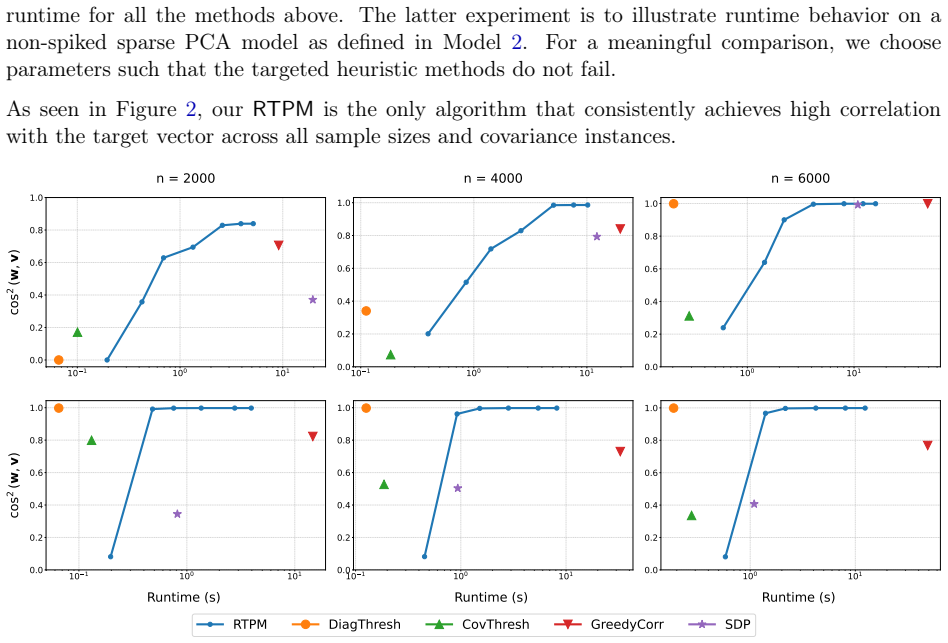
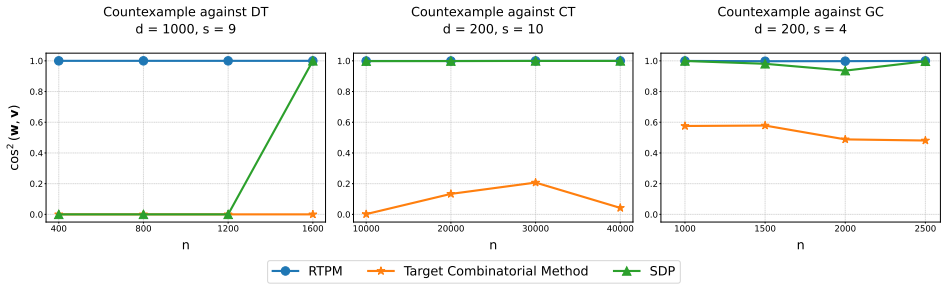
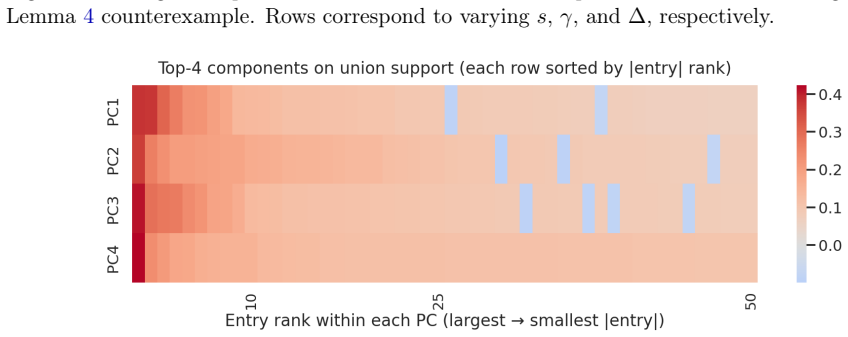
- The explicit counterexamples imply that diagonal thresholding, covariance thresholding, and greedy correlation are not reliable outside the spiked identity model, so their prior analyses do not transfer to general covariances.
- For a single sparse component, the output can be made exactly s-sparse by a final truncation step, at the cost of a constant factor in the correlation error.
- The guarantee extends to recovering a vector in the leading k-dimensional sparse eigenspace (Model 3), not just the top eigenvector.
- The deflation barrier shows that the natural reduction from sparse k-PCA to repeated sparse 1-PCA fails in general: the residual matrix can lose sparsity entirely, so new ideas are needed for multi-component recovery.
Where Pith is reading between the lines
- The same proof template—restarting from all basis vectors and oversampling the support—may yield global convergence for other truncated or projected iterative methods, suggesting that the counterexamples expose a property of specific heuristics rather than of combinatorial approaches as a class.
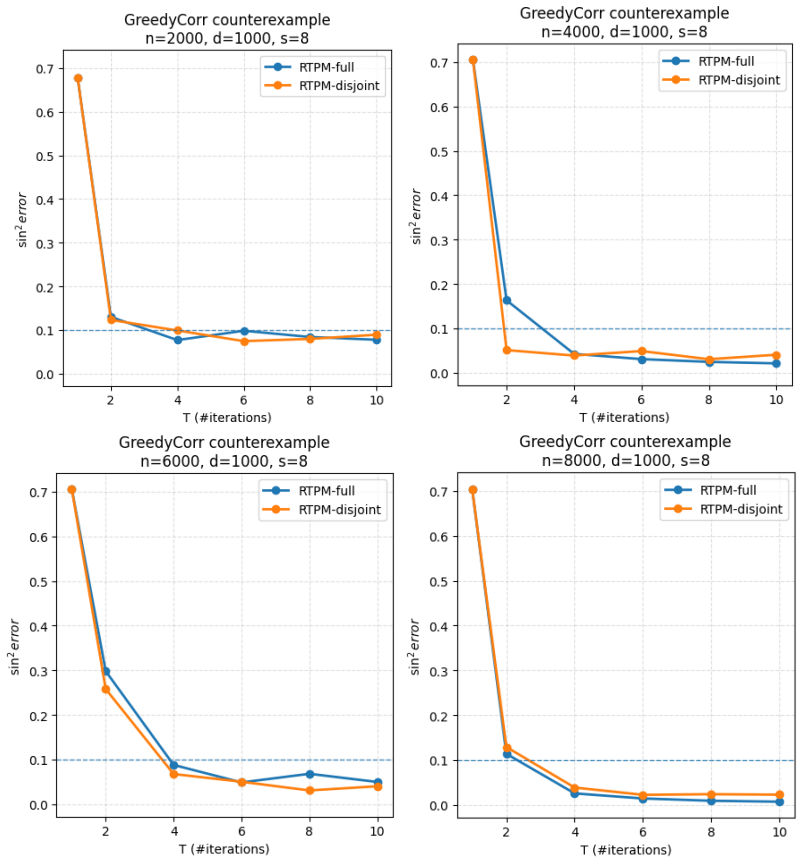
- The analysis applies to the sample-split variant RTPM-disjoint, while the experiments use RTPM-full, which reuses all samples per iteration; closing this gap would make the practical algorithm the proven one and likely remove the T factor from the sample bound.
- The deflation barrier hints that a provable sparse k-PCA algorithm will need to maintain the residual support explicitly or use a joint optimization, so the open problem left by the paper may require a non-deflationary design.
Editorial analysis
A structured set of objections, weighed in public.
Referee Report
Summary. This paper studies sparse PCA under a general covariance model (Model 2), where only the top eigenvector is s-sparse and an eigen-gap is assumed, as opposed to the usual spiked identity model. The authors give explicit counterexamples showing that diagonal thresholding, covariance thresholding, and a greedy correlation heuristic fail under Model 2. Their main contribution is a restarted, sample-split truncated power method (Algorithm 1, RTPM-disjoint) and a global convergence guarantee: under Model 3, with n = O(s^2 polylog d) samples and O(nd^2) time, it returns an r-sparse unit vector with squared correlation at least 1−Δ with the leading eigenspace. The paper also provides a deflation barrier for sparse subspace recovery and reports experiments on synthetic and NYTimes data.
Significance. If the main theorem is established, this is a significant advance: it provides a lightweight combinatorial method for sparse PCA under a general covariance model, nearly matching the conjectured s^2 log d sample complexity while avoiding SDPs. The counterexamples in Section 3 are concrete, checkable, and valuable for delineating the limits of standard heuristics. The paper is also unusually transparent about the gap between the analyzed algorithm (RTPM-disjoint) and the experimental variant (RTPM-full). However, the central convergence lemma contains an invalid algebraic step, so the main theorem is not proved as written. The issue appears fixable with a more careful choice of constants, but it is load-bearing and must be corrected before the paper can be accepted.
major comments (1)
- [§4.1, Lemma 9, Eq. (16) and final display] The proof of the per-iteration progress factor (1+3ρ/10) is invalid as written. From Eq. (16), after using Eq. (23), the lower bound is ψ_t ≥ (Cψ − η)/√(1+2η), where C = 1+3ρ/5 and η = √(s/r)(1+√(s/r)). The final display replaces η by √(s/r) in both the numerator and the denominator. Since η ≥ √(s/r) and the function η ↦ (Cψ − η)/√(1+2η) is decreasing in η, this replacement gives an upper bound, not a lower bound. Additionally, the last line computes (1−ρ/5)((1+3ρ/5)ψ − ρψ/10) = (1+3ρ/10 − ρ²/10)ψ, which is strictly less than the claimed (1+3ρ/10)ψ. Because Lemma 9 is the engine of Theorem 2, this is a load-bearing gap. The issue appears repairable by strengthening the constant in r = Ω(s²/(pρ²)) so that η ≤ cρψ for a sufficiently small absolute constant c, and then redoing the arithmetic, but as written the theorem is not established.
minor comments (5)
- [§4.1, Lemma 9, proof of Eq. (17)] The statement that 'each uniquely determines a choice of a_t via its support' is unclear and not literally true, since a_t also depends on u_{t-1}. The bound on ω_t is best justified conditionally: because of sample splitting, the batch bΣ_t is independent of the previous randomness that determines u_{t-1} and a_t, so Fact 4 applies after conditioning. Please clarify this step.
- [Theorem 2 statement] Substituting ϵ = β = Δγ/2 into Proposition 1 gives a second sample-complexity term k²/(Δ⁴γ⁴), not k²/(Δ²γ⁶). The first term likely dominates, so the theorem may still be true, but the displayed expression should be corrected or a derivation should justify the weaker second term.
- [Section 5 (experiments)] The experiments are run on RTPM-full, while the theoretical guarantee is for RTPM-disjoint. The paper explicitly acknowledges this, which is commendable, but it means the empirical section does not directly validate the analyzed algorithm. The ablation comparing the two variants is helpful, but a theoretical treatment of RTPM-full remains open.
- [Lemma 4 statement] Lemma 4 says 'Algorithm 2 applied ...' but the counterexample concerns Algorithm 4 (GreedyCorr). This appears to be a typo.
- [References in §1.2] The reference pair [dBEG08, AW08] appears twice in the same sentence in the related-work section.
Circularity Check
No significant circularity: the positive result is derived from external concentration inequalities, a self-contained truncation lemma, and explicit algebraic reductions, with no fitted parameter renamed as a prediction.
full rationale
The main positive claim (Theorem 2) is proved from scratch rather than assumed. Its ingredients are standard sub-Gaussian concentration facts (Fact 2, Fact 3, Fact 4, Corollary 1), an external truncation bound from Yuan and Zhang 2013 (Lemma 6), and a self-contained version proved in the appendix (Lemma 15). The restart initialization uses only the deterministic identity sum_i ||V_p^T e_i||_2^2 = p to guarantee some basis vector has correlation at least sqrt(p/s); this does not presuppose the output or the convergence target. The sample size n and truncation radius r are explicit functions of s, k, Delta, gamma chosen in the proof, and the progress Lemma 9 is a conditional convergence argument, not a restatement of the theorem. The only self-citation of note is Lemma 1, restating a counterexample from the authors' prior work [KS24]; it is motivational for the counterexample section, is not used in the proof of Theorem 2, and is an externally checkable construction, so it does not make the central claim circular. The paper also discloses that experiments use RTPM-full while the theorems cover RTPM-disjoint; this is a scope limitation on the empirical validation, not a circularity in the derivation. Any algebraic issue in Lemma 9's progress factor would be a proof-correctness gap, not circularity, because the claimed bound is not shown to reduce to an input by construction.
Axiom & Free-Parameter Ledger
axioms (4)
- standard math Sub-Gaussian concentration facts (Facts 2-4) hold with universal constants.
- domain assumption Spectral gap assumption λ_{k+1}(Σ)/λ_k(Σ) ≤ 1−γ in Model 3.
- domain assumption Data are i.i.d. σ-sub-Gaussian with covariance Σ whose top-k eigenspace has union support of size s.
- standard math Friedman's theorem on r-regular expanders: exists r-regular graph on u vertices with max_{i≥2}|λ_i(A)| ≤ 3√r.
Cite this review
Pith. "Pith review of Combinatorial Sparse PCA Beyond the Spiked Identity Model." pith.science (2026). https://pith.science/paper/7DXS4A4B
@misc{pith2026260302607,
  author       = {Pith},
  title        = {Pith review of: Combinatorial Sparse PCA Beyond the Spiked Identity Model},
  year         = {2026},
  howpublished = {\url{https://pith.science/paper/7DXS4A4B}},
  note         = {Machine review of arXiv:2603.02607}
}
abstract
Sparse PCA is one of the most well-studied problems in high-dimensional statistics. In this problem, we are given samples from a distribution with covariance $\Sigma$, whose top eigenvector $v \in R^d$ is $s$-sparse. Existing sparse PCA algorithms can be broadly categorized into (1) combinatorial algorithms (e.g., diagonal or elementwise covariance thresholding) and (2) SDP-based algorithms. While combinatorial algorithms are much simpler, they are typically only analyzed under the spiked identity model (where $\Sigma = I_d + \gamma vv^\top$ for some $\gamma > 0$), whereas SDP-based algorithms require no additional assumptions on $\Sigma$. We demonstrate explicit counterexample covariances $\Sigma$ against the success of standard combinatorial algorithms for sparse PCA, when moving beyond the spiked identity model. In light of this discrepancy, we give the first combinatorial method for sparse PCA that provably succeeds for general $\Sigma$ using $s^2 \cdot \mathrm{polylog}(d)$ samples and $d^2 \cdot \mathrm{poly}(s, \log(d))$ time, by providing a global convergence guarantee on a variant of the truncated power method of Yuan and Zhang (2013). We provide a natural generalization of our method to recovering a vector in a sparse leading eigenspace. Finally, we evaluate our method on synthetic and real-world sparse PCA datasets.
Figures
Reference graph
Works this paper leans on
-
[2]
unconstrained
Next, we evaluateQx: Qx= Id −2 uu⊤ ∥u∥2 2 ! x=x−2u· u⊤x ∥u∥2 2 =x−2u· 1−t ⊤x 2 (1−t ⊤x) =x−u=t. In Section 4.1 we used the following helper result. 31 Lemma 14.LetA,B∈S d×d ⪰0 . Fixp∈[d−1]and letV∈R d×p have orthonormal columns spanning the top-peigenspace ofB, and letbV∈R d×p have orthonormal columns spanning the top-p eigenspace ofA. Definegap:=λ p(B)−λ...
-
[244]
[JKL+24] Arun Jambulapati, Syamantak Kumar, Jerry Li, Shourya Pandey, Ankit Pensia, and Kevin Tian
IEEE, 2022. [JKL+24] Arun Jambulapati, Syamantak Kumar, Jerry Li, Shourya Pandey, Ankit Pensia, and Kevin Tian. Black-box k-to-1-pca reductions: Theory and applications. InThe Thirty Seventh Annual Conference on Learning Theory, pages 2564–2607. PMLR, 2024. [JL09a] Iain M. Johnstone and Arthur Yu Lu. On consistency and sparsity for principal com- ponents ...
Pith/arXiv arXiv 2022
This paper was first reviewed by deepseek-v4-flash on August 2, 2026.
discussion (0)
Sign in with ORCID, Apple, or X to comment. Anyone can read and Pith papers without signing in.