REVIEW 3 major objections 5 minor 2 cited by
A hybrid lattice-plus-data calculation brings the Standard Model prediction for the muon's magnetic moment to within 0.5σ of experiment.
Reviewed by Pith at T0; open to challenge. T0 means a machine referee read the full paper against a public rubric. the ladder, T0–T4 →
T0 review · deepseek-v4-flash
2026-08-02 18:59 UTC pith:7CGLELBN
load-bearing objection This is a proceedings summary of BMW/DMZ's hybrid HVP result; the genuinely new 0.5σ claim lives in arXiv:2407.10913, not here, and the data-driven tail carries a common-normalization caveat that the paper treats conservatively but cannot by itself dispel. the 3 major comments →
BMW/DMZ calculation of the hadronic vacuum polarisation for the muon magnetic moment
The pith
A machine-rendered reading of the paper's core claim, the machinery that carries it, and where it could break.
Core claim
On the paper's own terms, the discovery is that the conflict between lattice and data-driven determinations of the hadronic vacuum polarisation is confined to the intermediate Euclidean-time window that emphasizes the rho resonance, while the long-distance tail beyond 2.8 fm — dominated by low-energy states well below the rho — gives mutually consistent results from both methods. Exploiting this, the authors build a hybrid a_mu^HVP that uses the lattice for everything except the tail, replaces that tail with the data-driven value, and obtains a result whose uncertainty is smaller than either method alone. Combined with the other Standard Model contributions, this yields a prediction that dis
What carries the argument
The central object is the Euclidean-time window decomposition of the HVP integral. The integral over the vector-vector correlator C(t) with kinematic kernel K(t) is split into short (<0.4 fm), intermediate (0.4–1.0 fm), and long-distance (1.0–2.8 fm lattice; >2.8 fm tail) windows. The paper's key move is the hybrid construction: in the far tail, where lattice errors grow but the kernel suppresses the rho-peak region where e+e- experiments disagree, it substitutes the data-driven value, adding a doubled systematic to cover variations between experimental treatments. This lets each method contribute where it is strongest and removes the finite-volume and statistical errors that dominate the la
Load-bearing premise
The result stands or falls on the premise that the e+e- data in the long-distance tail (Euclidean times beyond 2.8 fm, energies well below the rho resonance) have no hidden common systematic, so substituting that data for the lattice tail cannot bias the final value.
What would settle it
A re-analysis of the low-energy e+e- data that introduces a common normalisation parameter finds a shift in the tail integral larger than the doubled uncertainty the paper assigns; or a new independent measurement of the two-pion cross section below about 0.6 GeV moves the tail average by more than roughly 10% of the HVP total, which would move the final prediction away from the measured value.
If this is right
- If the hybrid value is correct, the Standard Model and the measured muon magnetic moment agree within 0.5σ, removing the need for new physics to explain this observable.
- The remaining methodological dispute about the HVP is now localised to the rho-peak region; resolving the experimental disagreements there would reconcile the lattice and data-driven approaches entirely.
- With the tail essentially fixed by data, further improvement of the lattice calculation can focus on the short and intermediate windows, where the continuum limit controls the uncertainty.
- The 0.31 ppm validation means the full Standard Model stack — QED, electroweak, hadronic light-by-light, and this HVP — is consistent with experiment at the level tested.
Where Pith is reading between the lines
- The same hybrid logic may transfer to other low-energy observables, such as the running of the electromagnetic coupling, wherever lattice and data-driven determinations overlap in a region free of known tensions.
- A dedicated, independent low-energy measurement of the two-pion cross section below roughly 0.6 GeV would directly test the region the hybrid leans on; a significant shift there would propagate into the final prediction.
- If the agreement survives, any future hint of new physics in muon g-2 would have to enter through quantities other than the HVP contribution, since that part now matches experiment.
- Recomputing the tail with a qualitatively different lattice discretisation at higher statistics would test whether the data-driven tail is unbiased or whether the 0.5σ agreement reflects the specific choice of window.
Editorial analysis
A structured set of objections, weighed in public.
Referee Report
Summary. This proceedings contribution from the BMW/DMZ collaboration describes an updated lattice-QCD calculation of the hadronic vacuum polarisation (HVP) contribution to the muon anomalous magnetic moment, combined with a data-driven evaluation of the very-long-distance tail (t > 2.8 fm). The central claim, stated in the abstract, Section 1 and Section 10, is that the hybrid determination reaches 0.45% precision, differs from the experimental measurement by only 0.5σ, and validates the Standard Model to 0.31 ppm. The paper describes the lattice ensembles, the analysis strategy based on AIC-weighted global fits, the Euclidean-time window decomposition, the hybrid tail replacement, the new f_π scale-setting procedure, and the changes relative to the 2020 BMW result. It also discloses several conservative systematics and the blinded nature of the 2024 analysis.
Significance. If the hybrid result is correct, it would be a major step toward closing the long-standing muon g−2 tension: a first-principles lattice HVP, supplemented by data only in a small low-energy tail, would agree with the Fermilab measurement, implying no new physics is needed in this observable. The paper has clear methodological strengths: the analysis was performed blind; scale setting was cross-checked with the independent f_π input after the Ω-based scale setting was identified as potentially contaminated by KΞ states; the hybrid tail systematics are deliberately conservative and overestimated; and the window results agree with independent lattice and data-driven determinations. The main weaknesses are that the actual numerical result and uncertainty budget are not reported in this text, and the hybrid tail replacement relies on an assumption about common systematic errors in e+e− data that is not quantitatively tested. These issues prevent the central claim from being fully evaluated from this manuscript alone.
major comments (3)
- [Abstract, §1, §10] The central quantitative claims — a 0.45%-precision hybrid a_mu^HVP, a 0.5σ difference from experiment, and 0.31 ppm Standard Model validation — are stated in the abstract, §1 and §10, but no numerical value, uncertainty budget, or comparison plot is given in this proceedings. Table 1 is the white-paper consensus, not the hybrid result. The reader is referred to arXiv:2407.10913 [1], but a paper whose title announces a 'calculation' should at least give the central value and its main components in a table. As written, the central claim cannot be checked from this text.
- [§7 (Hybrid Approach)] The replacement of the t>2.8 fm tail by data-driven results is justified by the statement that this region is dominated by low-energy states and that the rho-region tensions are suppressed. However, the variations listed to estimate the associated uncertainty (pre- vs post-integration averaging, inclusion of partial-coverage experiments, CMD-3 in/out, BaBar vs KLOE) are all internal choices among data sets; they do not constrain a common normalization or radiative-correction offset shared by e+e− experiments. The tau-driven point in Fig. 9 is a useful external check but relies on isospin-breaking corrections. Since the tail contributes roughly 5% of a_mu^HVP (≈35×10^-10), a common 3% offset would shift the hybrid by ≈1×10^-10, which is non-negligible against a claimed total uncertainty of ≈3×10^-10 and could move the 0.5σ statement by about 0.3σ. Doubling the tail uncertainty from the li
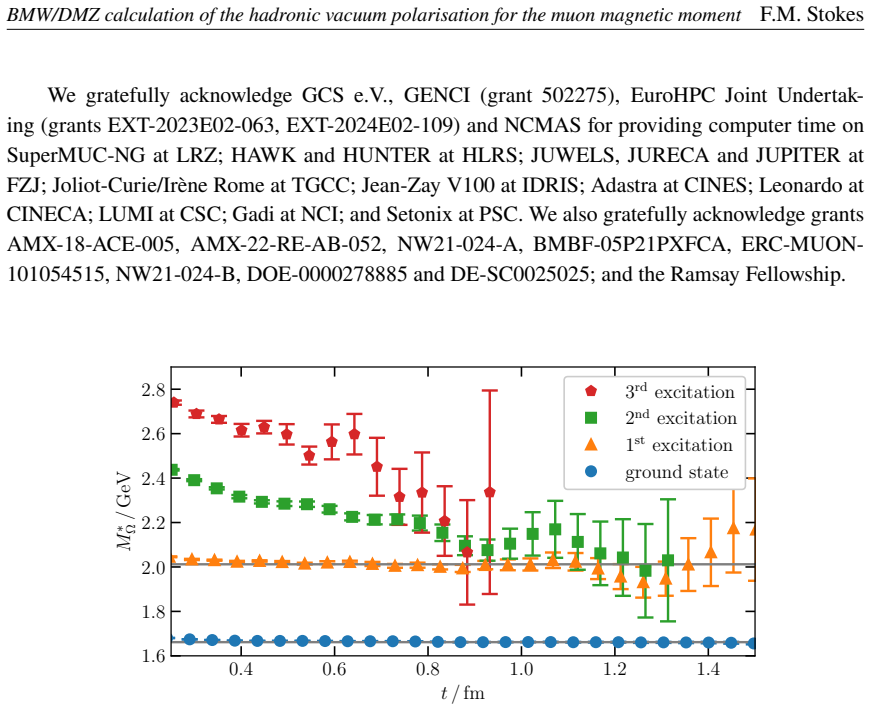
- [§8 (Scale Setting)] The disclosure that the Ω-based scale setting has a possible uncontrolled contamination from KΞ states, and that the 2024 analysis therefore moved to f_π, is welcome. But the proceedings do not state the resulting f_π scale-setting uncertainty or its contribution to the final 0.45% error budget. Given that scale setting was previously a significant systematic in BMW analyses, this omission is part of the missing numerical support for the headline claim. A summary table with the scale-setting error and its treatment in the hybrid combination should be included, or the relevant numbers from [1] reproduced.
minor comments (5)
- [References] References [31] and [38] appear to be the same BMW 2018 paper (Phys. Rev. Lett. 121, 022002) listed twice. One should be removed or the citation differentiated.
- [Figures 5-10] Several window labels in the figures and captions use corrupted glyphs (e.g., 'a_{μ,04}^{□10}', 'a_{μ,00}^{□04}'). These should be typeset using the same window notation as in the text.
- [§9] The quoted correlated change between the 2020 and 2024 results, 7.6(5.2)×10^-10, is presented without specifying how the correlation between the two analyses was estimated. A sentence describing the correlation model would make the 1.5σ statement reproducible.
- [§5] The uncertainty estimate takes the larger of half the 68% CDF width and a quarter of the 95% CDF width. Some PDFs, e.g., Fig. 8, are visibly bimodal. It would help to state explicitly which estimator was used for the final quoted uncertainty and how bimodality is handled.
- [Abstract/§1] 'an 0.45% precision' should read 'a 0.45% precision'.
Circularity Check
No significant circularity: the hybrid result combines an independently confirmed lattice calculation with external e+e−/tau data, and the 0.5σ agreement is a genuine comparison rather than a fitted output.
full rationale
I walked the derivation chain from Sections 3, 6, 7, and 10. The central quantity, the hybrid a_mu^HVP, is obtained by combining (i) the BMW lattice calculation of the short- and intermediate-distance windows and the 1.0–2.8 fm region, and (ii) a data-driven determination of the t>2.8 fm tail. The lattice input is largely cited to the collaboration's own [1] and [3], but this is not load-bearing circularity: the text notes independent confirmation by Mainz [7] and RBC/UKQCD [6], and describes a blinded analysis ('Our 2024 calculation was performed completely blind, with all HVP data multiplied by unknown random numbers before analysis commenced'). The data-driven tail is based on external experimental inputs (BaBar, KLOE, CMD-3, tau) through dispersive relations; it is not derived from the experimental value of a_mu. The selection of the t>2.8 fm window is justified physically by kernel suppression of the rho-region tensions and by the observed agreement in Fig. 9, but the final comparison 'differs from the experimental measurement by only 0.5σ' is not obtained by fitting to the experimental a_mu. The manuscript also explicitly accounts for procedural variants and doubles the tail uncertainty, stating this 'gives an overestimate of the final uncertainties.' The common-normalization concern raised by the skeptic is a legitimate systematic-risk caveat, not a circularity: it does not make any equation reduce to an input by construction. No step in this paper exhibits the specific reduction required for self-definitional, fitted-input, or self-citation circularity.
Axiom & Free-Parameter Ledger
free parameters (3)
- Continuum extrapolation coefficients A0, A2, A4, A6 and exponent γ =
A_i and γ ∈ {0, 0.5, ..., 2.5} fitted per window; combined via AIC weights
- Euclidean-time window boundaries (0.4 fm, 1.0 fm, 2.8 fm) =
not fitted; chosen by hand
- Data-driven averaging procedure variants (pre/post integration average, CMD-3 in/out, BaBar vs KLOE) =
n/a (treated as systematics)
axioms (6)
- standard math Time-momentum representation a_mu^HVP = α² ∫ K(t) C(t) dt (Eq 2)
- domain assumption Staggered fermion discretization with stout smearing reproduces the continuum HVP at the β values used
- domain assumption The continuum extrapolation ansatz O(a² α_s^γ) with AIC model averaging covers the true systematic error
- domain assumption Perturbative QCD matches the lattice short-distance window below 0.3 fm
- domain assumption The data-driven dispersive evaluation of the t > 2.8 fm tail is reliable and free of the rho-region tensions
- domain assumption Finite-volume effects in the 11 fm box are exponentially suppressed, with residual effects covered by dedicated simulations
read the original abstract
For twenty years, a persistent discrepancy between experimental measurements and theoretical calculations of the muon anomalous magnetic moment have provided tantalising hints of new physics. In recent years, improvements to the experimental precision have appeared to make the tension stronger and stronger. However, at the same time, our lattice calculation overturned the theoretical consensus, completely eliminating the tension. I will present the latest results from the Budapest-Marseille-Wuppertal (BMW) and DMZ collaborations, with a hybrid determination of the hadronic vacuum polarisation contribution to a precision of 0.45%
Figures



Forward citations
Cited by 2 Pith papers
-
Precision mass measurements of multistrange baryons and their antiparticles
ALICE reports mass measurements of Ω−, Ξ− and antiparticles at ~60 ppm precision via invariant-mass reconstruction in pp collisions, calibrated on K0S and Λ, reducing lattice QCD scale uncertainty.
-
An Update on the Isospin-Breaking Effects in the Pion Decay Constant with Staggered Quarks
Preliminary update on isospin-breaking corrections to the pion decay constant in staggered N_f=2+1+1 QCD with QED_L, including correlator data for scale setting.
Reference graph
Works this paper leans on
-
[1]
A. Boccaletti et al.,High precision calculation of the hadronic vacuum polarisation contribution to the muon anomaly,arXiv:2407.10913. [2]Muon g-2collaboration,Measurement of the Positive Muon Anomalous Magnetic Moment to 127 ppb,Phys. Rev. Lett.135(2025) 101802 [arXiv:2506.03069]
Pith/arXiv arXiv 2025
-
[3]
S. Borsanyi et al.,Leading hadronic contribution to the muon magnetic moment from lattice QCD,Nature593(2021) 51 [arXiv:2002.12347]. [4]RBC, UKQCDcollaboration,Calculation of the hadronic vacuum polarization contribution to the muon anomalous magnetic moment,Phys. Rev. Lett.121(2018) 022003 [arXiv:1801.07224]. [5]RBC, UKQCDcollaboration,Update of Euclidea...
Pith/arXiv arXiv 2021
-
[7]
D. Djukanovic, G. von Hippel, S. Kuberski, H.B. Meyer, N. Miller, K. Ottnad et al.,The hadronic vacuum polarization contribution to the muon𝑔−2at long distances, arXiv:2411.07969
-
[8]
Aliberti et al.,The anomalous magnetic moment of the muon in the Standard Model: an update,Phys
R. Aliberti et al.,The anomalous magnetic moment of the muon in the Standard Model: an update,Phys. Rept.1143(2025) 1 [arXiv:2505.21476]
Pith/arXiv arXiv 2025
-
[9]
Aoyama et al.,The anomalous magnetic moment of the muon in the Standard Model,Phys
T. Aoyama et al.,The anomalous magnetic moment of the muon in the Standard Model,Phys. Rept.887(2020) 1 [arXiv:2006.04822]
Pith/arXiv arXiv 2020
-
[10]
M. Davier, A. Hoecker, A.-M. Lutz, B. Malaescu and Z. Zhang,Tensions in 𝑒+𝑒−→𝜋+𝜋−(𝛾)measurements: the new landscape of data-driven hadronic vacuum polarization predictions for the muon𝑔−2,Eur. Phys. J. C84(2024) 721 [arXiv:2312.02053]. [11]BaBarcollaboration,Precise measurement of the e+ e- —>pi+ pi- (gamma) cross section with the Initial State Radiation ...
Pith/arXiv arXiv 2024
-
[18]
M. Davier, A. Hoecker, G. Lopez Castro, B. Malaescu, X. Mo, G. Toledo Sanchez et al.,The Discrepancy Between tau and e+e- Spectral Functions Revisited and the Consequences for the Muon Magnetic Anomaly,Eur. Phys. J. C66(2010) 127 [arXiv:0906.5443]
Pith/arXiv arXiv 2010
-
[19]
M. Davier, A. Höcker, B. Malaescu, C.-Z. Yuan and Z. Zhang,Update of the ALEPH non-strange spectral functions from hadronic𝜏decays,Eur. Phys. J. C74(2014) 2803 [arXiv:1312.1501]. [20]Muon g-2collaboration,Final Report of the Muon E821 Anomalous Magnetic Moment Measurement at BNL,Phys. Rev. D73(2006) 072003 [hep-ex/0602035]. [21]Muon g-2collaboration,Measu...
Pith/arXiv arXiv 2014
-
[22]
Aoyama, T
T. Aoyama, T. Kinoshita and M. Nio,Theory of the Anomalous Magnetic Moment of the Electron,Atoms7(2019) 28
2019
-
[23]
T. Aoyama, M. Hayakawa, T. Kinoshita and M. Nio,Complete Tenth-Order QED Contribution to the Muon g-2,Phys. Rev. Lett.109(2012) 111808 [arXiv:1205.5370]
Pith/arXiv arXiv 2012
-
[24]
A. Czarnecki, W.J. Marciano and A. Vainshtein,Refinements in electroweak contributions to the muon anomalous magnetic moment,Phys. Rev. D67(2003) 073006 [hep-ph/0212229]
Pith/arXiv arXiv 2003
-
[25]
C. Gnendiger, D. Stöckinger and H. Stöckinger-Kim,The electroweak contributions to (𝑔−2) 𝜇 after the Higgs boson mass measurement,Phys. Rev. D88(2013) 053005 [arXiv:1306.5546]
Pith/arXiv arXiv 2013
-
[26]
M. Davier, A. Hoecker, B. Malaescu and Z. Zhang,Reevaluation of the hadronic vacuum polarisation contributions to the Standard Model predictions of the muon𝑔−2and𝛼(𝑀2 𝑍) using newest hadronic cross-section data,Eur. Phys. J.C77(2017) 827 [arXiv:1706.09436]
Pith/arXiv arXiv 2017
-
[27]
A. Keshavarzi, D. Nomura and T. Teubner,Muon𝑔−2and𝛼(𝑀2 𝑍): a new data-based analysis,Phys. Rev.D97(2018) 114025 [arXiv:1802.02995]. 18 BMW/DMZ calculation of the hadronic vacuum polarisation for the muon magnetic momentF.M. Stokes
Pith/arXiv arXiv 2018
-
[28]
G. Colangelo, M. Hoferichter and P. Stoffer,Two-pion contribution to hadronic vacuum polarization,JHEP02(2019) 006 [arXiv:1810.00007]
Pith/arXiv arXiv 2019
-
[29]
M. Hoferichter, B.-L. Hoid and B. Kubis,Three-pion contribution to hadronic vacuum polarization,JHEP08(2019) 137 [arXiv:1907.01556]
Pith/arXiv arXiv 2019
-
[30]
D. Bernecker and H.B. Meyer,Vector Correlators in Lattice QCD: Methods and applications,Eur. Phys. J.A47(2011) 148 [arXiv:1107.4388]. [31]Budapest-Marseille-Wuppertalcollaboration,Hadronic vacuum polarization contribution to the anomalous magnetic moments of leptons from first principles,Phys. Rev. Lett.121(2018) 022002 [arXiv:1711.04980]
Pith/arXiv arXiv 2011
-
[32]
D. Giusti and S. Simula,Lepton anomalous magnetic moments in Lattice QCD+QED,PoS LATTICE2019(2019) 104 [arXiv:1910.03874]. [33]PACScollaboration,Hadronic vacuum polarization contribution to the muon𝑔−2with 2+1 flavor lattice QCD on a larger than (10 fm)4 lattice at the physical point,Phys. Rev. D100 (2019) 034517 [arXiv:1902.00885]. [34]Fermilab Lattice, ...
Pith/arXiv arXiv 2019
-
[35]
A. Gerardin, M. Ce, G. von Hippel, B. Horz, H.B. Meyer, D. Mohler et al.,The leading hadronic contribution to(𝑔−2) 𝜇 from lattice QCD with𝑁f =2+1flavours of O(𝑎) improved Wilson quarks,Phys. Rev.D100(2019) 014510 [arXiv:1904.03120]
Pith/arXiv arXiv 2019
-
[36]
C. Lehner and A.S. Meyer,Consistency of hadronic vacuum polarization between lattice QCD and the R-ratio,Phys. Rev. D101(2020) 074515 [arXiv:2003.04177]
Pith/arXiv arXiv 2020
-
[37]
C. Aubin, T. Blum, M. Golterman and S. Peris,Muon anomalous magnetic moment with staggered fermions: Is the lattice spacing small enough?,Phys. Rev. D106(2022) 054503 [arXiv:2204.12256]. [38]Budapest-Marseille-Wuppertalcollaboration,Hadronic vacuum polarization contribution to the anomalous magnetic moments of leptons from first principles,Phys. Rev. Lett...
Pith/arXiv arXiv 2022
-
[39]
G.S. Bali, S. Collins and A. Schafer,Effective noise reduction techniques for disconnected loops in Lattice QCD,Comput. Phys. Commun.181(2010) 1570 [arXiv:0910.3970]
Pith/arXiv arXiv 2010
-
[40]
T. Blum, T. Izubuchi and E. Shintani,New class of variance-reduction techniques using lattice symmetries,Phys. Rev.D88(2013) 094503 [arXiv:1208.4349]
Pith/arXiv arXiv 2013
-
[41]
H. Neff, N. Eicker, T. Lippert, J.W. Negele and K. Schilling,On the low fermionic eigenmode dominance in QCD on the lattice,Phys. Rev.D64(2001) 114509 [hep-lat/0106016]. 19 BMW/DMZ calculation of the hadronic vacuum polarisation for the muon magnetic momentF.M. Stokes
Pith/arXiv arXiv 2001
-
[42]
Luscher and P
M. Luscher and P. Weisz,On-Shell Improved Lattice Gauge Theories,Commun. Math. Phys. 97(1985) 59
1985
-
[43]
C. Morningstar and M.J. Peardon,Analytic smearing of SU(3) link variables in lattice QCD, Phys. Rev.D69(2004) 054501 [hep-lat/0311018]
Pith/arXiv arXiv 2004
-
[44]
C. McNeile, C.T.H. Davies, E. Follana, K. Hornbostel and G.P. Lepage,High-Precision c and b Masses, and QCD Coupling from Current-Current Correlators in Lattice and Continuum QCD,Phys. Rev. D82(2010) 034512 [arXiv:1004.4285]
Pith/arXiv arXiv 2010
-
[45]
Takaishi,Heavy quark potential and effective actions on blocked configurations,Phys
T. Takaishi,Heavy quark potential and effective actions on blocked configurations,Phys. Rev.D54(1996) 1050
1996
-
[46]
T.A. DeGrand, A. Hasenfratz and T.G. Kovacs,Improving the chiral properties of lattice fermions,Phys. Rev.D67(2003) 054501 [hep-lat/0211006]
Pith/arXiv arXiv 2003
-
[47]
Akaike,Information theory and an extension of the maximum likelihood principle, in2nd International Symposium on Information Theory, B
H. Akaike,Information theory and an extension of the maximum likelihood principle, in2nd International Symposium on Information Theory, B. Petrov and F. Csaki, eds., pp. 267–281, Akademiai Kiado, Budapest, 1973
1973
-
[48]
Akaike,A new look at the statistical model identification,IEEE Trans
H. Akaike,A new look at the statistical model identification,IEEE Trans. Automatic Control 19(1974) 716
1974
-
[49]
Akaike,On the likelihood of a time series model,The Statistician27(1978) 217
H. Akaike,On the likelihood of a time series model,The Statistician27(1978) 217. [50]chiQCDcollaboration,Muon g-2 with overlap valence fermions,Phys. Rev. D107(2023) 034513 [arXiv:2204.01280]
Pith/arXiv arXiv 1978
-
[51]
M. Cè et al.,Window observable for the hadronic vacuum polarization contribution to the muon g-2 from lattice QCD,Phys. Rev. D106(2022) 114502 [arXiv:2206.06582]. [52]Extended Twisted Masscollaboration,Lattice calculation of the short and intermediate time-distance hadronic vacuum polarization contributions to the muon magnetic moment using twisted-mass f...
Pith/arXiv arXiv 2022
-
[54]
G. Benton, D. Boito, M. Golterman, A. Keshavarzi, K. Maltman and S. Peris,Data-Driven Determination of the Light-Quark Connected Component of the Intermediate-Window Contribution to the Muon g-2,Phys. Rev. Lett.131(2023) 251803 [arXiv:2306.16808]
Pith/arXiv arXiv 2023
-
[55]
S. Kuberski, M. Cè, G. von Hippel, H.B. Meyer, K. Ottnad, A. Risch et al.,Hadronic vacuum polarization in the muon g−2: the short-distance contribution from lattice QCD,JHEP03 (2024) 172 [arXiv:2401.11895]
Pith/arXiv arXiv 2024
-
[56]
S. Spiegel and C. Lehner,High-precision continuum limit study of the HVP short-distance window,Phys. Rev. D111(2025) 114517 [arXiv:2410.17053]. 20 BMW/DMZ calculation of the hadronic vacuum polarisation for the muon magnetic momentF.M. Stokes [57]Bellecollaboration,Observation of an ExcitedΩ − Baryon,Phys. Rev. Lett.121(2018) 052003 [arXiv:1805.09384]
Pith/arXiv arXiv 2025
-
[58]
Gusken, U
S. Gusken, U. Low, K.H. Mutter, R. Sommer, A. Patel and K. Schilling,Nonsinglet Axial Vector Couplings of the Baryon Octet in Lattice QCD,Phys. Lett.B227(1989) 266
1989
-
[59]
C. Aubin and K. Orginos,A new approach for Delta form factors,AIP Conf. Proc.1374 (2011) 621 [arXiv:1010.0202]
Pith/arXiv arXiv 2011
-
[60]
S. Capstick and N. Isgur,Baryons in a relativized quark model with chromodynamics,Phys. Rev. D34(1986) 2809. [61]Extended Twisted Masscollaboration,Ratio of kaon and pion leptonic decay constants with𝑁 𝑓 =2+1+1Wilson-clover twisted-mass fermions,Phys. Rev. D104(2021) 074520 [arXiv:2104.06747]
Pith/arXiv arXiv 1986
-
[62]
N. Miller et al.,Scale setting the Möbius domain wall fermion on gradient-flowed HISQ action using the omega baryon mass and the gradient-flow scales𝑡0 and𝑤 0,Phys. Rev. D 103(2021) 054511 [arXiv:2011.12166]. [63]MILCcollaboration,GradientflowandscalesettingonMILCHISQensembles,Phys.Rev.D 93(2016) 094510 [arXiv:1503.02769]
Pith/arXiv arXiv 2021
-
[64]
R. Dowdall, C. Davies, G. Lepage and C. McNeile,Vus from pi and K decay constants in full lattice QCD with physical u, d, s and c quarks,Phys. Rev. D88(2013) 074504 [arXiv:1303.1670]. [65]Extended Twisted Masscollaboration,Quark masses and decay constants in 𝑁𝑓 =2+1+1isoQCD with Wilson clover twisted mass fermions,PoSLATTICE2019 (2020) 181 [arXiv:2001.091...
Pith/arXiv arXiv 2013
-
[67]
M. Di Carlo, D. Giusti, V. Lubicz, G. Martinelli, C.T. Sachrajda, F. Sanfilippo et al., Light-meson leptonic decay rates in lattice QCD+QED,Phys. Rev.D100(2019) 034514 [arXiv:1904.08731]
Pith/arXiv arXiv 2019
-
[68]
Hunter,Matplotlib: A 2d graphics environment,Computing in Science & Engineering9 (2007) 90
J.D. Hunter,Matplotlib: A 2d graphics environment,Computing in Science & Engineering9 (2007) 90. 21
2007
discussion (0)
Sign in with ORCID, Apple, or X to comment. Anyone can read and Pith papers without signing in.