Masking Causality and Conditional Dependence
Pith reviewed 2026-05-21 12:09 UTC · model grok-4.3
The pith
Averaged constraints on conditional effects almost surely yield policies that satisfy the average but violate the independence requirement within individual strata.
A machine-rendered reading of the paper's core claim, the machinery that carries it, and where it could break.
Core claim
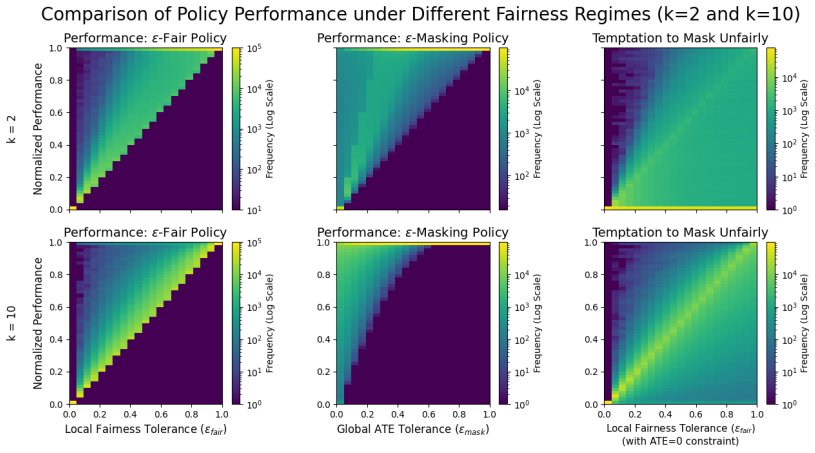
Formulating causal masking as a linear program on the regulator's side shows that averaged-constraint optimization almost surely produces policies violating the stratum-wise requirement while satisfying the averaged constraint exactly. The gains from this masking increase with confounding and outcome heterogeneity. On the optimizer's side, the same construction shows masked policies recover most of the reward of unconstrained exploitation while being far harder to detect, since detection would require the conditional-independence tests averaging seeks to bypass. These results establish that regulating direct dependence through averaged statistics on observed decisions is structurally limited
What carries the argument
The linear-program formulation of causal masking that places the averaged constraint on the conditional effect of the prohibited variable across strata.
If this is right
- The advantage of masked policies over stratum-wise enforcement grows as confounding and outcome heterogeneity increase.
- Detection of violations requires conditional-independence tests that the averaged-constraint approach is designed to circumvent.
- Masked policies achieve nearly the performance of fully unconstrained policies while evading detection more effectively.
- Meaningful regulation of direct dependence requires constraints applied at the level of the decision rule itself rather than aggregate observed statistics.
Where Pith is reading between the lines
- In applications such as path-specific fairness, averaged metrics may permit hidden influences within subgroups that average statistics overlook.
- Regulators dealing with classified information or insider trading could benefit from auditing the full decision rule instead of relying on summary statistics alone.
- The linear-program construction suggests similar masking effects could appear in other constrained optimization settings with heterogeneous populations.
Load-bearing premise
The enforcement of the conditional-independence requirement admits a linear-program formulation in which the constraint is imposed on the average conditional effect rather than enforced separately within each stratum.
What would settle it
A concrete instance or numerical optimization in which the solution to the averaged-constraint linear program satisfies the aggregate conditional effect exactly but produces a positive violation probability within at least one stratum.
Figures



read the original abstract
Many regulatory and analytic problems require that a prohibited variable influence a decision only through a designated allowable channel -- a conditional-independence requirement that arises in path-specific fairness, the handling of classified information, and the regulation of trading on non-public information, among other settings. Such requirements may be enforced either stratum-by-stratum or, more commonly (and more efficiently), through a single averaged constraint on the conditional effect. We study the resulting enforcement problem from two perspectives. From the regulator's side, we formulate causal masking as a linear program and show that averaged-constraint optimization almost surely produces policies that violate the stratum-wise requirement while satisfying the averaged one exactly. The gains from masking grow with confounding and outcome heterogeneity, and detection requires precisely the conditional-independence tests that average constraints aim to avoid. From the optimizer's side, the same construction shows that masked policies recover most of the reward of unconstrained exploitation while being far harder to detect, making them attractive in any setting where the basis of decisions is itself sensitive. Together, these results argue that regulating direct dependence through averaged statistics on observed decisions is structurally limited, and that meaningful enforcement must operate at the level of the decision rule itself.
Editorial analysis
A structured set of objections, weighed in public.
Referee Report
Summary. The manuscript studies enforcement of conditional-independence requirements (e.g., path-specific fairness or regulation of sensitive information) in decision policies. It formulates causal masking as a linear program and claims that optimizing under a single averaged constraint on the conditional effect across strata almost surely produces policies that satisfy the averaged constraint exactly while violating the stratum-wise requirement. The magnitude of the masking gains increases with confounding strength and outcome heterogeneity. From the optimizer's perspective, the same construction shows that masked policies recover most of the reward of unconstrained policies while being substantially harder to detect. The paper concludes that regulating direct dependence via averaged observed statistics is structurally limited and that meaningful enforcement must operate at the level of the decision rule itself.
Significance. If the central claims are rigorously established, the work identifies a concrete limitation of averaged-constraint approaches to causal regulation in machine learning and decision systems. It supplies an LP formulation that can be used to analyze the gap between averaged and stratum-wise enforcement, together with a generic (almost-sure) violation result and a dual perspective on detection difficulty. These elements would be useful for fairness auditing, privacy regulation, and the design of decision rules that must remain opaque to certain tests.
major comments (2)
- [Abstract / regulator's side LP construction] Abstract and regulator-side construction: the claim that averaged-constraint optimization 'almost surely' produces policies violating the stratum-wise requirement is load-bearing for the central thesis. The probability space (measure over reward functions, confounding strengths, or outcome distributions) on which this 'almost surely' is taken must be defined explicitly, together with the argument that the set of objectives for which an optimum satisfies both constraints has measure zero. Without this, the result reduces to an existence statement rather than a generic one.
- [Linear-program formulation] LP formulation section: the explicit linear program for causal masking, the precise statement of the averaged constraint on the conditional effect, and the proof that its feasible set strictly contains policies violating per-stratum conditional independence are not visible in the provided material. These derivations are required to support both the regulator-side violation result and the optimizer-side reward-recovery claim.
minor comments (2)
- [Introduction / notation] Clarify early in the paper the precise mathematical definitions of 'conditional effect', 'stratum-wise requirement', and 'causal masking' with consistent notation.
- [Theoretical results] If the full proofs appear only in an appendix, consider adding a short proof sketch or key steps in the main text to improve readability.
Simulated Author's Rebuttal
We thank the referee for the careful and constructive report. The comments correctly identify points where additional explicitness will strengthen the presentation. We address each major comment below and will revise the manuscript accordingly.
read point-by-point responses
-
Referee: Abstract and regulator-side construction: the claim that averaged-constraint optimization 'almost surely' produces policies violating the stratum-wise requirement is load-bearing for the central thesis. The probability space (measure over reward functions, confounding strengths, or outcome distributions) on which this 'almost surely' is taken must be defined explicitly, together with the argument that the set of objectives for which an optimum satisfies both constraints has measure zero. Without this, the result reduces to an existence statement rather than a generic one.
Authors: We agree that the probability space must be stated explicitly. In the revision we will define it as the uniform (Lebesgue) measure on a compact subset of the space of bounded continuous reward functions and confounding strengths. We will prove that the set of objectives for which an optimum of the averaged LP also satisfies all stratum-wise constraints is a proper algebraic subvariety of positive codimension and therefore has measure zero under this measure. This converts the result from an existence claim to the generic statement asserted in the abstract. revision: yes
-
Referee: LP formulation section: the explicit linear program for causal masking, the precise statement of the averaged constraint on the conditional effect, and the proof that its feasible set strictly contains policies violating per-stratum conditional independence are not visible in the provided material. These derivations are required to support both the regulator-side violation result and the optimizer-side reward-recovery claim.
Authors: The manuscript contains a dedicated LP section, but we accept that the excerpt supplied to the referee may have omitted the full derivations. We will expand the section to display the complete linear program (variables are stratum-specific decision probabilities, objective is expected reward, constraints are the single averaged conditional-effect equality together with probability simplex constraints), state the averaged constraint explicitly as the linear equality summing stratum-weighted conditional effects to zero, and supply the short constructive proof that any solution with opposing nonzero stratum effects lies in the feasible set while violating per-stratum independence. The same construction yields the quantitative reward-recovery bounds used for the optimizer-side claims. revision: yes
Circularity Check
No circularity: LP formulation and almost-sure claim are self-contained
full rationale
The paper formulates causal masking directly as a linear program whose feasible set for the averaged constraint strictly contains policies violating per-stratum conditional independence. The almost-sure violation result follows from the geometry of that feasible set under generic objectives; no step defines a quantity in terms of itself, renames a fitted parameter as a prediction, or relies on a load-bearing self-citation whose content reduces to the present claim. The derivation remains independent of any data-fitting procedure or prior result by the same authors.
Axiom & Free-Parameter Ledger
axioms (1)
- domain assumption Causal masking can be expressed as a linear program whose feasible set encodes the averaged conditional-independence constraint.
Lean theorems connected to this paper
-
IndisputableMonolith/Foundation/Cost/FunctionalEquation.leanwashburn_uniqueness_aczel unclear?
unclearRelation between the paper passage and the cited Recognition theorem.
formulate causal masking as a linear program … averaged-constraint optimization almost surely produces policies that violate the stratum-wise requirement while satisfying the averaged one exactly
-
IndisputableMonolith/Foundation/AlexanderDuality.leanalexander_duality_circle_linking unclear?
unclearRelation between the paper passage and the cited Recognition theorem.
The gains from masking grow with confounding and outcome heterogeneity
What do these tags mean?
- matches
- The paper's claim is directly supported by a theorem in the formal canon.
- supports
- The theorem supports part of the paper's argument, but the paper may add assumptions or extra steps.
- extends
- The paper goes beyond the formal theorem; the theorem is a base layer rather than the whole result.
- uses
- The paper appears to rely on the theorem as machinery.
- contradicts
- The paper's claim conflicts with a theorem or certificate in the canon.
- unclear
- Pith found a possible connection, but the passage is too broad, indirect, or ambiguous to say the theorem truly supports the claim.
Reference graph
Works this paper leans on
-
[1]
URLhttps: //dl.acm.org/doi/10.1145/3188745.3188756
doi: 10.1145/3188745.3188756. URLhttps: //dl.acm.org/doi/10.1145/3188745.3188756. Silvia Chiappa. Path-specific counterfactual fairness. InProceedings of the AAAI conference on artificial intelligence, volume 33, pages 7801–7808, 2019. Alexandra Chouldechova. Fair Prediction with Dis- parate Impact: A Study of Bias in Recidivism Pre- diction Instruments.B...
- [2]
-
[3]
Big Data 5(2), 153–163 (2017) https://doi.org/10.1089/big.2016.0047
URLhttps://www.liebertpub.com/doi/ abs/10.1089/big.2016.0047. Sam Corbett-Davies, Emma Pierson, Avi Feller, Sharad Goel, and Aziz Huq. Algorithmic Deci- sion Making and the Cost of Fairness. InProceed- ings of the 23rd ACM SIGKDD International Con- ference on Knowledge Discovery and Data Min- ing, KDD ’17, pages 797–806, New York, NY, USA, August 2017. As...
-
[4]
ISBN 978-0-521-88588-1. Google-Books-ID: Bf1tBwAAQBAJ. Kwangho Kim and Jose R. Zubizarreta. Fair and Robust Estimation of Heterogeneous Treat- ment Effects for Policy Learning. InProceed- ings of the 40th International Conference on Ma- chine Learning, pages 16997–17014. PMLR, July
-
[5]
Matt J Kusner, Joshua Loftus, Chris Russell, and Ricardo Silva
URLhttps://proceedings.mlr.press/ v202/kim23ab.html. Matt J Kusner, Joshua Loftus, Chris Russell, and Ricardo Silva. Counterfactual Fairness. In I. Guyon, U. Von Luxburg, S. Bengio, H. Wallach, R. Fergus, S. Vishwanathan, and R. Gar- nett, editors,Advances in Neural Information Processing Systems, volume 30. Curran Asso- ciates, Inc., 2017. URLhttps://pro...
work page 2017
-
[6]
URLhttps://proceedings.mlr.press/ v258/mazaheri25a.html. ISSN: 2640-3498. John H. McDonald.Handbook of Biological Statistics. Sparky House Publishing, Baltimore, Maryland, 3 edition, 2014. Web page version contains content of pages 77–85 from the printed book. Christopher Meek. Strong completeness and faith- fulness in Bayesian networks. InProceedings of ...
-
[7]
ISSN 2374-3468. doi: 10.1609/aaai.v32i1. 11553. URLhttps://ojs.aaai.org/index.php/ AAAI/article/view/11553. Razieh Nabi, Daniel Malinsky, and Ilya Shpitser. Learning Optimal Fair Policies. InProceed- ings of the 36th International Conference on Ma- chine Learning, pages 4674–4682. PMLR, May
-
[8]
URLhttps://proceedings.mlr.press/ v97/nabi19a.html. Judea Pearl.Causality. Cambridge university press, 2009. Krishna Pendakur and Simon Woodcock. Glass Ceil- ings or Glass Doors? Wage Disparity Within and Between Firms.Journal of Business & Economic Statistics, 28(1):181–189, January 2010. ISSN 0735-0015. doi: 10.1198/jbes.2009.08124. URL https://doi.org/...
-
[9]
doi: 10.1561/2200000106. URLhttp://www. nowpublishers.com/article/Details/MAL-106. Donald B. Rubin. Causal Inference Using Potential Outcomes: Design, Modeling, Decisions.Journal of the American Statistical Association, 100(469): 322–331, 2005. ISSN 0162-1459. URLhttps:// www.jstor.org/stable/27590541. Jakob Runge. Conditional independence testing based o...
-
[10]
The utility is: W(D fair) =ρ·w avg i
Utility of the Optimal Fair Policy:Under the smallρassumption, the optimal fair policy is to participate only in stratumiwith ratesα i,1 =α i,0 =ρ/Pr(X=i). The utility is: W(D fair) =ρ·w avg i
-
[11]
Construct a Valid Masking Candidate Policy,D ′′ p,j:We build a candidate policy from scratch that is inspired by an arbitrage between states (i,1) and (j,0) (the argument for (i,0) and (j,1) is symmetric). Step A: Define the Unscaled Arbitrage Policy (D ′).Let’s construct an intermediate policyD ′ that has non-zero participation only for ratesα ′ i,1 andα...
-
[12]
Bounding the Gap:The optimal masking policy’s utility,W(D mask), must be at least as high as the utility of the best of these constructed candidates. The performance gap ∆ is therefore bounded by: ∆ =W(D mask)− W(D fair) ⩾max j̸=i,p∈{0,1} W(D ′′ p,j) − W(D fair) =ρ·max j̸=i,p∈{0,1} {Rp(j)} −ρ·w avg i . Factoring outρand ensuring the gap is non-negative co...
-
[13]
Vol(V mask(ε))∝ε 1 16 Proof (Sketch).Theε-fair problem constrains the policy vector⃗ αto lie withinkindependent slabs, each of width proportional toε. The volume of their intersection thus scales withε k. Theε-masking problem imposes only a single slab constraint, so its volume scales linearly withε. The ratio of the feasible volumes, Vol(V mask)/Vol(Vfai...
work page 2014
discussion (0)
Sign in with ORCID, Apple, or X to comment. Anyone can read and Pith papers without signing in.