Recognition: no theorem link
A Tutorial Review of Bayesian Optimization with Gaussian Processes to Accelerate Stationary Point Searches
Pith reviewed 2026-05-15 12:49 UTC · model grok-4.3
The pith
Bayesian optimization with Gaussian processes unifies minimization, saddle searches, and double-ended paths on potential energy surfaces via one shared surrogate loop.
A machine-rendered reading of the paper's core claim, the machinery that carries it, and where it could break.
Core claim
Minimization, single-point saddle searches, and double-ended path searches all follow the identical six-step Bayesian optimization surrogate loop that employs Gaussian process regression with derivative observations and inverse-distance kernels; the tasks differ solely in the choice of inner optimization target and acquisition criterion, with optional extensions such as farthest-point sampling via Earth Mover's Distance, MAP regularization, adaptive trust radius, and random Fourier features available for production scaling.
What carries the argument
The six-step surrogate loop of Gaussian process regression with derivative observations and inverse-distance kernels that generates acquisition-guided proposals for the next electronic structure calculation.
If this is right
- The same code structure implements minimization, saddle searches, and path searches, with only the target function and acquisition criterion changed.
- Electronic structure evaluations drop by roughly an order of magnitude depending on oracle cost, search distance, and availability of analytical forces.
- Optional production extensions such as adaptive trust radius and random Fourier features maintain the core loop while improving scalability.
- The accompanying Rust code demonstrates direct translation from the unified theoretical formulation to executable searches.
Where Pith is reading between the lines
- The same surrogate loop could be adapted to other local optimization problems in quantum chemistry where derivative information is available.
- Combining the framework with pre-trained machine-learned potentials might further lower the cost for very large systems.
- Systematic tests on surfaces with varying curvature would clarify how the observed speedup scales with problem difficulty.
Load-bearing premise
Gaussian process regression with inverse-distance kernels and derivative observations can serve as reliable local surrogates that reduce electronic structure evaluations by roughly an order of magnitude while preserving the accuracy of the underlying theory.
What would settle it
Running the surrogate loop and a standard search side-by-side on the same set of molecular benchmarks and finding that the surrogate version requires more than half as many electronic structure calls to reach stationary points of equivalent accuracy would falsify the claimed reduction.
Figures




read the original abstract
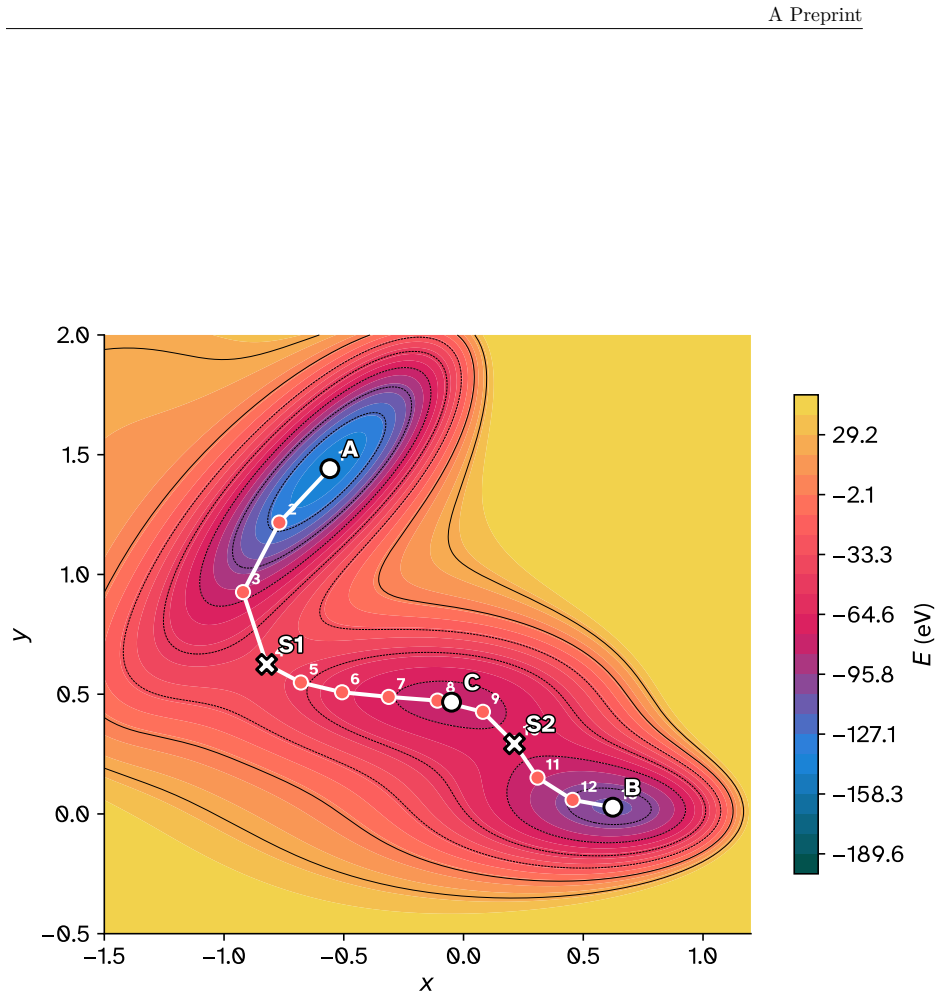
Building local surrogates to accelerate stationary point searches on potential energy surfaces spans decades of effort. Done correctly, surrogates can reduce the number of expensive electronic structure evaluations by roughly an order of magnitude while preserving the accuracy of the underlying theory, with the gain depending on oracle cost, search distance, and the availability of analytical forces. We present a unified Bayesian optimization view of minimization, single-point saddle searches, and double-ended path searches: all three share one six-step surrogate loop and differ only in the inner optimization target and the acquisition criterion. The framework uses Gaussian process regression with derivative observations, inverse-distance kernels, and active learning, and we develop optional extensions for production use, including farthest-point sampling with the Earth Mover's Distance, MAP regularization, an adaptive trust radius, and random Fourier features for scaling. Accompanying pedagogical Rust code demonstrates that all three applications use the same Bayesian optimization loop, bridging the gap between theoretical formulation and practical execution.
Editorial analysis
A structured set of objections, weighed in public.
Referee Report
Summary. The manuscript presents a unified Bayesian optimization framework for accelerating stationary point searches on potential energy surfaces. It claims that minimization, single-point saddle searches, and double-ended path searches all follow the same six-step surrogate loop using Gaussian process regression with derivative observations and inverse-distance kernels, differing only in the inner optimization target and acquisition criterion. The work includes optional extensions (farthest-point sampling, MAP regularization, adaptive trust radius, random Fourier features) and provides accompanying pedagogical Rust code to demonstrate practical execution.
Significance. If the central unification holds and is verified by the provided code, the paper offers a coherent tutorial synthesis that could lower the barrier for applying surrogate methods in computational chemistry. The reproducible code is a clear strength, enabling independent verification of the shared loop structure across the three applications. The performance claim of roughly order-of-magnitude reduction in electronic structure evaluations is conditional on oracle cost and search distance, which appropriately limits overstatement.
major comments (2)
- [Abstract and §3] Abstract and §3 (six-step loop): the central unification claim that all three searches 'share one six-step surrogate loop and differ only in the inner optimization target and the acquisition criterion' is load-bearing but would be strengthened by an explicit comparison table listing the target function and acquisition function for each of the three cases; without it the 'differ only in' assertion remains conceptual rather than directly verifiable.
- [Abstract] Abstract: the statement that surrogates 'can reduce the number of expensive electronic structure evaluations by roughly an order of magnitude' is presented as a key practical benefit yet lacks a specific benchmark, timing table, or reference to a controlled comparison within the manuscript; this quantitative claim should be evidenced or qualified with the conditions under which it holds.
minor comments (3)
- [Methods] The inverse-distance kernel and its derivative observations are central but the explicit functional form and hyperparameter handling could be stated in a single equation block for clarity.
- [Introduction] Consider adding a short related-work subsection that distinguishes the present synthesis from earlier GP-based PES surrogate papers to better highlight the tutorial contribution.
- [Code availability] The Rust code repository link should be accompanied by a permanent archive (e.g., Zenodo DOI) to ensure long-term reproducibility.
Simulated Author's Rebuttal
We thank the referee for the positive assessment, the recommendation of minor revision, and the constructive comments that help strengthen the presentation of the unified framework. We address each major comment below.
read point-by-point responses
-
Referee: [Abstract and §3] Abstract and §3 (six-step loop): the central unification claim that all three searches 'share one six-step surrogate loop and differ only in the inner optimization target and the acquisition criterion' is load-bearing but would be strengthened by an explicit comparison table listing the target function and acquisition function for each of the three cases; without it the 'differ only in' assertion remains conceptual rather than directly verifiable.
Authors: We agree that an explicit table would make the unification directly verifiable rather than conceptual. In the revised manuscript we will insert a comparison table in §3 that enumerates, for each of the three applications (minimization, single-point saddle search, double-ended path search): the inner optimization target, the precise acquisition criterion, the form of the derivative observations used, and the specific instantiation of the six-step loop. This table will sit alongside the existing algorithmic description and will be cross-referenced from the abstract. revision: yes
-
Referee: [Abstract] Abstract: the statement that surrogates 'can reduce the number of expensive electronic structure evaluations by roughly an order of magnitude' is presented as a key practical benefit yet lacks a specific benchmark, timing table, or reference to a controlled comparison within the manuscript; this quantitative claim should be evidenced or qualified with the conditions under which it holds.
Authors: The manuscript already qualifies the claim by stating that the gain depends on oracle cost, search distance, and availability of analytical forces. To address the request for substantiation, we will add two short sentences in the abstract and §1 that cite representative controlled comparisons from the surrogate-assisted saddle-search literature (e.g., reductions of 5–20× reported for similar systems) and will include a one-paragraph illustrative example drawn from the pedagogical Rust code that reports the number of oracle calls with and without the surrogate for a model problem. Because the paper is a tutorial synthesis rather than a new benchmark study, we do not add a full timing table, but the added references and example provide the requested evidence. revision: partial
Circularity Check
No significant circularity in derivation chain
full rationale
The paper is a tutorial review synthesizing established Bayesian optimization and Gaussian process techniques for stationary point searches on potential energy surfaces. The central claim is a conceptual unification of minimization, saddle searches, and path searches under one standard six-step surrogate loop using derivative observations and inverse-distance kernels. No load-bearing step reduces by construction to a self-definition, fitted input renamed as prediction, or self-citation chain; the framework is presented as a reframing of known methods with optional extensions and accompanying code for independent verification. The presentation is self-contained against external benchmarks.
Axiom & Free-Parameter Ledger
axioms (1)
- domain assumption Gaussian process regression with derivative observations and inverse-distance kernels can accurately approximate local regions of potential energy surfaces
Reference graph
Works this paper leans on
-
[1]
Peter Hänggi, Peter Talkner, and Michal Borkovec. Reaction-rate theory: Fifty years after Kramers. Reviews of Modern Physics, 62(2):251–341, April 1990. doi:10.1103/RevModPhys.62.251
-
[2]
The activated complex in chemical reactions.Journal of Chemical Physics, 3(2):107–115, February 1935
Henry Eyring. The activated complex in chemical reactions.Journal of Chemical Physics, 3(2):107–115, February 1935. ISSN 0021-9606. doi:10.1063/1.1749604
-
[3]
George H. Vineyard. Frequency factors and isotope effects in solid state rate processes.Journal of Physics and Chemistry of Solids, 3(1):121–127, January 1957. ISSN 0022-3697. doi:10.1016/0022- 3697(57)90059-8
-
[4]
Elsevier, Amsterdam ; Cambrige, MA, 2017
Baron Peters.Reaction Rate Theory and Rare Events. Elsevier, Amsterdam ; Cambrige, MA, 2017. ISBN 978-0-444-56349-1
work page 2017
-
[5]
Michele Re Fiorentin, Michele G. Bianchi, Magnus A. H. Christiansen, Anna Ciotti, Francesca Risplendi, Wei Wang, Elvar Ö. Jónsson, Hannes Jónsson, and Giancarlo Cicero. Methodological frameworks for computational electrocatalysis: From theory to practice.Small Methods, page e01542, February 2026. ISSN 2366-9608, 2366-9608. doi:10.1002/smtd.202501542
-
[6]
Springer New York, New York, NY, 2013
Gareth James, Daniela Witten, Trevor Hastie, and Robert Tibshirani.An Introduction to Statistical Learning, volume 103 ofSpringer Texts in Statistics. Springer New York, New York, NY, 2013. ISBN 978-1-4614-7137-0 978-1-4614-7138-7. doi:10.1007/978-1-4614-7138-7
-
[7]
D. Madsen, R. Pearman, and M. Gruebele. Approximate factorization of molecular potential surfaces. I. Basic approach.Journal of Chemical Physics, 106(14):5874–5893, April 1997. ISSN 0021-9606, 1089-7690. doi:10.1063/1.473253
-
[8]
Giovanni Pizzi, Andrea Cepellotti, Riccardo Sabatini, Nicola Marzari, and Boris Kozinsky. AiiDA: Automated interactive infrastructure and database for computational science.Computational Materials Science, 111:218–230, January 2016. ISSN 0927-0256. doi:10.1016/j.commatsci.2015.09.013
-
[9]
Felix Mölder, Kim Philipp Jablonski, Brice Letcher, Michael B. Hall, Christopher H. Tomkins-Tinch, Vanessa Sochat, Jan Forster, Soohyun Lee, Sven O. Twardziok, Alexander Kanitz, Andreas Wilm, Manuel Holtgrewe, Sven Rahmann, Sven Nahnsen, and Johannes Köster. Sustainable data analysis with Snakemake, April 2021
work page 2021
-
[10]
Graeme Henkelman and Hannes Jónsson. Long time scale kinetic Monte Carlo simulations without lattice approximation and predefined event table.The Journal of Chemical Physics, 115(21):9657–9666, November 2001. ISSN 0021-9606. doi:10.1063/1.1415500
-
[11]
Efficient exploration of chemical kinetics, October 2025
Rohit Goswami. Efficient exploration of chemical kinetics, October 2025
work page 2025
-
[12]
Bartók, Christoph Ortner, Gábor Csányi, and Michele Ceriotti
Felix Musil, Andrea Grisafi, Albert P. Bartók, Christoph Ortner, Gábor Csányi, and Michele Ceriotti. Physics-Inspired Structural Representations for Molecules and Materials.Chemical Reviews, 121(16): 9759–9815, August 2021. ISSN 0009-2665, 1520-6890. doi:10.1021/acs.chemrev.1c00021
-
[13]
Andrea Grisafi, David M. Wilkins, Michael J. Willatt, and Michele Ceriotti. Atomic-Scale Representation and Statistical Learning of Tensorial Properties. In Edward O. Pyzer-Knapp and Teodoro Laino, editors, ACS Symposium Series, volume 1326, pages 1–21. American Chemical Society, Washington, DC, January
-
[14]
doi:10.1021/bk-2019-1326.ch001
ISBN 978-0-8412-3505-2 978-0-8412-3504-5. doi:10.1021/bk-2019-1326.ch001
-
[15]
Albert Pártay Bart\ok.The Gaussian Approximation Potential. Springer Theses. Springer Berlin Heidelberg, Berlin, Heidelberg, 2010. ISBN 978-3-642-14066-2 978-3-642-14067-9. doi:10.1007/978-3- 642-14067-9
-
[16]
Alexander V. Shapeev. Moment Tensor Potentials: A Class of Systematically Improvable Interatomic Potentials.Multiscale Modeling & Simulation, 14(3):1153–1173, January 2016. ISSN 1540-3459. doi:10.1137/15M1054183
-
[17]
Jörg Behler and Michele Parrinello. Generalized Neural-Network Representation of High- Dimensional Potential-Energy Surfaces.Physical Review Letters, 98(14):146401, April 2007. doi:10.1103/PhysRevLett.98.146401. 60 A Preprint
-
[18]
Volker L. Deringer, Albert P. Bartók, Noam Bernstein, David M. Wilkins, Michele Ceriotti, and Gábor Csányi. Gaussian Process Regression for Materials and Molecules.Chemical Reviews, 121(16): 10073–10141, August 2021. ISSN 0009-2665, 1520-6890. doi:10.1021/acs.chemrev.1c00022
-
[19]
Arslan Mazitov, Filippo Bigi, Matthias Kellner, Paolo Pegolo, Davide Tisi, Guillaume Fraux, Sergey Pozdnyakov, Philip Loche, and Michele Ceriotti. PET-MAD as a lightweight universal interatomic potential for advanced materials modeling.Nature Communications, 16(1):10653, November 2025. ISSN 2041-1723. doi:10.1038/s41467-025-65662-7
-
[20]
Filippo Bigi, Paolo Pegolo, Arslan Mazitov, Jonathan Schmidt, and Michele Ceriotti. Pushing the limits of unconstrained machine-learned interatomic potentials.Machine Learning: Science and Technology, April 2026. doi:10.1088/2632-2153/ae6417. DOI: 10.1088/2632-2153/ae6417
-
[21]
Ilyes Batatia, Philipp Benner, Yuan Chiang, Alin M. Elena, Dávid P. Kovács, Janosh Riebesell, Xavier R. Advincula, Mark Asta, Matthew Avaylon, William J. Baldwin, Fabian Berger, Noam Bernstein, Arghya Bhowmik, Filippo Bigi, Samuel M. Blau, Vlad Cărare, Michele Ceriotti, Sanggyu Chong, James P. Darby, Sandip De, Flaviano Della Pia, Volker L. Deringer, Roka...
-
[22]
Mathias Schreiner, Arghya Bhowmik, Tejs Vegge, Jonas Busk, and Ole Winther. Transition1x - a dataset for building generalizable reactive machine learning potentials.Scientific Data, 9(1):779, December
-
[23]
doi:10.1038/s41597-022-01870-w
ISSN 2052-4463. doi:10.1038/s41597-022-01870-w
-
[24]
Probabilistic Machine Learning
Philipp Hennig. Probabilistic Machine Learning. Lecture notes, Tübingen AI Center, University of Tübingen, September 2023
work page 2023
-
[25]
Richard S. Sutton and Andrew G. Barto.Reinforcement Learning: An Introduction. Adaptive Computation and Machine Learning Series. The MIT Press, Cambridge, Massachusetts, second edition edition, 2018. ISBN 978-0-262-03924-6
work page 2018
-
[26]
Practical Bayesian Optimization of Machine Learning Algorithms
Jasper Snoek, Hugo Larochelle, and Ryan P Adams. Practical Bayesian Optimization of Machine Learning Algorithms. In F. Pereira, C. J. C. Burges, L. Bottou, and K. Q. Weinberger, editors,Advances in Neural Information Processing Systems 25, pages 2960–2968. Curran Associates, Inc., 2012
work page 2012
-
[27]
Rohit Goswami, Maxim Masterov, Satish Kamath, Alejandro Pena-Torres, and Hannes Jónsson. Efficient Implementation of Gaussian Process Regression Accelerated Saddle Point Searches with Application to Molecular Reactions.Journal of Chemical Theory and Computation, 21(16):7935–7943, July 2025. doi:10.1021/acs.jctc.5c00866
-
[28]
Rohit Goswami and Hannes Jónsson. Adaptive Pruning for Increased Robustness and Reduced Computational Overhead in Gaussian Process Accelerated Saddle Point Searches.ChemPhysChem, 27 (4):e202500730, February 2026. ISSN 1439-7641. doi:10.1002/cphc.202500730
-
[29]
Torrisi, Simon Batzner, Yu Xie, Lixin Sun, Alexie M
Jonathan Vandermause, Steven B. Torrisi, Simon Batzner, Yu Xie, Lixin Sun, Alexie M. Kolpak, and Boris Kozinsky. On-the-fly active learning of interpretable Bayesian force fields for atomistic rare events. npj Computational Materials, 6(1):20, 2020. doi:10.1038/s41524-020-0283-z
-
[30]
Albert P. Bartók. Gaussian Approximation Potential: An interatomic potential derived from first principles Quantum Mechanics.arXiv:1003.2817 [cond-mat, physics:physics], March 2010. 61 A Preprint
work page internal anchor Pith review Pith/arXiv arXiv 2010
-
[31]
Gerardo Raggi, Ignacio Fdez. Galván, Christian L. Ritterhoff, Morgane Vacher, and Roland Lindh. Restricted-Variance Molecular Geometry Optimization Based on Gradient-Enhanced Kriging.Journal of Chemical Theory and Computation, 16(6):3989–4001, June 2020. ISSN 1549-9618, 1549-9626. doi:10.1021/acs.jctc.0c00257
-
[32]
Galván, Gerardo Raggi, and Roland Lindh
Ignacio Fdez. Galván, Gerardo Raggi, and Roland Lindh. Restricted-Variance Constrained, Re- action Path, and Transition State Molecular Optimizations Using Gradient-Enhanced Kriging. Journal of Chemical Theory and Computation, 17(1):571–582, January 2021. ISSN 1549-9618. doi:10.1021/acs.jctc.0c01163
-
[33]
Dagbjartsdóttir, Vilhjálmur Ásgeirsson, Aki Vehtari, and Hannes Jónsson
Olli-Pekka Koistinen, Freyja B. Dagbjartsdóttir, Vilhjálmur Ásgeirsson, Aki Vehtari, and Hannes Jónsson. Nudged elastic band calculations accelerated with Gaussian process regression.The Journal of Chemical Physics, 147(15):152720, September 2017. ISSN 0021-9606. doi:10.1063/1.4986787
-
[34]
Olli-Pekka Koistinen, Vilhjálmur Ásgeirsson, Aki Vehtari, and Hannes Jónsson. Nudged Elastic Band Calculations Accelerated with Gaussian Process Regression Based on Inverse Interatomic Distances. Journal of Chemical Theory and Computation, 15(12):6738–6751, December 2019. ISSN 1549-9618. doi:10.1021/acs.jctc.9b00692
-
[35]
Alexander Denzel, Bernard Haasdonk, and Johannes Kästner. Gaussian Process Regression for Minimum Energy Path Optimization and Transition State Search.The Journal of Physical Chemistry A, 123(44): 9600–9611, November 2019. ISSN 1089-5639. doi:10.1021/acs.jpca.9b08239
-
[36]
PhD thesis, Technical University of Denmark, Kgs
Andreas Lynge Vishart.Accelerating Catalysis Simulations Using Surrogate Machine Learning Models. PhD thesis, Technical University of Denmark, Kgs. Lyngby, 2023
work page 2023
-
[37]
José A. Garrido Torres, Paul C. Jennings, Martin H. Hansen, Jacob R. Boes, and Thomas Bligaard. Low-Scaling Algorithm for Nudged Elastic Band Calculations Using a Surrogate Machine Learning Model.Physical Review Letters, 122(15):156001, April 2019. doi:10.1103/PhysRevLett.122.156001
-
[38]
Chong Teng, Daniel Huang, and Junwei Lucas Bao. A spur to molecular geometry optimization: Gradient-enhanced universal kriging with on-the-fly adaptive ab initio prior mean functions in curvilinear coordinates.The Journal of Chemical Physics, 158(2):024112, 2023. doi:10.1063/5.0133675
-
[39]
Chong Teng, Yang Wang, and Junwei Lucas Bao. Physical prior mean function-driven gaussian processes search for minimum-energy reaction paths with a climbing-image nudged elastic band: A general method for gas-phase, interfacial, and bulk-phase reactions.Journal of Chemical Theory and Computation, 20 (10):4308–4324, 2024. doi:10.1021/acs.jctc.4c00291
-
[40]
Chong Teng, Daniel Huang, Elizabeth Donahue, and Junwei Lucas Bao. Exploring torsional conformer space with physical prior mean function-driven meta-gaussian processes.The Journal of Chemical Physics, 159(21):214111, 2023. doi:10.1063/5.0176709
-
[41]
Andrew Gelman, John B Carlin, Hal S Stern, David B Dunson, Aki Vehtari, and Donald B Rubin. Bayesian Data Analysis. Chapman & Hall/CRC Texts in Statistical Science. CRC Press, Boca Raton, third edition edition, 2013. ISBN 978-1-4398-4095-5. doi:10.1201/b16018
-
[42]
Gramacy.Surrogates: Gaussian Process Modeling, Design, and Optimization for the Applied Sciences
Robert B. Gramacy.Surrogates: Gaussian Process Modeling, Design, and Optimization for the Applied Sciences. CRC Press ; Taylor & Francis Group, New York, NY, 2020. ISBN 978-0-367-41542-6
work page 2020
-
[43]
Miguel A. Caro. Optimizing many-body atomic descriptors for enhanced computational performance of machine learning based interatomic potentials.Physical Review B, 100(2):024112, July 2019. doi:10.1103/PhysRevB.100.024112
-
[44]
Lewars.Computational Chemistry
Errol G. Lewars.Computational Chemistry. Springer International Publishing, Cham, 2016. ISBN 978-3-319-30914-9 978-3-319-30916-3. doi:10.1007/978-3-319-30916-3
-
[45]
Klaus Müller and Leo D. Brown. Location of saddle points and minimum energy paths by a constrained simplex optimization procedure.Theoretica chimica acta, 53(1):75–93, March 1979. ISSN 1432-2234. doi:10.1007/BF00547608
-
[46]
Graeme Henkelman and Hannes Jónsson. A dimer method for finding saddle points on high dimensional potential surfaces using only first derivatives.The Journal of Chemical Physics, 111(15):7010–7022, October 1999. ISSN 0021-9606, 1089-7690. doi:10.1063/1.480097. 62 A Preprint
-
[47]
Hannes Jonsson, Greg Mills, and Karsten W. Jacobsen. Nudged elastic band method for finding minimum energy paths of transitions. InClassical and Quantum Dynamics in Condensed Phase Simulations, pages 385–404. World Scientific, June 1998. ISBN 978-981-02-3498-0. doi:10.1142/9789812839664_0016
-
[48]
Graeme Henkelman, Blas P. Uberuaga, and Hannes Jónsson. A climbing image nudged elastic band method for finding saddle points and minimum energy paths.The Journal of Chemical Physics, 113 (22):9901–9904, November 2000. ISSN 0021-9606. doi:10.1063/1.1329672
-
[49]
Dong C. Liu and Jorge Nocedal. On the limited memory BFGS method for large scale optimization. Mathematical Programming, 45(1):503–528, August 1989. ISSN 1436-4646. doi:10.1007/BF01589116
-
[50]
A lim- ited memory algorithm for bound constrained op- timization,
Richard H. Byrd, Peihuang Lu, Jorge Nocedal, and Ciyou Zhu. A limited memory algorithm for bound constrained optimization.SIAM Journal on Scientific Computing, 16:1190–1208, September 1995. ISSN 1064-8275. doi:10.1137/0916069
-
[51]
Jorge Nocedal and Stephen J. Wright.Numerical Optimization. Springer Series in Operations Research. Springer, New York, 2nd ed edition, 2006. ISBN 978-0-387-30303-1
work page 2006
-
[52]
Olli-Pekka Koistinen, Vilhjálmur Ásgeirsson, Aki Vehtari, and Hannes Jónsson. Minimum Mode Saddle Point Searches Using Gaussian Process Regression with Inverse-Distance Covariance Func- tion.Journal of Chemical Theory and Computation, 16(1):499–509, January 2020. ISSN 1549-9618. doi:10.1021/acs.jctc.9b01038
-
[53]
Gaussian Process Regression for Transition State Search
Alexander Denzel and Johannes Kästner. Gaussian Process Regression for Transition State Search. Journal of Chemical Theory and Computation, 14(11):5777–5786, November 2018. ISSN 1549-9618. doi:10.1021/acs.jctc.8b00708
-
[54]
R. A. Olsen, G. J. Kroes, G. Henkelman, A. Arnaldsson, and H. Jónsson. Comparison of methods for finding saddle points without knowledge of the final states.The Journal of Chemical Physics, 121(20): 9776–9792, November 2004. ISSN 0021-9606. doi:10.1063/1.1809574
-
[55]
Enhanced climbing image nudged elastic band method with hessian eigenmode alignment, January 2026
Rohit Goswami, Miha Gunde, and Hannes Jónsson. Enhanced climbing image nudged elastic band method with hessian eigenmode alignment, January 2026
work page 2026
-
[56]
Wiley, Hoboken, NJ, second edition edition, 2012
James F Epperson.An Introduction to Numerical Methods and Analysis. Wiley, Hoboken, NJ, second edition edition, 2012
work page 2012
-
[57]
E. Polak and G. Ribiere. Note sur la convergence de méthodes de directions conjuguées.Revue française d’informatique et de recherche opérationnelle. Série rouge, 3(16):35–43, 1969. ISSN 0373-8000. doi:10.1051/m2an/196903R100351
-
[58]
Andreas Heyden, Alexis T. Bell, and Frerich J. Keil. Efficient methods for finding transition states in chemical reactions: Comparison of improved dimer method and partitioned rational function optimization method.The Journal of Chemical Physics, 123(22):224101, December 2005. ISSN 0021-9606. doi:10.1063/1.2104507
-
[59]
Superlinearly converging dimer method for transition state search
Johannes Kästner and Paul Sherwood. Superlinearly converging dimer method for transition state search. The Journal of Chemical Physics, 128(1):014106, January 2008. ISSN 0021-9606. doi:10.1063/1.2815812
-
[60]
Rohit Goswami. Bayesian hierarchical models for quantitative estimates for performance metrics applied to saddle search algorithms.AIP Advances, 15(8):85210, August 2025. ISSN 2158-3226. doi:10.1063/5.0283639
-
[61]
Jing Leng, Weiguo Gao, Cheng Shang, and Zhi-Pan Liu. Efficient softest mode finding in transi- tion states calculations.Journal of Chemical Physics, 138(9):94110, March 2013. ISSN 0021-9606. doi:10.1063/1.4792644
-
[62]
Marko Melander, Kari Laasonen, and Hannes Jónsson. Removing External Degrees of Freedom from Transition-State Search Methods using Quaternions.Journal of Chemical Theory and Computation, 11 (3):1055–1062, March 2015. ISSN 1549-9618. doi:10.1021/ct501155k
-
[63]
String method for the study of rare events.Physical Review B, 66(5):52301, August 2002
Weinan E, Weiqing Ren, and Eric Vanden-Eijnden. String method for the study of rare events.Physical Review B, 66(5):52301, August 2002. doi:10.1103/PhysRevB.66.052301. 63 A Preprint
-
[64]
Weinan E, Weiqing Ren, and Eric Vanden-Eijnden. Simplified and improved string method for computing the minimum energy paths in barrier-crossing events.The Journal of Chemical Physics, 126(16):164103, April 2007. ISSN 0021-9606, 1089-7690. doi:10.1063/1.2720838
-
[65]
Daniel Sheppard, Rye Terrell, and Graeme Henkelman. Optimization methods for finding mini- mum energy paths.The Journal of Chemical Physics, 128(13):134106, April 2008. ISSN 0021-9606. doi:10.1063/1.2841941
-
[66]
Vilhjálmur Ásgeirsson, Benedikt Orri Birgisson, Ragnar Bjornsson, Ute Becker, Frank Neese, Christoph Riplinger, and Hannes Jónsson. Nudged Elastic Band Method for Molecular Reactions Using Energy- Weighted Springs Combined with Eigenvector Following.Journal of Chemical Theory and Computation, 17(8):4929–4945, August 2021. ISSN 1549-9618. doi:10.1021/acs.j...
-
[67]
Graeme Henkelman and Hannes Jónsson. Improved tangent estimate in the nudged elastic band method for finding minimum energy paths and saddle points.The Journal of Chemical Physics, 113(22): 9978–9985, December 2000. ISSN 0021-9606. doi:10.1063/1.1323224
-
[68]
Carl Edward Rasmussen and Christopher K. I. Williams.Gaussian Processes for Machine Learning. Adaptive Computation and Machine Learning. MIT Press, Cambridge, Mass, 2006. ISBN 978-0-262- 18253-9
work page 2006
-
[69]
CBMS-NSF Regional Conference Series in Applied Mathematics
Grace Wahba.Spline Models for Observational Data. CBMS-NSF Regional Conference Series in Applied Mathematics. Society for Industrial and Applied Mathematics, 1990. doi:10.1137/1.9781611970128
- [70]
-
[71]
Mykel J Kochenderfer and Tim A Wheeler.Algorithms for Optimization. MIT Press, Cambridge, MA,
-
[72]
ISBN 978-0-262-03942-0
-
[73]
Bartók, Risi Kondor, and Gábor Csányi
Albert P. Bartók, Risi Kondor, and Gábor Csányi. On representing chemical environments.Physical Review B, 87(18):184115, May 2013. doi:10.1103/PhysRevB.87.184115
-
[74]
Ralf Drautz. Atomic cluster expansion for accurate and transferable interatomic potentials.Physical Review B, 99(1):014104, January 2019. doi:10.1103/PhysRevB.99.014104
-
[75]
Machine-learning-enabled optimization of atomic structures using atoms with fractional existence
Casper Larsen, Sami Kaappa, Andreas Lynge Vishart, Thomas Bligaard, and Karsten Wedel Jacobsen. Machine-learning-enabled optimization of atomic structures using atoms with fractional existence. Physical Review B, 107(21):214101, June 2023. doi:10.1103/PhysRevB.107.214101
-
[76]
PhD thesis, Aalto University School of Science, Espoo, 2019
Olli-Pekka Koistinen.Algorithms for Finding Saddle Points and Minimum Energy Paths Using Gaussian Process Regression. PhD thesis, Aalto University School of Science, Espoo, 2019
work page 2019
-
[77]
Matthias Rupp, Alexandre Tkatchenko, Klaus-Robert Müller, and O. Anatole von Lilienfeld. Fast and Accurate Modeling of Molecular Atomization Energies with Machine Learning.Physical Review Letters, 108(5):058301, January 2012. ISSN 0031-9007, 1079-7114. doi:10.1103/PhysRevLett.108.058301
-
[78]
KaiChengandRalfZimmermann. Slicedgradient-enhancedkrigingforhigh-dimensionalfunctionapprox- imation.SIAM Journal on Scientific Computing, 45(6):A2858–A2885, 2023. doi:10.1137/22M154315X
-
[79]
Selvakumar Ulaganathan, Ivo Couckuyt, Tom Dhaene, Joris Degroote, and Eric Laermans. Performance study of gradient-enhanced kriging.Engineering with Computers, 32(1):15–34, February 2015. ISSN 1435-5663. doi:10.1007/s00366-015-0397-y
-
[80]
Martin Fodslette Møller. A scaled conjugate gradient algorithm for fast supervised learning.Neural Networks, 6(4):525–533, January 1993. ISSN 0893-6080. doi:10.1016/S0893-6080(05)80056-5
discussion (0)
Sign in with ORCID, Apple, or X to comment. Anyone can read and Pith papers without signing in.