Recognition: 2 theorem links
· Lean TheoremDiFlowDubber: Discrete Flow Matching for Automated Video Dubbing via Cross-Modal Alignment and Synchronization
Pith reviewed 2026-05-15 11:51 UTC · model grok-4.3
The pith
DiFlowDubber applies discrete flow matching in a two-stage process to generate lip-synchronized speech with expressive prosody from video input.
A machine-rendered reading of the paper's core claim, the machinery that carries it, and where it could break.
Core claim
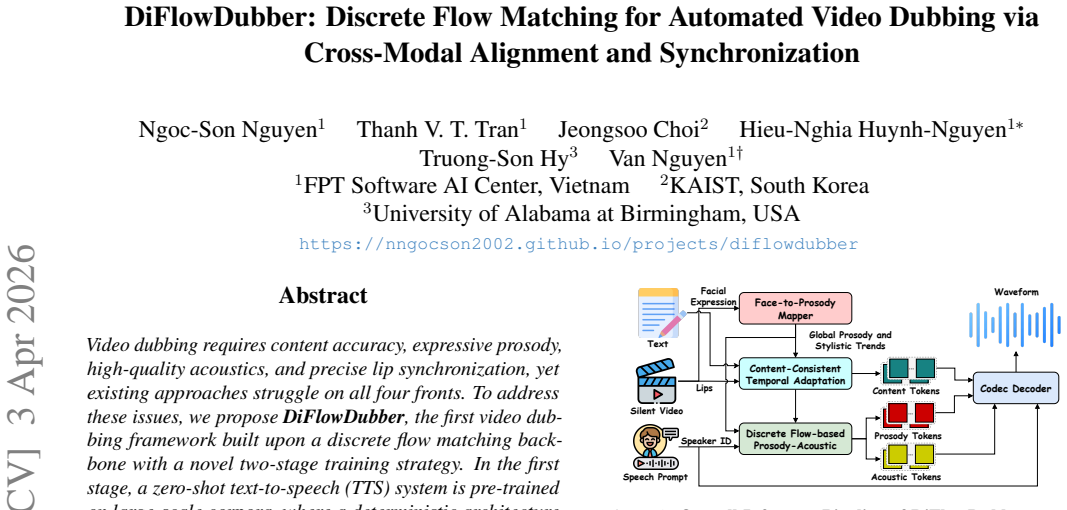
DiFlowDubber is the first video dubbing framework built upon a discrete flow matching backbone. A zero-shot TTS system is pre-trained on large-scale data with a deterministic architecture for linguistic structures and a Discrete Flow-based Prosody-Acoustic module for expressive prosody and realistic acoustics. Content-Consistent Temporal Adaptation then transfers this knowledge: its Synchronizer enforces cross-modal alignment for lip synchronization, while the Face-to-Prosody Mapper conditions prosody on facial expressions; their fused multimodal embeddings guide the flow module to generate content-consistent speech tokens.
What carries the argument
Content-Consistent Temporal Adaptation (CCTA) with its Synchronizer for cross-modal alignment and Face-to-Prosody Mapper (FaPro) for conditioning prosody on faces, which together produce multimodal embeddings to steer the Discrete Flow-based Prosody-Acoustic module.
If this is right
- Dubbed videos exhibit tighter lip synchronization with the original mouth movements.
- Generated speech carries prosody that reflects the speaker's facial expressions.
- Acoustic quality remains high while staying consistent with the source content.
- The framework achieves better scores than previous approaches across standard evaluation metrics.
Where Pith is reading between the lines
- The two-stage adaptation could extend to other cross-modal tasks such as generating gestures from speech.
- Reducing reliance on paired video-speech data might follow if the pre-trained TTS backbone generalizes further.
- Real-time dubbing applications become more feasible if the discrete flow steps can be accelerated at inference.
Load-bearing premise
The pre-trained TTS knowledge transfers to the dubbing domain through CCTA without introducing artifacts or breaking synchronization.
What would settle it
Running DiFlowDubber on the two benchmark datasets and observing no improvement over prior methods on lip synchronization or prosody metrics would falsify the performance claim.
Figures


read the original abstract
Video dubbing requires content accuracy, expressive prosody, high-quality acoustics, and precise lip synchronization, yet existing approaches struggle on all four fronts. To address these issues, we propose DiFlowDubber, the first video dubbing framework built upon a discrete flow matching backbone with a novel two-stage training strategy. In the first stage, a zero-shot text-to-speech (TTS) system is pre-trained on large-scale corpora, where a deterministic architecture captures linguistic structures, and the Discrete Flow-based Prosody-Acoustic (DFPA) module models expressive prosody and realistic acoustic characteristics. In the second stage, we propose the Content-Consistent Temporal Adaptation (CCTA) to transfer TTS knowledge to the dubbing domain: its Synchronizer enforces cross-modal alignment for lip-synchronized speech. Complementarily, the Face-to-Prosody Mapper (FaPro) conditions prosody on facial expressions, whose outputs are then fused with those of the Synchronizer to construct rich, fine-grained multimodal embeddings that capture prosody-content correlations, guiding the DFPA to generate expressive prosody and acoustic tokens for content-consistent speech. Experiments on two benchmark datasets demonstrate that DiFlowDubber outperforms prior methods across multiple evaluation metrics.
Editorial analysis
A structured set of objections, weighed in public.
Referee Report
Summary. The paper introduces DiFlowDubber, the first video dubbing framework based on a discrete flow matching backbone. It uses a two-stage training process: first pre-training a zero-shot TTS system with a deterministic architecture and Discrete Flow-based Prosody-Acoustic (DFPA) module on large corpora to capture linguistic structure, expressive prosody, and acoustics; then applying Content-Consistent Temporal Adaptation (CCTA) whose Synchronizer enforces cross-modal alignment for lip synchronization while the Face-to-Prosody Mapper (FaPro) conditions prosody on facial expressions. The outputs are fused into multimodal embeddings that guide DFPA to generate content-consistent speech tokens. Experiments on two benchmark datasets are reported to show outperformance over prior methods across multiple evaluation metrics.
Significance. If the empirical results and the CCTA transfer mechanism hold under scrutiny, the work would be significant for automated video dubbing by demonstrating how discrete flow matching can be adapted for cross-modal prosody transfer from facial cues, potentially improving expressiveness and synchronization beyond lip-sync-only baselines. The two-stage strategy that reuses large-scale TTS pre-training is a practical strength.
major comments (2)
- [§3.2] §3.2 (CCTA and fusion description): the fusion of Synchronizer and FaPro outputs into multimodal embeddings is described only at a high level without an explicit equation, attention mechanism, or concatenation rule. This is load-bearing for the central claim because, without it, it is impossible to verify whether facial-prosody information survives fusion or collapses to lip-sync features when correlations are weak.
- [Experiments] Experiments section: the outperformance claim is stated without any numerical metric values (e.g., MCD, F0 correlation, synchronization error), error bars, statistical tests, or ablation deltas (with vs. without FaPro). This directly undermines assessment of whether the CCTA stage actually delivers the claimed expressive prosody gains over a lip-sync-only baseline.
minor comments (1)
- [Abstract] Abstract and §2: the term 'discrete flow matching backbone' is used without a one-sentence definition or citation to the base discrete flow matching formulation, which would help readers unfamiliar with the technique.
Simulated Author's Rebuttal
We thank the referee for the constructive feedback on the clarity of the CCTA fusion mechanism and the presentation of experimental results. We address each major comment below and have prepared revisions to strengthen the manuscript.
read point-by-point responses
-
Referee: [§3.2] §3.2 (CCTA and fusion description): the fusion of Synchronizer and FaPro outputs into multimodal embeddings is described only at a high level without an explicit equation, attention mechanism, or concatenation rule. This is load-bearing for the central claim because, without it, it is impossible to verify whether facial-prosody information survives fusion or collapses to lip-sync features when correlations are weak.
Authors: We agree that an explicit formulation is needed to substantiate the claim that facial-prosody information is preserved. In the revised manuscript we add Equation (3) that defines the fusion as a concatenation of the Synchronizer and FaPro embeddings followed by a lightweight cross-attention block (query from Synchronizer, key/value from FaPro) whose output is projected to the multimodal embedding fed to DFPA. We also insert a new figure panel showing the information flow and a short ablation confirming that removing the cross-attention degrades prosody metrics when facial cues are weakly correlated with lip motion. revision: yes
-
Referee: [Experiments] Experiments section: the outperformance claim is stated without any numerical metric values (e.g., MCD, F0 correlation, synchronization error), error bars, statistical tests, or ablation deltas (with vs. without FaPro). This directly undermines assessment of whether the CCTA stage actually delivers the claimed expressive prosody gains over a lip-sync-only baseline.
Authors: The original submission summarized results at a high level in the main text while placing full tables in the appendix. We have moved the key quantitative results (MCD, F0 correlation, LSE-D, WER, and synchronization error) with standard deviations across three random seeds and paired t-test p-values into the main Experiments section. We also add a new ablation table (Table 3) that reports deltas for the full CCTA versus the lip-sync-only baseline (Synchronizer alone), confirming statistically significant gains in prosody expressiveness attributable to FaPro. revision: yes
Circularity Check
No significant circularity in derivation chain
full rationale
The paper introduces DiFlowDubber as a new discrete flow matching framework with a two-stage training process: pre-training a zero-shot TTS with DFPA module on large corpora, followed by CCTA adaptation using Synchronizer and FaPro for cross-modal alignment. No equations, derivations, or predictions are presented that reduce claimed improvements to self-defined parameters, fitted inputs renamed as outputs, or load-bearing self-citations. Performance claims rest on empirical evaluations across benchmarks rather than any self-referential construction, satisfying the criteria for a self-contained, non-circular derivation.
Axiom & Free-Parameter Ledger
axioms (1)
- domain assumption Discrete flow matching can model expressive prosody and acoustic tokens from multimodal embeddings
invented entities (2)
-
Discrete Flow-based Prosody-Acoustic (DFPA) module
no independent evidence
-
Content-Consistent Temporal Adaptation (CCTA)
no independent evidence
Lean theorems connected to this paper
-
IndisputableMonolith/Cost/FunctionalEquation.leanwashburn_uniqueness_aczel unclear?
unclearRelation between the paper passage and the cited Recognition theorem.
DiFlowDubber, the first video dubbing framework built upon a discrete flow matching backbone with a novel two-stage training strategy... DFPA module models expressive prosody and realistic acoustic characteristics
-
IndisputableMonolith/Foundation/ArithmeticFromLogic.leanembed_strictMono_of_one_lt unclear?
unclearRelation between the paper passage and the cited Recognition theorem.
Synchronizer enforces cross-modal alignment... Face-to-Prosody Mapper (FaPro) conditions prosody on facial expressions
What do these tags mean?
- matches
- The paper's claim is directly supported by a theorem in the formal canon.
- supports
- The theorem supports part of the paper's argument, but the paper may add assumptions or extra steps.
- extends
- The paper goes beyond the formal theorem; the theorem is a base layer rather than the whole result.
- uses
- The paper appears to rely on the theorem as machinery.
- contradicts
- The paper's claim conflicts with a theorem or certificate in the canon.
- unclear
- Pith found a possible connection, but the passage is too broad, indirect, or ambiguous to say the theorem truly supports the claim.
Forward citations
Cited by 1 Pith paper
-
CoSyncDiT: Cognitive Synchronous Diffusion Transformer for Movie Dubbing
CoSyncDiT is a cognitive-inspired diffusion transformer that achieves state-of-the-art lip synchronization and naturalness in movie dubbing by guiding noise-to-speech generation through acoustic, visual, and contextua...
Reference graph
Works this paper leans on
-
[1]
wav2vec 2.0: A framework for self-supervised learning of speech representations
Alexei Baevski, Yuhao Zhou, Abdelrahman Mohamed, and Michael Auli. wav2vec 2.0: A framework for self-supervised learning of speech representations. InAdvances in Neural Information Processing Systems, pages 12449–12460. Curran Associates, Inc., 2020. 2
work page 2020
-
[2]
Qi Chen, Mingkui Tan, Yuankai Qi, Jiaqiu Zhou, Yuanqing Li, and Qi Wu. V2c: Visual voice cloning. In2022 IEEE/CVF Conference on Computer Vision and Pattern Recognition (CVPR), pages 21210–21219, 2022. 7, 14
work page 2022
-
[3]
Vall-e 2: Neural codec language models are human parity zero-shot text to speech synthesizers, 2024
Sanyuan Chen, Shujie Liu, Long Zhou, Yanqing Liu, Xu Tan, Jinyu Li, Sheng Zhao, Yao Qian, and Furu Wei. Vall-e 2: Neural codec language models are human parity zero-shot text to speech synthesizers, 2024. 2
work page 2024
-
[4]
Neural codec language models are zero-shot text to speech synthesizers
Sanyuan Chen, Chengyi Wang, Yu Wu, Ziqiang Zhang, Long Zhou, Shujie Liu, Zhuo Chen, Yanqing Liu, Huaming Wang, Jinyu Li, Lei He, Sheng Zhao, and Furu Wei. Neural codec language models are zero-shot text to speech synthesizers. IEEE Transactions on Audio, Speech and Language Process- ing, pages 1–15, 2025. 2
work page 2025
-
[5]
F5-TTS: A fairytaler that fakes fluent and faithful speech with flow matching
Yushen Chen, Zhikang Niu, Ziyang Ma, Keqi Deng, Chunhui Wang, JianZhao JianZhao, Kai Yu, and Xie Chen. F5-TTS: A fairytaler that fakes fluent and faithful speech with flow matching. InProceedings of the 63rd Annual Meeting of the Association for Computational Linguistics (Volume 1: Long Papers), pages 6255–6271, Vienna, Austria, 2025. Associa- tion for Co...
work page 2025
-
[6]
Intelligible lip-to-speech synthesis with speech units
Jeongsoo Choi, Minsu Kim, and Yong Man Ro. Intelligible lip-to-speech synthesis with speech units. InInterspeech 2023, pages 4349–4353, 2023. 2
work page 2023
-
[7]
Aligndit: Multimodal aligned dif- fusion transformer for synchronized speech generation
Jeongsoo Choi, Ji-Hoon Kim, Kim Sung-Bin, Tae-Hyun Oh, and Joon Son Chung. Aligndit: Multimodal aligned dif- fusion transformer for synchronized speech generation. In Proceedings of the 33rd ACM International Conference on Multimedia, page 10758–10767, New York, NY , USA, 2025. Association for Computing Machinery. 6, 8
work page 2025
-
[8]
Accelerating Diffusion- based Text-to-Speech Model Training with Dual Modality Alignment
Jeongsoo Choi, Zhikang Niu, Ji-Hoon Kim, Chunhui Wang, Joon Son Chung, and Xie Chen. Accelerating Diffusion- based Text-to-Speech Model Training with Dual Modality Alignment. InInterspeech 2025, pages 3459–3463, 2025. 6
work page 2025
-
[9]
Wei Chu and Abeer Alwan. Reducing f0 frame error of f0 tracking algorithms under noisy conditions with an un- voiced/voiced classification frontend. InProceedings of the 2009 IEEE International Conference on Acoustics, Speech and Signal Processing, page 3969–3972, USA, 2009. IEEE Computer Society. 15
work page 2009
-
[10]
Out of time: au- tomated lip sync in the wild
Joon Son Chung and Andrew Zisserman. Out of time: au- tomated lip sync in the wild. InWorkshop on Multi-view Lip-reading, ACCV, 2016. 6
work page 2016
-
[11]
Learning to dub movies via hierarchical prosody models
Gaoxiang Cong, Liang Li, Yuankai Qi, Zheng-Jun Zha, Qi Wu, Wenyu Wang, Bin Jiang, Ming-Hsuan Yang, and Qing- ming Huang. Learning to dub movies via hierarchical prosody models. InProceedings of the IEEE/CVF Conference on Com- puter Vision and Pattern Recognition, pages 14687–14697,
-
[12]
StyleDubber: Towards multi- scale style learning for movie dubbing
Gaoxiang Cong, Yuankai Qi, Liang Li, Amin Beheshti, Zhe- dong Zhang, Anton Hengel, Ming-Hsuan Yang, Chenggang Yan, and Qingming Huang. StyleDubber: Towards multi- scale style learning for movie dubbing. InFindings of the Association for Computational Linguistics ACL 2024, pages 6767–6779, 2024. 3, 6, 7, 14
work page 2024
-
[13]
Emodubber: Towards high quality and emotion con- trollable movie dubbing
Gaoxiang Cong, Jiadong Pan, Liang Li, Yuankai Qi, Yuxin Peng, Anton van den Hengel, Jian Yang, and Qingming Huang. Emodubber: Towards high quality and emotion con- trollable movie dubbing. InProceedings of the IEEE/CVF Conference on Computer Vision and Pattern Recognition (CVPR), pages 15863–15873, 2025. 1, 3, 6, 7, 14
work page 2025
-
[14]
Martin Cooke, Jon Barker, Stuart Cunningham, and Xu Shao. An audio-visual corpus for speech perception and automatic speech recognition.The Journal of the Acoustical Society of America, 120(5):2421–2424, 2006. 6, 12, 14
work page 2006
-
[15]
Stefan Elfwing, Eiji Uchibe, and Kenji Doya. Sigmoid- weighted linear units for neural network function approx- imation in reinforcement learning.Neural networks, 107: 3–11, 2018. 13
work page 2018
-
[16]
E2 tts: Embarrassingly easy fully non-autoregressive zero-shot tts
Sefik Emre Eskimez, Xiaofei Wang, Manthan Thakker, Can- run Li, Chung-Hsien Tsai, Zhen Xiao, Hemin Yang, Zirun Zhu, Min Tang, Xu Tan, et al. E2 tts: Embarrassingly easy fully non-autoregressive zero-shot tts. In2024 IEEE Spoken Language Technology Workshop (SLT), pages 682–689. IEEE,
-
[17]
LLaMA-omni: Seamless speech interaction with large language models
Qingkai Fang, Shoutao Guo, Yan Zhou, Zhengrui Ma, Shaolei Zhang, and Yang Feng. LLaMA-omni: Seamless speech interaction with large language models. InThe Thirteenth International Conference on Learning Representations, 2025. 2
work page 2025
-
[18]
Itai Gat, Tal Remez, Neta Shaul, Felix Kreuk, Ricky T. Q. Chen, Gabriel Synnaeve, Yossi Adi, and Yaron Lipman. Dis- crete flow matching. InAdvances in Neural Information Pro- cessing Systems, pages 133345–133385. Curran Associates, Inc., 2024. 2, 13
work page 2024
-
[19]
V oiceflow: Efficient text-to-speech with rectified flow match- ing
Yiwei Guo, Chenpeng Du, Ziyang Ma, Xie Chen, and Kai Yu. V oiceflow: Efficient text-to-speech with rectified flow match- ing. InICASSP 2024 - 2024 IEEE International Conference on Acoustics, Speech and Signal Processing (ICASSP), pages 11121–11125, 2024. 2
work page 2024
-
[20]
Vall-e r: Robust and efficient zero-shot text-to-speech synthesis via monotonic alignment,
Bing Han, Long Zhou, Shujie Liu, Sanyuan Chen, Lingwei Meng, Yanming Qian, Yanqing Liu, Sheng Zhao, Jinyu Li, and Furu Wei. Vall-e r: Robust and efficient zero-shot text- to-speech synthesis via monotonic alignment.arXiv preprint arXiv:2406.07855, 2024. 2
-
[21]
Boosting large language model for speech synthesis: An empirical study
Hongkun Hao, Long Zhou, Shujie Liu, Jinyu Li, Shujie Hu, Rui Wang, and Furu Wei. Boosting large language model for speech synthesis: An empirical study. InICASSP 2025 - 2025 IEEE International Conference on Acoustics, Speech and Signal Processing (ICASSP), pages 1–5, 2025. 2
work page 2025
-
[22]
Gaussian Error Linear Units (GELUs)
Dan Hendrycks and Kevin Gimpel. Gaussian error linear units (gelus).arXiv preprint arXiv:1606.08415, 2016. 14
work page internal anchor Pith review Pith/arXiv arXiv 2016
-
[23]
OZSpeech: One-step zero-shot speech synthesis with learned-prior-conditioned flow matching
Nghia Huynh Nguyen Hieu, Ngoc Son Nguyen, Huynh Nguyen Dang, Thieu V o, Truong-Son Hy, and Van Nguyen. OZSpeech: One-step zero-shot speech synthesis with learned-prior-conditioned flow matching. In Proceedings of the 63rd Annual Meeting of the Association for Computational Linguistics (Volume 1: Long Papers), 9 pages 21500–21517, Vienna, Austria, 2025. As...
work page 2025
-
[24]
Neural dubber: Dubbing for videos according to scripts
Chenxu Hu, Qiao Tian, Tingle Li, Wang Yuping, Yuxuan Wang, and Hang Zhao. Neural dubber: Dubbing for videos according to scripts. InAdvances in Neural Information Processing Systems, pages 16582–16595. Curran Associates, Inc., 2021. 6, 12, 14
work page 2021
-
[25]
A.J. Hunt and A.W. Black. Unit selection in a concatenative speech synthesis system using a large speech database. In 1996 IEEE International Conference on Acoustics, Speech, and Signal Processing Conference Proceedings, pages 373– 376 vol. 1, 1996. 2
work page 1996
-
[26]
MobileSpeech: A fast and high-fidelity frame- work for mobile zero-shot text-to-speech
Shengpeng Ji, Ziyue Jiang, Hanting Wang, Jialong Zuo, and Zhou Zhao. MobileSpeech: A fast and high-fidelity frame- work for mobile zero-shot text-to-speech. InProceedings of the 62nd Annual Meeting of the Association for Compu- tational Linguistics (Volume 1: Long Papers), pages 13588– 13600, Bangkok, Thailand, 2024. Association for Computa- tional Linguistics. 2
work page 2024
-
[27]
NaturalSpeech 3: Zero-shot speech synthesis with factor- ized codec and diffusion models
Zeqian Ju, Yuancheng Wang, Kai Shen, Xu Tan, Detai Xin, Dongchao Yang, Eric Liu, Yichong Leng, Kaitao Song, Sil- iang Tang, Zhizheng Wu, Tao Qin, Xiangyang Li, Wei Ye, Shikun Zhang, Jiang Bian, Lei He, Jinyu Li, and Sheng Zhao. NaturalSpeech 3: Zero-shot speech synthesis with factor- ized codec and diffusion models. InProceedings of the 41st International...
work page 2024
-
[28]
Minki Kang, Wooseok Han, Sung Ju Hwang, and Eunho Yang. Zet-speech: Zero-shot adaptive emotion-controllable text-to- speech synthesis with diffusion and style-based models. In Interspeech 2023, pages 4339–4343, 2023
work page 2023
-
[29]
Glow-tts: A generative flow for text-to-speech via monotonic alignment search
Jaehyeon Kim, Sungwon Kim, Jungil Kong, and Sungroh Yoon. Glow-tts: A generative flow for text-to-speech via monotonic alignment search. InAdvances in Neural Infor- mation Processing Systems, pages 8067–8077. Curran Asso- ciates, Inc., 2020. 2, 5
work page 2020
-
[30]
Shih, Rohan Badlani, Joao Felipe Santos, Evelina Bakhturina, Mikyas T
Sungwon Kim, Kevin J. Shih, Rohan Badlani, Joao Felipe Santos, Evelina Bakhturina, Mikyas T. Desta, Rafael Valle, Sungroh Yoon, and Bryan Catanzaro. P-flow: A fast and data-efficient zero-shot TTS through speech prompting. In Thirty-seventh Conference on Neural Information Processing Systems, 2023. 12
work page 2023
-
[31]
V oicebox: Text- guided multilingual universal speech generation at scale
Matthew Le, Apoorv Vyas, Bowen Shi, Brian Karrer, Leda Sari, Rashel Moritz, Mary Williamson, Vimal Manohar, Yossi Adi, Jay Mahadeokar, and Wei-Ning Hsu. V oicebox: Text- guided multilingual universal speech generation at scale. In Thirty-seventh Conference on Neural Information Processing Systems, 2023
work page 2023
-
[32]
DiTTo-TTS: Diffusion transformers for scalable text-to-speech without domain-specific factors
Keon Lee, Dong Won Kim, Jaehyeon Kim, Seungjun Chung, and Jaewoong Cho. DiTTo-TTS: Diffusion transformers for scalable text-to-speech without domain-specific factors. In The Thirteenth International Conference on Learning Repre- sentations, 2025. 2
work page 2025
-
[33]
Decoupled weight de- cay regularization
Ilya Loshchilov and Frank Hutter. Decoupled weight de- cay regularization. InInternational Conference on Learning Representations, 2019. 14
work page 2019
-
[34]
Xutai Ma, Juan Miguel Pino, James Cross, Liezl Puzon, and Jiatao Gu. Monotonic multihead attention. InInternational Conference on Learning Representations, 2020. 14
work page 2020
-
[35]
Montreal forced aligner: Trainable text-speech alignment using kaldi
Michael McAuliffe, Michaela Socolof, Sarah Mihuc, Michael Wagner, and Morgan Sonderegger. Montreal forced aligner: Trainable text-speech alignment using kaldi. InInterspeech 2017, pages 498–502, 2017. 5, 12
work page 2017
-
[36]
Matcha-tts: A fast tts architecture with conditional flow matching
Shivam Mehta, Ruibo Tu, Jonas Beskow, ´Eva Sz´ekely, and Gustav Eje Henter. Matcha-tts: A fast tts architecture with conditional flow matching. InICASSP 2024 - 2024 IEEE International Conference on Acoustics, Speech and Signal Processing (ICASSP), pages 11341–11345, 2024. 2
work page 2024
-
[37]
Lingwei Meng, Long Zhou, Shujie Liu, Sanyuan Chen, Bing Han, Shujie Hu, Yanqing Liu, Jinyu Li, Sheng Zhao, Xixin Wu, Helen M. Meng, and Furu Wei. Autoregressive speech synthesis without vector quantization. InProceedings of the 63rd Annual Meeting of the Association for Computational Linguistics (Volume 1: Long Papers), pages 1287–1300, Vi- enna, Austria,...
work page 2025
-
[38]
Mish: A self regularized non-monotonic neural activation function.arXiv preprint arXiv:1908.08681,
Diganta Misra. Mish: A self regularized non-monotonic neural activation function.arXiv preprint arXiv:1908.08681,
-
[39]
Ngoc-Son Nguyen, Hieu-Nghia Huynh-Nguyen, Thanh V . T. Tran, Truong-Son Hy, and Van Nguyen. Diflow-tts: Discrete flow matching with factorized speech tokens for low-latency zero-shot text-to-speech, 2025. 2
work page 2025
- [40]
-
[41]
Scalable diffusion models with transformers
William Peebles and Saining Xie. Scalable diffusion models with transformers. InProceedings of the IEEE/CVF inter- national conference on computer vision, pages 4195–4205,
-
[42]
VoiceCraft: Zero-shot speech editing and text-to-speech in the wild
Puyuan Peng, Po-Yao Huang, Shang-Wen Li, Abdelrahman Mohamed, and David Harwath. VoiceCraft: Zero-shot speech editing and text-to-speech in the wild. InProceedings of the 62nd Annual Meeting of the Association for Computational Linguistics (Volume 1: Long Papers), pages 12442–12462, Bangkok, Thailand, 2024. Association for Computational Linguistics. 2
work page 2024
-
[43]
Long-Khanh Pham, Thanh V . T. Tran, Minh-Tan Pham, and Van Nguyen. RESOUND: Speech Reconstruction from Silent Videos via Acoustic-Semantic Decomposed Modeling. In Interspeech 2025, pages 5613–5617, 2025. 2
work page 2025
-
[44]
Speech resynthesis from discrete disentangled self-supervised representations
Adam Polyak, Yossi Adi, Jade Copet, Eugene Kharitonov, Kushal Lakhotia, Wei-Ning Hsu, Abdelrahman Mohamed, and Emmanuel Dupoux. Speech resynthesis from discrete disentangled self-supervised representations. InInterspeech 2021, pages 3615–3619, 2021. 2
work page 2021
-
[45]
Robust speech recog- nition via large-scale weak supervision
Alec Radford, Jong Wook Kim, Tao Xu, Greg Brockman, Christine Mcleavey, and Ilya Sutskever. Robust speech recog- nition via large-scale weak supervision. InProceedings of the 40th International Conference on Machine Learning, pages 28492–28518. PMLR, 2023. 6
work page 2023
-
[46]
Fastspeech: Fast, robust and con- trollable text to speech
Yi Ren, Yangjun Ruan, Xu Tan, Tao Qin, Sheng Zhao, Zhou Zhao, and Tie-Yan Liu. Fastspeech: Fast, robust and con- trollable text to speech. InAdvances in Neural Information Processing Systems. Curran Associates, Inc., 2019. 2, 12
work page 2019
-
[47]
Fastspeech 2: Fast and high-quality 10 end-to-end text to speech
Yi Ren, Chenxu Hu, Xu Tan, Tao Qin, Sheng Zhao, Zhou Zhao, and Tie-Yan Liu. Fastspeech 2: Fast and high-quality 10 end-to-end text to speech. InInternational Conference on Learning Representations, 2021. 2, 12
work page 2021
-
[48]
Jonathan Shen, Ruoming Pang, Ron J. Weiss, Mike Schuster, Navdeep Jaitly, Zongheng Yang, Zhifeng Chen, Yu Zhang, Yuxuan Wang, Rj Skerrv-Ryan, Rif A. Saurous, Yannis Agiomvrgiannakis, and Yonghui Wu. Natural tts synthesis by conditioning wavenet on mel spectrogram predictions. In 2018 IEEE International Conference on Acoustics, Speech and Signal Processing...
work page 2018
-
[49]
Naturalspeech 2: Latent diffusion models are natural and zero-shot speech and singing synthesizers
Kai Shen, Zeqian Ju, Xu Tan, Eric Liu, Yichong Leng, Lei He, Tao Qin, sheng zhao, and Jiang Bian. Naturalspeech 2: Latent diffusion models are natural and zero-shot speech and singing synthesizers. InThe Twelfth International Conference on Learning Representations, 2024. 2
work page 2024
-
[50]
Ella-v: Stable neural codec language modeling with alignment-guided sequence reordering, 2024
Yakun Song, Zhuo Chen, Xiaofei Wang, Ziyang Ma, and Xie Chen. Ella-v: Stable neural codec language modeling with alignment-guided sequence reordering, 2024. 2
work page 2024
-
[51]
Roformer: Enhanced transformer with rotary position embedding.Neurocomputing, 568:127063,
Jianlin Su, Murtadha Ahmed, Yu Lu, Shengfeng Pan, Wen Bo, and Yunfeng Liu. Roformer: Enhanced transformer with rotary position embedding.Neurocomputing, 568:127063,
-
[52]
UTMOS: UTokyo-SaruLab System for V oiceMOS Challenge
Takaaki Saeki and Detai Xin and Wataru Nakata and Tomoki Koriyama and Shinnosuke Takamichi and Hiroshi Saruwatari. UTMOS: UTokyo-SaruLab System for V oiceMOS Challenge
-
[53]
InInterspeech 2022, pages 4521–4525, 2022. 6
work page 2022
-
[54]
Xinsheng Wang, Mingqi Jiang, Ziyang Ma, Ziyu Zhang, Songxiang Liu, Linqin Li, Zheng Liang, Qixi Zheng, Rui Wang, Xiaoqin Feng, et al. Spark-tts: An efficient llm-based text-to-speech model with single-stream decoupled speech tokens.arXiv preprint arXiv:2503.01710, 2025. 2
-
[55]
Skerry-Ryan, Daisy Stanton, Yonghui Wu, Ron J
Yuxuan Wang, R.J. Skerry-Ryan, Daisy Stanton, Yonghui Wu, Ron J. Weiss, Navdeep Jaitly, Zongheng Yang, Ying Xiao, Zhifeng Chen, Samy Bengio, Quoc Le, Yannis Agiomyrgian- nakis, Rob Clark, and Rif A. Saurous. Tacotron: Towards end-to-end speech synthesis. InInterspeech 2017, pages 4006–4010, 2017. 2
work page 2017
-
[56]
MaskGCT: Zero-shot text- to-speech with masked generative codec transformer
Yuancheng Wang, Haoyue Zhan, Liwei Liu, Ruihong Zeng, Haotian Guo, Jiachen Zheng, Qiang Zhang, Xueyao Zhang, Shunsi Zhang, and Zhizheng Wu. MaskGCT: Zero-shot text- to-speech with masked generative codec transformer. InThe Thirteenth International Conference on Learning Representa- tions, 2025. 2
work page 2025
-
[57]
Con- vnext v2: Co-designing and scaling convnets with masked autoencoders
Sanghyun Woo, Shoubhik Debnath, Ronghang Hu, Xinlei Chen, Zhuang Liu, In So Kweon, and Saining Xie. Con- vnext v2: Co-designing and scaling convnets with masked autoencoders. InProceedings of the IEEE/CVF Conference on Computer Vision and Pattern Recognition (CVPR), pages 16133–16142, 2023. 4, 5, 14
work page 2023
-
[58]
Lipvoicer: Generating speech from silent videos guided by lip reading
Yochai Yemini, Aviv Shamsian, Lior Bracha, Sharon Gannot, and Ethan Fetaya. Lipvoicer: Generating speech from silent videos guided by lip reading. InThe Twelfth International Conference on Learning Representations, 2024. 2
work page 2024
-
[59]
Simultaneous mod- eling of spectrum, pitch and duration in hmm-based speech synthesis
Takayoshi Yoshimura, Keiichi Tokuda, Takashi Masuko, Takao Kobayashi, and Tadashi Kitamura. Simultaneous mod- eling of spectrum, pitch and duration in hmm-based speech synthesis. In6th European Conference on Speech Communi- cation and Technology, pages 2347–2350, 1999. 2
work page 1999
-
[60]
Weiss, Ye Jia, Zhifeng Chen, and Yonghui Wu
Heiga Zen, Viet Dang, Rob Clark, Yu Zhang, Ron J. Weiss, Ye Jia, Zhifeng Chen, and Yonghui Wu. Libritts: A corpus derived from librispeech for text-to-speech. InInterspeech 2019, pages 1526–1530, 2019. 1, 6, 12, 14
work page 2019
-
[61]
Neural codec language models are zero-shot text to speech synthesizers, 2023b
Ziqiang Zhang, Long Zhou, Chengyi Wang, Sanyuan Chen, Yu Wu, Shujie Liu, Zhuo Chen, Yanqing Liu, Huaming Wang, Jinyu Li, et al. Speak foreign languages with your own voice: Cross-lingual neural codec language modeling.arXiv preprint arXiv:2303.03926, 2023. 2
-
[62]
From speaker to dubber: Movie dubbing with prosody and duration consistency learning
Zhedong Zhang, Liang Li, Gaoxiang Cong, Haibing Yin, Yuhan Gao, Chenggang Yan, Anton van den Hengel, and Yuankai Qi. From speaker to dubber: Movie dubbing with prosody and duration consistency learning. InProceedings of the 32nd ACM International Conference on Multimedia, MM 2024, Melbourne, VIC, Australia, 28 October 2024 - 1 November 2024, pages 7523–75...
work page 2024
-
[63]
Prosody- enhanced acoustic pre-training and acoustic-disentangled prosody adapting for movie dubbing
Zhedong Zhang, Liang Li, Chenggang Yan, Chunshan Liu, Anton van den Hengel, and Yuankai Qi. Prosody- enhanced acoustic pre-training and acoustic-disentangled prosody adapting for movie dubbing. InProceedings of the Computer Vision and Pattern Recognition Conference (CVPR), pages 172–182, 2025. 1, 3, 7, 14
work page 2025
-
[64]
Jialong Zuo, Shengpeng Ji, Minghui Fang, Mingze Li, Ziyue Jiang, Xize Cheng, Xiaoda Yang, Chen Feiyang, Xinyu Duan, and Zhou Zhao. Rhythm controllable and efficient zero-shot voice conversion via shortcut flow matching. InProceedings of the 63rd Annual Meeting of the Association for Compu- tational Linguistics (Volume 1: Long Papers), pages 16203– 16217, ...
work page 2025
-
[65]
Every block contains a depthwise 1D convolution with kernel size 7, followed by layer normalization and 2 linear projections. Between these projections, we apply a GELU activation [22] and a Global Response Normaliza- tion (GRN) module, which stabilizes the feature scale by normalizing the response of each channel with respect to its global L2 magnitude. ...
-
[66]
The light fusion network is implemented as a linear projection layer
The learnable upsampling layer and the ConvNeXt V2 [56] encoder stack use the same architecture and hyper- parameters as those in theFaPromodule. The light fusion network is implemented as a linear projection layer. B.3. Training Details The training is conducted in 2 stages: Zero-shot TTS Pre-training.We train on 470 hours of the LibriTTS dataset [59] us...
discussion (0)
Sign in with ORCID, Apple, or X to comment. Anyone can read and Pith papers without signing in.