REVIEW 4 major objections 5 minor 69 references
Automated identification of Ichneumonoidea wasps via YOLO-based deep learning: Integrating HiresCam for Explainable AI
T0 review · 4 major / 5 minor · reviewed 2026-08-02 · deepseek-v4-flash
Pith's one-line read A YOLOv26 classifier trained on 3,556 focus-stacked microscope images identifies parasitoid wasp families with 96.14% top-1 accuracy, and HiResCAM maps show it relies on the same wing-vein and body traits used in taxonomic keys.
desk verdict Useful new dataset and a plausible-looking 96% accuracy figure, but the image-level split may leak specimens across train/test, so the generalization claim is not yet established. read the letter →
The pith
A machine-rendered reading of the paper's core claim, the machinery that carries it, and where it could break.
The reading
What carries the argument
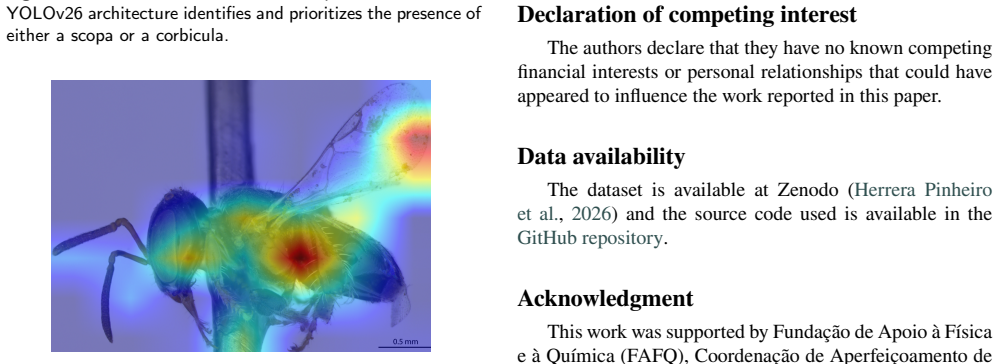
The machinery is the YOLOv26 nano classification model, a compact convolutional network, combined with HiResCAM, a class-activation-mapping method that produces element-wise importance scores at full resolution. The model is trained at 512×512 pixels on the stacked microscope images; HiResCAM is applied at inference to generate heatmaps that the authors compare against the characters in published identification keys, such as fore-wing vein 2m-cu, the discosubmarginal cell, and metasomal fusion. This combination lets the paper make a two-part argument: high accuracy plus biologically plausible attention.
What would settle it
Identify the same eleven families in a second collection photographed with different equipment or in the field and compare family-level accuracy; alternatively, occlude the wing-vein regions the heatmaps highlight for Ichneumonidae and check whether accuracy actually falls. If accuracy drops sharply, or stays unchanged when the highlighted region is removed, the paper's generalization and attention claims are not supported.
Extended reading notes
Core claim
The central claim is that a YOLOv26 nano image classifier, trained and tested on 3,556 high-resolution, focus-stacked Hymenoptera images, identifies eleven families—including the two ichneumonoid families Ichneumonidae (97% per-family accuracy) and Braconidae (above 94%)—at 96.14% top-1 accuracy overall. The paper further claims that HiResCAM activation maps show the model bases decisions on taxonomically diagnostic characters: presence or absence of the fore-wing vein 2m-cu and the areolet, fused metasomal tergites 2+3 in Braconidae, and scopa or corbicula in Apidae. Where the model attends to structures not in standard keys, the authors read this as evidence of usable, under-emphasised cha
Load-bearing premise
The load-bearing assumption is that the 15% test hold-out, drawn from the same institutional collection and imaged with the same microscope and focus-stacking workflow as the training images, is representative enough to justify the paper's claim of generalizing across morphological variation.
Editorial extensions
If this is right
- Family-level screening of Ichneumonoidea specimens could be automated at roughly 96% accuracy, reducing the bottleneck of expert-only identification in large biodiversity samples.
- The HiResCAM heatmaps give a concrete way to audit each prediction against morphological knowledge, allowing misclassifications to be inspected rather than treated as black-box outputs.
- Per-family results—97% for Ichneumonidae and above 94% for Braconidae—suggest the approach is already serviceable for the two focal families, not only for easier classes.
- Because the dataset and code are public, other groups can retrain or fine-tune the model for their own collections; the same pipeline could later be pushed to subfamily or genus level.
Reading between the lines
- Editorial inference: the 96.14% figure is measured on a test split from the same collection and imaging pipeline as the training images; accuracy on specimens from other collections, different lighting, or field photographs is an open question the paper does not test.
- Editorial inference: the cases where the model ignores textbook characters and uses broader body patterns suggest the heatmaps could be mined as a source of candidate new taxonomic characters, but those candidates would need morphological confirmation before being treated as discovered traits.
- Editorial inference: HiResCAM is used qualitatively; a quantitative localization check—such as occluding the highlighted wing region and measuring how much accuracy drops—would sharpen the claim that the model causally depends on those regions.
Editorial analysis
A structured set of objections, weighed in public.
Referee Report
Summary. The paper describes a deep-learning pipeline for family-level identification of Hymenoptera, with emphasis on the parasitoid superfamily Ichneumonoidea. The authors contribute the DAPWH dataset of 3,556 microscope images spanning 11 families, fine-tune YOLOv12 and YOLOv26 classification models at 512×512 resolution on a 70/15/15 image-level split, and report that the best model (YOLOv26) achieves 96.14% top-1 accuracy, 93.43% precision, 97.04% recall, and 95.20% F1 on the test set. They also use HiResCAM to produce class-activation heatmaps, which they interpret as evidence that the model attends to diagnostic morphological features such as wing venation and metasomal structure. The dataset and code are made publicly available.
Significance. If the reported performance transfers to unseen specimens and imaging conditions, the system would be a practical tool for accelerating biodiversity assessments of a hyper-diverse and taxonomically challenging superfamily. The open dataset and code are valuable contributions, and the use of HiResCAM is an appropriate step beyond opaque 'black-box' classification. However, the central empirical claim—96% accuracy on unseen Ichneumonoidea—depends on whether the image-level split avoids specimen-level leakage, which the manuscript does not demonstrate. The XAI 'confirmation' language also exceeds what post-hoc heatmaps can establish. The work is a useful application report, but its core generalization claims are not yet fully supported.
major comments (4)
- [§2.3, Table 2, Figs. 7–20] The train/validation/test split is performed on images, not on specimens. Table 2 reports counts per family as numbers of images, and the text in §2.3 says '70% of the total images,' but the paper never states whether each image corresponds to a unique specimen. The figures strongly suggest a multi-view protocol: Fig. 7 shows both 'Habitus lateral' and 'Head frontal' for Ichneumonidae, Fig. 8 shows the same two views for Braconidae, and Figs. 9–20 show wing, face, and metasomal images from the same families. If multiple views of one specimen appear in both training and test partitions, near-duplicate images violate the independence assumption and can inflate the reported 96.14% accuracy, precision, and recall. The authors must (a) report the number of unique specimens, (b) perform a grouped split by specimen ID, or (c) demonstrate that each image is a distinct specimen. This is load-bear
- [§3.1, Abstract] The claim of 'robust generalization across morphological variations' is not supported by the experimental design. The test set is drawn from the same DCBU collection and the same Leica/Helicon imaging pipeline as the training set. There is no external dataset, no cross-collection evaluation, and no evaluation on images acquired with different lighting, orientation, or stacking settings. Moreover, the paper reports single runs with no confidence intervals or repeated-seed experiments, so the 96.14% figure is a point estimate. The wording in the abstract and §3.1 should be tempered to describe performance on the DAPWH test set, not robust generalization to unseen imaging domains.
- [§3.3–3.5, Abstract, Conclusion] The abstract and conclusion state that HiResCAM visualizations 'confirm that the model focuses on taxonomically relevant anatomical regions,' but this is not a confirmatory test. The heatmaps are post-hoc qualitative interpretations, and the paper itself acknowledges in §3.3 that in some cases the model relied on 'non-traditional diagnostic characteristics' rather than features in standard keys. There is no quantitative comparison of heatmap regions against annotated morphological landmarks, and no blinded expert evaluation of whether the highlighted regions are diagnostic. The language 'confirm' and 'validate' overstates what the evidence can show. Recommend rewording to 'suggest' or 'are consistent with' and adding a quantitative evaluation if the confirmatory claim is retained.
- [§2.2, §3.1] The paper claims YOLOv12 and YOLOv26 represent 'current state-of-the-art,' but the evaluation includes no non-YOLO baselines such as a ResNet or vision transformer, no comparison to the cited works (e.g., Shirali et al. 2024 with BEiTv2), and no human-expert accuracy on the same test set. The only comparison is YOLOv12 vs. YOLOv26. This is insufficient to support the state-of-the-art claim and gives no calibration of how much the 96% figure improves upon existing methods or expert performance. A minimal fix is to add a standard baseline and, if possible, a human expert evaluation on the same test images.
minor comments (5)
- [Conclusion] The conclusion refers to 'the incorporation of Grad-CAM,' but the paper uses HiResCAM. Please correct this inconsistency.
- [Fig. 15 caption] The caption reads 'nandibles open'—likely a typo for 'mandibles open.'
- [§2.3] The split is described as 70/15/15, but the text does not explicitly state that the split was stratified by family. Table 2 shows near-proportional counts, but the process should be described (e.g., stratified random split with a fixed seed).
- [§3.1] Per-class accuracy values (e.g., 'Ichneumonidae achieved 97% accuracy') are mentioned in the text but are not reported in a table; please include a per-class breakdown with confidence intervals, especially for the underrepresented families Colletidae (n=51) and Halictidae (n=75).
- [General] The title and keywords use both 'HiresCam' and 'HiResCAM'; please standardize to 'HiResCAM' throughout.
Circularity Check
No significant circularity: the accuracy claim is an empirical measurement on a held-out split; self-citations are present but not load-bearing.
full rationale
The paper's central result is a supervised image-classification benchmark: the YOLOv26 model is trained on 70% of DAPWH and evaluated on a 15% test hold-out (Section 2.3, Table 3). No parameter is fit to the test labels and then reported as a prediction, and the HiResCAM analysis is post hoc and not fed back into the model or metrics. The dataset and prior thesis are self-citations, but they supply the input images and architecture-selection rationale, not the result; the test set is held out and the data are publicly available, so the claim is externally checkable. The main validity concern is that the split is at image level rather than specimen level, which could inflate generalization if multiple views of one specimen straddle the split; that is a data-leakage/correctness risk, not a circular derivation. No definitional equivalence, fitted-parameter-as-prediction, or uniqueness-imported-from-authors step is present.
Assumptions & free parameters
free parameters (3)
- input_resolution =
512×512 pixels
- training_epochs =
150
- architecture_scale =
nano (yolov12n-cls / yolo26n-cls)
assumptions (4)
- domain assumption Family labels in DAPWH are taxonomically correct.
- domain assumption The held-out test set represents the deployment distribution.
- domain assumption HiResCAM maps faithfully reflect the model's computations.
- domain assumption A researcher's visual reading of heatmaps establishes which morphological features the model uses.
Cite this review
Pith. "Pith review of Automated identification of Ichneumonoidea wasps via YOLO-based deep learning: Integrating HiresCam for Explainable AI." pith.science (2026). https://pith.science/paper/TA332KK3
@misc{pith2026260316351,
  author       = {Pith},
  title        = {Pith review of: Automated identification of Ichneumonoidea wasps via YOLO-based deep learning: Integrating HiresCam for Explainable AI},
  year         = {2026},
  howpublished = {\url{https://pith.science/paper/TA332KK3}},
  note         = {Machine review of arXiv:2603.16351}
}
read the original abstract
Accurate taxonomic identification of parasitoid wasps within the superfamily Ichneumonoidea is essential for biodiversity assessment, ecological monitoring, and biological control programs. However, morphological similarity, small body size, and fine-grained interspecific variation make manual identification labor-intensive and expertise-dependent. This study proposes a deep learning-based framework for the automated identification of Ichneumonoidea wasps using a YOLO-based architecture integrated with High-Resolution Class Activation Mapping (HiResCAM) to enhance interpretability. The proposed system simultaneously identifies wasp families from high-resolution images. The dataset comprises 3556 high-resolution images of Hymenoptera specimens. The taxonomic distribution is primarily concentrated among the families Ichneumonidae (n = 786), Braconidae (n = 648), Apidae (n = 466), and Vespidae (n = 460). Extensive experiments were conducted using a curated dataset, with model performance evaluated through precision, recall, F1 score, and accuracy. The results demonstrate high accuracy of over 96 % and robust generalization across morphological variations. HiResCAM visualizations confirm that the model focuses on taxonomically relevant anatomical regions, such as wing venation, antennae segmentation, and metasomal structures, thereby validating the biological plausibility of the learned features. The integration of explainable AI techniques improves transparency and trustworthiness, making the system suitable for entomological research to accelerate biodiversity characterization in an under-described parasitoid superfamily.
Figures


Figures from the paper (14 more)


Reference graph
Works this paper leans on
-
[1]
editor Allison, J.D. , editor Paine, T.D. , editor Slippers, B. , editor Wingfield, M.J. (Eds.), year 2023 . title Forest Entomology and Pathology . edition 1 ed., publisher Springer Cham . https://doi.org/10.1007/978-3-031-11553-0, :10.1007/978-3-031-11553-0
-
[2]
author Alzubaidi, L. , author Zhang, J. , author Humaidi, A.J. , author Al-Dujaili, A. , author Duan, Y. , author Al-Shamma, O. , author Santamaría, J. , author Fadhel, M.A. , author Al-Amidie, M. , author Farhan, L. , year 2021 . title Review of deep learning: concepts, cnn architectures, challenges, applications, future directions . journal Journal of B...
-
[3]
author Athey, K. , author Fernandez-Triana, J. , author Penteado-Dias, A. , author Quicke, D. , author Sharkey, M. , year 2023 . title 2023 key to the new world subfamilies of the family braconidae (hymenoptera) . journal Canadian Journal of Arthropod Identification :10.3752/cjai.2023.49
-
[4]
author Barbedo, J.G.A. , year 2020 . title Detecting and classifying pests in crops using proximal images and machine learning: A review . journal AI volume 1 , pages 312--328 . https://www.mdpi.com/2673-2688/1/2/21, :10.3390/ai1020021
-
[5]
, author Somavilla, A
author Barbizan Sühs, R. , author Somavilla, A. , author Köhler, A. , author Putzke, J. , year 2009 . title Vespídeos (hymenoptera, vespidae) vetores de pólen de schinus terebinthifolius raddi (anacardiaceae), santa cruz do sul, rs, brasil . journal Brazilian Journal of Biosciences volume 7 , pages 138--143
2009
-
[6]
author Batz, P. , author Will, T. , author Thiel, S. , author Ziesche, T.M. , author Joachim, C. , year 2023 . title From identification to forecasting: the potential of image recognition and artificial intelligence for aphid pest monitoring . journal Frontiers in Plant Science volume Volume 14 - 2023 . https://www.frontiersin.org/journals/plant-science/a...
arXiv 2023
-
[7]
author Beggs, J.R. , author Brockerhoff, E.G. , author Corley, J.C. , author Kenis, M. , author Masciocchi, M. , author Muller, F. , author Rome, Q. , author Villemant, C. , year 2011 . title Ecological effects and management of invasive alien vespidae . journal BioControl volume 56 , pages 505--526 . https://doi.org/10.1007/s10526-011-9389-z, :10.1007/s1...
-
[8]
author Bhatt, D. , author Patel, C. , author Talsania, H. , author Patel, J. , author Vaghela, R. , author Pandya, S. , author Modi, K. , author Ghayvat, H. , year 2021 . title Cnn variants for computer vision: History, architecture, application, challenges and future scope . journal Electronics volume 10 . https://www.mdpi.com/2079-9292/10/20/2470, :10.3...
Show all 69 references
-
[9]
, author Zemcik, T
author Bilik, S. , author Zemcik, T. , author Kratochvila, L. , author Ricanek, D. , author Richter, M. , author Zambanini, S. , author Horak, K. , year 2024 . title Machine learning and computer vision techniques in continuous beehive monitoring applications: A survey . journ...
2024
-
[10]
, author Bishop, H
author Bishop, C. , author Bishop, H. , year 2023 . title Deep Learning: Foundations and Concepts . publisher Springer International Publishing
2023
-
[11]
, author Quicke, D
author Butcher, B. , author Quicke, D. , year 2023 . title The Parasitoid Wasps of South East Asia . publisher CAB International
2023
-
[12]
, author Barton, P.S
author Cardoso, P. , author Barton, P.S. , author Birkhofer, K. , author Chichorro, F. , author Deacon, C. , author Fartmann, T. , author Fukushima, C.S. , author Gaigher, R. , author Habel, J.C. , author Hallmann, C.A. , author Hill, M.J. , author Hochkirch, A. , author Kwak,...
2020
-
[13]
, author van Achterberg, C
author Chen, X.x. , author van Achterberg, C. , year 2019 . title Systematics, phylogeny, and evolution of braconid wasps: 30 years of progress . journal Annual Review of Entomology volume 64 , pages 335--358 . https://www.annualreviews.org/content/journals/10.1146/annurev-ent...
2019 doi
-
[14]
, author Hervet, E
author Christin, S. , author Hervet, E. , author Lecomte, N. , year 2019 . title Applications for deep learning in ecology . journal Methods in Ecology and Evolution volume 10 , pages 1632--1644 . https://besjournals.onlinelibrary.wiley.com/doi/abs/10.1111/2041-210X.13256, :ht...
2019 doi
-
[15]
, author Rieder, R
author De Cesaro Júnior , T. , author Rieder, R. , year 2020 . title Automatic identification of insects from digital images: A survey . journal Computers and Electronics in Agriculture volume 178 , pages 105784 . https://www.sciencedirect.com/science/article/pii/S016816992031...
2020
-
[16]
, author Carin, L
author Draelos, R.L. , author Carin, L. , year 2021 . title Use hirescam instead of grad-cam for faithful explanations of convolutional neural networks . https://arxiv.org/abs/2011.08891, arXiv:2011.08891 http://arxiv.org/abs/2011.08891
2021 arXiv
-
[17]
, year 2020
author Eggleton, P. , year 2020 . title The state of the world’s insects . journal Annual Review of Environment and Resources volume 45 , pages 61--82 . https://www.annualreviews.org/content/journals/10.1146/annurev-environ-012420-050035, :https://doi.org/10.1146/annurev-envir...
2020 doi
-
[18]
, author Calviño, A
author Fenoglio, M.S. , author Calviño, A. , author González, E. , author Salvo, A. , author Videla, M. , year 2021 . title Urbanisation drivers and underlying mechanisms of terrestrial insect diversity loss in cities . journal Ecological Entomology volume 46 , pages 757--771 ...
2021 doi
-
[19]
, author Bagley, R.K
author Forbes, A.A. , author Bagley, R.K. , author Beer, M.A. , author Hippee, A.C. , author Widmayer, H.A. , year 2018 . title Quantifying the unquantifiable: why hymenoptera, not coleoptera, is the most speciose animal order . journal BMC Ecology volume 18 , pages 21 . https...
2018 doi
-
[20]
, author Tscharntke, T
author Gabriel, D. , author Tscharntke, T. , year 2007 . title Insect pollinated plants benefit from organic farming . journal Agriculture, Ecosystems & Environment volume 118 , pages 43--48 . https://www.sciencedirect.com/science/article/pii/S0167880906001484, :https://doi.or...
2007 doi
-
[21]
, author Xue, X
author Gao, Y. , author Xue, X. , author Qin, G. , author Li, K. , author Liu, J. , author Zhang, Y. , author Li, X. , year 2024 . title Application of machine learning in automatic image identification of insects - a review . journal Ecological Informatics volume 80 , pages 1...
2024
-
[22]
, author Bolton, B
author Gauld, I. , author Bolton, B. , year 1988 . title The Hymenoptera . publisher British Museum (Natural History)
1988
-
[23]
, author Bengio, Y
author Goodfellow, I. , author Bengio, Y. , author Courville, A. , year 2016 . title Deep Learning . Adaptive Computation and Machine Learning series, publisher MIT Press
2016
-
[24]
, author Gauld, I.D
author Hanson, P.E. , author Gauld, I.D. , year 1995 . title The Hymenoptera of Costa Rica: The Natural History Museum, London . publisher Oxford University Press . https://doi.org/10.1093/oso/9780198549055.001.0001, :10.1093/oso/9780198549055.001.0001
1995
-
[25]
, author do Nascimento Herrera, G
author Herrera Pinheiro, J.M. , author do Nascimento Herrera, G. , author Bueno dos Reis Fernandes, L. , author Doria dos Santos, A. , author Vilela de Godoy, R. , author Andrade Botelho de Almeida, E. , author Carolina Onody, H. , author Andrade da Costa Vieira, M. , author M...
2026 doi
-
[26]
, author Ärje, J
author Høye, T.T. , author Ärje, J. , author Bjerge, K. , author Hansen, O.L.P. , author Iosifidis, A. , author Leese, F. , author Mann, H.M.R. , author Meissner, K. , author Melvad, C. , author Raitoharju, J. , year 2021 . title Deep learning and computer vision will transfor...
2021 doi
-
[27]
, author Goswami, A.K
author Indolia, S. , author Goswami, A.K. , author Mishra, S. , author Asopa, P. , year 2018 . title Conceptual understanding of convolutional neural network- a deep learning approach . journal Procedia Computer Science volume 132 , pages 679--688 . https://www.sciencedirect.c...
2018 doi
-
[28]
, year 2018
author Jankielsohn, A. , year 2018 . title The importance of insects in agricultural ecosystems . journal Advances in Entomology volume 06 , pages 62--73 . :10.4236/ae.2018.62006
2018
-
[29]
, author Santos, B.F
author Klopfstein, S. , author Santos, B.F. , author Shaw, M.R. , author Alvarado, M. , author Bennett, A.M. , author Dal Pos, D. , author Giannotta, M. , author Herrera Florez, A.F. , author Karlsson, D. , author Khalaim, A.I. , author et al. , year 2019 . title Darwin wasps:...
2019
-
[30]
, author Bengio, Y
author LeCun, Y. , author Bengio, Y. , author Hinton, G. , year 2015 . title Deep learning . journal Nature volume 521 , pages 436--444 . https://doi.org/10.1038/nature14539, :10.1038/nature14539
2015 doi
-
[31]
, author Zheng, T
author Li, W. , author Zheng, T. , author Yang, Z. , author Li, M. , author Sun, C. , author Yang, X. , year 2021 . title Classification and detection of insects from field images using deep learning for smart pest management: A systematic review . journal Ecological Informati...
2021
-
[32]
, author Maire, M
author Lin, T.Y. , author Maire, M. , author Belongie, S. , author Bourdev, L. , author Girshick, R. , author Hays, J. , author Perona, P. , author Ramanan, D. , author Zitnick, C.L. , author Dollár, P. , year 2015 . title Microsoft coco: Common objects in context . https://ar...
2015 arXiv
-
[33]
, author Harvey, A.D
author Magni, P.A. , author Harvey, A.D. , author Guareschi, E.E. , year 2023 . title Insects associated with ancient human remains: How archaeoentomology can provide additional information in archaeological studies . journal Heritage volume 6 , pages 435--465 . https://www.md...
2023 doi
-
[34]
, year 1974
author Matthews, R. , year 1974 . title Biology of braconidae . journal Annual Review of Entomology volume 19 , pages 15--32 . :10.1146/annurev.en.19.010174.000311
1974
-
[35]
, year 1986
author May, R.M. , year 1986 . title Biological diversity: How many species are there? journal Nature volume 324 , pages 514--515 . https://doi.org/10.1038/324514a0, :10.1038/324514a0
1986 doi
-
[36]
, year 2007
author Michener, C. , year 2007 . title The Bees of the World . publisher Johns Hopkins University Press
2007
-
[37]
, author Tittensor, D.P
author Mora, C. , author Tittensor, D.P. , author Adl, S. , author Simpson, A.G.B. , author Worm, B. , year 2011 . title How many species are there on earth and in the ocean? journal PLOS Biology volume 9 , pages 1--8 . https://doi.org/10.1371/journal.pbio.1001127, :10.1371/jo...
2011 doi
-
[38]
, author Campbell, S
author O'Mahony, N. , author Campbell, S. , author Carvalho, A. , author Harapanahalli, S. , author Hernandez, G.V. , author Krpalkova, L. , author Riordan, D. , author Walsh, J. , year 2020 . title Deep learning vs. traditional computer vision , in: editor Arai, K. , editor K...
2020
-
[39]
, author Tan, B
author Ong, X.R. , author Tan, B. , author Chang, C.H. , author Puniamoorthy, N. , author Slade, E.M. , year 2025 . title Identifying the knowledge and capacity gaps in southeast asian insect conservation . journal Ecology Letters volume 28 , pages e70038 . https://onlinelibra...
2025 doi
-
[40]
, author Borges, P.A
author Pardo, A. , author Borges, P.A. , year 2020 . title Worldwide importance of insect pollination in apple orchards: A review . journal Agriculture, Ecosystems & Environment volume 293 , pages 106839 . https://www.sciencedirect.com/science/article/pii/S0167880920300244, :h...
2020
-
[41]
, author Tsakalos, K.A
author Passias, A. , author Tsakalos, K.A. , author Rigogiannis, N. , author Voglitsis, D. , author Papanikolaou, N. , author Michalopoulou, M. , author Broufas, G. , author Sirakoulis, G.C. , year 2024 . title Insect pest trap development and dl-based pest detection: A compre...
2024
-
[42]
, author Fernandes, L.B.d.R
author Penteado-Dias, A.M. , author Fernandes, L.B.d.R. , year 2025 . title Dcbu - cole c \ ao taxon \^o mica do departamento de ecologia e biologia evolutiva da ufscar . https://doi.org/10.15468/xzkz3y, :10.15468/xzkz3y
2025 doi
-
[43]
, author Becker, M
author Pinheiro, J.M.H. , author Becker, M. , year 2026 . title Deep learning-based computer vision techniques for automated identification of Ichneumonoidea and other Hymenoptera insects . Master's thesis. Universidade de São Paulo. :10.11606/D.18.2026.tde-09022026-143242
2026 doi
-
[44]
, author Herrera, G.D.N
author Pinheiro, J.M.H. , author Herrera, G.D.N. , author Fernandes, L.B.D.R. , author Santos, A.D.D. , author Godoy, R.V. , author Almeida, E.A.B. , author Onody, H.C. , author Vieira, M.A.D.C. , author Penteado-Dias, A.M. , author Becker, M. , year 2026 . title Descriptor: D...
2026 arXiv
-
[45]
, year 2015
author Quicke, D. , year 2015 . title The Braconid and Ichneumonid Parasitoid Wasps: Biology, Systematics, Evolution and Ecology . publisher Wiley
2015
-
[46]
, year 2020
author Raschka, S. , year 2020 . title Model evaluation, model selection, and algorithm selection in machine learning . https://arxiv.org/abs/1811.12808, arXiv:1811.12808 http://arxiv.org/abs/1811.12808
2020 arXiv
-
[47]
, author Card \'e , R
author Resh, V. , author Card \'e , R. , year 2009 . title Encyclopedia of Insects . Encyclopedia of Insects, publisher Academic Press
2009
-
[48]
, author Cheppally, R.H
author Sapkota, R. , author Cheppally, R.H. , author Sharda, A. , author Karkee, M. , year 2026 . title Yolo26: Key architectural enhancements and performance benchmarking for real-time object detection . https://arxiv.org/abs/2509.25164, arXiv:2509.25164 http://arxiv.org/abs/...
2026
-
[49]
, year 2021
author Sarker, I.H. , year 2021 . title Deep learning: A comprehensive overview on techniques, taxonomy, applications and research directions . journal SN Computer Science volume 2 , pages 420 . https://doi.org/10.1007/s42979-021-00815-1, :10.1007/s42979-021-00815-1
2021 doi
-
[50]
, author Noriega, J
author Schowalter, T. , author Noriega, J. , author Tscharntke, T. , year 2018 . title Insect effects on ecosystem services—introduction . journal Basic and Applied Ecology volume 26 , pages 1--7 . https://www.sciencedirect.com/science/article/pii/S1439179117302207, :https://d...
2018 doi
-
[51]
, author Amini, M
author Sharifani, K. , author Amini, M. , year 2023 . title Machine learning and deep learning: A review of methods and applications . journal World Information Technology and Engineering Journal volume 10 , pages 3897--3904 . https://ssrn.com/abstract=4458723. note available ...
2023
-
[52]
, author Huddleston, T
author Shaw, M. , author Huddleston, T. , year 1991 . title Classification and Biology of Braconid Wasps (Hymenoptera: Braconidae) . Handbooks for the identification of British insects, publisher Royal Entomological Society of London
1991
-
[53]
, author Shah, S
author Shinde, P.P. , author Shah, S. , year 2018 . title A review of machine learning and deep learning applications , in: booktitle 2018 Fourth International Conference on Computing Communication Control and Automation (ICCUBEA) , pp. pages 1--6 . :10.1109/ICCUBEA.2018.8697857
2018
-
[54]
, author H \"u bner, J
author Shirali, H. , author H \"u bner, J. , author Both, R. , author Raupach, M. , author Reischl, M. , author Schmidt, S. , author Pylatiuk, C. , year 2024 . title Image-based recognition of parasitoid wasps using advanced neural networks . journal Invertebrate Systematics v...
2024 doi
-
[55]
, author Ong, X.R
author Slade, E.M. , author Ong, X.R. , year 2023 . title The future of tropical insect diversity: strategies to fill data and knowledge gaps . journal Current Opinion in Insect Science volume 58 , pages 101063 . https://www.sciencedirect.com/science/article/pii/S2214574523000...
2023
-
[56]
, year 2018
author Stork, N.E. , year 2018 . title How many species of insects and other terrestrial arthropods are there on earth? journal Annual Review of Entomology volume 63 , pages 31--45 . https://www.annualreviews.org/content/journals/10.1146/annurev-ento-020117-043348, :https://do...
2018 doi
-
[57]
, author Ribeiro, J
author Teixeira, A.C. , author Ribeiro, J. , author Morais, R. , author Sousa, J.J. , author Cunha, A. , year 2023 . title A systematic review on automatic insect detection using deep learning . journal Agriculture volume 13 . https://www.mdpi.com/2077-0472/13/3/713, :10.3390/...
2023 doi
-
[58]
, author Ye, Q
author Tian, Y. , author Ye, Q. , author Doermann, D. , year 2025 . title Yolo12: Attention-centric real-time object detectors . journal arXiv preprint arXiv:2502.12524
2025 arXiv
-
[59]
, author Grames, E.M
author Wagner, D.L. , author Grames, E.M. , author Forister, M.L. , author Berenbaum, M.R. , author Stopak, D. , year 2021 . title Insect decline in the anthropocene: Death by a thousand cuts . journal Proceedings of the National Academy of Sciences volume 118 , pages e2023989...
2021 doi
-
[60]
, year 2018
author Weinstein, B.G. , year 2018 . title A computer vision for animal ecology . journal Journal of Animal Ecology volume 87 , pages 533--545 . https://besjournals.onlinelibrary.wiley.com/doi/abs/10.1111/1365-2656.12780, :https://doi.org/10.1111/1365-2656.12780, arXiv:https:/...
2018
-
[61]
, author Pohl, H
author Wipfler, B. , author Pohl, H. , author Yavorskaya, M.I. , author Beutel, R.G. , year 2016 . title A review of methods for analysing insect structures — the role of morphology in the age of phylogenomics . journal Current Opinion in Insect Science volume 18 , pages 60--6...
2016 doi
-
[62]
, author Zhan, C
author Wu, X. , author Zhan, C. , author Lai, Y.K. , author Cheng, M.M. , author Yang, J. , year 2019 . title Ip102: A large-scale benchmark dataset for insect pest recognition , in: booktitle 2019 IEEE/CVF Conference on Computer Vision and Pattern Recognition (CVPR) , pp. pag...
2019
-
[63]
, author Pylatiuk, C
author Wührl, L. , author Pylatiuk, C. , author Giersch, M. , author Lapp, F. , author von Rintelen, T. , author Balke, M. , author Schmidt, S. , author Cerretti, P. , author Meier, R. , year 2022 . title Diversityscanner: Robotic handling of small invertebrates with machine l...
2022
-
[64]
, author Rettenberger, L
author Wührl, L. , author Rettenberger, L. , author Meier, R. , author Hartop, E. , author Graf, J. , author Pylatiuk, C. , year 2024 . title Entomoscope: An open-source photomicroscope for biodiversity discovery . journal IEEE Access volume 12 , pages 11785--11794 . :10.1109/...
2024
-
[65]
, author van Achterberg, C
author Yu, D. , author van Achterberg, C. , author Horstmann, K. , year 2012 . title World Ichneumonoidea 2011: Taxonomy, Biology, Morphology and Distribution . publisher Taxapad
2012
-
[66]
, author van Achterberg, C
author Yu, D.S. , author van Achterberg, C. , author Horstmann, K. , year 2016 . title World ichneumonoidea 2015: Taxonomy, biology, morphology and distribution . howpublished Taxapad 2016
2016
-
[67]
, author Wang, L
author Zhao, X. , author Wang, L. , author Zhang, Y. , author Han, X. , author Deveci, M. , author Parmar, M. , year 2024 . title A review of convolutional neural networks in computer vision . journal Artificial Intelligence Review volume 57 , pages 99 . https://doi.org/10.100...
2024 doi
-
[68]
, author Raitoharju, J
author Ärje, J. , author Raitoharju, J. , author Iosifidis, A. , author Tirronen, V. , author Meissner, K. , author Gabbouj, M. , author Kiranyaz, S. , author Kärkkäinen, S. , year 2020 . title Human experts vs. machines in taxa recognition . journal Signal Processing: Image C...
2020
-
[69]
write newline
" write newline "" before.all 'output.state := FUNCTION n.dashify 't := "" t empty not t #1 #1 substring "-" = t #1 #2 substring "--" = not "--" * t #2 global.max substring 't := t #1 #1 substring "-" = "-" * t #2 global.max substring 't := while if t #1 #1 substring * t #2 gl...
Reviewed August 2, 2026 · model on record in the stance chip above.
Discussion (0). Sign in to comment.