REVIEW 2 major objections 4 minor 37 references
Stochastic Resetting Accelerates Reinforcement Learning Beyond Random Search
T0 review · 2 major / 4 minor · reviewed 2026-08-02 · deepseek-v4-flash
Pith's one-line read Randomly resetting a learning agent to its start can speed policy convergence even when it slows random-walk search.
desk verdict The empirical finding—that resetting speeds Q-learning/DQN in sparse-reward, hard-exploration settings—looks solid, but the paper's central 'beyond search' claim rests on a random-walker baseline that doesn't control for the learner's own goal encounters, and the abstract promises a deterministic comparison the paper never delivers. read the letter →
The pith
A machine-rendered reading of the paper's core claim, the machinery that carries it, and where it could break.
The reading
What carries the argument
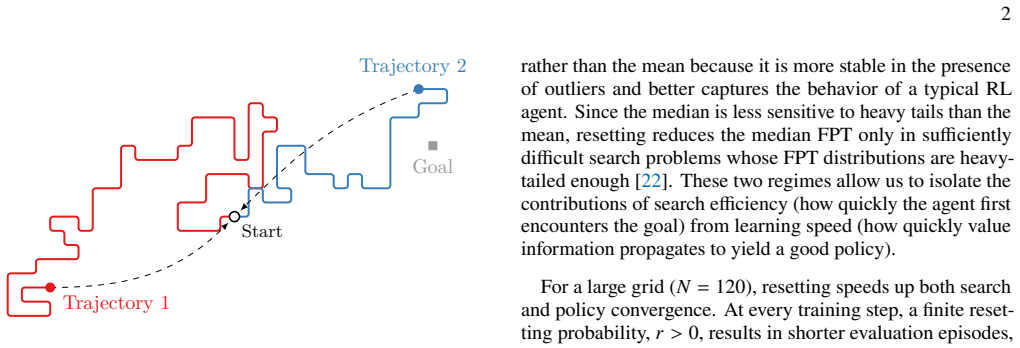
The load-bearing object is the stochastic resetting protocol itself: at each training step, before action selection, the agent returns to the start state with probability r, independent of its state and action, with no value update on the reset transition. Its work is to reshape the distribution of training trajectories — most importantly, to shorten the final segment from the last reset to the goal — which in one-step temporal-difference algorithms controls how quickly value information propagates backward from the reward. The paper contrasts this with the discount factor gamma, which changes the optimal value landscape and hence the learned policy.
What would settle it
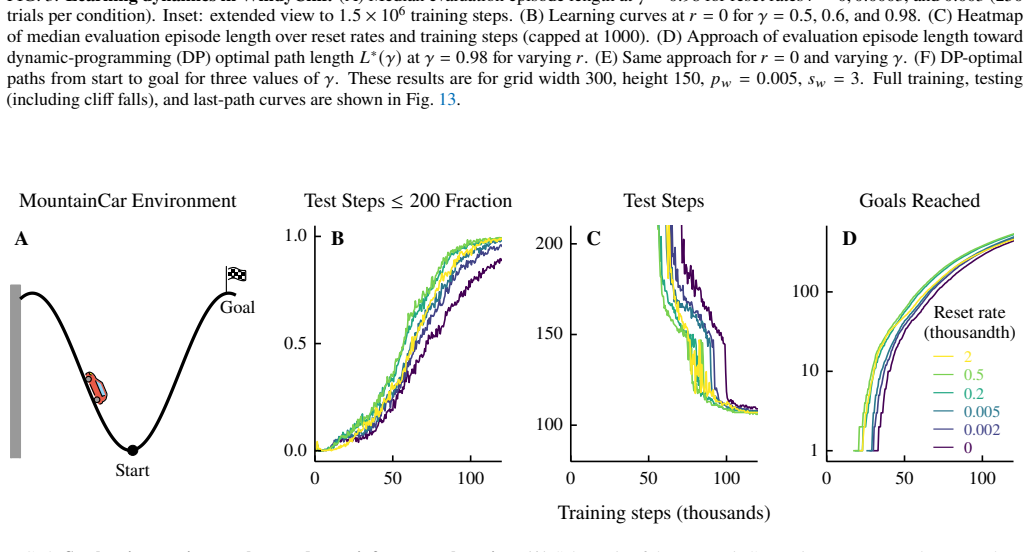
Measure, during GridWorld training, the cumulative number of times the epsilon-greedy agent actually reaches the goal as a function of reset rate. If for N=60 the agent's own goal encounters improve with r — mirroring Fig. 4D in MountainCar — then the claimed mechanism beyond search optimization is falsified for that environment.
Extended reading notes
Core claim
On the paper's own terms, the central discovery is a mechanism: stochastic resetting speeds temporal-difference value propagation by clipping the 'final path' — the contiguous segment between the last reset and the goal — so that Bellman updates act on shorter, more direct backups. In a 60x60 grid where the median first-passage time of a random walker increases monotonically with reset rate, a small nonzero reset rate still makes the learning curve drop below the no-resetting baseline, indicating faster policy convergence despite worse search. The same intervention in a 120x120 grid speeds both search and learning. In WindyCliff, resetting alters the speed of convergence but not its endpoint
Load-bearing premise
The load-bearing baseline is that the median first-passage time of a uniformly random walker is the right measure of 'search' for an epsilon-greedy Q-learner; the paper never reports the learning agent's own goal-encounter rate in GridWorld, and if resetting improves that rate (as it does in MountainCar), the 'beyond search' conclusion collapses into ordinary search improvement.
Editorial extensions
If this is right
- Resetting accelerates policy convergence in tabular Q-learning at moderate exploration rates, and the speedup grows with grid size where search is also improved.
- The benefit is separable from search efficiency: in N=60 GridWorld, resetting hurts random-walker median first-passage time yet still speeds learning at epsilon=0.1 and 0.5.
- Resetting does not alter the optimal policy in WindyCliff; different reset rates converge to the same final episode length, whereas different discount factors converge to different DP-optimal paths.
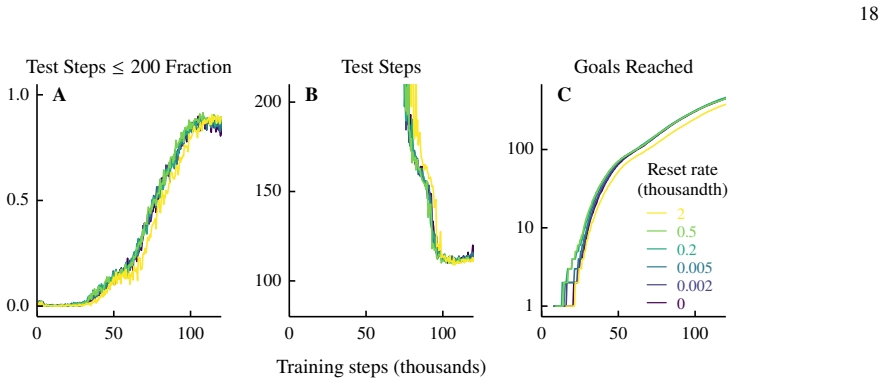
- In continuous-state MountainCar with DQN, intermediate reset rates accelerate learning when goal discovery is hard and rewards are sparse; the gain disappears with step penalties or an easy-to-reach goal.
- Since resetting is applied externally and no value update occurs on the reset transition, the method is a drop-in training-time intervention that preserves the learned value function.
Reading between the lines
- If the GridWorld learning agent's own goal-encounter rate also increases with resetting (as it does in MountainCar, Fig. 4D), the 'beyond search optimization' claim would reduce to ordinary search improvement; the paper does not report that metric for GridWorld.
- The mechanism suggests a general principle for episodic RL: truncating uninformative trajectories is a cheap substitute for richer exploration methods when the bottleneck is finding sparse rewards — but it will not help when progress requires identifying informative behaviors in deceptive or partially observable environments, a limitation the paper acknowledges.
- The comparison with the deterministic limit (fixed-interval restarting, equivalent to episode-length truncation) invites a systematic test of whether periodic or adaptive reset schedules dominate memoryless resetting; this is declared future work.
- One could test the mechanism directly by measuring the median length of the final path under resetting and correlating it with convergence speed across a range of reset rates; the paper's Fig. 2C already shows shorter final paths at higher r.
Signed reviews
Editorial analysis
A structured set of objections, weighed in public.
Referee Report
Summary. The paper studies the effect of stochastic resetting — returning an RL agent to its start state with probability r at each training step — on Q-learning in tabular GridWorld and WindyCliff environments and on DQN in MountainCar. The main claims are: (i) in a large GridWorld (N=120) resetting speeds up both search and policy convergence, while in a smaller GridWorld (N=60) resetting accelerates policy convergence even though the median first-passage time of a uniformly random walker worsens, indicating a mechanism beyond classical search optimization; (ii) unlike the discount factor, resetting changes the speed of convergence but not the optimal policy; (iii) in a hard-exploration sparse-reward MountainCar variant, intermediate reset rates accelerate DQN learning; and (iv) deterministic resetting accelerates learning more than stochastic resetting but over a narrower range of rates. The evidence includes reset-rate sweeps, 250–512 replicates per condition, null controls with standard and step-penalty reward schemes, and dynamic-programming baselines for the cliff environment. No code or data are provided.
Significance. If the central claim holds, the paper would extend stochastic-resetting theory from static searchers to adaptive learning agents and identify a training-time intervention that speeds temporal-difference value propagation without changing the optimal policy. The study has notable strengths: reset rates are swept rather than fitted, results are based on many independent replicates, the discount-factor comparison in WindyCliff is grounded by Bellman-iteration optimal policies, and the MountainCar ablation (hard vs. easy exploration, sparse vs. step-penalty reward) cleanly identifies a regime where resetting helps. The main risk is that the 'beyond search' conclusion in GridWorld is inferred from a random-walker first-passage baseline rather than from the learning agent's own goal-encounter rate; if the learner's search also improves with resetting in N=60, the claimed distinct mechanism is not established. In addition, the abstract's deterministic-resetting result is not supported by any experiment in the manuscript.
major comments (2)
- [Section II.A / Fig. 2B] The central 'beyond search optimization' claim rests on comparing policy-convergence curves against the median FPT of a uniformly random walker (dashed curves in Fig. 2B). However, the search efficiency of the actual ε-greedy Q-learner is never measured in GridWorld. In MountainCar, Fig. 4D shows that resetting increases the learner's goal-encounter rate; the same may be true in N=60, in which case the r=0.0015 speedup in Fig. 2A is explained by improved search for the adaptive agent rather than a distinct value-propagation mechanism. Please report the learning agent's goal-encounter rate (or first-goal time) during training for each r and ε in GridWorld, or otherwise demonstrate that resetting does not improve the learner's own search efficiency in N=60. This is load-bearing for the abstract's primary claim.
- [Abstract vs. Discussion III] The abstract states: 'We show that deterministic, sharp resetting accelerates learning more than the stochastic protocol but over a narrower range of reset rates.' The manuscript contains no experiment or analysis comparing stochastic and deterministic reset schedules. The Discussion (Section III) explicitly says 'A systematic empirical comparison between stochastic and deterministic restart schedules is an important direction for future work.' This is an internal inconsistency: the abstract claims a result the paper does not provide. The deterministic statement should be removed from the abstract or supported by the corresponding experiment.
minor comments (4)
- [Title] The metadata/arXiv title is 'Stochastic Resetting Accelerates Reinforcement Learning Beyond Random Search', while the manuscript title on the first page is 'Stochastic Resetting Accelerates Policy Convergence in Reinforcement Learning'. Please harmonize these titles.
- [Discussion III] The sentence 'This simplicity also limits its scope...' appears twice verbatim in the Discussion; one copy should be deleted.
- [Fig. 3D/E] The y-axis label in Fig. 3D/E reads 'log10 (max(0.01, |median L*|))', which does not appear to describe the quantity plotted. The caption says 'Approach of evaluation episode length toward DP optimal path length L*', so the label likely should be something like log10(|median episode length − L*|). Please correct.
- [Reproducibility] No code or data repository is provided or referenced. For a computational study with many experimental conditions and replicate sweeps, this limits verification and reuse. At least a repository with the exact environment implementations, hyperparameters, and analysis scripts should be made available.
Circularity Check
No circular derivation found: reset rates are swept, not fitted; the Fig. 2B dissociation compares two independently simulated quantities; 'resetting preserves the optimal policy' is an acknowledged construction property, not a prediction. The abstract's deterministic-resetting claim is unsupported by the manuscript (Discussion defers it), which is a missing-support flag rather than a circular ste
full rationale
No circular derivation chain is present. The paper's central load-bearing empirical claims—faster policy convergence under resetting in GridWorld/WindyCliff, and the dissociation between learning curves and random-walker first-passage time in Fig. 2B—come from independent simulations: the FPT baselines (dashed curves, 2500 random-walker trials per (N,r)) and the Q-learning learning curves (solid curves, 250 trials per condition) are separately computed, and reset rates are swept over a fixed grid (r = 0, 0.0001, ..., 0.003) rather than fitted to the target outcome. Thus no 'prediction' reduces to a fitted input, and no equation reduces to another by construction. The statement in Methods II.C, 'Because resetting does not alter the reward structure or the definition of the value function, it does not change the optimal policy,' is an analytic property of the intervention that the paper honestly discloses; confirming it in WindyCliff (Fig. 3A/D) is a consistency check, and the convergence-speed comparison is the independent part, so this is not circular. The 'beyond search optimization' conclusion is an empirical dissociation relative to the stated random-walker baseline; the skeptic's concern that the learner's own goal-encounter rate is never reported for GridWorld (whereas it improves with resetting in MountainCar, Fig. 4D) is a construct-validity/correctness risk, not circularity of derivation. The only self-citation, Ref. [32] (Strouse et al., with co-author Schwab), appears in a future-work sentence about multi-agent settings and is not load-bearing. In-scope flags weighed but not scored as circularity: (1) the Abstract sentence 'We show that deterministic, sharp resetting accelerates learning more than the stochastic protocol but over a narrower range of reset rates' is not supported by any experiment in the manuscript, and the Discussion states 'A systematic empirical comparison between stochastic and deterministic restart schedules is an important direction for future work'—an unsupported-claim/rigor issue, not a circular step; (2) the authors' own scope limitation about deceptive rewards and partial observability is honestly stated. Verdict: no significant circularity; score 1.
Assumptions & free parameters
free parameters (4)
- GridWorld small-system size N=60
- MountainCar left boundary = -1.7 =
-1.7
- WindyCliff wind probability/strength p_w=0.005, s_w=3 =
p_w=0.005, s_w=3
- Reset-rate sweep range [0, 0.003]
assumptions (4)
- standard math Q-learning with tabular representation and ε-greedy exploration converges to the optimal policy in the no-reset limit
- domain assumption Resetting during training does not alter the environment MDP or the optimal policy because reset transitions carry no value update
- ad hoc to paper A random walker's median first-passage time is a valid proxy for the search efficiency of the ε-greedy learning agent
- domain assumption Median statistics adequately summarize the heavy-tailed training/evaluation distributions
Cite this review
Pith. "Pith review of Stochastic Resetting Accelerates Reinforcement Learning Beyond Random Search." pith.science (2026). https://pith.science/paper/G36KQDHA
@misc{pith2026260316842,
  author       = {Pith},
  title        = {Pith review of: Stochastic Resetting Accelerates Reinforcement Learning Beyond Random Search},
  year         = {2026},
  howpublished = {\url{https://pith.science/paper/G36KQDHA}},
  note         = {Machine review of arXiv:2603.16842}
}
read the original abstract
Stochastic resetting -- intermittently returning a process to a fixed reference state -- has emerged as an effective mechanism for optimizing first-passage properties. Existing theory largely treats processes that search but do not learn: the searcher follows fixed dynamics, accumulating no knowledge between resets. Here we ask how stochastic resetting interacts with reinforcement learning, where the underlying dynamics adapt through experience. In tabular grid environments, we find that resetting can accelerate learning even when it does not reduce the search time of a diffusive agent. Our results reveal a distinct additional mechanism through which resetting speeds the propagation of reward information. We show that deterministic, sharp resetting accelerates learning more than the stochastic protocol but over a narrower range of reset rates. In a continuous-state task with neural-network-based value approximation, we demonstrate that resetting speeds up learning when exploration is hard and rewards are sparse. We argue further that, in the tabular tasks, resetting accelerates learning without altering the solution the agent ultimately reaches, unlike other techniques such as temporal discounting, which biases the optimal behavior. Our results establish stochastic resetting as a simple, tunable mechanism for accelerating learning by shaping how experience accumulates, extending a canonical phenomenon of statistical mechanics to adaptive systems.
Figures


Figures from the paper (14 more)




Reference graph
Works this paper leans on
-
[1]
G. H. Orions and N. E. Pearson, On the theory of central place foraging (Ohio State University Press, Columbus, 1979) pp. 154–177
1979
-
[2]
Lecheval, E
V. Lecheval, E. J. H. Robinson, and R. P. Mann, Random walks with spatial and temporal resets can explain individual and colony-level searching patterns in ants, J. R. Soc. Interface21, 20240149 (2024)
2024
-
[3]
M.Luby, A.Sinclair,andD.Zuckerman,Optimalspeedupoflas vegas algorithms, Information Processing Letters47, 173–180 (1993)
1993
-
[4]
C.P.Gomes,B.Selman,andH.A.Kautz,Boostingcombinatorial search through randomization, inAAAI/IAAI(1998)
1998
-
[5]
Montanari and R
A. Montanari and R. Zecchina, Optimizing searches via rare events, Phys. Rev. Lett.88, 178701 (2002)
2002
-
[6]
J. J. Hopfield, Kinetic proofreading: A new mechanism for re- ducingerrorsinbiosyntheticprocessesrequiringhighspecificity, Proceedings of the National Academy of Sciences71, 4135 (1974)
1974
-
[7]
Ninio, Kinetic amplification of enzyme discrimination, Biochimie57, 587 (1975)
J. Ninio, Kinetic amplification of enzyme discrimination, Biochimie57, 587 (1975)
1975
-
[8]
M. R. Evans and S. N. Majumdar, Diffusion with stochastic resetting, Phys. Rev. Lett.106, 160601 (2011)
2011
Show all 37 references
-
[9]
M. R. Evans, S. N. Majumdar, and G. Schehr, Stochastic reset- ting and applications, Journal of Physics A: Mathematical and Theoretical53, 193001 (2020)
2020
-
[10]
Gupta and A
S. Gupta and A. M. Jayannavar, Stochastic resetting: A (very) brief review, Frontiers in Physics10, 10.3389/fphy.2022.789097 (2022)
2022
-
[11]
S.Reuveni,Optimalstochasticrestartrendersfluctuationsinfirst passage times universal, Phys. Rev. Lett.116, 170601 (2016)
2016
-
[12]
Pal and S
A. Pal and S. Reuveni, First passage under restart, Phys. Rev. Lett.118, 030603 (2017)
2017
-
[13]
Kusmierz, S
L. Kusmierz, S. N. Majumdar, S. Sabhapandit, and G. Schehr, First order transition for the optimal search time of lévy flights with resetting, Phys. Rev. Lett.113, 220602 (2014)
2014
-
[14]
P. C. Bressloff, Search processes with stochastic resetting and multiple targets, Phys. Rev. E102, 022115 (2020)
2020
-
[15]
D.Gupta, C.A.Plata, A.Kundu,andA.Pal,Stochasticresetting with stochastic returns using external trap, Journal of Physics A: Mathematical and Theoretical54, 025003 (2020)
2020
-
[16]
T.D.Keidar, O.Blumer, B.Hirshberg,andS.Reuveni,Adaptive resetting for informed search strategies and the design of non- equilibrium steady-states, Nature Communications16, 7259 (2025)
2025
-
[17]
Falcón-Cortés, D
A. Falcón-Cortés, D. Boyer, L. Giuggioli, and S. N. Majumdar, Localization transition induced by learning in random searches, Phys. Rev. Lett.119, 140603 (2017)
2017
-
[18]
R.SuttonandA.Barto,Reinforcementlearning: Anintroduction, IEEE Transactions on Neural Networks9, 1054–1054 (1998)
1998
-
[19]
C. J. C.H. Watkinsand P. Dayan,Q-learning, Machine Learning 8, 279–292 (1992)
1992
-
[20]
A. W. Moore,Efficient Memory-based Learning for Robot Con- trol, Tech. Rep. (University of Cambridge, 1990)
1990
-
[21]
V. Mnih, K. Kavukcuoglu, D. Silver, A. A. Rusu, J. Veness, M. G. Bellemare, A. Graves, M. Riedmiller, A. K. Fidjeland, G. Ostrovski, S. Petersen, C. Beattie, A. Sadik, I. Antonoglou, H. King, D. Kumaran, D. Wierstra, S. Legg, and D. Hassabis, 8 Human-levelcontrolthroughdeeprei...
2015
-
[22]
Belan, Median and mode in first passage under restart, Phys
S. Belan, Median and mode in first passage under restart, Phys. Rev. Res.2, 013243 (2020)
2020
-
[23]
Burda, H
Y. Burda, H. Edwards, A. Storkey, and O. Klimov, Exploration by random network distillation (2018)
2018
-
[24]
Ecoffet, J
A. Ecoffet, J. Huizinga, J. Lehman, K. O. Stanley, and J. Clune, First return, then explore, Nature590, 580–586 (2021)
2021
-
[25]
Eysenbach, A
B. Eysenbach, A. Gupta, J. Ibarz, and S. Levine, Diversity is all you need: Learning skills without a reward function (2018)
2018
-
[26]
Osband, C
I. Osband, C. Blundell, A. Pritzel, and B. Van Roy, Deep explo- ration via bootstrapped dqn (2016)
2016
-
[27]
D.Pathak,D.Gandhi,andA.Gupta,Self-supervisedexploration via disagreement (2019)
2019
-
[28]
J.-B.MouretandJ.Clune,Illuminatingsearchspacesbymapping elites (2015)
2015
-
[29]
U.Bhat,C.DeBacco,andS.Redner,Stochasticsearchwithpois- son and deterministic resetting, Journal of Statistical Mechanics: Theory and Experiment2016, 083401 (2016)
2016
-
[30]
Pardo, A
F. Pardo, A. Tavakoli, V. Levdik, and P. Kormushev, Time limits in reinforcement learning, inProceedings of the 35th International Conference on Machine Learning, Proceedings of Machine Learning Research, Vol. 80, edited by J. Dy and A. Krause (PMLR, 2018) pp. 4045–4054
2018
-
[31]
R. J. Williams, Simple statistical gradient-following algorithms for connectionist reinforcement learning, Machine Learning8, 229 (1992)
1992
-
[32]
Strouse, M
D. Strouse, M. Kleiman-Weiner, J. Tenenbaum, M. Botvinick, and D. J. Schwab, Learning to share and hide intentions using information regularization, inAdvances in Neural Information Processing Systems, Vol. 31, edited by S. Bengio, H. Wallach, H. Larochelle, K. Grauman, N. Ces...
2018
-
[33]
A. J. Park, A. Z. Harris, K. M. Martyniuk, C.-Y. Chang, A. I. Abbas, D. C. Lowes, C. Kellendonk, J. A. Gogos, and J. A. Gordon, Reset of hippocampal–prefrontal circuitry facilitates learning, Nature591, 615 (2021)
2021
-
[34]
Ravasio, K
R. Ravasio, K. Husain, C. G. Evans, R. Phillips, M. Ribezzi- Crivellari, J. W. Szostak, and A. Murugan, Evolution of error correction through a need for speed, Science391, 818–824 (2026)
2026
-
[35]
Rotbart, S
T. Rotbart, S. Reuveni, and M. Urbakh, Michaelis-menten reac- tion scheme as a unified approach towards the optimal restart problem, Phys. Rev. E92, 060101 (2015)
2015
-
[36]
Towers, A
M. Towers, A. Kwiatkowski, J. U. Balis, G. D. Cola, T. Deleu, M. Goulão, K. Andreas, M. Krimmel, A. KG, R. D. L. Perez- Vicente, J. K. Terry, A. Pierré, S. V. Schulhoff, J. J. Tai, H. Tan, and O. G. Younis, Gymnasium: A standard interface for rein- forcement learning environme...
2025
-
[37]
D. P. Kingma and J. Ba, Adam: A method for stochastic opti- mization, in3rd International Conference on Learning Repre- sentations, ICLR 2015, San Diego, CA, USA, May 7-9, 2015, ConferenceTrackProceedings,editedbyY.BengioandY.LeCun (2015). 9 V. SUPPLEMENTARY INFORMATION max_Q(...
2015
Reviewed August 2, 2026 · model on record in the stance chip above.
Discussion (0). Continue with ORCID to comment.