REVIEW 3 major objections 4 minor 44 references
In charge-ordered LiV2F6, a laser-driven polarization flip in about 15 fs also reverses the altermagnetic band spin polarization.
Reviewed by Pith at T0; open to challenge. T0 means a machine referee read the full paper against a public rubric. the ladder, T0–T4 →
T0 review · grok-4.5
2026-07-13 20:03 UTC pith:FP5MTPGM
load-bearing objection Solid computational prediction of laser-driven dual P/altermagnet switching in known LiV2F6, with a real but proportionate gap between TDDFT charge transfer and a demonstrated post-pulse free-energy minimum. the 3 major comments →
Ultrafast optical route to coupled ferroelectric and altermagnetic switching
The pith
A machine-rendered reading of the paper's core claim, the machinery that carries it, and where it could break.
Core claim
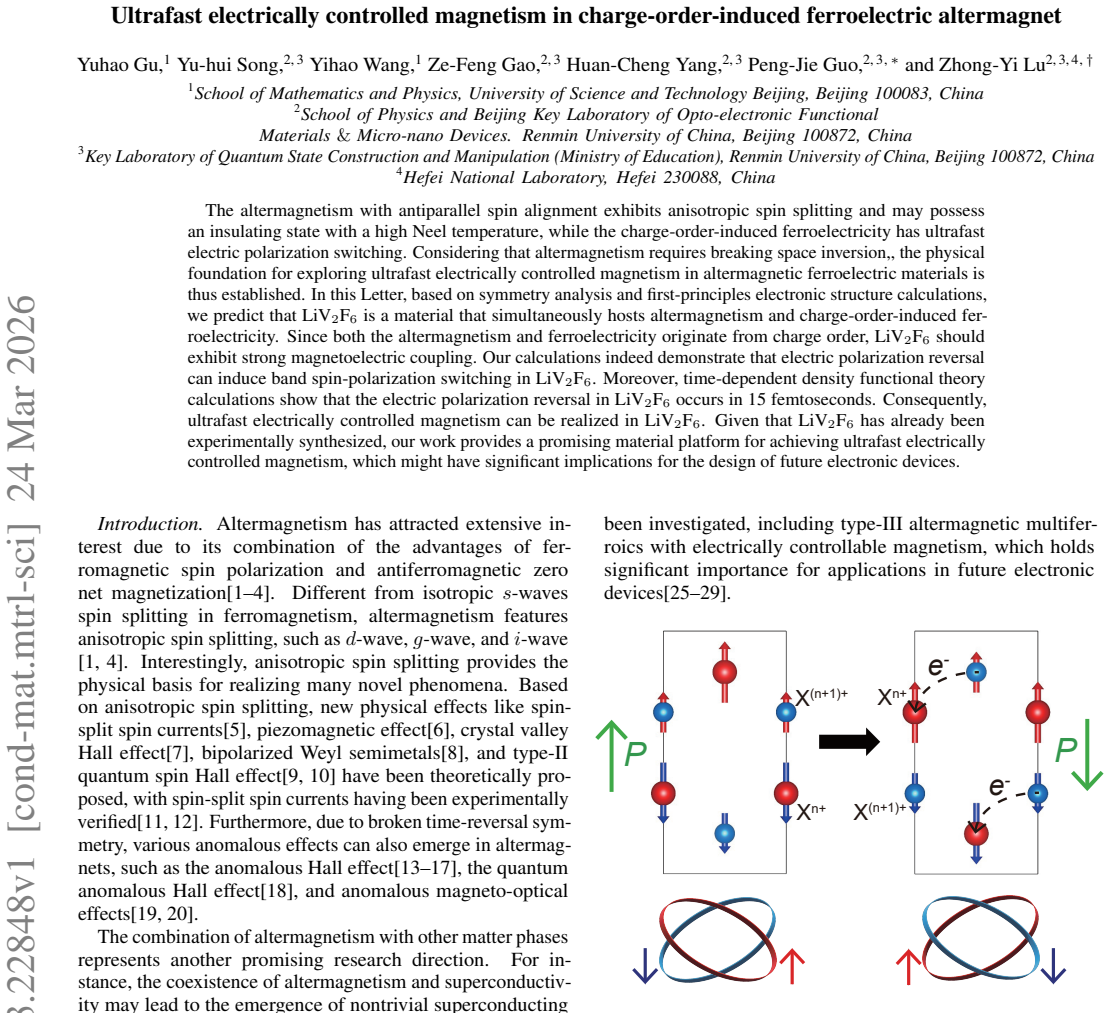
LiV2F6 is a charge-order-induced altermagnetic ferroelectric in which laser-driven electron hopping reverses ferroelectric polarization on a ~15 fs timescale and, by the same charge rearrangement, reverses the spin polarization of the electronic bands, realizing concurrent ultrafast switching of both orders.
What carries the argument
Charge-order-driven dual switching: the same valence-state pattern that breaks inversion (producing ferroelectricity) also selects the altermagnetic spin arrangement, so electron hopping that reverses the local dipoles necessarily reverses band spin polarization; demonstrated by symmetry analysis, Berry-phase polarization, CI-NEB barriers, and real-time TDDFT charge dynamics on the four V sites.
Load-bearing premise
The claim rests on GGA+U with U around 5 eV correctly making the charge-ordered low-symmetry altermagnetic state the true low-temperature ground state of LiV2F6, even though the same method prefers ferromagnetism in the high-symmetry structure that is observed at room temperature.
What would settle it
Low-temperature structural, magnetic, and spectroscopic measurements on LiV2F6 that either confirm or rule out charge order into distinct V2+/V3+ sites with the predicted AM2 altermagnetism and ~12 µC/cm2 polarization; or a time-resolved optical experiment that fails to observe polarization and spin-texture reversal on the femtosecond scale under the stated laser conditions.
If this is right
- If the dual-switching mechanism is confirmed, LiV2F6 becomes a ready-made experimental platform for ultrafast optical control of both ferroelectric and altermagnetic order.
- Materials that satisfy the two stated design rules (fractional-valence magnetic ions in the high-symmetry structure; charge order that simultaneously creates ferroelectricity and altermagnetism) are predicted to show the same concurrent switching.
- Because the polarization flip is electron-hopping driven rather than ionic, the switching speed can reach the 15-fs scale, opening a path to spintronic devices that operate far faster than conventional multiferroics.
- Electric-field or laser control of band spin polarization without net magnetization becomes possible in an insulating altermagnet.
Where Pith is reading between the lines
- The same charge-order logic should apply to other trirutile or related fluorides with mixed-valence magnetic ions, suggesting a short list of candidate compounds that can be screened with existing synthesis recipes.
- Time-resolved magneto-optical or spin-resolved ARPES experiments on LiV2F6 under mid-infrared or visible pulses would directly test whether the predicted 15-fs dual switch is observable before heating or structural damage intervenes.
- If the U-tuned charge-ordered state is only metastable, optical pumping itself might still transiently populate it, offering a non-equilibrium route even if the thermodynamic ground state differs.
Editorial analysis
A structured set of objections, weighed in public.
Referee Report
Summary. The manuscript proposes that charge-order-induced altermagnetic ferroelectrics enable simultaneous ultrafast laser switching of ferroelectric polarization and altermagnetic spin texture. Using symmetry analysis, GGA+U DFT, Berry-phase polarization, CI-NEB, and real-time TDDFT, it identifies LiV2F6 (experimentally known) as realizing this: the low-symmetry charge-ordered structure hosts d-wave altermagnetism (AM2) with P ≈ 12 µC/cm²; reversing the charge order reverses band spin polarization; and a 10 fs laser pulse drives complementary V-site charge transfer within ~15 fs that is interpreted as coherent dual switching.
Significance. If the dual-switching picture holds, the work supplies a concrete, already-synthesized platform for type-III multiferroic control on femtosecond timescales and a clear materials-design rule (fractional-valence magnetic ions in a high-symmetry structure that is not already altermagnetic). The combination of static spin-texture reversal with an explicit TDDFT charge-dynamics calculation is a useful step beyond purely static magnetoelectric proposals and is of direct interest for ultrafast spintronics.
major comments (3)
- Results, Figs. 2–3 and choice of U = 5 eV: In the high-symmetry structure the method yields a ferromagnetic ground state for all U, contradicting the reported antiferromagnetic susceptibility. The charge-ordered low-symmetry AM2 state becomes lowest only for U ≳ 4–5 eV. Because both the ferroelectric and altermagnetic orders are charge-order-driven, the dual-switching claim rests on this U-tuned phase being the true low-T ground state. A more robust justification (hybrid functionals, constrained RPA U, or explicit comparison with the experimental magnetic data) is required before the material can be presented as a reliable platform.
- Results, Figs. 4(d–e) and TDDFT paragraph: The simulation shows laser-driven complementary charge shifts on the four V sites within ~15 fs. The text equates this transient redistribution with stable reversal of both P and the altermagnetic band spin texture. However, the calculation does not recompute the Berry-phase polarization or the spin-resolved bands after the pulse, does not relax ions or quench into a new free-energy minimum, and does not verify that the final charge-ordered AM2 configuration remains lower in energy than competing FM/FIM states once the vector potential is off. Without that mapping, the ultrafast dual-switching claim is not yet demonstrated.
- Computational details and Results: The TDDFT run uses Ueff = 4 eV while the static calculations use U = 5 eV (J = U/5). Given the strong U-dependence of the magnetic ground state already noted, the consistency of the dynamical trajectory with the static AM2 free-energy landscape needs to be checked explicitly (e.g., by projecting the final charge density onto the static magnetic configurations).
minor comments (4)
- Abstract and title emphasize an “optical route,” yet the static CI-NEB barrier (0.55 eV/f.u.) is still presented as supporting evidence; a clearer separation of the optical versus field-driven pathways would help the reader.
- Fig. 4(b–c) insets and main text: the labeling of V2+/V3+ sites and the corresponding spin arrows is dense; a single consistent color/legend scheme across all panels would improve readability.
- The manuscript cites the authors’ earlier LiFe2F6 work for contrast; a short explicit sentence stating why LiV2F6 (unlike LiFe2F6) satisfies the two design rules would sharpen the novelty claim.
- Typographical: “Liechtensteinet al.” missing space; occasional inconsistent hyphenation of “altermagnetism/altermagnetic.”
Circularity Check
No significant circularity: dual FE/altermagnetic switching follows from independent static DFT bands on opposite charge orders plus separate TDDFT charge dynamics; self-cites to prior LiFe2F6 work supply only contrast.
specific steps
-
self citation load bearing
[Results and discussion (final paragraphs before Acknowledgement)]
"For example, LiFe2F6 exhibits altermagnetism both before and after the appearance of charge ordering, yet it does not demonstrate ultrafast electrically controlled magnetism. These two features provide theoretical guidance for the further search for more altermagnetic multiferroic materials that exhibit ultrafast electrically controlled magnetism."
The two necessary features that “provide theoretical guidance” are extracted by contrasting LiV2F6 with the authors’ own prior LiFe2F6 study ([25], same group). The contrast is not load-bearing for the LiV2F6 calculations themselves (which stand on independent DFT/TDDFT), but the claimed general criteria are self-referential rather than externally derived.
full rationale
The derivation chain is self-contained and does not reduce by construction. High-symmetry vs low-symmetry structures, magnetic configurations (AM1/AM2/FIM/FM), and energies vs U are computed directly (Figs. 2–3). Ferroelectric polarization (Berry phase), NEB barrier, and spin-split bands for opposite polarizations are independent calculations (Fig. 4b–c); the observed band-spin reversal is the expected consequence of swapping V2+/V3+ assignments under fixed AM2 moments, but is not a fitted quantity renamed as a prediction. TDDFT (Octopus, separate Ueff) reports site-charge transfer on a ~15 fs scale (Figs. 4d–e) as a distinct dynamical run; the interpretive mapping to coherent P and spin-texture reversal is an assumption about post-pulse relaxation, not a definitional identity. Self-citations (e.g. [25] on LiFe2F6) are used for analogy and contrast (“does not demonstrate ultrafast…”) and do not supply a uniqueness theorem or load-bearing premise that forces the LiV2F6 result. U=5 eV is a conventional DFT+U choice that stabilizes the experimentally consistent charge-ordered AM2 phase; properties are then computed for that phase rather than fitted to dual-switching data. No self-definitional loop, no fitted-input-as-prediction, and no ansatz smuggled via citation. Score 1 reflects only the minor, non-load-bearing self-citation and U-parameter selection common to the field.
Axiom & Free-Parameter Ledger
free parameters (3)
- Hubbard U on V 3d (static DFT) =
5 eV (selected after U scan)
- Ueff = U−J on V 3d (TDDFT) =
4 eV
- Laser pulse parameters (carrier 1.52 eV, 10 fs FWHM, 45° xy polarization, sin2 envelope) =
1.52 eV, 10 fs FWHM, 45° in xy
axioms (5)
- domain assumption GGA+U (Liechtenstein / Dudarev-style) adequately ranks magnetic and charge-ordered phases of LiV2F6 for the purpose of ground-state selection.
- domain assumption Low-temperature charge order (V2+/V3+) is the physical origin of inversion breaking, ferroelectricity, and the AM2 altermagnetic state in LiV2F6.
- domain assumption Spin-group symmetries ({C2⊥∥C4z(1/2,1/2,1/2)}, etc.) correctly classify AM1/AM2 as d-wave altermagnets and conventional AFM/FIM states.
- domain assumption Real-time TDDFT in the dipole/velocity-gauge approximation with PBE+U captures the relevant femtosecond charge-transfer pathway that reverses macroscopic polarization.
- ad hoc to paper Reversing charge order (valence swap on magnetic sites) necessarily reverses altermagnetic band spin polarization when the magnetic pattern is the AM2 type.
read the original abstract
Exploring novel magnetoelectric coupling mechanisms to achieve control of ferroelectric polarization and magnetism is highly significant for both fundamental science and electronic device applications. Although extensive studies have been conducted on electrical switching of magnetism in multiferroic materials, simultaneous ultrafast laser switching of ferroelectric polarization and altermagnetism remains unexplored. In this letter, we propose that the ultrafast laser can be used to switch ferroelectric polarization and altermagnetism concurrently in charge-order-induced altermagnetic ferroelectrics. Building on this idea, we further demonstrate that such dual switching can be realized in charge-order-induced altermagnetic ferroelectric LiV$_2$F$_6$ by symmetry analysis and time-dependent density functional theory (TDDFT) calculation. Given that LiV$_2$F$_6$ has already been experimentally synthesized, our work not only provides an ideal material platform for experimentally realizing simultaneous switching of ferroelectric polarization and altermagnetism but also holds potential application value in future ultrafast spintronic devices.
Figures


Reference graph
Works this paper leans on
-
[1]
ˇSmejkal, J
L. ˇSmejkal, J. Sinova, and T. Jungwirth, Phys. Rev. X12, 031042 (2022)
2022
-
[2]
Hayami, Y
S. Hayami, Y . Yanagi, and H. Kusunose, Journal of the Physical Society of Japan88, 123702 (2019)
2019
-
[3]
Hayami, Y
S. Hayami, Y . Yanagi, and H. Kusunose, Phys. Rev. B102, 144441 (2020)
2020
-
[4]
ˇSmejkal, J
L. ˇSmejkal, J. Sinova, and T. Jungwirth, Phys. Rev. X12, 040501 (2022)
2022
-
[5]
Gonz´alez-Hern´andez, L
R. Gonz´alez-Hern´andez, L. ˇSmejkal, K. V ´yborn´y, Y . Yahagi, J. Sinova, T. c. v. Jungwirth, and J. ˇZelezn´y, Phys. Rev. Lett. 126, 127701 (2021)
2021
-
[6]
H.-Y . Ma, M. Hu, N. Li, J. Liu, W. Yao, J.-F. Jia, and J. Liu, Nat. Commun.12, 2846 (2021)
2021
-
[7]
Tan, Z.-F
C.-Y . Tan, Z.-F. Gao, H.-C. Yang, Z.-X. Liu, K. Liu, P.-J. Guo, and Z.-Y . Lu, Phys. Rev. B111, 094411 (2025)
2025
-
[8]
C.-Y . Tan, Z.-F. Gao, H.-C. Yang, K. Liu, P.-J. Guo, and Z.-Y . Lu, “Bipolarized Weyl semimetals and quantum crystal valley Hall effect in two-dimensional altermagnetic materials,” (2024), arXiv:2406.16603
Pith/arXiv arXiv 2024
-
[9]
Type-ii quantum spin hall insulator,
P. Feng, C.-Y . Tan, M. Gao, X.-W. Yan, Z.-X. Liu, P.-J. Guo, F. Ma, and Z.-Y . Lu, “Type-ii quantum spin hall insulator,” (2025), arXiv:2503.13397 [cond-mat.mes-hall]
Pith/arXiv arXiv 2025
-
[10]
C.-Y . Tan, P. Feng, Z.-F. Gao, F. Ma, P.-J. Guo, and Z.-Y . Lu, “Stacking-induced type-ii quantum spin hall insulators with high spin chern number in unconventional magnetism,” (2025), arXiv:2508.05365 [cond-mat.mes-hall]
Pith/arXiv arXiv 2025
-
[11]
H. Bai, L. Han, X. Y . Feng, Y . J. Zhou, R. X. Su, Q. Wang, L. Y . Liao, W. X. Zhu, X. Z. Chen, F. Pan, X. L. Fan, and C. Song, Phys. Rev. Lett.128, 197202 (2022)
2022
-
[12]
Karube, T
S. Karube, T. Tanaka, D. Sugawara, N. Kadoguchi, M. Kohda, and J. Nitta, Phys. Rev. Lett.129, 137201 (2022)
2022
-
[13]
ˇSmejkal, R
L. ˇSmejkal, R. Gonzalez-Hernandez, T. Jungwirth, and J. Sinova, Sci. Adv.6, eaaz8809 (2020)
2020
-
[14]
R. D. Gonzalez Betancourt, J. Zub´aˇc, R. Gonzalez-Hernandez, K. Geishendorf, Z. ˇSob´aˇn, G. Springholz, K. Olejn´ık, L.ˇSmejkal, J. Sinova, T. Jungwirth, S. T. B. Goennenwein, A. Thomas, H. Reichlov´a, J. ˇZelezn´y, and D. Kriegner, Phys. Rev. Lett.130, 036702 (2023)
2023
-
[15]
ˇSmejkal, A
L. ˇSmejkal, A. H. MacDonald, J. Sinova, S. Nakatsuji, and T. Jungwirth, Nat. Rev. Mater.7, 482 (2022)
2022
-
[16]
Z. Feng, X. Zhou, L. ˇSmejkal, L. Wu, H. Guo, R. Gonz ´alez- Hern´andez, X. Wang, H. Yan, P. Qin, X. Zhang, H. Wu, H. Chen, Z. Meng, L. Liu, Z. Xia, J. Sinova, T. Jungwirth, and Z. Liu, Nat. Electron.5, 735 (2022)
2022
-
[17]
Hou, H.-C
X.-Y . Hou, H.-C. Yang, Z.-X. Liu, P.-J. Guo, and Z.-Y . Lu, Phys. Rev. B107, L161109 (2023)
2023
-
[18]
Z.-F. Gao, S. Qu, B. Zeng, Y . Liu, J.-R. Wen, H. Sun, P.-J. Guo, and Z.-Y . Lu, Natl. Sci. Rev.12, nwaf066 (2025)
2025
-
[19]
Samanta, M
K. Samanta, M. Leˇzai´c, M. Merte, F. Freimuth, S. Bl¨ugel, and Y . Mokrousov, J. Appl. Phys127, 213904 (2020)
2020
-
[20]
X. Zhou, W. Feng, X. Yang, G.-Y . Guo, and Y . Yao, Phys. Rev. B104, 024401 (2021)
2021
-
[21]
Zhu, Z.-Y
D. Zhu, Z.-Y . Zhuang, Z. Wu, and Z. Yan, Phys. Rev. B108, 184505 (2023)
2023
-
[22]
L. V . Pupim and M. S. Scheurer, Phys. Rev. Lett.134, 146001 (2025)
2025
-
[23]
C. Xu, S. Wu, G.-X. Zhi, G. Cao, J. Dai, C. Cao, X. Wang, and H.-Q. Lin, Nat. Commun.16, 3114 (2025)
2025
-
[24]
Anomalous charge density wave in altermagnetism,
Z.-H. Ding, L. Wang, Z.-F. Ouyang, J. Qiao, Z.-F. Gao, W. Ji, K. Liu, P.-J. Guo, and Z.-Y . Lu, “Anomalous charge density wave in altermagnetism,” (2025), arXiv:2507.15429 [cond- mat.mtrl-sci]
Pith/arXiv arXiv 2025
-
[25]
P.-J. Guo, Y . Gu, Z.-F. Gao, and Z.-Y . Lu, arXiv preprint arXiv:2312.13911 (2023)
Pith/arXiv arXiv 2023
-
[26]
X. Duan, J. Zhang, Z. Zhu, Y . Liu, Z. Zhang, I. ˇZuti´c, and T. Zhou, Phys. Rev. Lett.134, 106801 (2025)
2025
-
[27]
M. Gu, Y . Liu, H. Zhu, K. Yananose, X. Chen, Y . Hu, A. Stroppa, and Q. Liu, Phys. Rev. Lett.134, 106802 (2025)
2025
-
[28]
ˇSmejkal, arXiv preprint arXiv:2411.19928 (2024)
L. ˇSmejkal, arXiv preprint arXiv:2411.19928 (2024)
Pith/arXiv arXiv 2024
-
[29]
W. Sun, W. Wang, C. Yang, Y . Liu, X. Wang, S. Huang, and Z. Cheng, Advanced Materials37, e202502575 (2025)
2025
-
[30]
Lin, Q.-R
L.-F. Lin, Q.-R. Xu, Y . Zhang, J.-J. Zhang, Y .-P. Liang, and S. Dong, Physical Review Materials1, 071401 (2017)
2017
-
[31]
J. Peng, Y . Zhang, L.-F. Lin, L. Lin, M. Liu, J.-M. Liu, and S. Dong, Journal of Physics D: Applied Physics51, 243002 (2018)
2018
-
[32]
Y . Qi, S. E. Reyes-Lillo, and K. M. Rabe, Physical Review B 111, L180101 (2025)
2025
-
[33]
Kresse and J
G. Kresse and J. Furthm ¨uller, Phys. rev. B54, 11169 (1996)
1996
-
[34]
Kresse and D
G. Kresse and D. Joubert, Phys. Rev. B59, 1758 (1999)
1999
-
[35]
J. P. Perdew, K. Burke, and M. Ernzerhof, Phys. Rev. Lett.77, 3865 (1996)
1996
-
[36]
Liechtenstein, V
A. Liechtenstein, V . I. Anisimov, and J. Zaanen, Physical Re- view B52, R5467 (1995)
1995
-
[37]
King-Smith and D
R. King-Smith and D. Vanderbilt, Physical Review B47, 1651 (1993)
1993
-
[38]
Resta, Reviews of modern physics66, 899 (1994)
R. Resta, Reviews of modern physics66, 899 (1994)
1994
-
[39]
Henkelman, B
G. Henkelman, B. P. Uberuaga, and H. J ´onsson, The Journal of chemical physics113, 9901 (2000)
2000
-
[40]
Tancogne-Dejean, M
N. Tancogne-Dejean, M. J. Oliveira, X. Andrade, H. Appel, C. H. Borca, G. Le Breton, F. Buchholz, A. Castro, S. Corni, A. A. Correa,et al., The Journal of chemical physics152(2020)
2020
-
[41]
S. L. Dudarev, G. A. Botton, S. Y . Savrasov, C. Humphreys, and A. P. Sutton, Physical Review B57, 1505 (1998)
1998
-
[42]
Metzger, N
R. Metzger, N. Heimer, C. Kuo, R. Williamson, and W. Boo, Inorganic Chemistry22, 1060 (1983)
1983
-
[43]
S. Dong, H. Xiang, and E. Dagotto, National Science Review6, 629 (2019)
2019
-
[44]
Ravindran, R
P. Ravindran, R. Vidya, A. Kjekshus, H. Fjellv˚ag, and O. Eriks- son, Physical Review B—Condensed Matter and Materials Physics74, 224412 (2006)
2006
discussion (0)
Sign in with ORCID, Apple, or X to comment. Anyone can read and Pith papers without signing in.