Separation is Optimal for LQR under Intermittent Feedback
Pith reviewed 2026-05-14 21:23 UTC · model grok-4.3
The pith
Separation principle holds for LQR under intermittent feedback with symmetric disturbances
A machine-rendered reading of the paper's core claim, the machinery that carries it, and where it could break.
Core claim
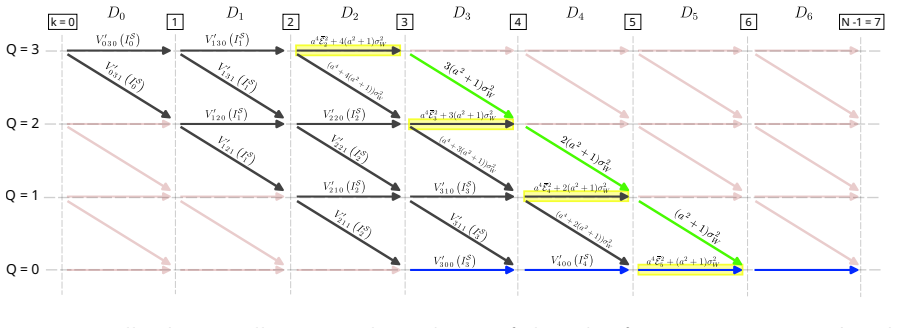
We first prove that the separation principle holds for communication-constrained LQR problems under i.i.d. zero-mean disturbances with a symmetric distribution. We then solve the dynamic programming problem and show that the optimal scheduling policy is a symmetric threshold rule on the accumulated disturbance since the most recent update, while the optimal controller is a discounted linear feedback law independent of the scheduling policy.
What carries the argument
Separation principle that decouples the discounted linear feedback controller from the symmetric threshold scheduler on accumulated disturbance
If this is right
- The controller can be designed exactly as in the classical LQR case without reference to the communication schedule.
- Scheduling decisions reduce to checking whether the magnitude of accumulated disturbance exceeds a fixed threshold.
- The overall optimal policy is obtained by independently solving the standard Riccati equation for the controller and a one-dimensional dynamic program for the thresholds.
- The result holds for any symmetric zero-mean disturbance distribution, not just Gaussian.
Where Pith is reading between the lines
- The same separation may simplify design in remote-control applications where bandwidth is limited but noise symmetry can be verified from data.
- If symmetry fails, the coupled optimization problem would have to be solved jointly, potentially requiring approximate dynamic programming.
- Explicit threshold computation for low-dimensional systems could be performed once the Riccati solution is known.
- The structure suggests similar threshold policies might appear in other quadratic-cost problems with intermittent observations.
Load-bearing premise
The disturbances must be independent, identically distributed, zero-mean, and symmetrically distributed around zero.
What would settle it
A numerical counter-example in which the optimal feedback gain changes when the scheduler is altered, even though the disturbances remain i.i.d., zero-mean, and symmetric.
Figures



read the original abstract
In this work, we first prove that the separation principle holds for communication-constrained LQR problems under i.i.d. zero-mean disturbances with a symmetric distribution. We then solve the dynamic programming problem and show that the optimal scheduling policy is a symmetric threshold rule on the accumulated disturbance since the most recent update, while the optimal controller is a discounted linear feedback law independent of the scheduling policy.
Editorial analysis
A structured set of objections, weighed in public.
Referee Report
Summary. The manuscript proves that the separation principle holds for communication-constrained LQR problems under i.i.d. zero-mean disturbances with symmetric distribution. It solves the dynamic programming problem to establish that the optimal scheduling policy is a symmetric threshold rule on the accumulated disturbance since the most recent update, while the optimal controller reduces to a discounted linear feedback law that is independent of the scheduling policy.
Significance. If the derivations hold under the stated conditions, the result supplies a rigorous structural characterization of optimal policies for intermittent-feedback LQR, confirming separation and yielding an explicit threshold scheduler together with a controller that decouples from scheduling decisions. This supplies a clean, symmetry-driven benchmark for networked control design and could simplify analysis of communication-constrained systems.
major comments (1)
- [Dynamic Programming Solution] The dynamic-programming recursion establishing controller independence from scheduling (abstract and corresponding DP section) relies on symmetry to separate the value function; the manuscript should explicitly verify that the Bellman operator preserves this separation for the given disturbance class, including a short inductive step or explicit form of the cost-to-go.
minor comments (2)
- Clarify in the introduction whether the threshold is parameter-free or depends on the LQR cost matrices and disturbance variance; the current abstract leaves this implicit.
- Add a brief remark on how the i.i.d. zero-mean symmetric assumption can be relaxed or checked in practice, to aid readers applying the result.
Simulated Author's Rebuttal
We thank the referee for the positive assessment and the recommendation for minor revision. We address the single major comment below.
read point-by-point responses
-
Referee: The dynamic-programming recursion establishing controller independence from scheduling (abstract and corresponding DP section) relies on symmetry to separate the value function; the manuscript should explicitly verify that the Bellman operator preserves this separation for the given disturbance class, including a short inductive step or explicit form of the cost-to-go.
Authors: We agree that making the preservation of the separation property under the Bellman operator fully explicit will improve clarity. In the revised version we will insert a short inductive argument in the dynamic-programming section. The argument shows that if the cost-to-go at stage k+1 separates into a term that depends only on the scheduling state and a quadratic term that depends only on the controller state, then the same additive separation is preserved at stage k for any i.i.d. zero-mean symmetric disturbance. We will also record the explicit form of the cost-to-go that results once the optimal threshold scheduler and discounted linear feedback are substituted. revision: yes
Circularity Check
Derivation proceeds directly from dynamic programming on stated assumptions
full rationale
The paper states the separation principle and optimal threshold scheduler follow from solving the dynamic programming recursion under i.i.d. zero-mean symmetric disturbances. The controller is shown to reduce to a discounted linear feedback law independent of the scheduler. No equation or claim reduces by construction to a fitted parameter, self-definition, or load-bearing self-citation; the symmetry condition is an explicit input assumption used to establish the threshold structure, not derived from the result itself. The derivation chain is therefore self-contained against the given model.
Axiom & Free-Parameter Ledger
axioms (1)
- domain assumption Disturbances are i.i.d. zero-mean with symmetric distribution
Reference graph
Works this paper leans on
-
[1]
Wireless network design for control systems: A survey,
P. Park, S. C. Ergen, C. Fischione, C. Lu, and K. H. Johansson, “Wireless network design for control systems: A survey,”IEEE Communications Surveys & Tutorials, vol. 20, no. 2, pp. 978–1013, 2017
work page 2017
-
[2]
A survey of recent results in networked control systems,
J. P. Hespanha, P. Naghshtabrizi, and Y. Xu, “A survey of recent results in networked control systems,”Proceedings of the IEEE, vol. 95, no. 1, pp. 138–162, 2007
work page 2007
-
[3]
Stability of networked control systems,
W. Zhang, M. S. Branicky, and S. M. Phillips, “Stability of networked control systems,” IEEE control systems magazine, vol. 21, no. 1, pp. 84–99, 2001
work page 2001
-
[4]
Scheduling of networked control systems,
G. C. Walsh and H. Ye, “Scheduling of networked control systems,”IEEE control systems magazine, vol. 21, no. 1, pp. 57–65, 2001
work page 2001
-
[5]
Comparison of riemann and lebesgue sampling for first order stochastic systems,
K. J. Astrom and B. M. Bernhardsson, “Comparison of riemann and lebesgue sampling for first order stochastic systems,” inProceedings of the 41st IEEE Conference on Decision and Control, 2002., vol. 2. IEEE, 2002, pp. 2011–2016
work page 2002
-
[6]
Event-triggered real-time scheduling of stabilizing control tasks,
P. Tabuada, “Event-triggered real-time scheduling of stabilizing control tasks,”IEEE Transactions on Automatic control, vol. 52, no. 9, pp. 1680–1685, 2007
work page 2007
-
[7]
Stability of model-based networked control systems with time-varying transmission times,
L. A. Montestruque and P. Antsaklis, “Stability of model-based networked control systems with time-varying transmission times,”IEEE Transactions on Automatic Control, vol. 49, no. 9, pp. 1562–1572, 2004. 51
work page 2004
-
[8]
An introduction to event-triggered and self-triggered control,
W. P. Heemels, K. H. Johansson, and P. Tabuada, “An introduction to event-triggered and self-triggered control,” in2012 ieee 51st ieee conference on decision and control (cdc). IEEE, 2012, pp. 3270–3285
work page 2012
-
[9]
W. M. H. Heemels, A. R. Teel, N. Van de Wouw, and D. Neˇ si´ c, “Networked control systems with communication constraints: Tradeoffs between transmission intervals, delays and performance,”IEEE Transactions on Automatic control, vol. 55, no. 8, pp. 1781–1796, 2010
work page 2010
-
[10]
Dual effect, certainty equivalence, and separation in stochastic control,
Y. Bar-Shalom and E. Tse, “Dual effect, certainty equivalence, and separation in stochastic control,”IEEE Transactions on Automatic Control, vol. 19, no. 5, pp. 494–500, 2003
work page 2003
-
[11]
On lqg joint optimal scheduling and control under communication constraints,
A. Molin and S. Hirche, “On lqg joint optimal scheduling and control under communication constraints,” inProceedings of the 48h IEEE Conference on Decision and Control (CDC) held jointly with 2009 28th Chinese Control Conference. IEEE, 2009, pp. 5832–5838
work page 2009
-
[12]
Performance characteri- zation using aoi in a single-loop networked control system,
J. P. Champati, M. H. Mamduhi, K. H. Johansson, and J. Gross, “Performance characteri- zation using aoi in a single-loop networked control system,” inIEEE INFOCOM 2019-IEEE Conference on Computer Communications Workshops (INFOCOM WKSHPS). IEEE, 2019, pp. 197–203
work page 2019
-
[13]
Age-of-information vs. value- of-information scheduling for cellular networked control systems,
O. Ayan, M. Vilgelm, M. Kl¨ ugel, S. Hirche, and W. Kellerer, “Age-of-information vs. value- of-information scheduling for cellular networked control systems,” inProceedings of the 10th ACM/IEEE International Conference on Cyber-Physical Systems, 2019, pp. 109–117
work page 2019
-
[14]
Value of information in networked control systems subject to delay,
S. Wang, Q. Liu, P. U. Abara, J. S. Baras, and S. Hirche, “Value of information in networked control systems subject to delay,” in2021 60th IEEE Conference on Decision and Control (CDC). IEEE, 2021, pp. 1275–1280
work page 2021
-
[15]
Value of information in feedback control: Quan- tification,
T. Soleymani, J. S. Baras, and S. Hirche, “Value of information in feedback control: Quan- tification,”IEEE Transactions on Automatic Control, vol. 67, no. 7, pp. 3730–3737, 2021
work page 2021
-
[16]
Foundations of control and estimation over lossy networks,
L. Schenato, B. Sinopoli, M. Franceschetti, K. Poolla, and S. S. Sastry, “Foundations of control and estimation over lossy networks,”Proceedings of the IEEE, vol. 95, no. 1, pp. 163–187, 2007
work page 2007
-
[17]
Optimal control of lti systems over unreliable com- munication links,
O. C. Imer, S. Y¨ uksel, and T. Ba¸ sar, “Optimal control of lti systems over unreliable com- munication links,”Automatica, vol. 42, no. 9, pp. 1429–1439, 2006
work page 2006
-
[18]
Design of state-based schedulers for a network of control loops,
C. Ramesh, H. Sandberg, and K. H. Johansson, “Design of state-based schedulers for a network of control loops,”IEEE Transactions on Automatic Control, vol. 58, no. 8, pp. 1962–1975, 2013
work page 1962
-
[19]
Price-based adaptive scheduling in multi-loop control systems with resource constraints,
A. Molin and S. Hirche, “Price-based adaptive scheduling in multi-loop control systems with resource constraints,”IEEE Transactions on Automatic Control, vol. 59, no. 12, pp. 3282–3295, 2014. 52
work page 2014
-
[20]
Event-based transmission scheduling and lqg control over a packet dropping link,
A. S. Leong, D. E. Quevedo, T. Tanaka, S. Dey, and A. Ahl´ en, “Event-based transmission scheduling and lqg control over a packet dropping link,”IFAC-PapersOnLine, vol. 50, no. 1, pp. 8945–8950, 2017
work page 2017
-
[21]
Interq: A dqn framework for optimal intermittent control,
S. Aggarwal, D. Maity, and T. Ba¸ sar, “Interq: A dqn framework for optimal intermittent control,”arXiv preprint arXiv:2504.09035, 2025
-
[22]
Optimal lqg control under delay-dependent costly information,
D. Maity, M. H. Mamduhi, S. Hirche, K. H. Johansson, and J. S. Baras, “Optimal lqg control under delay-dependent costly information,”IEEE control systems letters, vol. 3, no. 1, pp. 102–107, 2018
work page 2018
-
[23]
Linear quadratic zero-sum differential games with intermittent and costly sensing,
S. Aggarwal, T. Ba¸ sar, and D. Maity, “Linear quadratic zero-sum differential games with intermittent and costly sensing,”IEEE Control Systems Letters, 2024
work page 2024
-
[24]
D. Maity and J. S. Baras, “Minimal feedback optimal control of linear-quadratic-gaussian systems: No communication is also a communication,”IFAC-PapersOnLine, vol. 53, no. 2, pp. 2201–2207, 2020
work page 2020
-
[25]
On information structures, feedback and causality,
H. S. Witsenhausen, “On information structures, feedback and causality,”SIAM Journal on Control, vol. 9, no. 2, pp. 149–160, 1971
work page 1971
-
[26]
A. Molin and S. Hirche, “Optimal design of decentralized event-triggered controllers for large-scale systems with contention-based communication,” in2011 50th IEEE Conference on Decision and Control and European Control Conference. IEEE, 2011, pp. 4710–4716
work page 2011
-
[27]
On the dual effect in state-based scheduling of networked control systems,
C. Ramesh, H. Sandberg, L. Bao, and K. H. Johansson, “On the dual effect in state-based scheduling of networked control systems,” inProceedings of the 2011 American Control Conference. IEEE, 2011, pp. 2216–2221
work page 2011
-
[28]
Joint cross-layer optimization in real-time networked control systems,
M. Kl¨ ugel, M. Mamduhi, O. Ayan, M. Vilgelm, K. H. Johansson, S. Hirche, and W. Kellerer, “Joint cross-layer optimization in real-time networked control systems,”IEEE Transactions on Control of Network Systems, vol. 7, no. 4, pp. 1903–1915, 2020
work page 1903
-
[29]
K. J. ˚Astr¨ om,Introduction to stochastic control theory. Courier Corporation, 2012
work page 2012
-
[30]
Consistent event-triggered control for discrete-time linear systems with partial state information,
D. J. Antuneset al., “Consistent event-triggered control for discrete-time linear systems with partial state information,”IEEE Control Systems Letters, vol. 4, no. 1, pp. 181–186, 2019
work page 2019
-
[31]
Optimal power management in wireless control systems,
K. Gatsis, A. Ribeiro, and G. J. Pappas, “Optimal power management in wireless control systems,”IEEE Transactions on Automatic Control, vol. 59, no. 6, pp. 1495–1510, 2014
work page 2014
-
[32]
Tradeoffs in stochastic event- triggered control,
B. Demirel, A. S. Leong, V. Gupta, and D. E. Quevedo, “Tradeoffs in stochastic event- triggered control,”IEEE Transactions on Automatic Control, vol. 64, no. 6, pp. 2567–2574, 2018. 53
work page 2018
-
[33]
State-based communication design for wireless control systems,
K. Gatsis, A. Ribeiro, and G. J. Pappas, “State-based communication design for wireless control systems,” in2016 IEEE 55th Conference on Decision and Control (CDC). IEEE, 2016, pp. 129–134
work page 2016
-
[34]
A bi-level approach for the design of event-triggered control systems over a shared network,
A. Molin and S. Hirche, “A bi-level approach for the design of event-triggered control systems over a shared network,”Discrete Event Dynamic Systems, vol. 24, no. 2, pp. 153–171, 2014
work page 2014
-
[35]
Try-once-discard scheduling for stochastic networked con- trol systems,
M. H. Mamduhi and S. Hirche, “Try-once-discard scheduling for stochastic networked con- trol systems,”International Journal of Control, vol. 92, no. 11, pp. 2532–2546, 2019
work page 2019
-
[36]
Weighted age of information- based scheduling for large population games on networks,
S. Aggarwal, M. A. uz Zaman, M. Bastopcu, and T. Ba¸ sar, “Weighted age of information- based scheduling for large population games on networks,”IEEE Journal on Selected Areas in Information Theory, vol. 4, pp. 682–697, 2023
work page 2023
-
[37]
Control-aware uplink resource allocation for cyber-physical systems in wireless networks,
M. Vilgelm, O. Ayan, S. Zoppi, and W. Kellerer, “Control-aware uplink resource allocation for cyber-physical systems in wireless networks,” inEuropean Wireless 2017; 23th European Wireless Conference. VDE, 2017, pp. 1–7
work page 2017
-
[38]
Full-loop aoi-based joint design of control and deterministic transmission for industrial cps,
X. Lu, Q. Xu, X. Wang, M. Lin, C. Chen, Z. Shi, and X. Guan, “Full-loop aoi-based joint design of control and deterministic transmission for industrial cps,”IEEE Transactions on Industrial Informatics, vol. 19, no. 11, pp. 10 727–10 738, 2023
work page 2023
-
[39]
Optimal communication logics in networked control sys- tems,
Y. Xu and J. P. Hespanha, “Optimal communication logics in networked control sys- tems,” in2004 43rd IEEE Conference on Decision and Control (CDC)(IEEE Cat. No. 04CH37601), vol. 4. IEEE, 2004, pp. 3527–3532
work page 2004
-
[40]
Foundations of value of information: A semantic metric for networked control systems tasks,
T. Soleymani, J. S. Baras, S. Hirche, and K. H. Johansson, “Foundations of value of information: A semantic metric for networked control systems tasks,”arXiv preprint arXiv:2403.11927, 2024
-
[41]
Infinite-horizon optimal scheduling for feedback control,
S. Wang and S. Hirche, “Infinite-horizon optimal scheduling for feedback control,”arXiv preprint arXiv:2402.08819, 2024
-
[42]
Value of information in feedback control: Global optimality,
T. Soleymani, J. S. Baras, S. Hirche, and K. H. Johansson, “Value of information in feedback control: Global optimality,”IEEE Transactions on Automatic Control, vol. 68, no. 6, pp. 3641–3647, 2022
work page 2022
-
[43]
Bertsekas,Dynamic programming and optimal control: Volume I
D. Bertsekas,Dynamic programming and optimal control: Volume I. Athena scientific, 2012, vol. 4. 54
work page 2012
discussion (0)
Sign in with ORCID, Apple, or X to comment. Anyone can read and Pith papers without signing in.