Recognition: 2 theorem links
· Lean TheoremProbing Heavy Neutral Higgs Bosons via Single Vector-Like Bottom Quark Production at the HL-LHC
Pith reviewed 2026-05-14 21:23 UTC · model grok-4.3
The pith
XGBoost analysis extends vector-like bottom quark discovery to 1.6 TeV at the HL-LHC
A machine-rendered reading of the paper's core claim, the machinery that carries it, and where it could break.
Core claim
In the Type-II Two-Higgs-Doublet Model extended by an SU(2)_L vector-like (T,B) doublet, the exotic decay B to phi b can dominate conventional modes and reach branching ratios of order 50 percent for both neutral scalars in the alignment limit. Full simulation at 14 TeV shows that a conventional cut-based analysis yields 5 sigma discovery only at high integrated luminosity, whereas an XGBoost-based multivariate analysis substantially improves signal-background discrimination and extends the discovery reach up to m_B approximately 1.3 TeV with 600 fb inverse and up to m_B approximately 1.6 TeV with 3 ab inverse, even with systematic uncertainties as large as 15 percent.
What carries the argument
XGBoost-based multivariate analysis that combines kinematic variables from the one-lepton plus missing transverse energy plus multi-b-jet final state to discriminate the signal from Standard Model backgrounds.
If this is right
- The exotic decay B to phi b reaches branching ratios of order 50 percent for both H and A in the alignment limit.
- The XGBoost analysis extends 5 sigma discovery reach to 1.3 TeV at 600 fb inverse and 1.6 TeV at 3 ab inverse.
- The projected sensitivity holds even when systematic uncertainties are as large as 15 percent.
- The search simultaneously probes the existence of vector-like bottom quarks and heavy neutral Higgs bosons.
Where Pith is reading between the lines
- The same multivariate technique could be adapted to searches for other vector-like quarks in similar extended models.
- Non-observation at the HL-LHC would tighten upper bounds on the mass and mixing parameters in this class of models.
- A positive signal would motivate follow-up studies to measure the heavy Higgs branching ratios and couplings.
Load-bearing premise
The branching ratio for the exotic decay B to phi b reaches order 50 percent in the alignment limit of the Type-II 2HDM, and Monte Carlo simulation plus detector modeling accurately captures all relevant backgrounds and efficiencies.
What would settle it
A search at 14 TeV with 3 ab inverse integrated luminosity that finds no excess above expected backgrounds in the specified final state for vector-like bottom quark masses near 1.6 TeV would falsify the projected discovery reach.
Figures


read the original abstract
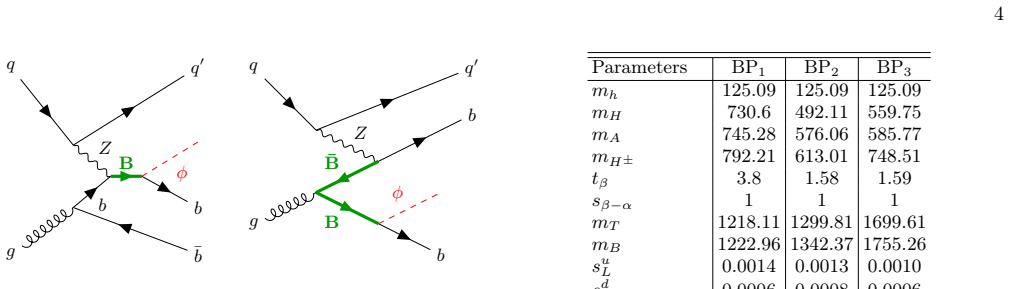
We investigate the discovery prospects of a singly produced vector-like bottom quark in the Type-II Two-Higgs-Doublet Model extended by an $SU(2)_L$ vector-like $(T,B)$ doublet. We focus on the non-standard decay chain $B \to \phi b$, followed by $\phi \to t\bar{t}$, where $\phi = H$ or $A$, leading to a final state with one charged lepton, missing transverse energy, and multiple $b$-jets. We perform a full simulation of both signal and Standard Model backgrounds at $\sqrt{s}=14$ TeV. We show that the exotic channels $B \to \phi b$ can dominate over the conventional decay modes, reaching branching ratios of order $50\%$ for both neutral scalars in the alignment limit. A conventional cut-based analysis provides a $5\sigma$ discovery significance only at sufficiently high integrated luminosity. By contrast, an XGBoost-based multivariate analysis substantially improves the signal-background discrimination and extends the discovery reach up to $m_B \simeq 1.3$ TeV with $600~\mathrm{fb}^{-1}$ and up to $m_B \simeq 1.6$ TeV with $3~\mathrm{ab}^{-1}$, even in the presence of systematic uncertainties as large as $15\%$.
Editorial analysis
A structured set of objections, weighed in public.
Referee Report
Summary. The manuscript investigates the discovery prospects for singly produced vector-like bottom quarks B in a Type-II 2HDM extended by an SU(2)_L vector-like (T,B) doublet at the HL-LHC. It focuses on the exotic decay chain B → ϕ b (ϕ = H or A) with ϕ → t t-bar, yielding a final state with one charged lepton, missing transverse energy, and multiple b-jets. Full Monte Carlo simulation of signal and SM backgrounds at 14 TeV is performed; the authors report that this exotic mode can reach branching ratios of order 50% in the alignment limit, that a cut-based analysis yields 5σ only at high luminosity, and that an XGBoost multivariate analysis extends the 5σ reach to m_B ≃ 1.3 TeV with 600 fb^{-1} and m_B ≃ 1.6 TeV with 3 ab^{-1} even with 15% systematic uncertainties.
Significance. If the multivariate discrimination and background modeling hold, the result would meaningfully extend the HL-LHC sensitivity to heavy neutral scalars via vector-like quark production, offering a complementary channel when conventional B decays are suppressed. The explicit inclusion of 15% systematics and comparison to cut-based limits are positive elements; however, the claimed improvement rests entirely on the fidelity of the MC modeling and classifier performance in a high-b-jet, lepton-plus-MET environment.
major comments (2)
- The headline 5σ reaches (1.3 TeV at 600 fb^{-1}, 1.6 TeV at 3 ab^{-1}) are load-bearing on the XGBoost background rejection. The manuscript states that a full simulation was performed and 15% systematics included, but provides no list of input features, training/validation procedure, or feature-importance ranking. Without these, it is impossible to judge whether the quoted improvement over cut-based analysis is robust or the result of over-training on MC statistics.
- Background modeling and systematic propagation: the dominant backgrounds (ttbar, W+jets) in the lepton + multi-b final state are sensitive to jet-tagging efficiencies and MET resolution. The text does not detail how these uncertainties are evaluated or folded into the final significance; a 15% flat systematic is quoted, but its breakdown and correlation with the classifier output are not shown, directly affecting the credibility of the high-mass claims.
minor comments (1)
- The abstract and results section would benefit from a brief table summarizing the input variables to the XGBoost classifier and the corresponding cut-based selection for direct comparison.
Simulated Author's Rebuttal
We thank the referee for the constructive comments and for recognizing the potential of the exotic decay channel. We address each major point below and will revise the manuscript accordingly to improve clarity and reproducibility.
read point-by-point responses
-
Referee: The headline 5σ reaches (1.3 TeV at 600 fb^{-1}, 1.6 TeV at 3 ab^{-1}) are load-bearing on the XGBoost background rejection. The manuscript states that a full simulation was performed and 15% systematics included, but provides no list of input features, training/validation procedure, or feature-importance ranking. Without these, it is impossible to judge whether the quoted improvement over cut-based analysis is robust or the result of over-training on MC statistics.
Authors: We agree that the current manuscript lacks sufficient technical details on the XGBoost implementation, which limits independent assessment of robustness. In the revised version we will add an appendix (or dedicated subsection) that explicitly lists all input features (kinematic variables, b-tagging discriminants, jet multiplicities, MET-related quantities, etc.), describes the training/validation split and cross-validation procedure used to mitigate over-training, and provides the feature-importance ranking obtained from the trained model. These additions will allow readers to evaluate the claimed improvement over the cut-based analysis. revision: yes
-
Referee: Background modeling and systematic propagation: the dominant backgrounds (ttbar, W+jets) in the lepton + multi-b final state are sensitive to jet-tagging efficiencies and MET resolution. The text does not detail how these uncertainties are evaluated or folded into the final significance; a 15% flat systematic is quoted, but its breakdown and correlation with the classifier output are not shown, directly affecting the credibility of the high-mass claims.
Authors: We acknowledge that the propagation of systematics through the multivariate analysis requires more explicit documentation. In the revision we will include a dedicated paragraph and table that (i) breaks down the 15% flat systematic into its main components (jet-tagging efficiency, MET resolution, luminosity, etc.), (ii) describes how each component is evaluated from auxiliary measurements or MC variations, and (iii) explains the procedure used to propagate these uncertainties to the final significance, including any assumed correlations with the XGBoost output score. This will make the high-mass reach claims more transparent. revision: yes
Circularity Check
No circularity: discovery reach computed from independent MC simulation and classifier
full rationale
The paper performs full Monte Carlo simulation of signal (B → ϕb → tt̄b) and SM backgrounds at 14 TeV, then trains an XGBoost classifier on kinematic features to extract significances. No analytic derivation exists; branching ratios of order 50% are computed outputs from the 2HDM parameter space in the alignment limit, not inputs. The quoted 5σ reaches (1.3 TeV at 600 fb⁻¹, 1.6 TeV at 3 ab⁻¹) are direct numerical results from event yields after selection, with 15% systematics applied post-simulation. No self-definition, fitted-input-as-prediction, or load-bearing self-citation reduces any central claim to its own inputs by construction. The study is self-contained against standard generators and detector modeling.
Axiom & Free-Parameter Ledger
free parameters (2)
- m_B
- tan beta
axioms (1)
- domain assumption Type-II two-Higgs-doublet model with SU(2)_L vector-like (T,B) doublet
invented entities (2)
-
Heavy neutral scalars H and A
no independent evidence
-
Vector-like bottom quark B
no independent evidence
Lean theorems connected to this paper
-
IndisputableMonolith/Foundation/RealityFromDistinction.leanreality_from_one_distinction unclear?
unclearRelation between the paper passage and the cited Recognition theorem.
We perform a full simulation of both signal and Standard Model backgrounds at √s=14 TeV... an XGBoost-based multivariate analysis substantially improves the signal-background discrimination
-
IndisputableMonolith/Cost/FunctionalEquation.leanwashburn_uniqueness_aczel unclear?
unclearRelation between the paper passage and the cited Recognition theorem.
exotic channels B→ϕb can dominate... branching ratios of order 50%
What do these tags mean?
- matches
- The paper's claim is directly supported by a theorem in the formal canon.
- supports
- The theorem supports part of the paper's argument, but the paper may add assumptions or extra steps.
- extends
- The paper goes beyond the formal theorem; the theorem is a base layer rather than the whole result.
- uses
- The paper appears to rely on the theorem as machinery.
- contradicts
- The paper's claim conflicts with a theorem or certificate in the canon.
- unclear
- Pith found a possible connection, but the passage is too broad, indirect, or ambiguous to say the theorem truly supports the claim.
Reference graph
Works this paper leans on
-
[1]
A First Top Partner Hunter's Guide
A. De Simone, O. Matsedonskyi, R. Rattazzi, and A. Wulzer, JHEP04, 004, arXiv:1211.5663 [hep-ph]
work page internal anchor Pith review Pith/arXiv arXiv
- [2]
-
[3]
Bulk Fields and Supersymmetry in a Slice of AdS
T. Gherghetta and A. Pomarol, Nucl. Phys. B586, 141 (2000), arXiv:hep-ph/0003129
work page internal anchor Pith review Pith/arXiv arXiv 2000
-
[4]
Higgs as a Holographic Pseudo-Goldstone Boson
R. Contino, Y. Nomura, and A. Pomarol, Nucl. Phys. B 10 671, 148 (2003), arXiv:hep-ph/0306259
work page internal anchor Pith review Pith/arXiv arXiv 2003
-
[5]
N. Arkani-Hamed, A. G. Cohen, E. Katz, A. E. Nelson, T. Gregoire, and J. G. Wacker, JHEP08, 021, arXiv:hep- ph/0206020
-
[6]
M. Schmaltz, Nucl. Phys. B Proc. Suppl.117, 40 (2003), arXiv:hep-ph/0210415
work page internal anchor Pith review Pith/arXiv arXiv 2003
-
[7]
Unitarity of Little Higgs Models Signals New Physics of UV Completion
S. Chang and H.-J. He, Phys. Lett. B586, 95 (2004), arXiv:hep-ph/0311177
work page internal anchor Pith review Pith/arXiv arXiv 2004
-
[8]
T. Han, H. E. Logan, B. McElrath, and L.-T. Wang, Phys. Rev. D67, 095004 (2003), arXiv:hep-ph/0301040
work page internal anchor Pith review Pith/arXiv arXiv 2003
-
[9]
The Minimal Composite Higgs Model
K. Agashe, R. Contino, and A. Pomarol, Nucl. Phys. B 719, 165 (2005), arXiv:hep-ph/0412089
work page internal anchor Pith review Pith/arXiv arXiv 2005
-
[10]
B. Bellazzini, C. Csáki, and J. Serra, Eur. Phys. J. C74, 2766 (2014), arXiv:1401.2457 [hep-ph]
work page internal anchor Pith review Pith/arXiv arXiv 2014
-
[11]
Light custodians in natural composite Higgs models
R. Contino, L. Da Rold, and A. Pomarol, Phys. Rev. D 75, 055014 (2007), arXiv:hep-ph/0612048
work page internal anchor Pith review Pith/arXiv arXiv 2007
-
[12]
Vector-like quarks in a composite Higgs model
P. Lodone, JHEP12, 029, arXiv:0806.1472 [hep-ph]
work page internal anchor Pith review Pith/arXiv arXiv
-
[13]
Light Top Partners for a Light Composite Higgs
O. Matsedonskyi, G. Panico, and A. Wulzer, JHEP01, 164, arXiv:1204.6333 [hep-ph]
work page internal anchor Pith review Pith/arXiv arXiv
-
[14]
J. L. Hewett and T. G. Rizzo, Phys. Rept.183, 193 (1989)
work page 1989
-
[15]
Effective description of quark mixing
F. del Aguila, M. Perez-Victoria, and J. Santiago, Phys. Lett. B492, 98 (2000), arXiv:hep-ph/0007160
work page internal anchor Pith review Pith/arXiv arXiv 2000
-
[16]
Single Top Production as a Probe of B-prime Quarks
J. Nutter, R. Schwienhorst, D. G. E. Walker, and J.-H. Yu, Phys. Rev. D86, 094006 (2012), arXiv:1207.5179 [hep-ph]
work page internal anchor Pith review Pith/arXiv arXiv 2012
-
[17]
A. Atre, G. Azuelos, M. Carena, T. Han, E. Ozcan, J. Santiago, and G. Unel, JHEP08, 080, arXiv:1102.1987 [hep-ph]
work page internal anchor Pith review Pith/arXiv arXiv 1987
-
[18]
LHC signatures of vector-like quarks
Y. Okada and L. Panizzi, Adv. High Energy Phys.2013, 364936 (2013), arXiv:1207.5607 [hep-ph]
work page internal anchor Pith review Pith/arXiv arXiv 2013
-
[19]
LHC Top Partner Searches Beyond the 2 TeV Mass Region
M. Backović, T. Flacke, S. J. Lee, and G. Perez, JHEP 09, 022, arXiv:1409.0409 [hep-ph]
work page internal anchor Pith review Pith/arXiv arXiv
- [20]
- [21]
- [22]
- [23]
- [24]
-
[25]
Y.-J. Zhang, Y.-T. Zhu, L. Han, Y.-P. Bi, and T.-G. Liu, Eur. Phys. J. C84, 1184 (2024)
work page 2024
- [26]
-
[27]
G. C. Branco, P. M. Ferreira, L. Lavoura, M. N. Re- belo, M. Sher, and J. P. Silva, Phys. Rept.516, 1 (2012), arXiv:1106.0034 [hep-ph]
work page internal anchor Pith review Pith/arXiv arXiv 2012
-
[28]
S. Moretti and S. Khalil,Supersymmetry Beyond Mini- mality: From Theory to Experiment(CRC Press, 2019)
work page 2019
-
[29]
Extra Neutral Scalars with Vector-like Fermions at the LHC
S. Gopalakrishna, T. S. Mukherjee, and S. Sadhukhan, Phys. Rev. D93, 055004 (2016), arXiv:1504.01074 [hep- ph]
work page internal anchor Pith review Pith/arXiv arXiv 2016
-
[30]
Benbriket al., JHEP05, 028, arXiv:1907.05929 [hep- ph]
R. Benbriket al., JHEP05, 028, arXiv:1907.05929 [hep- ph]
-
[31]
R. Benbrik, M. Berrouj, and M. Boukidi, Phys. Rev. D 111, 015027 (2025), arXiv:2408.15985 [hep-ph]
- [32]
-
[33]
R. Benbrik, M. Berrouj, M. Boukidi, A. Habjia, E. Ghourmin, and L. Rahili, Phys. Lett. B843, 138024 (2023)
work page 2023
-
[34]
R. Benbrik, M. Berrouj, M. Boukidi, and K. Kahime, Eur. Phys. J. C85, 500 (2025)
work page 2025
-
[35]
R. Benbrik, M. Boukidi, and S. Moretti, Phys. Rev. D 109, 055016 (2024), arXiv:2211.07259 [hep-ph]
-
[36]
R. Benbrik, M. Boukidi, and S. Moretti, PoS ICHEP2024, 083 (2025), arXiv:2409.16054 [hep-ph]
- [37]
- [38]
- [39]
-
[40]
Phenomenology of 2HDM with VLQs
A. Arhrib, R. Benbrik, S. J. D. King, B. Manaut, S.Moretti,andC.S.Un,Phys.Rev.D97,095015(2018), arXiv:1607.08517 [hep-ph]
work page internal anchor Pith review Pith/arXiv arXiv 2018
-
[41]
H. Abouabid, A. Arhrib, R. Benbrik, M. Boukidi, and J. E. Falaki, J. Phys. G51, 075001 (2024), arXiv:2302.07149 [hep-ph]
-
[42]
A. Angelescu, A. Djouadi, and G. Moreau, Phys. Lett. B 756, 126 (2016), arXiv:1512.04921 [hep-ph]
work page internal anchor Pith review Pith/arXiv arXiv 2016
-
[43]
A. Ghosh and P. Konar, Phys. Dark Univ.47, 101746 (2025), arXiv:2305.08662 [hep-ph]
-
[44]
R. Dermíšek, E. Lunghi, and S. Shin, JHEP04, 019, [Erratum: JHEP 10, 058 (2020)], arXiv:1901.03709 [hep- ph]
-
[45]
R. Benbrik, M. Berrouj, M. Boukidi, H. Chatoui, M. Ech- chaouy, K. Kahime, and K. Salime, Single Production of a Vector-Like Top as a Probe of Charged Higgs Bosons at a Muon-Proton Collider (2026), arXiv:2601.07758 [hep- ph]
- [46]
-
[47]
R. Dermisek, E. Lunghi, N. Mcginnis, and S. Shin, JHEP 08, 159, arXiv:2105.10790 [hep-ph]
-
[48]
Implications of a High-Mass Diphoton Resonance for Heavy Quark Searches
S. Banerjee, D. Barducci, G. Bélanger, and C. Delaunay, JHEP11, 154, arXiv:1606.09013 [hep-ph]
work page internal anchor Pith review Pith/arXiv arXiv
-
[49]
R. Benbrik, M. Berrouj, M. Boukidi, M. Ech-chaouy, K. Kahime, and K. Salime, Eur. Phys. J. C85, 1275 (2025)
work page 2025
-
[50]
A. Bhardwaj, T. Mandal, S. Mitra, and C. Neeraj, Phys. Rev. D106, 095014 (2022), arXiv:2203.13753 [hep-ph]
- [51]
-
[52]
R. Benbrik, M. Berrouj, M. Boukidi, M. Ech-Chaouy, K. Kahime, and K. Salime, Nuclear Physics B , 117436 (2026)
work page 2026
-
[53]
Model Independent Framework for Searches of Top Partners
M. Buchkremer, G. Cacciapaglia, A. Deandrea, and L. Panizzi, Nucl. Phys. B876, 376 (2013), arXiv:1305.4172 [hep-ph]
work page internal anchor Pith review Pith/arXiv arXiv 2013
-
[54]
On the Interpretation of Top Partners Searches
O. Matsedonskyi, G. Panico, and A. Wulzer, JHEP12, 097, arXiv:1409.0100 [hep-ph]
work page internal anchor Pith review Pith/arXiv arXiv
-
[55]
Aadet al.(ATLAS), JHEP11, 168, arXiv:2308.02595 [hep-ex]
G. Aadet al.(ATLAS), JHEP11, 168, arXiv:2308.02595 [hep-ex]
-
[56]
A. Hayrapetyanet al.(CMS), Phys. Rept.1115, 570 (2025), arXiv:2405.17605 [hep-ex]
-
[57]
R. Benbrik, M. Boukidi, M. Ech-chaouy, S. Moretti, K. Salime, and Q.-S. Yan, JHEP03, 020, arXiv:2412.01761 [hep-ph]
- [58]
-
[59]
J. F. Gunion, H. E. Haber, G. L. Kane, and S. Dawson, The Higgs Hunter’s Guide, Vol. 80 (2000)
work page 2000
- [60]
-
[61]
Lee-Quigg-Thacker Bounds for Higgs Boson Masses in a Two-Doublet Model
S. Kanemura, T. Kubota, and E. Takasugi, Phys. Lett. B313, 155 (1993), arXiv:hep-ph/9303263
work page internal anchor Pith review Pith/arXiv arXiv 1993
-
[62]
N. G. Deshpande and E. Ma, Phys. Rev. D18, 2574 (1978)
work page 1978
-
[63]
Metastability bounds on the two Higgs doublet model
A. Barroso, P. M. Ferreira, I. P. Ivanov, and R. Santos, JHEP06, 045, arXiv:1303.5098 [hep-ph]
work page internal anchor Pith review Pith/arXiv arXiv
-
[64]
A precision constraint on multi-Higgs-doublet models
W. Grimus, L. Lavoura, O. M. Ogreid, and P. Osland, J. Phys. G35, 075001 (2008), arXiv:0711.4022 [hep-ph]
work page internal anchor Pith review Pith/arXiv arXiv 2008
-
[65]
P. A. Zylaet al.(Particle Data Group), PTEP2020, 083C01 (2020)
work page 2020
-
[66]
2HDMC - Two-Higgs-Doublet Model Calculator
D. Eriksson, J. Rathsman, and O. Stal, Comput. Phys. Commun.181, 189 (2010), arXiv:0902.0851 [hep-ph]
work page internal anchor Pith review Pith/arXiv arXiv 2010
-
[67]
HiggsBounds: Confronting Arbitrary Higgs Sectors with Exclusion Bounds from LEP and the Tevatron
P. Bechtle, O. Brein, S. Heinemeyer, G. Weiglein, and K. E. Williams, Comput. Phys. Commun.181, 138 (2010), arXiv:0811.4169 [hep-ph]
work page internal anchor Pith review Pith/arXiv arXiv 2010
-
[68]
P. Bechtle, O. Brein, S. Heinemeyer, G. Weiglein, and K. E. Williams, Comput. Phys. Commun.182, 2605 (2011), arXiv:1102.1898 [hep-ph]
work page internal anchor Pith review Pith/arXiv arXiv 2011
-
[69]
P. Bechtle, O. Brein, S. Heinemeyer, O. Stål, T. Stefa- niak, G. Weiglein, and K. E. Williams, Eur. Phys. J. C 74, 2693 (2014), arXiv:1311.0055 [hep-ph]
work page internal anchor Pith review Pith/arXiv arXiv 2014
-
[70]
Applying Exclusion Likelihoods from LHC Searches to Extended Higgs Sectors
P. Bechtle, S. Heinemeyer, O. Stal, T. Stefaniak, and G. Weiglein, Eur. Phys. J. C75, 421 (2015), arXiv:1507.06706 [hep-ph]
work page internal anchor Pith review Pith/arXiv arXiv 2015
- [71]
-
[72]
P. Bechtle, S. Heinemeyer, T. Klingl, T. Stefaniak, G. Weiglein, and J. Wittbrodt, Eur. Phys. J. C81, 145 (2021), arXiv:2012.09197 [hep-ph]
-
[73]
P. Bechtle, D. Dercks, S. Heinemeyer, T. Klingl, T. Ste- faniak, G. Weiglein, and J. Wittbrodt, Eur. Phys. J. C 80, 1211 (2020), arXiv:2006.06007 [hep-ph]
-
[74]
G. Bevilacqua, M. Lupattelli, D. Stremmer, and M. Worek, Phys. Rev. D107, 114027 (2023), arXiv:2212.04722 [hep-ph]
-
[75]
Assault on the NLO Wishlist: pp -> tt bb
G. Bevilacqua, M. Czakon, C. G. Papadopoulos, R. Pit- tau, and M. Worek, JHEP09, 109, arXiv:0907.4723 [hep- ph]
work page internal anchor Pith review Pith/arXiv arXiv
-
[76]
G. Bevilacqua, H. B. Hartanto, M. Kraus, J. Nasufi, and M. Worek, JHEP08, 060, arXiv:2203.15688 [hep-ph]
-
[77]
J. M. Campbell and R. K. Ellis, JHEP07, 052, arXiv:1204.5678 [hep-ph]
work page internal anchor Pith review Pith/arXiv arXiv
- [78]
-
[79]
J. Alwall, R. Frederix, S. Frixione, V. Hirschi, F. Maltoni, O. Mattelaer, H. S. Shao, T. Stelzer, P. Torrielli, and M. Zaro, JHEP07, 079, arXiv:1405.0301 [hep-ph]
work page internal anchor Pith review Pith/arXiv arXiv
-
[80]
T.Sjöstrand, S.Ask, J.R.Christiansen, R.Corke, N.De- sai, P. Ilten, S. Mrenna, S. Prestel, C. O. Rasmussen, and P. Z. Skands, Comput. Phys. Commun.191, 159 (2015), arXiv:1410.3012 [hep-ph]
work page internal anchor Pith review Pith/arXiv arXiv 2015
discussion (0)
Sign in with ORCID, Apple, or X to comment. Anyone can read and Pith papers without signing in.