REVIEW 3 major objections 6 minor 50 references
Community-maintained tools with higher intrinsic quality raise tool-using agent scores by 6–22% relative to a smaller curated toolbox.
Reviewed by Pith at T0; open to challenge. T0 means a machine referee read the full paper against a public rubric. the ladder, T0–T4 →
T0 review · grok-4.5
2026-07-14 19:58 UTC pith:OLTRMJXM
load-bearing objection Solid open infrastructure for tool reliability and community maintenance; the headline 6–22% gains are real under their protocol but not cleanly isolated as “intrinsic accuracy” versus coverage and subsetting. the 3 major comments →
Open, Reliable, and Collective: A Community-Driven Framework for Tool-Using AI Agents
The pith
A machine-rendered reading of the paper's core claim, the machinery that carries it, and where it could break.
Core claim
End-to-end reliability of tool-integrated language models depends as much on the tools’ own correctness, stability, and safety as on how well agents select and invoke them. A community-driven toolbox that standardizes schemas, continuously evaluates tools with contributed tests, and exposes those tools through interchangeable agent workflows produces consistent downstream gains—relative improvements of 6% to 22% over a prior curated toolbox—across prompting, reason-and-act, planner–executor, and multi-agent setups, with the largest lifts on tasks that require external actions.
What carries the argument
OpenTools: a dual-loop design that separates a tool accuracy/maintenance loop (unified JSON schemas, living test suites, community contributions, regression and availability reports) from an agentic workflow that plugs the same toolbox into interchangeable agent policies and emits structured traces so failures can be attributed to tool-use errors versus tool-side faults.
Load-bearing premise
The reported end-to-end gains are mainly due to better tool correctness and reliability, not simply to offering many more tools and different task-specific subsets than the baseline toolbox.
What would settle it
Hold tool count and task-specific tool subsets fixed between the two toolboxes and re-run the same agent policies; if the 6–22% relative gains largely vanish, coverage—not intrinsic accuracy—was driving the result.
If this is right
- On hard agent tasks that require external actions, better tool breadth and reliability can matter more than a stronger base model alone.
- Tools can be improved and re-tested without rewriting agent policies, and agents can be swapped without rewriting tools.
- Living community test suites make API drift, nondeterminism, and silent regressions visible over time rather than only at release.
- Prior reliability scores can guide which tools an agent is allowed to use or prefer before a run.
- Public run-and-contribute interfaces lower the barrier for turning observed failures into shared tests.
Where Pith is reading between the lines
- If intrinsic tool accuracy is a real bottleneck, closed fixed tool catalogs may lag open continuously tested ones even when the agent policy is identical.
- A clean ablation that matches tool count and forced subsets would separate quality from mere coverage—an isolation the main results leave partly open.
- Routine agent debugging should split failures into policy mistakes versus tool regressions using structured call traces of the kind described here.
- Non-executing risk checks plus optional review may become a standard gate for shared agent tool registries as contribution volume grows.
Editorial analysis
A structured set of objections, weighed in public.
Referee Report
Summary. The paper introduces OpenTools, an open-source, community-driven toolbox and dual-workflow framework for tool-integrated LLM agents. It distinguishes tool-use accuracy from intrinsic tool accuracy (correctness, stability, robustness) and operationalizes the latter via standardized JSON-schema interfaces, community-contributed tests, continuous evaluation/maintenance, and a public web demo. Empirically, agents using OpenTools-T are compared to the same policies with the OctoTools toolbox on 15 benchmarks across five task groups and multiple agent architectures (Prompting, ReAct, OctoTools, MultiAgent), reporting 6%–22% relative average gains and larger gains on the Agent (GAIA-Text) task. The manuscript also releases code, a contribution protocol, and demo infrastructure under Apache 2.0.
Significance. If the systems contribution holds, OpenTools is a useful infrastructure paper: it makes intrinsic tool reliability a first-class, community-maintainable object rather than an implicit assumption of tool-learning work. Strengths include an open repository, standardized wrappers, a public interactive demo for tests/feedback, multi-framework agent evaluation with three-trial means±std (Appendix Table 2), and explicit separation of tool maintenance from agent policy. The reported end-to-end gains under fixed base models and policies are practically relevant for agent builders. The work is significant primarily as reproducible systems/infrastructure and as an empirical demonstration that toolbox choice matters; its stronger mechanistic claim about intrinsic accuracy is more provisional and needs tighter support.
major comments (3)
- Abstract and §4 attribute the 6%–22% relative gains primarily to ‘intrinsic tool accuracy’ / ‘higher-quality’ tools. Table 4 shows OpenTools-T has 42 tools vs 13 in OctoTools-T (16 vs 1 program-based; 19 vs 8 API-based). §3.1.2 further uses greedy task-specific subsetting for OpenTools-T versus paper-reported best sets for OctoTools-T. No experiment holds tool count/coverage fixed, swaps only tools with higher measured R(τ) on the same suite, or correlates per-tool reliability with end-to-end deltas. The Agent-task jumps (e.g., MultiAgent 53.92→66.14) are exactly where specialized coverage (maze solvers, etc.) would help regardless of reliability signals. Please either (i) add coverage-matched or reliability-only ablations, or (ii) reframe the central claim as gains from a larger, community-maintained, task-specific toolbox—of which intrinsic accuracy is one unisolated component.
- Workflow 1 defines reliability profiles R(τ) and continuous regression testing (§2.1), and tool cards can expose ‘current intrinsic accuracy,’ yet Tables 1–2 and the analysis never report suite-level accuracy, availability, or regression metrics for the tools actually used, nor show that agents preferred higher-R(τ) tools. Without those measurements, the dual-workflow architecture’s evaluation loop is described but not shown to drive the agentic results. At minimum, report per-tool or per-category reliability scores for OpenTools-T vs OctoTools-T tools used on the benchmarks, and state whether reliability signals were enabled during agent runs.
- The Abstract and introduction list safety and non-executing risk inspection as part of intrinsic accuracy, but §3–4 contain no safety, sandboxing, or adversarial-tool evaluation. Either provide a minimal safety/risk evaluation consistent with the abstract’s claims, or narrow the abstract/intro language so experimental claims match what is measured (correctness/coverage/end-to-end accuracy).
minor comments (6)
- Table 1 formatting is hard to parse (slash-separated model scores packed into cells; MultiAgent only reports gpt-5-mini). Consider separate columns or panels for each base model.
- §3.1.2 says zero-shot outperforms CoT in preliminary experiments and relegates the comparison to Appendix Table 3; a one-sentence note in the main text on why CoT hurts the stronger model would help readers.
- Figure 1 is dense; the two workflows are clear in text but the figure labels (1)/(2)/(3) repeat across panels and can confuse first-time readers.
- Minor inconsistencies: Abstract mentions MCP and ‘non-executing risk inspection / advisory LLM review,’ while the body emphasizes schemas, tests, and the web demo more than MCP; align terminology across abstract and §2.
- Typos/style: ‘OPENTOOLS’ capitalization varies; ‘Feedbacks’ in Figure 1; occasional missing spaces after periods in the arXiv text. Standard copy-edit pass recommended.
- Related Work could more explicitly position against StableToolBench, ToolFuzz, and other tool-stability/testing efforts already cited, clarifying what is new in the community maintenance loop versus prior tool libraries.
Circularity Check
No circularity: empirical toolbox comparison with measured end-to-end gains, not a derivation that reduces predictions to inputs.
full rationale
OpenTools is a systems/empirical paper. Its load-bearing claim is that equipping agents with OpenTools-T yields 6%–22% relative gains over OctoTools-T across frameworks (Abstract; Table 1; §4). That claim is supported by held-out benchmark measurements under fixed base LLMs and agent policies, not by a mathematical derivation, fitted parameter renamed as prediction, or uniqueness theorem. Reliability profiles R(τ) are defined as estimates from external test suites T (§2.1.1), not as quantities that force the Table 1 scores by construction. Self-citations (e.g., Dang et al. 2025 in Related Work) are ordinary framing and do not underwrite the gain numbers. Confounding between tool coverage (42 vs 13 tools) and intrinsic accuracy is a causal-attribution concern, not circularity under the stated patterns. No step reduces Eq./claim X to its own inputs by definition.
Axiom & Free-Parameter Ledger
free parameters (2)
- Task-specific tool subset size / greedy selection policy for OpenTools-T
- Number of independent trials (n=3) and base-model choice
axioms (4)
- domain assumption Tool-integrated LLM reliability decomposes into tool-use accuracy and intrinsic tool accuracy (correctness, stability, safety), and the latter is currently underexamined.
- domain assumption A unified natural-language description + typed JSON argument schema + structured output contract is sufficient for plug-and-play use across heterogeneous agent frameworks.
- domain assumption Community-contributed test cases, once accepted by maintainers, produce living reliability signals that track non-stationary tool behavior (API drift, nondeterminism, regressions).
- ad hoc to paper Comparing agents under identical policies while swapping only the toolbox isolates the effect of tool quality/coverage on end-to-end task accuracy.
invented entities (3)
-
OpenTools (toolbox + maintenance loop + contribution protocol + web demo)
no independent evidence
-
Reliability profile R(τ)
no independent evidence
-
Tool Accuracy / Maintenance Loop vs Agentic Workflow dual architecture
no independent evidence
read the original abstract
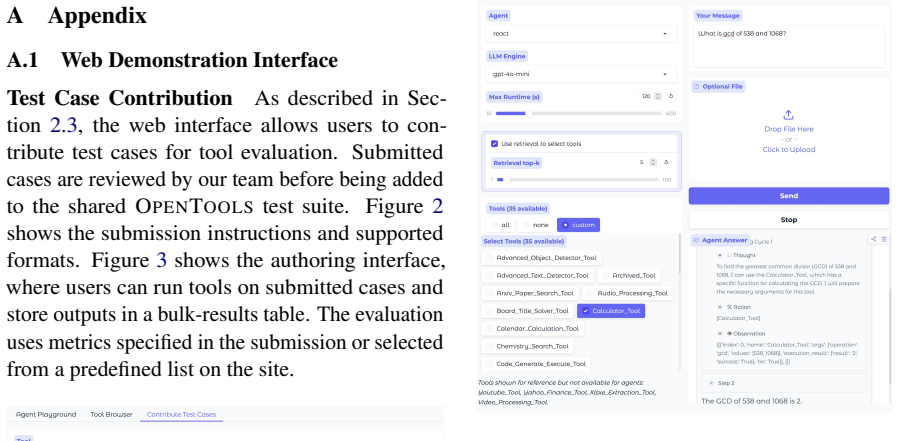
Tool-integrated LLMs retrieve information, perform computations, and take real-world actions, but their reliability depends on both tool-use accuracy and intrinsic tool accuracy, including tool correctness, stability, and safety. While prior work primarily emphasizes tool use, intrinsic tool accuracy remains underexamined. We introduce OpenTools, a community-driven and maintainable toolbox for discovering, using, evaluating, and contributing open-source tools. OpenTools standardizes tool interfaces, converts documented Python functions into reviewable bundles, supports maintainer-triggered evaluation, and combines non-executing risk inspection with optional advisory LLM review. A public web demo allows users to run tools and agents, inspect evidence, contribute tests, and submit tools for maintainer review, while MCP enables controlled access from external applications. Experiments show that community-contributed, task-specific tools yield relative gains of 6% to 22% over an existing toolbox across multiple agent architectures, highlighting the importance of intrinsic tool accuracy.
Figures



Reference graph
Works this paper leans on
-
[1]
online" 'onlinestring :=
ENTRY address archivePrefix author booktitle chapter edition editor eid eprint eprinttype howpublished institution journal key month note number organization pages publisher school series title type volume year doi pubmed url lastchecked label extra.label sort.label short.list INTEGERS output.state before.all mid.sentence after.sentence after.block STRING...
-
[2]
write newline
" write newline "" before.all 'output.state := FUNCTION n.dashify 't := "" t empty not t #1 #1 substring "-" = t #1 #2 substring "--" = not "--" * t #2 global.max substring 't := t #1 #1 substring "-" = "-" * t #2 global.max substring 't := while if t #1 #1 substring * t #2 global.max substring 't := if while FUNCTION word.in bbl.in capitalize " " * FUNCT...
-
[3]
Garima Agrawal, Tharindu Kumarage, Zeyad Alghamdi, and Huan Liu. 2024. https://doi.org/10.18653/v1/2024.naacl-long.219 Can knowledge graphs reduce hallucinations in LLM s? : A survey . In Proceedings of the 2024 Conference of the North American Chapter of the Association for Computational Linguistics: Human Language Technologies (Volume 1: Long Papers), p...
-
[4]
S \"o ren Arlt, Xuemei Gu, and Mario Krenn. 2025. Towards autonomous quantum physics research using llm agents with access to intelligent tools. arXiv preprint arXiv:2511.11752
arXiv 2025
-
[5]
Yew Ken Chia, Vernon Toh, Deepanway Ghosal, Lidong Bing, and Soujanya Poria. 2024. Puzzlevqa: Diagnosing multimodal reasoning challenges of language models with abstract visual patterns. In Findings of the Association for Computational Linguistics: ACL 2024, pages 16259--16273
2024
-
[6]
Hy Dang, Tianyi Liu, Zhuofeng Wu, Jingfeng Yang, Haoming Jiang, Tao Yang, Pei Chen, Zhengyang Wang, Helen Wang, Huasheng Li, Bing Yin, and Meng Jiang. 2025. https://doi.org/10.18653/v1/2025.emnlp-main.1242 Improving large language models function calling and interpretability via guided-structured templates . In Proceedings of the 2025 Conference on Empiri...
-
[7]
Bofei Gao, Feifan Song, Zhe Yang, Zefan Cai, Yibo Miao, Qingxiu Dong, Lei Li, Chenghao Ma, Liang Chen, Runxin Xu, and 1 others. 2024. Omni-math: A universal olympiad level mathematic benchmark for large language models. arXiv preprint arXiv:2410.07985
Pith/arXiv arXiv 2024
-
[8]
Yunfan Gao, Yun Xiong, Xinyu Gao, Kangxiang Jia, Jinliu Pan, Yuxi Bi, Yi Dai, Jiawei Sun, Haofen Wang, and Haofen Wang. 2023. Retrieval-augmented generation for large language models: A survey. arXiv preprint arXiv:2312.10997, 2
Pith/arXiv arXiv 2023
-
[9]
Deepanway Ghosal, Vernon Toh, Yew Ken Chia, and Soujanya Poria. 2025. Algopuzzlevqa: Diagnosing multimodal reasoning challenges of language models with algorithmic multimodal puzzles. In Proceedings of the 2025 Conference of the Nations of the Americas Chapter of the Association for Computational Linguistics: Human Language Technologies (Volume 1: Long Pa...
2025
-
[10]
Yash Goyal, Tejas Khot, Douglas Summers-Stay, Dhruv Batra, and Devi Parikh. 2017. Making the v in vqa matter: Elevating the role of image understanding in visual question answering. In Proceedings of the IEEE conference on computer vision and pattern recognition, pages 6904--6913
2017
-
[11]
Aaron Grattafiori, Abhimanyu Dubey, Abhinav Jauhri, Abhinav Pandey, Abhishek Kadian, Ahmad Al-Dahle, Aiesha Letman, Akhil Mathur, Alan Schelten, Alex Vaughan, and 1 others. 2024. The llama 3 herd of models. arXiv preprint arXiv:2407.21783
Pith/arXiv arXiv 2024
-
[12]
Tianrui Guan, Fuxiao Liu, Xiyang Wu, Ruiqi Xian, Zongxia Li, Xiaoyu Liu, Xijun Wang, Lichang Chen, Furong Huang, Yaser Yacoob, and 1 others. 2024. Hallusionbench: an advanced diagnostic suite for entangled language hallucination and visual illusion in large vision-language models. In Proceedings of the IEEE/CVF Conference on Computer Vision and Pattern Re...
2024
-
[13]
Zhicheng Guo, Sijie Cheng, Hao Wang, Shihao Liang, Yujia Qin, Peng Li, Zhiyuan Liu, Maosong Sun, and Yang Liu. 2024. https://doi.org/10.18653/v1/2024.findings-acl.664 S table T ool B ench: Towards stable large-scale benchmarking on tool learning of large language models . In Findings of the Association for Computational Linguistics: ACL 2024, pages 11143-...
-
[14]
Xuehai He, Yichen Zhang, Luntian Mou, Eric Xing, and Pengtao Xie. 2020. Pathvqa: 30000+ questions for medical visual question answering. arXiv preprint arXiv:2003.10286
Pith/arXiv arXiv 2020
-
[15]
Yushi Hu, Weijia Shi, Xingyu Fu, Dan Roth, Mari Ostendorf, Luke Zettlemoyer, Noah A Smith, and Ranjay Krishna. 2024. Visual sketchpad: Sketching as a visual chain of thought for multimodal language models. Advances in Neural Information Processing Systems, 37:139348--139379
2024
-
[16]
Xiaowei Huang, Wenjie Ruan, Wei Huang, Gaojie Jin, Yi Dong, Changshun Wu, Saddek Bensalem, Ronghui Mu, Yi Qi, Xingyu Zhao, and 1 others. 2024. A survey of safety and trustworthiness of large language models through the lens of verification and validation. Artificial Intelligence Review, 57(7):175
2024
-
[17]
Yue Huang, Jiawen Shi, Yuan Li, Chenrui Fan, Siyuan Wu, Qihui Zhang, Yixin Liu, Pan Zhou, Yao Wan, Neil Zhenqiang Gong, and Lichao Sun. 2023. Metatool benchmark: Deciding whether to use tools and which to use. arXiv preprint arXiv: 2310.03128
Pith/arXiv arXiv 2023
-
[18]
Dongsuk Jang, Ziyao Shangguan, Kyle Tegtmeyer, Anurag Gupta, Jan T Czerminski, Sophie Chheang, and Arman Cohan. 2025. Medtutor: A retrieval-augmented llm system for case-based medical education. In Proceedings of the 2025 Conference on Empirical Methods in Natural Language Processing: System Demonstrations, pages 319--353
2025
-
[19]
Ziwei Ji, Tiezheng Yu, Yan Xu, Nayeon Lee, Etsuko Ishii, and Pascale Fung. 2023. Towards mitigating llm hallucination via self reflection. In Findings of the Association for Computational Linguistics: EMNLP 2023, pages 1827--1843
2023
-
[20]
Haipeng Jiang, Kailong Ren, Zimo Yin, Zhetao Sun, Xin Gan, Guangyi Lv, Ming He, Peng Wang, Congli Yin, Hong Pan, and 1 others. 2026. Lemon agent technical report. arXiv preprint arXiv:2602.07092
arXiv 2026
-
[21]
Bowen Jin, Hansi Zeng, Zhenrui Yue, Jinsung Yoon, Sercan Arik, Dong Wang, Hamed Zamani, and Jiawei Han. 2025. Search-r1: Training llms to reason and leverage search engines with reinforcement learning. arXiv preprint arXiv:2503.09516
Pith/arXiv arXiv 2025
-
[22]
Di Jin, Eileen Pan, Nassim Oufattole, Wei-Hung Weng, Hanyi Fang, and Peter Szolovits. 2021. What disease does this patient have? a large-scale open domain question answering dataset from medical exams. Applied Sciences, 11(14):6421
2021
-
[23]
Toolscan: A benchmark for characterizing errors in tool-use llms
Shirley Kokane, Ming Zhu, Tulika Manoj Awalgaonkar, Jianguo Zhang, Akshara Prabhakar, Thai Quoc Hoang, Zuxin Liu, Rithesh RN, Liangwei Yang, Weiran Yao, and 1 others. Toolscan: A benchmark for characterizing errors in tool-use llms. In ICLR 2025 Workshop on Building Trust in Language Models and Applications
2025
-
[24]
Binxu Li, Tiankai Yan, Yuanting Pan, Jie Luo, Ruiyang Ji, Jiayuan Ding, Zhe Xu, Shilong Liu, Haoyu Dong, Zihao Lin, and 1 others. 2024 a . Mmedagent: Learning to use medical tools with multi-modal agent. In Findings of the Association for Computational Linguistics: EMNLP 2024, pages 8745--8760
2024
-
[25]
Zhiyuan Li, Hong Liu, Denny Zhou, and Tengyu Ma. 2024 b . Chain of thought empowers transformers to solve inherently serial problems. arXiv preprint arXiv:2402.12875, 1
Pith/arXiv arXiv 2024
-
[26]
Nathan Lile. 2024. Math twenty four (24s game) dataset. https://huggingface.co/datasets/nlile/24-game. Hugging Face Datasets
2024
-
[27]
Adam Dahlgren Lindstr \"o m and Savitha Sam Abraham. 2022. Clevr-math: A dataset for compositional language, visual and mathematical reasoning. arXiv preprint arXiv:2208.05358
Pith/arXiv arXiv 2022
-
[28]
Bo Liu, Li-Ming Zhan, Li Xu, Lin Ma, Yan Yang, and Xiao-Ming Wu. 2021. Slake: A semantically-labeled knowledge-enhanced dataset for medical visual question answering. In 2021 IEEE 18th international symposium on biomedical imaging (ISBI), pages 1650--1654. IEEE
2021
-
[29]
Qiang Liu, Xinlong Chen, Yue Ding, Bowen Song, Weiqiang Wang, Shu Wu, and Liang Wang. 2025. https://doi.org/10.18653/v1/2025.emnlp-main.1063 Attention-guided self-reflection for zero-shot hallucination detection in large language models . In Proceedings of the 2025 Conference on Empirical Methods in Natural Language Processing, pages 21016--21032, Suzhou,...
-
[30]
Pan Lu, Hritik Bansal, Tony Xia, Jiacheng Liu, Chunyuan Li, Hannaneh Hajishirzi, Hao Cheng, Kai-Wei Chang, Michel Galley, and Jianfeng Gao. 2023. Mathvista: Evaluating mathematical reasoning of foundation models in visual contexts. arXiv preprint arXiv:2310.02255
Pith/arXiv arXiv 2023
-
[31]
Pan Lu, Bowen Chen, Sheng Liu, Rahul Thapa, Joseph Boen, and James Zou. 2025. Octotools: An agentic framework with extensible tools for complex reasoning. arXiv preprint arXiv:2502.11271
Pith/arXiv arXiv 2025
-
[32]
Gr \'e goire Mialon, Cl \'e mentine Fourrier, Thomas Wolf, Yann LeCun, and Thomas Scialom. 2023. Gaia: a benchmark for general ai assistants. In The Twelfth International Conference on Learning Representations
2023
-
[33]
Ivan Milev, Mislav Balunovi \'c , Maximilian Baader, and Martin Vechev. 2025. Toolfuzz--automated agent tool testing. arXiv preprint arXiv:2503.04479
Pith/arXiv arXiv 2025
-
[34]
Bhargavi Paranjape, Scott Lundberg, Sameer Singh, Hannaneh Hajishirzi, Luke Zettlemoyer, and Marco Tulio Ribeiro. 2023. Art: Automatic multi-step reasoning and tool-use for large language models. arXiv preprint arXiv:2303.09014
Pith/arXiv arXiv 2023
-
[35]
Shishir G Patil, Tianjun Zhang, Xin Wang, and Joseph E Gonzalez. 2024. Gorilla: Large language model connected with massive apis. Advances in Neural Information Processing Systems, 37:126544--126565
2024
-
[36]
Yujia Qin, Shengding Hu, Yankai Lin, Weize Chen, Ning Ding, Ganqu Cui, Zheni Zeng, Xuanhe Zhou, Yufei Huang, Chaojun Xiao, and 1 others. 2024. Tool learning with foundation models. ACM Computing Surveys, 57(4):1--40
2024
-
[37]
Yujia Qin, Shihao Liang, Yining Ye, Kunlun Zhu, Lan Yan, Yaxi Lu, Yankai Lin, Xin Cong, Xiangru Tang, Bill Qian, Sihan Zhao, Runchu Tian, Ruobing Xie, Jie Zhou, Mark Gerstein, Dahai Li, Zhiyuan Liu, and Maosong Sun. 2023. https://doi.org/10.48550/ARXIV.2307.16789 Toolllm: Facilitating large language models to master 16000+ real-world apis . CoRR, abs/2307.16789
-
[38]
David Rein, Betty Li Hou, Asa Cooper Stickland, Jackson Petty, Richard Yuanzhe Pang, Julien Dirani, Julian Michael, and Samuel R Bowman. 2024. Gpqa: A graduate-level google-proof q&a benchmark. In First Conference on Language Modeling
2024
-
[39]
Jonathan Roberts, Kai Han, Neil Houlsby, and Samuel Albanie. 2024. Scifibench: Benchmarking large multimodal models for scientific figure interpretation. Advances in Neural Information Processing Systems, 37:18695--18728
2024
-
[40]
Timo Schick, Jane Dwivedi-Yu, Roberto Dess \` , Roberta Raileanu, Maria Lomeli, Eric Hambro, Luke Zettlemoyer, Nicola Cancedda, and Thomas Scialom. 2023. Toolformer: Language models can teach themselves to use tools. Advances in Neural Information Processing Systems, 36:68539--68551
2023
-
[41]
Xingyao Wang, Yangyi Chen, Lifan Yuan, Yizhe Zhang, Yunzhu Li, Hao Peng, and Heng Ji. 2024 a . Executable code actions elicit better llm agents. In Forty-first International Conference on Machine Learning
2024
-
[42]
Yubo Wang, Xueguang Ma, Ge Zhang, Yuansheng Ni, Abhranil Chandra, Shiguang Guo, Weiming Ren, Aaran Arulraj, Xuan He, Ziyan Jiang, and 1 others. 2024 b . Mmlu-pro: A more robust and challenging multi-task language understanding benchmark. Advances in Neural Information Processing Systems, 37:95266--95290
2024
-
[43]
Cailin Winston and Ren \'e Just. 2025. A taxonomy of failures in tool-augmented llms. In 2025 IEEE/ACM International Conference on Automation of Software Test (AST), pages 125--135. IEEE
2025
-
[44]
Mengsong Wu, YaFei Wang, Yidong Ming, Yuqi An, Yuwei Wan, Wenliang Chen, Binbin Lin, Yuqiang Li, Tong Xie, and Dongzhan Zhou. 2025. Chemagent: Enhancing llms for chemistry and materials science through tree-search based tool learning. arXiv preprint arXiv:2506.07551
Pith/arXiv arXiv 2025
-
[45]
Shunyu Yao, Dian Yu, Jeffrey Zhao, Izhak Shafran, Tom Griffiths, Yuan Cao, and Karthik Narasimhan. 2023 a . Tree of thoughts: Deliberate problem solving with large language models. Advances in neural information processing systems, 36:11809--11822
2023
-
[46]
Shunyu Yao, Jeffrey Zhao, Dian Yu, Nan Du, Izhak Shafran, Karthik Narasimhan, and Yuan Cao. 2023 b . React: Synergizing reasoning and acting in language models. In International Conference on Learning Representations (ICLR)
2023
-
[47]
Chengyue Yu, Siyuan Lu, Chenyi Zhuang, Dong Wang, Qintong Wu, Zongyue Li, Runsheng Gan, Chunfeng Wang, Siqi Hou, Gaochi Huang, and 1 others. 2025. Aworld: Orchestrating the training recipe for agentic ai. arXiv preprint arXiv:2508.20404
Pith/arXiv arXiv 2025
-
[48]
Xiang Zhang and Dujian Ding. 2024. Supervised chain of thought. arXiv preprint arXiv:2410.14198
Pith/arXiv arXiv 2024
-
[49]
Xuan Zhang, Chao Du, Tianyu Pang, Qian Liu, Wei Gao, and Min Lin. 2024. Chain of preference optimization: Improving chain-of-thought reasoning in llms. Advances in Neural Information Processing Systems, 37:333--356
2024
-
[50]
Yuqi Zhu, Shuofei Qiao, Yixin Ou, Shumin Deng, Shiwei Lyu, Yue Shen, Lei Liang, Jinjie Gu, Huajun Chen, and Ningyu Zhang. 2025. https://aclanthology.org/2025.findings-naacl.205/ K now A gent: Knowledge-augmented planning for LLM -based agents . In Findings of the Association for Computational Linguistics: NAACL 2025, pages 3709--3732, Albuquerque, New Mex...
2025
discussion (0)
Sign in with ORCID, Apple, or X to comment. Anyone can read and Pith papers without signing in.