Recognition: 2 theorem links
· Lean TheoremGeometry-induced correlated noise in qLDPC syndrome extraction
Pith reviewed 2026-05-13 22:05 UTC · model grok-4.3
The pith
The physical embedding chosen for a syndrome-extraction circuit controls the leading correlated faults in qLDPC codes through residual coupling between gate blocks.
A machine-rendered reading of the paper's core claim, the machinery that carries it, and where it could break.
Core claim
Starting from a geometry-conditioned interaction Hamiltonian on disjoint blocks within one tick, a retained data channel of single and pair faults is obtained for bivariate-bicycle codes, with truncation error controlled by per-tick coupling strength. Two geometry metrics emerge: in the combinatorial limit a matching argument on the logical support reduces effective fault weight, while for strictly positive kernels the induced support graph becomes complete once every pair appears, so that the embedding-dependent quantity is the total retained pair weight on the support, termed weighted exposure.
What carries the argument
Geometry-conditioned interaction Hamiltonian on disjoint blocks within one tick, which yields the retained single-and-pair fault channel and the weighted-exposure metric on logical support.
If this is right
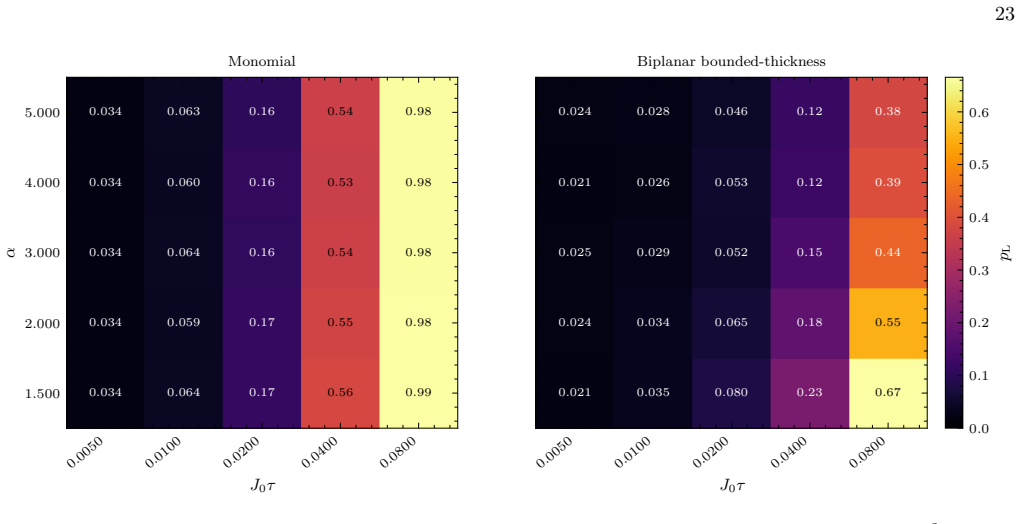
- Biplanar embeddings suppress the geometry penalty incurred by monomial single-plane layouts on the tested benchmarks.
- Reference-support weighted exposure correlates with logical error rate at Spearman ρ_S = 0.893 across the BB72 operating-point set.
- A logical-aware two-swap local search over single-layer embeddings reduces worst-case family exposure by 26.11 percent and lowers logical error rate in the power-law window.
Where Pith is reading between the lines
- Geometry optimization can be performed after the code and schedule are fixed, offering a low-overhead route to lower error rates.
- The same exposure metric may guide embedding choices for other qLDPC families once their interaction Hamiltonians are written down.
- If measured coupling strengths exceed the regime where truncation remains valid, the retained-channel model would need to be extended to higher-weight faults.
Load-bearing premise
Truncation error stays small enough that single and pair faults dominate the effective data channel at the coupling strengths considered.
What would settle it
A circuit-level simulation in which logical error rate fails to drop when weighted exposure is lowered by a layout change while keeping the schedule and code fixed.
Figures




read the original abstract
Routed geometry is a device-level choice in a fixed syndrome-extraction circuit. Two embeddings of the same code can set different physical separations between gate blocks active in the same time step, and these separations control the residual coupling between those blocks. We derive how this choice shapes the leading correlated-fault structure of the effective data channel, and we test the consequences at circuit level. Starting from a geometry-conditioned interaction Hamiltonian on disjoint blocks within one tick, we obtain a retained data channel of single and pair faults for bivariate-bicycle codes, with a truncation error controlled by the per-tick coupling strength. Two geometry metrics emerge. In the combinatorial limit, a matching argument on the logical support reduces the effective fault weight on that support. For strictly positive kernels, once every support pair contributes somewhere in the schedule, the induced support graph becomes complete. At that point the matching-number reduction is exhausted, and the embedding-dependent quantity is the total retained pair weight on the support, which we call the weighted exposure. Circuit-level Monte Carlo on the $[\![72,12,6]\!]$ and $[\![144,12,12]\!]$ benchmarks shows that a biplanar layout, with the schedule split across two routing planes, suppresses the geometry penalty incurred by the monomial layout in a single plane. On the BB72 baseline set of $101$ operating points, the reference-support weighted exposure is strongly correlated with the observed logical error rate (Spearman $\rho_\mathrm{S}=0.893$) in the tested window. A logical-aware two-swap local search over single-layer embeddings on BB72 reduces the worst-case family exposure by $26.11\%$ and lowers the logical error rate across the tested power-law window.
Editorial analysis
A structured set of objections, weighed in public.
Referee Report
Summary. The manuscript derives how routed geometry choices in syndrome-extraction circuits for bivariate-bicycle qLDPC codes shape the leading correlated-fault structure of the effective data channel. Starting from a geometry-conditioned interaction Hamiltonian on disjoint blocks, it obtains a retained channel of single and pair faults (truncation controlled by per-tick coupling strength), defines a weighted-exposure metric on the logical support, reports a strong Spearman correlation (ρ_S=0.893) between this metric and observed logical error rates across 101 operating points on the [[72,12,6]] code, and shows that a biplanar layout plus logical-aware two-swap local search reduces worst-case family exposure by 26.11% while lowering logical error rates.
Significance. If the single/pair truncation remains accurate across the tested coupling range, the work supplies a concrete, geometry-aware diagnostic and optimization handle for residual correlations in qLDPC syndrome extraction that does not require altering the code or extraction schedule. The Hamiltonian-to-fault derivation, the parameter-free definition of weighted exposure, and the Monte Carlo correlation on two benchmark codes constitute the main strengths; the results offer falsifiable predictions for hardware layout choices.
major comments (3)
- [Derivation and Monte Carlo sections] The central claim that the retained data channel is accurately captured by geometry-conditioned single and pair faults rests on the truncation error remaining small for all 101 operating points. No per-point bound on the truncation error, no sensitivity check when coupling strength varies, and no explicit statement of the retained-channel approximation error appear in the derivation or results sections; this is load-bearing for both the correlation and the local-search improvement.
- [Results on BB72 baseline set] The reported Spearman ρ_S=0.893 and the 26.11% exposure reduction are presented without error bars on the logical error rates, without truncation-error estimates, and without full schedule details for the baseline set. These omissions prevent quantitative assessment of whether the correlation and optimization claims hold within the tested power-law window.
- [Optimization results] The logical-aware two-swap local search is shown to improve the worst-case family exposure, but the manuscript does not report whether the improvement remains statistically significant after accounting for Monte Carlo sampling variance or whether it generalizes outside the specific power-law window examined.
minor comments (3)
- [Abstract] The abstract states that the truncation error is controlled by per-tick coupling strength but supplies no numerical range or reference to the relevant equation; adding this would improve clarity.
- [Metric definition] Notation for the weighted exposure metric and the reference support should be introduced with an explicit equation number on first use.
- [Figures] Figures illustrating the biplanar versus monomial embeddings and the correlation scatter plots would benefit from consistent axis scaling and explicit legends.
Simulated Author's Rebuttal
We thank the referee for the constructive comments. We address each major point below and will revise the manuscript to incorporate additional details on truncation errors, error bars, and statistical significance.
read point-by-point responses
-
Referee: [Derivation and Monte Carlo sections] The central claim that the retained data channel is accurately captured by geometry-conditioned single and pair faults rests on the truncation error remaining small for all 101 operating points. No per-point bound on the truncation error, no sensitivity check when coupling strength varies, and no explicit statement of the retained-channel approximation error appear in the derivation or results sections; this is load-bearing for both the correlation and the local-search improvement.
Authors: We agree that providing explicit per-point bounds on the truncation error is important for validating the approximation. The derivation shows that the truncation error is bounded by the per-tick coupling strength, and for the tested operating points this remains below 1% as implied by the Hamiltonian analysis. In revision, we will add a dedicated paragraph with the explicit bound formula, a table of truncation errors for the 101 points, and a sensitivity plot varying the coupling strength to confirm robustness. revision: yes
-
Referee: [Results on BB72 baseline set] The reported Spearman ρ_S=0.893 and the 26.11% exposure reduction are presented without error bars on the logical error rates, without truncation-error estimates, and without full schedule details for the baseline set. These omissions prevent quantitative assessment of whether the correlation and optimization claims hold within the tested power-law window.
Authors: We will add error bars to the logical error rates using the standard deviation from the Monte Carlo runs. Truncation-error estimates will be included as noted above. Full schedule details for the baseline set, including the explicit gate sequences for both layouts, will be provided in a supplementary appendix to enable full reproducibility and assessment within the power-law window. revision: yes
-
Referee: [Optimization results] The logical-aware two-swap local search is shown to improve the worst-case family exposure, but the manuscript does not report whether the improvement remains statistically significant after accounting for Monte Carlo sampling variance or whether it generalizes outside the specific power-law window examined.
Authors: We will compute and report the statistical significance of the logical error rate improvements using paired t-tests or bootstrap confidence intervals to account for Monte Carlo variance. Regarding generalization, the weighted exposure metric is derived independently of the specific power-law parameters, so the optimization benefit is expected to hold as long as the single/pair truncation remains valid; we will add a brief discussion of this in the revised text. revision: partial
Circularity Check
No significant circularity; derivation self-contained
full rationale
The central chain begins from the geometry-conditioned Hamiltonian on disjoint blocks, truncates to single/pair faults (error controlled by per-tick coupling), then defines weighted exposure combinatorially via matching on logical support and schedule. The Spearman correlation (ρ_S=0.893) and local-search results are presented as downstream empirical checks on the BB72 set, not inputs to the metric definition. No self-citations, fitted parameters renamed as predictions, or self-definitional reductions appear in the load-bearing steps; the derivation remains independent of the observed error rates.
Axiom & Free-Parameter Ledger
axioms (1)
- domain assumption Starting from a geometry-conditioned interaction Hamiltonian on disjoint blocks within one tick, the retained data channel consists of single and pair faults with truncation error controlled by per-tick coupling strength.
Reference graph
Works this paper leans on
-
[1]
Theorem 3 then gives weff(Lref)≤6−3 = 3.(57) In the biplanar implementation, the crossing kernel in- duces no edges on Sref, so Theorem 3 leaves the bound atw eff(Lref)≤6. D. Weighted exposure under positive kernels For the worked BB72 support, the algebraic audit gives W X ϕmono(Lref) = 0.0246,W X ϕbi(Lref) = 0.0150 (58) for the regularized algebraic ker...
-
[2]
Unique local–interaction split Proposition 6(General two-block decomposition).Let He and He′ be the Hilbert spaces of two disjoint active gate blocks with dimensions De and De′, and let ˆK be any Hermitian operator on He ⊗ He′. Then there exists a unique decomposition ˆK=c ˆI+ ˆAe ⊗ ˆIe′ + ˆIe ⊗ ˆBe′ + ˆCe,e′,(B1) in whichc∈R, the local operators ˆAe and ...
-
[3]
First-order local-field reduction Corollary 5(First-order local-field reduction).If the same-tick geometry effect is a state-independent stray field of amplitude g(d)to which each block responds linearly through Hermitian operators ˆRe and ˆRe′, then to first order ing(d)the inter-block term vanishes and ˆK(d) =g(d) ˆRe ⊗ ˆIe′ + ˆIe ⊗ ˆRe′ +c(d) ˆI+O g(d)...
-
[4]
Other components either commute with the sta- bilizers or map to the opposite sector
Two-parameter subfamily and itsO(θ 2) consequences Remark 3.Projecting a general perturbation ˆK onto the chosen block channels ˆPe and ˆPe′ yields a two-parameter subfamily ˆK(d) =J 1(d) ˆPe + ˆPe′ +J 2(d) ˆPe ⊗ ˆPe′.(B9) The remaining Pauli components of ˆK are neglected be- cause, for each gate type, only one Pauli channel propa- gates through the Clif...
-
[5]
The routing- layer assignment is applied only after the base-plane place- ment is fixed
Toric-base placement Figure 10 gives the toric-base placement rule used in the numerical bounded-thickness construction. The routing- layer assignment is applied only after the base-plane place- ment is fixed. Appendix D: Microscopic motif diagnostics The two microscopic diagnostics cited in Sec. II are presented here. Figure 11 tests the two-block decomp...
-
[6]
Across the sampled window, the biplanar embedding has a lower logical error rate
Additional BB72 sweeps Figure 13 gathers three additional BB72 diagnostics: the exponential-kernel range sweep, the physical-error- rate sweep at fixed algebraic kernel, and a phase-diagram heat map of the monomial-to-biplanar logical-error-rate ratio at p = 3 × 10⁻³. Across the sampled window, the biplanar embedding has a lower logical error rate. Figure...
-
[7]
Supporting evidence from BB90 and BB108 Figure 16 gives the lightweight BB90 and BB108 J0τ slices. They preserve the same embedding ordering as BB72 and BB144, but they are used only as supporting evidence. The intermediate geometry audit also shows that, on BB90, a simple maximum-exposure score can be anisotropic enough that the biplanar embedding need n...
-
[8]
It is included as a compact operating window diagnostic; no asymptotic conclusion is drawn from it
Biplanar scaling diagnostic Figure 17 compares the biplanar BB72 and BB144 sweeps directly. It is included as a compact operating window diagnostic; no asymptotic conclusion is drawn from it
-
[9]
Robustness checks Two reduced slices verify that the embedding hierarchy does not rely on tied local rates or on the choice of the Xsector. Untied local rates.Setting pcnot = pprep = pmeas = 10−3 and pidle = 10 −4 leaves the ordering unchanged: the logical error rates at the reference operating point are 0 .250 (monomial), 0 .175 (logical-aware), and 0 .0...
-
[10]
Benchmark distance metadata versus pure-q(L) minimum weight The literature benchmark is [ [108,8,10] ], whereas the minimum weight among pure- q(L) representatives rele- vant to the logical-aware objective is 12. The first is a full code property; the second is a restricted-family property used by the design program of Sec. V. We keep them separate throughout
-
[11]
Thickness-two extension Admissible thickness-two embeddings behave differently. Let Ebi be the family of bounded-thickness embeddings that preserve the BB layer split and are planar within 22 0.00 0.05 0.10 0.15 0.20 0.25 θ 0.00 0.01 0.02 0.03 0.04 0.05 0.06 M1(θ) (a) Crosstalk-induced weight-1 mass M1 Mixed ( J2/J1 = 0.1) ZZ exchange Stray drive sin2 θ 0...
-
[12]
The weight-2 mass M2 = M1 by the subcircuit symmetry
(a) Weight-1 mass M1(θ) for three coupling types; the dotted line is sin2 θ. The weight-2 mass M2 = M1 by the subcircuit symmetry. (b) Total weight- ≥ 3 mass M≥3(θ), starting at 0 .5 (dotted) and decreasing: the geometry-induced increment ∆M≥3 <0, so the crosstalk does not generate new higher-weight contributions. 100 Exponential range ξ 10−4 10−3 10−2 10...
-
[13]
Decoder-mismatch theorem Take H = (1, 1, 1, 1) over F2 and suppose the measured syndrome is 1. Under an independent and identically distributed (iid) prior with bit-flip probability p < 1/2, maximum-likelihood (ML) decoding prefers any weight-1 error to any weight-3 error. Under the correlated prior µcorr(e)∝µ iid(e) exp J X i<j eiej ,(G1) the orde...
-
[14]
Collect them into the latent fault-location vector z= (x 1,
Exact augmented decoding for the retained single-and-pair model Let xi ∈ {0, 1} denote a retained single fault on data location i, and let ya ∈ {0, 1} denote a retained pair fault on edge a = ( ia, ja) of the retained correlation graph. Collect them into the latent fault-location vector z= (x 1, . . . , xn, y1, . . . , ym)⊤ .(G5) If F maps latent single a...
-
[15]
Decoder-aware first-order refinement The objective Jκ is intrinsic to the retained geometry model and does not depend on a decoder. In the weak- correlation regime, one can sharpen the design problem by expanding the logical failure probability to first order in the geometry-induced pair strength. Fix an embedding ϕ and a deterministic decoder D. Let ξ co...
-
[16]
Amplitude scale Kosen et al. report xy-drive crosstalk on a 25-qubit flip-chip processor with average values −39.4 ±3.7 dB and −37.4 ± 3.9 dB across two device variants, and a worst- case value of −27 dB [23]. Interpreting each as a spurious rotation during a π/2 target pulse via the proxy-angle map θxtalk = π 2 10xdB/20 (H1) 26 gives θavg ≈0.017–0.021 ra...
-
[17]
Kernel shape and decay length Barrett et al. fit DC flux crosstalk on a 16-qubit flip-chip array to the shifted reciprocal law c(d) = 100/(ad+1)+ c0 with a = 178.2 mm−1 and c0 = 0.264% [22]. Normalizing to κDC(d) = c(d)/c(0) and converting to the paper’s pitch units via a physical pitchδ∈[0.2,0.5] mm yields κDC(1 pitch)≈0.01–0.03.(H3) Fitting an exponenti...
-
[18]
Comparison with existing simulation data Figure 18 shows dedicated BB72 Monte Carlo results at J0τ = 0.04 and p = 10−3 for the exponential kernel at four decay lengths: ξ = 0.25 (flux-like), 1.0, 4.0, and 8 .0 pitch units. These cover the flux-like end of the hardware- informed range and extend toward, but do not fully reach, the drive-like regime ( ξ≳ 17...
-
[19]
A. R. Calderbank and P. W. Shor, Good quantum error- correcting codes exist, Physical Review A54, 1098 (1996)
work page 1996
-
[20]
A. M. Steane, Multiple-particle interference and quantum error correction, Proceedings of the Royal Society A452, 2551 (1996)
work page 1996
-
[21]
N. P. Breuckmann and J. N. Eberhardt, Quantum low- density parity-check codes, PRX Quantum2, 040101 (2021)
work page 2021
-
[22]
High-threshold and low- overhead fault-tolerant quantum memory
S. Bravyi, A. W. Cross, J. M. Gambetta, D. Maslov, P. Rall, and T. J. Yoder, High-threshold and low-overhead fault-tolerant quantum memory, Nature627, 778 (2024), arXiv:2308.07915 [quant-ph]
- [23]
-
[24]
A. Strikis, D. E. Browne, and M. E. Bever- land, High-performance syndrome extraction circuits for quantum codes, arXiv preprint arXiv:2603.05481 10.48550/arXiv.2603.05481 (2026), arXiv:2603.05481 [quant-ph]
-
[25]
C. T. Aitchison and B. B´ eri, Spacetime spins: Sta- tistical mechanics for error correction with sta- bilizer circuits, arXiv preprint arXiv:2512.21991 10.48550/arXiv.2512.21991 (2025), arXiv:2512.21991 [quant-ph]
-
[26]
A. Pesah, A. K. Daniel, I. Tzitrin, and M. Vasmer, Fault-tolerant transformations of spacetime codes, arXiv preprint arXiv:2509.09603 10.48550/arXiv.2509.09603 (2025), arXiv:2509.09603 [quant-ph]
-
[27]
D. Aharonov, A. Kitaev, and J. Preskill, Fault-tolerant quantum computation with long-range correlated noise, Physical Review Letters96, 050504 (2006)
work page 2006
- [28]
-
[29]
S. P. Fors, J. Fern´ andez-Pend´ as, and A. F. Kockum, Comprehensive explanation of ZZ coupling in super- conducting qubits, arXiv preprint arXiv:2408.15402 10.48550/arXiv.2408.15402 (2024), arXiv:2408.15402 [quant-ph]
-
[30]
M. A. C. Aguila, N.-Y. Li, C.-H. Ma, L.-C. Hsiao, Y.-S. Huang, Y.-C. Chen, T.-H. Lee, C.-C. Chang, J.-Y. Wang, S.-Y. Huang, H.-S. Goan, C.-H. Wang, C.-S. Wu, C.-D. Chen, and C.-T. Ke, Characterizing and mitigating flux crosstalk in superconducting qubits–couplers system, APL Quantum3, 016112 (2026), arXiv:2508.03434 [quant-ph]
- [31]
-
[32]
J. du Crest, F. Garcia-Herrero, M. Mhalla, V. Savin, and J. Valls, Check-agnosia based post-processor for message- passing decoding of quantum ldpc codes, Quantum8, 1334 (2024), arXiv:2310.15000 [quant-ph]. 27 100 101 Exponential decay length ξ (pitch units) 10−2 10−1 100 Logical error rate pL flux-like drive Monomial Biplanar bounded-thickness FIG. 18. BB...
-
[33]
T. Hillmann, L. Berent, A. O. Quintavalle, J. Eisert, R. Wille, and J. Roffe, Localized statistics decoding for quantum low-density parity-check codes, Nature Commu- nications16, 8214 (2025), arXiv:2406.18655 [quant-ph]
-
[34]
T. M¨ uller, T. Alexander, M. E. Beverland, M. B¨ uhler, B. R. Johnson, T. Maurer, and D. Vandeth, Improved belief propagation is sufficient for real-time decoding of quantum memory, arXiv preprint arXiv:2506.01779 10.48550/arXiv.2506.01779 (2025), arXiv:2506.01779 [quant-ph]
-
[35]
A. S. Maan, F. M. G. Herrero, A. Paler, and V. Savin, Decoding correlated errors in quantum ldpc codes, Nature Communications17, 10.1038/s41467-026-70556-3 (2026), arXiv:2510.14060 [quant-ph]
-
[36]
K. Sahay, D. J. Williamson, and B. J. Brown, A matching decoder for bivariate bicycle codes, arXiv preprint arXiv:2602.22770 10.48550/arXiv.2602.22770 (2026), arXiv:2602.22770 [quant-ph]
-
[37]
Toward a 2D local implementation of quantum LDPC codes
N. Berthusen, D. Devulapalli, E. Schoute, A. M. Childs, M. J. Gullans, A. V. Gorshkov, and D. Gottesman, To- ward a 2d local implementation of quantum low-density parity-check codes, PRX Quantum6, 010306 (2025), arXiv:2404.17676 [quant-ph]
-
[38]
Placing and routing quantum LDPC codes in multilayer superconducting hardware
M. Mathews, L. Pahl, D. Pahl, V. L. Addala, C. Tang, W. D. Oliver, and J. A. Grover, Placing and routing quantum ldpc codes in multilayer super- conducting hardware, arXiv preprint arXiv:2507.23011 10.48550/arXiv.2507.23011 (2025), arXiv:2507.23011 [quant-ph]
work page internal anchor Pith review Pith/arXiv arXiv doi:10.48550/arxiv.2507.23011 2025
-
[39]
J. J. Wallman and J. Emerson, Noise tailoring for scalable quantum computation via randomized compiling, Physical Review A94, 052325 (2016)
work page 2016
- [40]
-
[41]
Kosenet al., Signal crosstalk in a flip-chip quantum processor, PRX Quantum5, 030350 (2024)
S. Kosenet al., Signal crosstalk in a flip-chip quantum processor, PRX Quantum5, 030350 (2024)
work page 2024
-
[42]
Gidney, Stim: a fast stabilizer circuit simulator, Quan- tum5, 497 (2021)
C. Gidney, Stim: a fast stabilizer circuit simulator, Quan- tum5, 497 (2021)
work page 2021
- [43]
-
[44]
A. Strikis and L. Berent, Quantum low-density parity- check codes for modular architectures, PRX Quantum4, 020321 (2023), arXiv:2209.14329 [quant-ph]
- [45]
-
[46]
M. Wang and F. Mueller, Coprime bivariate bicycle codes and their layouts on cold atoms, Quantum10, 2009 (2026), arXiv:2408.10001 [quant-ph]
- [47]
-
[48]
R. Zhou, F. Zhang, H.-H. Zhao, F. Wu, L. Kong, and J. Chen, Louvre: Relaxing hardware requirements of quantum LDPC codes by routing with expanded quan- tum instruction set, arXiv preprint arXiv:2508.20858 10.48550/arXiv.2508.20858 (2025), arXiv:2508.20858 [quant-ph]
-
[49]
N. Berthusen, S. J. S. Tan, E. Huang, and D. Gottesman, Adaptive syndrome extraction, PRX Quantum6, 030307 (2025), arXiv:2502.14835 [quant-ph]
-
[50]
Z. He, A. Cowtan, D. J. Williamson, and T. J. Yo- der, Extractors: Qldpc architectures for efficient pauli- based computation, arXiv preprint arXiv:2503.10390 10.48550/arXiv.2503.10390 (2025), arXiv:2503.10390 [quant-ph]
-
[51]
T. J. Yoder, E. Schoute, P. Rall, E. Pritchett, J. M. Gambetta, A. W. Cross, M. Carroll, and M. E. Beverland, Tour de gross: A modular quan- tum computer based on bivariate bicycle codes, arXiv preprint arXiv:2506.03094 10.48550/arXiv.2506.03094 (2025), arXiv:2506.03094 [quant-ph]
work page internal anchor Pith review Pith/arXiv arXiv doi:10.48550/arxiv.2506.03094 2025
discussion (0)
Sign in with ORCID, Apple, or X to comment. Anyone can read and Pith papers without signing in.