Recognition: no theorem link
IndustryCode: A Benchmark for Industry Code Generation
Pith reviewed 2026-05-13 20:22 UTC · model grok-4.3
The pith
IndustryCode introduces a benchmark of 125 primary industrial challenges and 579 sub-problems to test large language models on code generation across multiple domains and languages.
A machine-rendered reading of the paper's core claim, the machinery that carries it, and where it could break.
Core claim
The paper establishes IndustryCode as the first benchmark that spans multiple industrial domains and programming languages, built from 125 primary challenges decomposed into 579 sub-problems, each accompanied by rigorous descriptions and executable test cases, thereby providing a direct measure of how well large language models can handle the generalization and coding demands of real industrial applications.
What carries the argument
The IndustryCode dataset itself, structured as 125 primary challenges each decomposed into multiple sub-problems with accompanying test cases, functions as the evaluation mechanism that isolates domain-specific and language-specific performance.
If this is right
- Models will be ranked on their ability to solve problems that cross domain and language boundaries rather than on isolated academic tasks.
- Developers will receive granular feedback on which domains or languages remain weak points.
- Automated evaluation scripts will allow consistent, reproducible comparison of new models against the reported baseline.
- Sub-problem versus main-problem accuracy gaps will guide targeted improvements in decomposition and integration skills.
Where Pith is reading between the lines
- Performance on IndustryCode could serve as a proxy for estimating how much human oversight a model still requires when used inside production industrial pipelines.
- Extending the benchmark with new domains such as biotechnology or supply-chain optimization would test whether the current coverage is sufficient or merely a starting point.
- If scores remain low even after further training, the gap may indicate a deeper limit in how language models represent domain-specific constraints rather than a simple data shortage.
Load-bearing premise
The chosen 125 challenges and their 579 sub-problems with test cases accurately reflect the generalization and coding demands of actual industrial applications.
What would settle it
A model that scores above 90 percent on the benchmark yet produces incorrect or unsafe code when deployed on equivalent real industrial tasks would show that the benchmark does not capture true proficiency.
Figures




read the original abstract
Code generation and comprehension by Large Language Models (LLMs) have emerged as core drivers of industrial intelligence and decision optimization, finding widespread application in fields such as finance, automation, and aerospace. Although recent advancements have demonstrated the remarkable potential of LLMs in general code generation, existing benchmarks are mainly confined to single domains and languages. Consequently, they fail to effectively evaluate the generalization capabilities required for real-world industrial applications or to reflect the coding proficiency demanded by complex industrial scenarios. To bridge this gap, we introduce IndustryCode, the first comprehensive benchmark designed to span multiple industrial domains and programming languages. IndustryCode comprises 579 sub-problems derived from 125 primary industrial challenges, accompanied by rigorous problem descriptions and test cases. It covers a wide range of fields, including finance, automation, aerospace, and remote sensing-and incorporates diverse programming languages such as MATLAB, Python, C++, and Stata. In our evaluation, the top-performing model, Claude 4.5 Opus, achieved an overall accuracy of 68.1% on sub-problems and 42.5% main problems. The benchmark dataset and automated evaluation code will be made publicly available upon acceptance.
Editorial analysis
A structured set of objections, weighed in public.
Referee Report
Summary. The manuscript introduces IndustryCode, a benchmark for LLM-based industrial code generation consisting of 125 primary challenges decomposed into 579 sub-problems. It spans multiple domains (finance, automation, aerospace, remote sensing) and languages (MATLAB, Python, C++, Stata), provides problem descriptions and test cases, and reports model accuracies with Claude 4.5 Opus achieving the highest scores of 68.1% on sub-problems and 42.5% on main problems. The dataset and evaluation code are promised for public release.
Significance. If the problems are shown to be representative of real industrial coding demands, IndustryCode would address a clear gap in existing single-domain benchmarks and provide a useful public resource for measuring LLM generalization across languages and sectors. The multi-language coverage and planned release of automated evaluation code are positive features that would support reproducibility.
major comments (2)
- [Abstract / Introduction] Abstract and Introduction: The headline claim that the benchmark 'accurately capture[s] the generalization and coding proficiency demands of real-world industrial applications' is unsupported. No sourcing methodology, expert validation process, comparison to actual industrial codebases or issue trackers, or inter-annotator agreement statistics are provided for the 125 primary challenges or their 579 sub-problems.
- [Abstract] Dataset construction (implied in Abstract): Without details on how challenges were selected or test cases validated for coverage and correctness, the reported accuracies (68.1% sub-problem, 42.5% main-problem) cannot be interpreted as evidence of industrial readiness rather than performance on a curated suite of examples.
minor comments (1)
- [Abstract] Abstract: The phrase 'rigorous problem descriptions and test cases' is asserted without any accompanying description of the validation procedure or coverage metrics.
Simulated Author's Rebuttal
We thank the referee for their constructive feedback. We address the major comments point by point below, indicating where revisions have been made to the manuscript.
read point-by-point responses
-
Referee: [Abstract / Introduction] Abstract and Introduction: The headline claim that the benchmark 'accurately capture[s] the generalization and coding proficiency demands of real-world industrial applications' is unsupported. No sourcing methodology, expert validation process, comparison to actual industrial codebases or issue trackers, or inter-annotator agreement statistics are provided for the 125 primary challenges or their 579 sub-problems.
Authors: We agree that the original manuscript provided insufficient detail on construction methodology. The 125 primary challenges were developed internally by the authors drawing on their combined expertise in the target domains (finance, automation, aerospace, remote sensing) to reflect representative industrial coding tasks, such as financial data processing in Stata or control algorithm implementation in MATLAB. We have added a new 'Benchmark Construction' section that explicitly describes the selection criteria, decomposition into sub-problems, and design of test cases for functional coverage. However, no external expert validation panel or inter-annotator agreement was performed. We have revised the abstract and introduction to replace 'accurately capture' with 'aims to capture' and have added a limitations paragraph noting the absence of proprietary codebase comparisons due to confidentiality restrictions. This constitutes a partial revision. revision: partial
-
Referee: [Abstract] Dataset construction (implied in Abstract): Without details on how challenges were selected or test cases validated for coverage and correctness, the reported accuracies (68.1% sub-problem, 42.5% main-problem) cannot be interpreted as evidence of industrial readiness rather than performance on a curated suite of examples.
Authors: We accept this critique and have substantially expanded the manuscript with a dedicated 'Benchmark Construction' section. This section now details the process for selecting the 125 primary challenges to ensure domain and language diversity, the systematic decomposition into 579 sub-problems, and the manual creation and verification of test cases by the authors to cover core functionality and edge cases. The reported accuracies are presented strictly as results on this benchmark; we have added explicit text clarifying that they should not be taken as direct proof of industrial readiness. The full dataset and evaluation code will be released publicly to support independent assessment of coverage and correctness. revision: yes
- Formal inter-annotator agreement statistics or external expert validation, as the benchmark was constructed internally by the author team without multiple independent annotators.
- Direct comparison against actual proprietary industrial codebases or issue trackers, which are inaccessible due to confidentiality and intellectual property constraints.
Circularity Check
No circularity: benchmark introduction and direct accuracy reporting
full rationale
The paper introduces a new dataset (125 primary challenges yielding 579 sub-problems) and reports direct accuracy measurements (68.1% sub-problem, 42.5% main-problem) for public models on provided test cases. No equations, fitted parameters, predictions, or derivations appear; results are independent measurements rather than reductions to inputs by construction. No self-citation chains or ansatzes are invoked to justify the central claims or numbers.
Axiom & Free-Parameter Ledger
Forward citations
Cited by 1 Pith paper
-
ClassEval-Pro: A Cross-Domain Benchmark for Class-Level Code Generation
ClassEval-Pro benchmark shows frontier LLMs achieve at most 45.6% Pass@1 on class-level code tasks, with logic errors (56%) and dependency errors (38%) as dominant failure modes.
Reference graph
Works this paper leans on
-
[1]
SYSTEMOVERVIEW ANDLIBRARYDEPENDENCIES Main Problem: Automated LTI System Stability Analysis Suite Develop a comprehensive industrial-grade pipeline forRoot Locus Analysisof Linear Time-Invariant (LTI) systems. The system must process raw transfer function coefficients and show how closed-loop poles move in the complex plane as gainKvaries from 0 to infini...
-
[2]
COREALGORITHMSPECIFICATIONS Technical Details of Example Problems CASE IMPLEMENT A TION / 01 Convolution Function Implementation Problem Description The problem aims to create a pipeline for processing N-dimensional images and kernels to generate feature maps. It involves extracting normalized sliding windows from images, flattening kernels, computing dot...
-
[3]
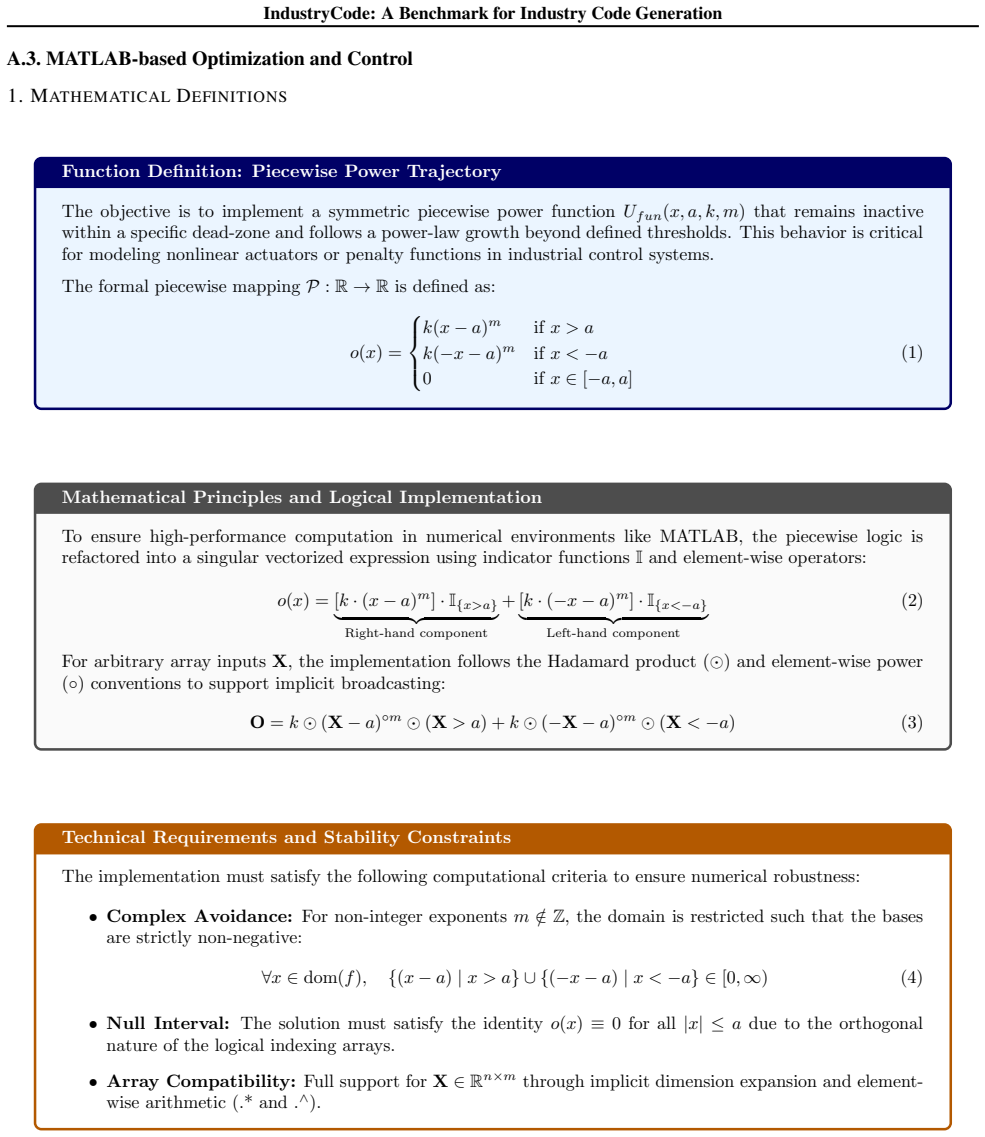
MATHEMATICALDEFINITIONS Function Definition: Piecewise Power Trajectory The objective is to implement a symmetric piecewise power functionU f un(x, a, k, m) that remains inactive within a specific dead-zone and follows a power-law growth beyond defined thresholds. This behavior is critical for modeling nonlinear actuators or penalty functions in industria...
-
[4]
OPTIMIZATIONSTRATEGY(GWO) CASE IMPLEMENT A TION / 02 GWO and Objective Functions Implementation Problem Description The problem requires implementing specifiedMATLABfunctions (objective functions, initial- ization,GWOoptimizer, plot) for optimization tasks. Problem IO The problem takes specifications of functions (Ufun,F1-F23,Get_Functions_details, initia...
-
[5]
Function Definition:function o = Ufun(x, a, k, m) Algorithm Flow:
DETAILEDFUNCTIONREQUIREMENTS Sub-Problem 1 Detailed-Description Please use MATLAB code to generate a function namedUfunthat implements a piecewise power function based on the input parameters. Function Definition:function o = Ufun(x, a, k, m) Algorithm Flow:
-
[6]
Calculate the first component: element-wise multiply k by (x - a) raised to the power m, then element-wise multiply by the logical array where x is greater than a
-
[7]
Calculate the second component: element-wise multiply k by (-x - a) raised to the power m, then element-wise multiply by the logical array where x is less than -a
-
[8]
Element-wise sum the two components to obtain the output o. MathematicalPrinciple:Thefunctionimplementsapiecewisepowerfunctiondefinedasfollows:𝑜(𝑥)=𝑘∗(𝑥−𝑎)𝑚 when𝑥 > 𝑎;𝑜(𝑥)=𝑘∗(−𝑥−𝑎)𝑚 when𝑥 <−𝑎;𝑜(𝑥)=0otherwise. Technical Requirements:1. Use element-wise operators (.* for multiplication,.ˆfor exponentiation) to support array inputs. 2. Use logical indexing t...
-
[9]
Architectural Misalignment in Semiconductors and Microelectronics Performance in theSemiconductors and Microelectronicssector is consistently suppressed across all evaluated models, with GPT-5.2 recording approximately 32.0%, while Qwen3-Max and Claude achieve roughly 60%. The fundamental cause 22 IndustryCode: A Benchmark for Industry Code Generation app...
-
[10]
Knowledge Retrieval in Physical Engineering In heavy engineering fields such asAerospace Engineering(82.4%) andMining(80.6%), GPT-5.2 demonstrates superior performance. This suggests that the pre-training corpus for GPT-5.2 likely contains a higher density of technical specifica- tions, standard operating procedures (SOPs), and industry standards (e.g. NA...
-
[11]
Claude 4.5 Sonnet (79.0%) outperforms Qwen3-Max ( ∼50%) and GPT-5.2 ( ∼42%) by a wide margin
Mathematical Reasoning versus Pattern Matching A significant performance divergence is observed inOptimization Algorithms. Claude 4.5 Sonnet (79.0%) outperforms Qwen3-Max ( ∼50%) and GPT-5.2 ( ∼42%) by a wide margin. Optimization problems necessitate multi-step logical deduction rather than pattern recognition. The architecture of Claude, which is optimiz...
-
[12]
Mixture-of-Experts Efficiency in IT and Manufacturing Qwen3-Max achieves the highest individual score in the benchmark (86.5% in IT) and leads inMachinery Manufacturing. These results support the efficacy of the Mixture-of-Experts (MoE) architecture in standardized coding problems. By routing code-generation problems to specialized parameter groups traine...
-
[13]
Precise Contextual Segregation (Heuristic Control):The critical differentiator is the capacity of Claude to maintain strict segregation between generalized reasoning priors and specific domain constraints. In reasoning-enhanced models, the generation of intermediate thoughts activates broad engineering heuristics that can conflict with local requirements....
-
[14]
The redefinition errors in Doubao (Case
Long-Horizon State Persistence (KV Cache Fidelity):Code generation is a state-dependent task; the model must remember a variable defined at token t= 50 when generating token t= 2000 . The redefinition errors in Doubao (Case
work page 2000
-
[15]
indicate a decay in its Key-Value (KV) cache fidelity over time—it fails to retain the information that a structure was already defined. Claude maintains state persistence far more effectively, essentially acting as if it has a larger, more stable working memory for symbol tables, ensuring strict adherence to the One Definition Rule (ODR)
-
[16]
The Syntax-First Alignment Hypothesis:We hypothesize that Claude utilizes a dual-stack alignment strategy. While comparison models allow the semantic intent to occasionally displace syntactic requirements, Claude enforces a strict hierarchy where grammatical correctness acts as a hard constraint. Even when the reasoning is complex or the architecture is d...
discussion (0)
Sign in with ORCID, Apple, or X to comment. Anyone can read and Pith papers without signing in.