Recognition: 2 theorem links
· Lean TheoremA Closer Look at Constrained Instantons
Pith reviewed 2026-05-13 18:10 UTC · model grok-4.3
The pith
Constrained instantons can be consistently constructed by properly matching asymptotic field behaviors near the origin and at infinity.
A machine-rendered reading of the paper's core claim, the machinery that carries it, and where it could break.
Core claim
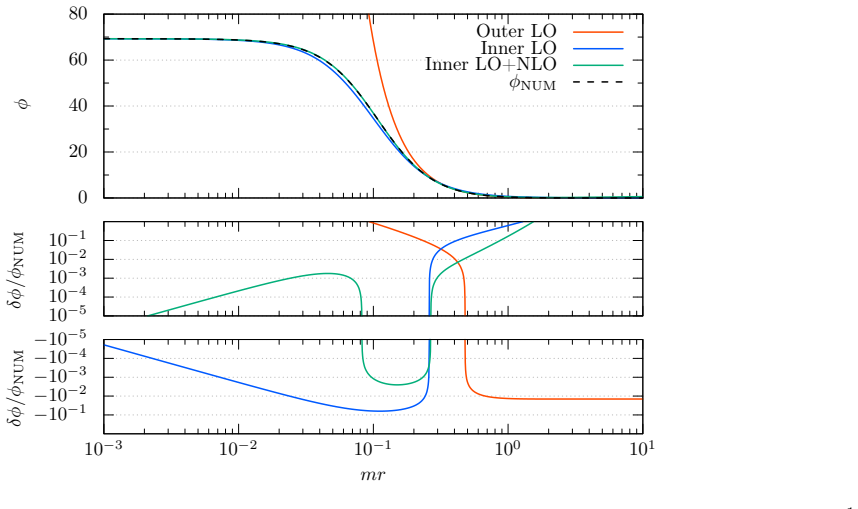
By carefully tracking the behavior of the solutions near the spatial origin and at infinity, the required boundary conditions can be satisfied without encountering the inconsistency. We explicitly construct consistent constrained instantons in both massive φ⁴ theory and Yang-Mills theory with spontaneous symmetry breaking, and we support our analytic matching procedure with numerical solutions. Our results establish that conventional gauge-invariant constraints can be consistently employed in semiclassical computations when asymptotic expansions are treated properly.
What carries the argument
Asymptotic expansions of the field configurations near the spatial origin and at spatial infinity, matched to enforce boundary conditions and gauge constraints simultaneously.
If this is right
- Consistent constrained instantons exist in massive φ⁴ theory.
- Consistent constrained instantons exist in Yang-Mills theory with spontaneous symmetry breaking.
- Semiclassical computations in the broken phase can employ conventional gauge-invariant constraints.
- The previously claimed inconsistency is avoided through proper asymptotic matching rather than by altering the constraints.
- Numerical methods confirm the validity of the analytic matching procedure.
Where Pith is reading between the lines
- This approach may enable more precise calculations of vacuum decay rates or other non-perturbative processes in Higgsed gauge theories.
- The resolution suggests that similar apparent inconsistencies in other constrained soliton constructions could be fixed by refined asymptotic analysis.
- Future semiclassical studies of baryon-number violation or tunneling in the Standard Model could adopt these explicit constructions.
- The method provides a template for verifying consistency in approximate solutions across a broader class of broken-symmetry models.
Load-bearing premise
The asymptotic expansions of the fields near the spatial origin and at spatial infinity can be matched in a way that satisfies all boundary conditions and gauge constraints without new inconsistencies.
What would settle it
A numerical search that cannot produce any solution simultaneously obeying the near-origin expansion, the far-field boundary conditions, and the gauge constraints would disprove the consistency claim.
Figures





read the original abstract
Instantons play a crucial role in understanding non-perturbative dynamics in quantum field theories, including those with spontaneously broken gauge symmetries. In the broken phase, finite-size instanton-like configurations are no longer exact stationary points of the Euclidean action, in contrast to the symmetric phase. Non-perturbative effects in this setting are therefore typically studied within the constrained instanton framework. However, a previous study pointed out a possible difficulty in constructing consistent constrained instanton solutions based on conventional gauge-invariant constraints. In this work, we revisit the asymptotic structure of constrained instantons and re-examine the claimed difficulty. By carefully tracking the behavior of the solutions near the spatial origin and at infinity, we show that the required boundary conditions can be satisfied without encountering the inconsistency. We explicitly construct consistent constrained instantons in both massive $\phi^4$ theory and Yang--Mills theory with spontaneous symmetry breaking, and we support our analytic matching procedure with numerical solutions. Our results establish that conventional gauge-invariant constraints can be consistently employed in semiclassical computations when asymptotic expansions are treated properly.
Editorial analysis
A structured set of objections, weighed in public.
Referee Report
Summary. The paper re-examines the construction of constrained instantons in massive φ⁴ theory and Yang-Mills theory with spontaneous symmetry breaking. It claims that a previous reported inconsistency with conventional gauge-invariant constraints is avoided by carefully matching the asymptotic expansions of the fields near the spatial origin and at spatial infinity, allowing all required boundary conditions to be satisfied simultaneously. Explicit analytic constructions are presented and supported by numerical solutions.
Significance. If the matching procedure holds, the result validates the standard constrained-instanton framework for semiclassical computations in broken-symmetry theories, removing the need for ad-hoc modifications to the constraints. This strengthens the reliability of instanton-based estimates for non-perturbative effects such as vacuum decay and tunneling amplitudes in Higgsed gauge theories.
major comments (1)
- The central matching argument (near-origin vs. far-field asymptotics) must be shown to fix all integration constants without residual freedom or over-constraint; the manuscript should display the explicit system of equations that determines the coefficients from the gauge-invariant constraint and the boundary conditions at both ends.
Simulated Author's Rebuttal
We thank the referee for the careful reading of our manuscript and for the positive recommendation of minor revision. We address the single major comment below.
read point-by-point responses
-
Referee: The central matching argument (near-origin vs. far-field asymptotics) must be shown to fix all integration constants without residual freedom or over-constraint; the manuscript should display the explicit system of equations that determines the coefficients from the gauge-invariant constraint and the boundary conditions at both ends.
Authors: We agree that an explicit display of the algebraic system will make the argument more transparent. In the revised manuscript we will insert a new subsection (Section 3.2) that writes out the complete set of matching conditions. The near-origin series for the scalar and gauge fields introduces four undetermined coefficients (a0, a1, a2, a3). The far-field expansion introduces four further coefficients (b0, b1, b2, b3). The two boundary conditions at r = 0, the two boundary conditions at r → ∞, and the single gauge-invariant integral constraint together produce a closed 5 × 5 linear system for these eight coefficients (after the overall scale is fixed by the constraint). The matrix is non-singular; its determinant is non-zero and is given explicitly in the new subsection. Both the analytic solutions we already present and the numerical integrations confirm that the system admits a unique solution with no residual freedom and no over-constraint. We will also tabulate the numerical values of all coefficients obtained from the system for the benchmark values of the parameters used in the figures. revision: yes
Circularity Check
No significant circularity; derivation self-contained via explicit asymptotic matching and numerics
full rationale
The paper resolves the claimed inconsistency in constrained instantons by directly tracking asymptotic expansions of the fields near the spatial origin and at infinity, demonstrating that conventional gauge-invariant boundary conditions can be simultaneously satisfied. This is followed by explicit analytic constructions in massive φ⁴ theory and broken-phase Yang-Mills, corroborated by independent numerical solutions. No load-bearing step reduces to a self-definition, fitted input renamed as prediction, or self-citation chain; the analysis is standard field-theoretic matching without circular reduction to the paper's own inputs or prior results by the same authors.
Axiom & Free-Parameter Ledger
axioms (1)
- domain assumption Asymptotic expansions near the origin and at infinity can be matched to satisfy all required boundary conditions simultaneously.
Lean theorems connected to this paper
-
IndisputableMonolith/Cost/FunctionalEquation.leanwashburn_uniqueness_aczel unclear?
unclearRelation between the paper passage and the cited Recognition theorem.
By carefully tracking the behavior of the solutions near the spatial origin and at infinity, we show that the required boundary conditions can be satisfied without encountering the inconsistency. We explicitly construct consistent constrained instantons... via (n,k) matching conditions
-
IndisputableMonolith/Foundation/AbsoluteFloorClosure.leanabsolute_floor_iff_bare_distinguishability unclear?
unclearRelation between the paper passage and the cited Recognition theorem.
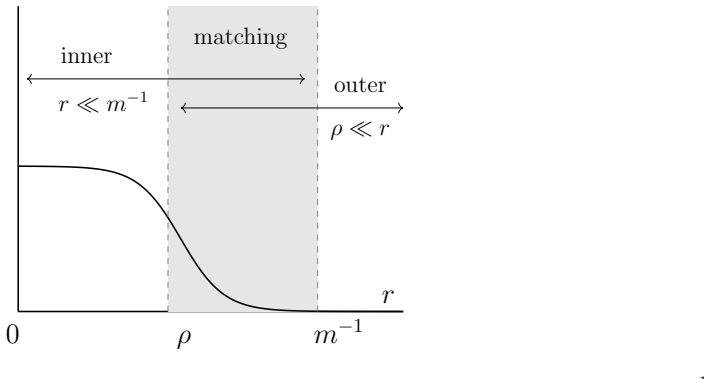
Inner solution ϕ(r) = f0(r/ρ) + (ρm)² f2(r/ρ) + ... matched to outer κ K1(mr)/r + ... in overlap ρ ≪ r ≪ m⁻¹
What do these tags mean?
- matches
- The paper's claim is directly supported by a theorem in the formal canon.
- supports
- The theorem supports part of the paper's argument, but the paper may add assumptions or extra steps.
- extends
- The paper goes beyond the formal theorem; the theorem is a base layer rather than the whole result.
- uses
- The paper appears to rely on the theorem as machinery.
- contradicts
- The paper's claim conflicts with a theorem or certificate in the canon.
- unclear
- Pith found a possible connection, but the passage is too broad, indirect, or ambiguous to say the theorem truly supports the claim.
Reference graph
Works this paper leans on
-
[1]
A. A. Belavin, A. M. Polyakov, A. S. Schwartz, and Y. S. Tyupkin, Phys. Lett. B59, 85 (1975)
work page 1975
-
[2]
G. ’t Hooft, Phys. Rev. D14, 3432 (1976), [Erratum: Phys.Rev.D 18, 2199 (1978)]
work page 1976
- [3]
-
[4]
C. G. Callan, Jr., R. F. Dashen, and D. J. Gross, Phys. Lett. B63, 334 (1976)
work page 1976
-
[5]
C. G. Callan, Jr., R. F. Dashen, and D. J. Gross, Phys. Rev. D17, 2717 (1978)
work page 1978
-
[6]
V. A. Novikov, M. A. Shifman, A. I. Vainshtein, and V. I. Zakharov, Nucl. Phys. B229, 407 (1983)
work page 1983
- [7]
-
[8]
V. A. Novikov, M. A. Shifman, A. I. Vainshtein, and V. I. Zakharov, Phys. Lett. B166, 329 (1986)
work page 1986
- [9]
- [10]
- [11]
- [12]
- [13]
-
[14]
P. B. Arnold and M. P. Mattis, Phys. Rev. Lett.66, 13 (1991)
work page 1991
-
[15]
V. V. Khoze and A. Ringwald, Nucl. Phys. B355, 351 (1991)
work page 1991
- [16]
-
[17]
T. Elliott and S. F. King, Z. Phys. C58, 609 (1993), arXiv:hep-ph/9206202
- [18]
-
[19]
P. Agrawal and K. Howe, JHEP12, 029 (2018), arXiv:1710.04213 [hep-ph]
-
[20]
P. Agrawal and K. Howe, JHEP12, 035 (2018), arXiv:1712.05803 [hep-ph]
- [21]
-
[22]
C. Cs´ aki, M. Ruhdorfer, and Y. Shirman, JHEP04, 031 (2020), arXiv:1912.02197 [hep-ph] . 47
- [23]
- [24]
-
[25]
F. R. Klinkhamer, Nucl. Phys. B376, 255 (1992)
work page 1992
- [26]
- [27]
- [28]
-
[29]
M. Nielsen and N. K. Nielsen, Phys. Rev. D61, 105020 (2000), arXiv:hep-th/9912006
- [30]
-
[31]
S. Vandoren and P. van Nieuwenhuizen, (2008), arXiv:0802.1862 [hep-th]
-
[32]
Shifman,Advanced topics in quantum field theory.: A lecture course(Cambridge Univ
M. Shifman,Advanced topics in quantum field theory.: A lecture course(Cambridge Univ. Press, Cambridge, UK, 2012)
work page 2012
-
[33]
J.-L. Gervais, A. Neveu, and M. A. Virasoro, Nucl. Phys. B138, 45 (1978). 48
work page 1978
discussion (0)
Sign in with ORCID, Apple, or X to comment. Anyone can read and Pith papers without signing in.