Recognition: no theorem link
PR3DICTR: A modular AI framework for medical 3D image-based detection and outcome prediction
Pith reviewed 2026-05-13 20:38 UTC · model grok-4.3
The pith
PR3DICTR supplies a modular open framework that lets users build 3D medical image classification models in as little as two lines of code.
A machine-rendered reading of the paper's core claim, the machinery that carries it, and where it could break.
Core claim
PR3DICTR is a platform for research in 3D image classification and standardised training that supplies users with a wealth of pre-established functionality in model architecture design, hyper-parameter solutions and training methodologies while still permitting them to plug in their own solutions or modules, all accessible for any binary or event-based three-dimensional classification task with as little as two lines of code.
What carries the argument
The PR3DICTR framework, which applies modular design principles and standardization on PyTorch and MONAI to deliver pre-built components for 3D image classification while preserving user customizability.
Load-bearing premise
That the modular design and pre-established functionality will meaningfully reduce developmental burden for a broad range of users without requiring substantial additional custom coding or validation.
What would settle it
A controlled comparison in which independent teams build equivalent 3D medical image classifiers using PR3DICTR versus conventional codebases and record no reduction in lines of code written or total development time.
Figures
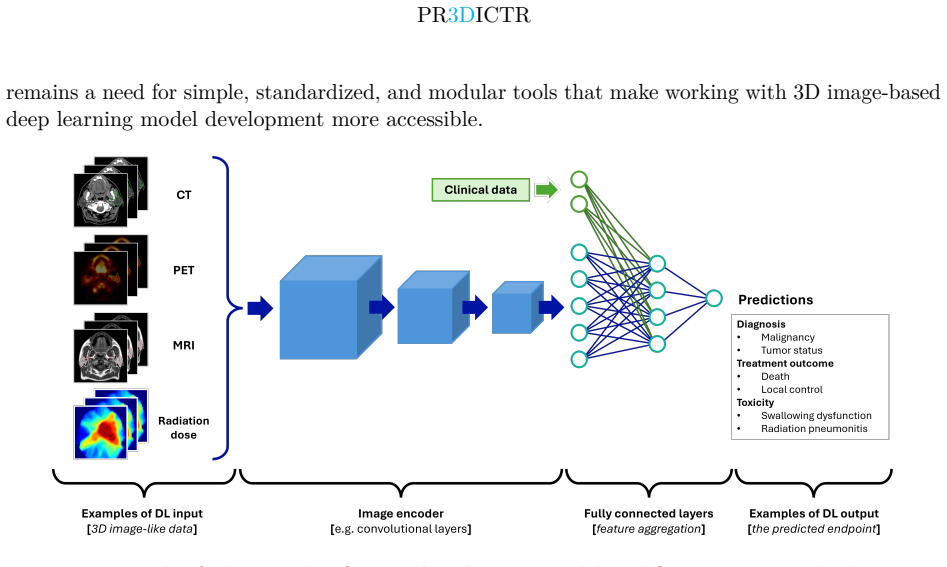


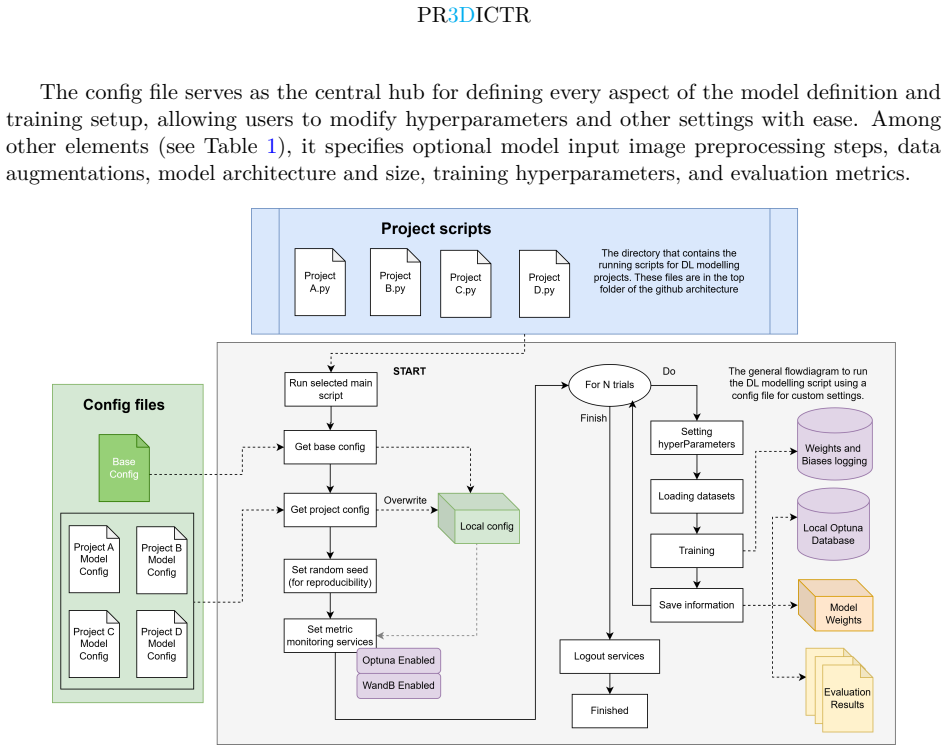


read the original abstract
Three-dimensional medical image data and computer-aided decision making, particularly using deep learning, are becoming increasingly important in the medical field. To aid in these developments we introduce PR3DICTR: Platform for Research in 3D Image Classification and sTandardised tRaining. Built using community-standard distributions (PyTorch and MONAI), PR3DICTR provides an open-access, flexible and convenient framework for prediction model development, with an explicit focus on classification using three-dimensional medical image data. By combining modular design principles and standardization, it aims to alleviate developmental burden whilst retaining adjustability. It provides users with a wealth of pre-established functionality, for instance in model architecture design options, hyper-parameter solutions and training methodologies, but still gives users the opportunity and freedom to ``plug in'' their own solutions or modules. PR3DICTR can be applied to any binary or event-based three-dimensional classification task and can work with as little as two lines of code.
Editorial analysis
A structured set of objections, weighed in public.
Referee Report
Summary. The manuscript introduces PR3DICTR, a modular framework built on PyTorch and MONAI for developing classification models on 3D medical images. It emphasizes standardization of architectures, hyper-parameter solutions, and training methods while allowing users to plug in custom modules, with the explicit claim that it supports any binary or event-based 3D classification task and can be used with as little as two lines of code to alleviate developmental burden.
Significance. A well-validated modular framework could improve reproducibility and lower entry barriers for 3D medical image classification research. The design principles align with community standards, but the absence of any empirical validation, code examples, or quantitative measures of burden reduction means the claimed practical benefits remain untested assertions rather than demonstrated outcomes.
major comments (2)
- Abstract: The central claim that PR3DICTR 'can work with as little as two lines of code' and meaningfully alleviates developmental burden is presented without any code snippets, usage examples, installation details, or side-by-side comparisons to baseline PyTorch/MONAI implementations, leaving the convenience assertion unsubstantiated.
- Abstract and full text: No benchmarks, validation results on real datasets, ablation studies, or metrics (e.g., lines-of-code savings, training time comparisons) are supplied to support the claims of flexibility and reduced burden, which are load-bearing for the paper's contribution as a practical framework.
minor comments (1)
- Consider adding a dedicated usage section with minimal working examples and a diagram of the modular architecture to clarify how pre-established components integrate with custom modules.
Simulated Author's Rebuttal
We thank the referee for their detailed and constructive report. We address each major comment point by point below, indicating the specific revisions we will implement to strengthen the manuscript while preserving its focus as a framework description.
read point-by-point responses
-
Referee: Abstract: The central claim that PR3DICTR 'can work with as little as two lines of code' and meaningfully alleviates developmental burden is presented without any code snippets, usage examples, installation details, or side-by-side comparisons to baseline PyTorch/MONAI implementations, leaving the convenience assertion unsubstantiated.
Authors: We agree that the convenience claim requires concrete support. In the revised manuscript we will add a new 'Usage and Implementation' section containing: (i) the exact two-line code example for a standard binary classification task, (ii) complete installation instructions, and (iii) a side-by-side code-length comparison table against equivalent PyTorch/MONAI scripts. These additions will directly substantiate the burden-reduction assertion. revision: yes
-
Referee: Abstract and full text: No benchmarks, validation results on real datasets, ablation studies, or metrics (e.g., lines-of-code savings, training time comparisons) are supplied to support the claims of flexibility and reduced burden, which are load-bearing for the paper's contribution as a practical framework.
Authors: The manuscript's core contribution is the modular architecture and standardization approach rather than a full empirical benchmark study. To address the concern we will incorporate quantitative metrics in the new Usage section, including measured lines-of-code savings for representative tasks and example training-time comparisons on a public 3D dataset. Comprehensive multi-dataset validation and ablation studies remain outside the present scope; we will revise the abstract and discussion to clarify this boundary while still demonstrating the framework's flexibility through the added metrics and design documentation. revision: partial
Circularity Check
No circularity detected; software framework description only
full rationale
The paper introduces PR3DICTR as a modular software framework built on PyTorch and MONAI for 3D medical image classification tasks. It describes pre-established functionality for architectures, hyperparameters, and training methods, with claims that the design alleviates developmental burden and supports use in as little as two lines of code. No equations, derivations, predictions, fitted parameters, or mathematical steps appear anywhere in the text. There are no self-citations of uniqueness theorems, ansatzes smuggled via prior work, or renamings of known results that reduce any claim to its own inputs by construction. The central assertions are descriptive and implementation-focused rather than derived, so the derivation chain is empty and the paper is self-contained against external benchmarks.
Axiom & Free-Parameter Ledger
Reference graph
Works this paper leans on
-
[1]
Advances in medical imaging techniques,
J. Rong and Y. Liu, “Advances in medical imaging techniques,”BMC Methods, vol. 1, p. 10, 8 2024. [Online]. Available: https://bmcmethods.biomedcentral.com/articles/10.1186/ s44330-024-00010-7
work page 2024
-
[2]
Imaging diagnosis and treatment selection for brain tumors in the era of molecular therapeutics,
S. Vagvala, J. P. Guenette, C. Jaimes, and R. Y. Huang, “Imaging diagnosis and treatment selection for brain tumors in the era of molecular therapeutics,”Cancer Imaging, vol. 22, p. 19, 12 2022. [Online]. Available: https://cancerimagingjournal.biomedcentral.com/articles/10.1186/ s40644-022-00455-5
work page 2022
-
[3]
L. Saba and E. D’Aloja, “Predictive techniques in medical imaging: opportunities, limitations, and ethical-economic challenges,”npj Digital Medicine, vol. 8, p. 392, 7 2025. [Online]. Available: https://www.nature.com/articles/s41746-025-01791-z
work page 2025
-
[4]
The challenges of diagnostic imaging in the era of big data,
M. Aiello, C. Cavaliere, A. D’Albore, and M. Salvatore, “The challenges of diagnostic imaging in the era of big data,”Journal of Clinical Medicine, vol. 8, p. 316, 3 2019. [Online]. Available: https://www.mdpi.com/2077-0383/8/3/316
work page 2019
-
[5]
I. F. van Galen, C. R. Guetter, E. Caron, J. Darling, J. Park, R. B. Davis, M. Kricfalusi, V. I. Patel, J. A. van Herwaarden, T. F. O’Donnell, and M. L. Schermerhorn, “The effect of aneurysm diameter on perioperative outcomes following complex endovascular PR3DICTR repair,”Journal of Vascular Surgery, vol. 81, pp. 1023–1032.e1, 5 2025. [Online]. Available...
work page 2025
-
[6]
Deep learning techniques for imaging diagnosis and treatment of aortic aneurysm,
L. Huang, J. Lu, Y. Xiao, X. Zhang, C. Li, G. Yang, X. Jiao, and Z. Wang, “Deep learning techniques for imaging diagnosis and treatment of aortic aneurysm,” Frontiers in Cardiovascular Medicine, vol. 11, 2 2024. [Online]. Available: https: //www.frontiersin.org/articles/10.3389/fcvm.2024.1354517/full
-
[7]
Lung cancer staging: Imaging and potential pitfalls,
L. T. Erasmus, T. A. Strange, R. Agrawal, C. D. Strange, J. Ahuja, G. S. Shroff, and M. T. Truong, “Lung cancer staging: Imaging and potential pitfalls,”Diagnostics, vol. 13, p. 3359, 11
-
[8]
Available: https://www.mdpi.com/2075-4418/13/21/3359
[Online]. Available: https://www.mdpi.com/2075-4418/13/21/3359
work page 2075
-
[9]
A. Wehbe, S. Dellepiane, and I. Minetti, “Enhanced lung cancer detection and tnm staging using yolov8 and tnmclassifier: An integrated deep learning approach for ct imaging,”IEEE Access, vol. 12, pp. 141414–141424, 2024. [Online]. Available: https://ieeexplore.ieee.org/document/10681569/
-
[10]
Gandlf: the generally nuanced deep learning framework for scalable end-to-end clinical workflows,
S. Pati, S. P. Thakur, İbrahim Ethem Hamamcı, U. Baid, B. Baheti, M. Bhalerao, O. Güley, S. Mouchtaris, D. Lang, S. Thermos, K. Gotkowski, C. González, C. Grenko, A. Getka, B. Edwards, M. Sheller, J. Wu, D. Karkada, R. Panchumarthy, V. Ahluwalia, C. Zou, V. Bashyam, Y. Li, B. Haghighi, R. Chitalia, S. Abousamra, T. M. Kurc, A. Gastounioti, S. Er, M. Bergm...
work page 2023
-
[11]
PyTorch: An Imperative Style, High-Performance Deep Learning Library
A. Paszke, S. Gross, F. Massa, A. Lerer, J. Bradbury, G. Chanan, T. Killeen, Z. Lin, N. Gimelshein, L. Antiga, A. Desmaison, A. Köpf, E. Yang, Z. DeVito, M. Raison, A. Tejani, S. Chilamkurthy, B. Steiner, L. Fang, J. Bai, and S. Chintala, “Pytorch: An imperative style, high-performance deep learning library,” 12 2019. [Online]. Available: http://arxiv.org...
work page internal anchor Pith review Pith/arXiv arXiv 2019
-
[12]
MONAI: An open-source framework for deep learning in healthcare
M. J. Cardoso, W. Li, R. Brown, N. Ma, E. Kerfoot, Y. Wang, B. Murrey, A. Myronenko, C. Zhao, D. Yang, V. Nath, Y. He, Z. Xu, A. Hatamizadeh, A. Myronenko, W. Zhu, Y. Liu, M. Zheng, Y. Tang, I. Yang, M. Zephyr, B. Hashemian, S. Alle, M. Z. Darestani, C. Budd, M. Modat, T. Vercauteren, G. Wang, Y. Li, Y. Hu, Y. Fu, B. Gorman, H. Johnson, B. Genereaux, B. S...
work page internal anchor Pith review arXiv 2022
-
[13]
Ludwig: a type-based declarative deep learning toolbox,
P. Molino, Y. Dudin, and S. S. Miryala, “Ludwig: a type-based declarative deep learning toolbox,” 9 2019. [Online]. Available: http://arxiv.org/abs/1909.07930
-
[14]
mixup: Beyond Empirical Risk Minimization
H. Zhang, M. Cisse, Y. N. Dauphin, and D. Lopez-Paz, “mixup: Beyond empirical risk minimization,” 4 2018. [Online]. Available: http://arxiv.org/abs/1710.09412
work page internal anchor Pith review Pith/arXiv arXiv 2018
-
[15]
Deep Residual Learning for Image Recognition
K. He, X. Zhang, S. Ren, and J. Sun, “Deep residual learning for image recognition,” 12 2015. [Online]. Available: http://arxiv.org/abs/1512.03385 PR3DICTR
work page internal anchor Pith review Pith/arXiv arXiv 2015
-
[16]
Densely connected convolutional networks,
G. Huang, Z. Liu, L. van der Maaten, and K. Q. Weinberger, “Densely connected convolutional networks,” 1 2018. [Online]. Available: http://arxiv.org/abs/1608.06993
-
[17]
Efficientnetv2: Smaller models and faster training,
M. Tan and Q. V. Le, “Efficientnetv2: Smaller models and faster training,” 6 2021. [Online]. Available: http://arxiv.org/abs/2104.00298
-
[18]
An Image is Worth 16x16 Words: Transformers for Image Recognition at Scale
A. Dosovitskiy, L. Beyer, A. Kolesnikov, D. Weissenborn, X. Zhai, T. Unterthiner, M. Dehghani, M. Minderer, G. Heigold, S. Gelly, J. Uszkoreit, and N. Houlsby, “An image is worth 16x16 words: Transformers for image recognition at scale,” 6 2021. [Online]. Available: http://arxiv.org/abs/2010.11929
work page internal anchor Pith review Pith/arXiv arXiv 2021
-
[19]
B. Ma, J. Guo, L. V. van Dijk, P. M. van Ooijen, S. Both, and N. M. Sijtsema, “Transrp: Transformer-based pet/ct feature extraction incorporating clinical data for recurrence-free survival prediction in oropharyngeal cancer,” inMedical Imaging and Deep Learning, 2023
work page 2023
-
[20]
Adam: A Method for Stochastic Optimization
D. P. Kingma and J. Ba, “Adam: A method for stochastic optimization,” 1 2017. [Online]. Available: http://arxiv.org/abs/1412.6980
work page internal anchor Pith review Pith/arXiv arXiv 2017
-
[21]
Decoupled Weight Decay Regularization
I. Loshchilov and F. Hutter, “Decoupled weight decay regularization,” 1 2019. [Online]. Available: http://arxiv.org/abs/1711.05101
work page internal anchor Pith review Pith/arXiv arXiv 2019
-
[22]
Adaptive gradient methods with dynamic bound of learning rate,
L. Luo, Y. Xiong, Y. Liu, and X. Sun, “Adaptive gradient methods with dynamic bound of learning rate,” 2 2019. [Online]. Available: http://arxiv.org/abs/1902.09843
-
[23]
Measuring calibration in deep learning,
J. Nixon, M. Dusenberry, G. Jerfel, T. Nguyen, J. Liu, L. Zhang, and D. Tran, “Measuring calibration in deep learning,” 8 2020. [Online]. Available: http://arxiv.org/abs/1904.01685
-
[24]
Optuna: A Next-generation Hyperparameter Optimization Framework
T. Akiba, S. Sano, T. Yanase, T. Ohta, and M. Koyama, “Optuna: A next- generation hyperparameter optimization framework,” 7 2019. [Online]. Available: http: //arxiv.org/abs/1907.10902
work page Pith review arXiv 2019
-
[25]
Data from nsclc-radiomics (version 4) [data set],
H. J. W. L. Aerts, L. Wee, E. R. Velazquez, R. T. H. Leijenaar, C. Parmar, P. Grossmann, S. Carvalho, J. Bussink, R. Monshouwer, B. Haibe-Kains, D. Rietveld, F. Hoebers, M. M. Rietbergen, C. R. Leemans, A. Dekker, J. Quackenbush, R. J. Gillies, and P. Lambin, “Data from nsclc-radiomics (version 4) [data set],” 2014
work page 2014
-
[26]
H. Chu, S. P. M. de Vette, H. Neh, N. M. Sijtsema, R. J. H. M. Steenbakkers, A. Moreno, J. A. Langendijk, P. M. A. van Ooijen, C. D. Fuller, and L. V. V. Dijk, “Three-dimensional deep learning normal tissue complication probability model to predict late xerostomia in patients with head and neck cancer,”International Journal of Radiation Oncology, Biology,...
work page 2025
-
[27]
S. P. M. de Vette, H. Neh, L. V. D. Hoek, D. C. MacRae, H. Chu, A. Gawryszuk, R. Steenbakkers, P. M. A. V. Ooijen, C. D. Fuller, K. A. Hutcheson, J. A. Langendijk, N. M. Sijtsema, and L. V. V. Dijk, “Deep learning ntcp model for late dysphagia after radiotherapy for head and neck cancer patients based on 3d dose, ct and segmentations,”Radiotherapy and Onc...
work page 2025
-
[28]
D. MacRae, L. van der Hoek, S. de Vette, H. Neh, A. Moreno, C. Fuller, J. Langendijk, M. Valdenegro-Toro, N. Sijtsema, P. van Ooijen, and L. van Dijk, “A multi-toxicity deep learning approach for normal tissue complication probability modelling in head and neck cancer patients receiving radiotherapy,”Radiotherapy and Oncology, 3 2026. [Online]. Available:...
-
[29]
D. MacRae, L. van der Hoek, J. van Aalst, S. de Vette, R. van der Wal, H. Neh, B. Ma, N. Sijtsema, M. Valdenegro-Toro, P. van Ooijen, and L. van Dijk, “An evaluation of uncertainty quantification methods and measures for deep learning outcome prediction models in head and neck cancer radiotherapy,” 12 2025. [Online]. Available: https://ssrn.com/abstract=6041252
work page 2025
-
[30]
Aid-rt: Standardising ai documentation in radiotherapy with a domain-specific model card
A. M. Barragán-Montero, M. Huet-Dastarac, S. M. Herranz-Hernández, B. Tengler, E. S. Buhl, A. Galapon, C. E. Cárdenas, M. Fusella, G. Herbin, Y. de Hond, F. Knuth, C. Malone, P. van Ooijen, C. Robert, M. Zeverino, C. Hurkmans, T. Janssen, S. S. Korreman, and C. L. Brouwer, “Aid-rt: Standardising ai documentation in radiotherapy with a domain-specific model card.”
-
[31]
Available: https://zenodo.org/records/17399354
[Online]. Available: https://zenodo.org/records/17399354
discussion (0)
Sign in with ORCID, Apple, or X to comment. Anyone can read and Pith papers without signing in.