Recognition: no theorem link
Topolons: Stable Particle-Like Remnants of Collapsed Vacuum Bubbles
Pith reviewed 2026-05-13 17:46 UTC · model grok-4.3
The pith
Vacuum bubbles carrying quantized monopole flux on their walls collapse to stable particle-like remnants whose mass is fixed by the wall scale and conserved flux.
A machine-rendered reading of the paper's core claim, the machinery that carries it, and where it could break.
Core claim
for nonzero monopole flux the energy does not vanish in the collapsed limit. Instead, the bubble relaxes to a finite-energy remnant whose mass is set by the wall scale and the conserved flux.
Load-bearing premise
We restrict attention to the semiclassically admissible four form flux window for which the Hartle-Hawking wave function has support.
Figures


read the original abstract
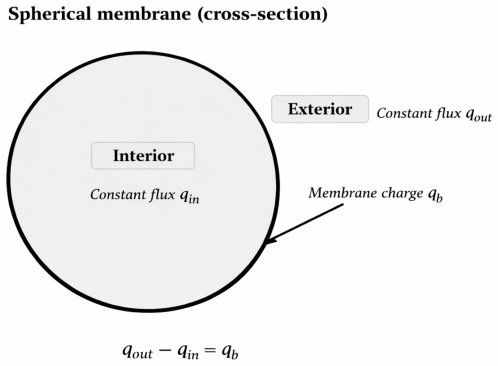
We study a three-form gauge sector in four spacetime dimensions coupled to electrically charged spherical membranes whose worldvolume dynamics are governed by a Dirac--Born--Infeld action. The associated four-form field strength has no local propagating degrees of freedom and contributes a branch-dependent vacuum energy. Motivated by the Hartle--Hawking--Wu selection argument, we restrict attention to the semiclassically admissible four form flux window for which the Hartle-Hawking wave function has support. We then endow the bubble wall with a worldvolume $U(1)$ gauge field carrying quantized monopole flux $n \in \mathbb{Z}$ and evaluate the full DBI energy of the resulting spherical configurations. We show that the energetically preferred branch collapses toward a microscopic core rather than stabilizing at finite radius, but for nonzero monopole flux the energy does not vanish in the collapsed limit. Instead, the bubble relaxes to a finite-energy remnant whose mass is set by the wall scale and the conserved flux. We interpret these objects as stable flux-supported particle-like states, which we call topolons. Within the admissible sector, the effective energy analysis distinguishes stable collapsed remnants from the contrasting runaway vacuum-decay channel, thereby isolating the sector relevant for cosmological relic formation. At macroscopic distances, topolons behave as heavy localized states and provide a concrete microphysical realization of a dark relic candidate. The detailed cosmological abundance and phenomenology are left for future work.
Editorial analysis
A structured set of objections, weighed in public.
Referee Report
Summary. The paper examines a three-form gauge sector in 4D coupled to electrically charged spherical membranes governed by a DBI action. Restricting to the semiclassically admissible four-form flux window, it endows the wall with a U(1) gauge field carrying integer monopole flux n and evaluates the DBI energy of spherical configurations. The central claim is that the energetically preferred branch collapses to a microscopic core, but for nonzero n the energy remains finite in the R→0 limit, yielding stable particle-like remnants ('topolons') whose mass is set by the wall scale and conserved flux; these are proposed as dark relic candidates.
Significance. If the result holds, the construction supplies a microphysical mechanism distinguishing stable flux-supported collapsed states from vacuum-decay runaways, offering a concrete realization of heavy localized relics at macroscopic distances. The parameter-free character of the limiting mass (set only by wall tension and integer n) would be a notable strength if explicitly demonstrated.
major comments (3)
- [Abstract] Abstract and energy analysis: the claim that the total energy (DBI wall term plus branch-dependent four-form vacuum energy) approaches a nonzero constant set only by wall tension and n as R→0 is asserted without an explicit derivation of the DBI integral ∫sqrt(det(g+F)) over the shrinking S^2 or the resulting finite-mass expression; the integration yielding ∼|n| must be shown step-by-step.
- [Section on DBI energy evaluation] The manuscript provides no expansion of the full action to next order in derivatives or four-form strength, leaving unsecured whether UV-sensitive operators coupling F to the four-form flux or renormalizing the tension alter the claimed nonzero, parameter-independent limit.
- [Stability discussion] No stability analysis or error estimates are supplied for the collapsed remnant; it is unclear whether the configuration is a local minimum or merely a formal limit of the effective energy.
minor comments (2)
- [Introduction] Notation for the admissible flux window and the precise definition of the Hartle-Hawking support condition should be stated explicitly with equation numbers rather than by reference to prior work.
- [Figures] Figure captions (if present) should clarify the plotted quantity (e.g., total energy versus radius for different n) and the units employed.
Axiom & Free-Parameter Ledger
free parameters (2)
- monopole flux n
- wall scale
axioms (2)
- domain assumption Hartle-Hawking selection restricts to admissible four-form flux window
- standard math DBI action governs worldvolume dynamics of charged membranes
invented entities (1)
-
topolons
no independent evidence
Reference graph
Works this paper leans on
-
[1]
Hidden constants: Theθpa- rameter of QCD and the cosmological constant ofN= 8 supergravity,
A. Aurilia, H. Nicolai and P.K. Townsend, “Hidden constants: Theθpa- rameter of QCD and the cosmological constant ofN= 8 supergravity,” Nucl. Phys. B176, 509–522 (1980)
work page 1980
-
[2]
Quantum inequivalence of different field representations,
M. J. Duff and P. van Nieuwenhuizen, “Quantum inequivalence of different field representations,” Phys. Lett. B94, 179–182 (1980)
work page 1980
-
[3]
Zero cosmological constant from minimum action,
E. Baum, “Zero cosmological constant from minimum action,” Phys. Lett. B133, 185 (1983)
work page 1983
-
[4]
The cosmological constant is probably zero,
S.W. Hawking, “The cosmological constant is probably zero,”Phys. Lett. B134, 403–404 (1984)
work page 1984
-
[5]
The cosmological constant as a canonical variable,
M. Henneaux and C. Teitelboim, “The cosmological constant as a canonical variable,” Phys. Lett. B143, 415–420 (1984)
work page 1984
-
[6]
Dynamical Neutralization of the Cosmo- logical Constant,
J.D. Brown and C. Teitelboim, “Dynamical Neutralization of the Cosmo- logical Constant,”Phys. Lett. B195, 177–182 (1987)
work page 1987
-
[7]
Neutralization of the Cosmological Con- stant by Membrane Creation,
J.D. Brown and C. Teitelboim, “Neutralization of the Cosmological Con- stant by Membrane Creation,”Nucl. Phys. B297, 787–836 (1988). 44
work page 1988
-
[8]
Quantization of Four-form Fluxes and Dynamical Neutralization of the Cosmological Constant
R. Bousso and J. Polchinski, “Quantization of four-form fluxes and dynam- ical neutralization of the cosmological constant,”JHEP0006, 006 (2000) [arXiv hep-th/0004134]
work page Pith review arXiv 2000
-
[9]
Self-tuning vacuum variable and cos- mological constant,
F.R. Klinkhamer and G.E. Volovik, “Self-tuning vacuum variable and cos- mological constant,”Phys. Rev. D77, 085015 (2008) [arXiv:0711.3170]
-
[10]
Vacuum energy density kicked by the electroweak crossover,
F.R. Klinkhamer and G.E. Volovik, “Vacuum energy density kicked by the electroweak crossover,”Phys. Rev. D80, 083001 (2009) [arXiv:0905.1919]
-
[11]
Volovik,The Universe in a Helium Droplet(Oxford University Press, 2003)
G.E. Volovik,The Universe in a Helium Droplet(Oxford University Press, 2003)
work page 2003
-
[12]
Sequestering the Standard Model vacuum energy,
N. Kaloper and A. Padilla, “Sequestering the Standard Model vacuum energy,” Phys. Rev. Lett.112, 091304 (2014) [arXiv:1309.6562 [hep-th]]
-
[13]
Vacuum energy sequestering: The frame- work and its cosmological consequences,
N. Kaloper and A. Padilla, “Vacuum energy sequestering: The frame- work and its cosmological consequences,” Phys. Rev. D90, 084023 (2014) [arXiv:1406.0711 [hep-th]]
-
[14]
Sequestration of vacuum energy and the end of the universe,
N. Kaloper and A. Padilla, “Sequestration of vacuum energy and the end of the universe,” Phys. Rev. Lett.114, 101302 (2015) [arXiv:1409.7073 [hep-th]]
-
[15]
A manifestly local theory of vacuum energy sequestering,
N. Kaloper, A. Padilla, D. Stefanyszyn and G. Zahariade, “A manifestly local theory of vacuum energy sequestering,” Phys. Rev. Lett.116, 051302 (2016) [arXiv:1505.01492 [hep-th]]
-
[16]
Vacuum energy sequestering and graviton loops,
N. Kaloper and A. Padilla, “Vacuum energy sequestering and graviton loops,” Phys. Rev. Lett.118, 061303 (2017) [arXiv:1606.04958 [hep-th]]
-
[17]
Vacuum energy sequestering and cosmic dynamics,
P. P. Avelino, “Vacuum energy sequestering and cosmic dynamics,” Phys. Rev. D90, 103523 (2014) [arXiv:1410.4555 [gr-qc]]
-
[18]
Vacuum en- ergy sequestering and conformal symmetry,
I. Ben-Dayan, R. Richter, F. Ruehle and A. Westphal, “Vacuum en- ergy sequestering and conformal symmetry,” JCAP05, 002 (2016) [arXiv:1507.04158 [hep-th]]
-
[19]
An ´ etude on global vacuum energy sequester,
G. D’Amico, N. Kaloper, A. Padilla, D. Stefanyszyn, A. Westphal and G. Zahariade, “An ´ etude on global vacuum energy sequester,” JHEP09, 074 (2017) [arXiv:1705.08950 [hep-th]]
-
[20]
DESI Collaboration (A. G. Adameet al.),DESI 2024 VI: Cosmologi- cal Constraints from the Measurements of Baryon Acoustic Oscillations, arXiv:2404.03002 [astro-ph.CO] (2024)
work page internal anchor Pith review Pith/arXiv arXiv 2024
-
[21]
Data Release 1 of the Dark Energy Spectroscopic Instrument
DESI Collaboration (M. Abdul-Karimet al.),Data Release 1 of the Dark Energy Spectroscopic Instrument, arXiv:2503.14745 [astro-ph.CO] (2025). 45
work page internal anchor Pith review Pith/arXiv arXiv 2025
-
[22]
DESI DR2 Results II: Measurements of Baryon Acoustic Oscillations and Cosmological Constraints
DESI Collaboration (M. Abdul-Karimet al.),DESI DR2 Results II: Mea- surements of Baryon Acoustic Oscillations and Cosmological Constraints, Phys. Rev. D112, 083515 (2025), arXiv:2503.14738 [astro-ph.CO]
work page internal anchor Pith review Pith/arXiv arXiv 2025
-
[23]
The Tension of Space as Dark Energy: Dy- namics and Phenomenology,
M. Ghulam Khuwajah Khan, “The Tension of Space as Dark Energy: Dy- namics and Phenomenology,” arXiv:2507.20073 [gr-qc] (2025)
-
[24]
M. Ghulam Khuwajah Khan,Spatial Phonons: A Phenomenological Vis- cous Dark Energy Model for DESI, arXiv:2512.00056 [astro-ph.CO] (2025)
-
[25]
Lecture Notes on General Relativity,
S. M. Carroll, “Lecture Notes on General Relativity,”Preposterous Uni- verse, https://www.preposterousuniverse.com/grnotes/, (accessed 2025- 07-30)
work page 2025
-
[26]
Gravitational effects on and of vacuum decay,
S. Coleman and F. De Luccia, “Gravitational effects on and of vacuum decay,”Phys. Rev. D21, 3305–3315 (1980)
work page 1980
-
[27]
J. Polchinski,String Theory, Vol. 2: Superstring Theory and Beyond(Cam- bridge University Press, 1998)
work page 1998
-
[28]
Wave function of the universe,
J.B. Hartle and S.W. Hawking, “Wave function of the universe,”Phys. Rev. D28(1983) 2960 doi:10.1103/PhysRevD.28.2960 [arXiv:gr-qc/9312026 [gr- qc]]
-
[29]
J.J. Halliwell and J.Louko, “Steepest-descent contours in the path-integral approach to quantum cosmology. I. The de Sitter minisuperspace model,” Phys. Rev. D39(1989) 2206 doi:10.1103/PhysRevD.39.2206
-
[30]
Les Houches Lectures on De Sitter Space
M.Spradlin, A.Strominger and A.Volovich, “Les Houches lectures on de Sitter space,” [arXiv:hep-th/0110007 [hep-th]]
work page internal anchor Pith review Pith/arXiv arXiv
-
[31]
More on equations of motion for interacting massless fields of all spins in (3+1)-dimensions
M.J. Duff, “The cosmological constant is possibly zero, but the proof is probably wrong,”Phys. Lett. B226(1989) 36 doi:10.1016/0370- 2693(89)90287-2
-
[32]
The cosmological constant is probably zero, and a proof is pos- sibly right,
Z.C. Wu, “The cosmological constant is probably zero, and a proof is pos- sibly right,”Phys. Lett. B659, 891–893 (2008) [arXiv:0709.3314]
-
[33]
Fate of the false vacuum: Semiclassical theory,
S. Coleman, “Fate of the false vacuum: Semiclassical theory,”Phys. Rev. D15, 2929–2936 (1977)
work page 1977
-
[34]
Fate of the false vacuum II: First quan- tum corrections,
C.G. Callan, Jr. and S. Coleman, “Fate of the false vacuum II: First quan- tum corrections,”Phys. Rev. D16, 1762–1768 (1977)
work page 1977
-
[35]
Decay of the False Vacuum at Finite Temperature,
A. D. Linde, “Decay of the False Vacuum at Finite Temperature,” Nucl. Phys. B216, 421 (1983); Erratum: Nucl. Phys. B223, 544 (1983)
work page 1983
-
[36]
Quantum-Statistical Metastability,
I. Affleck, “Quantum-Statistical Metastability,” Phys. Rev. Lett.46, 388 (1981). 46
work page 1981
-
[37]
Foundations of the new field theory,
M. Born and L. Infeld, “Foundations of the new field theory,”Proc. Roy. Soc. Lond. A144, 425–451 (1934)
work page 1934
-
[38]
Dirac–Born–Infeld Action from Dirichlet Sigma Model,
R.G. Leigh, “Dirac–Born–Infeld Action from Dirichlet Sigma Model,”Mod. Phys. Lett. A4, 2767–2772 (1989)
work page 1989
-
[39]
J. Polchinski,String Theory. Vol. 1: An Introduction to the Bosonic String, Cambridge University Press, Cambridge, UK (1998)
work page 1998
-
[40]
Concept of Nonintegrable Phase Factors and Global Formulation of Gauge Fields,
T. T. Wu and C. N. Yang, “Concept of Nonintegrable Phase Factors and Global Formulation of Gauge Fields,”Physical Review D, vol. 12, no. 12, pp. 3845–3857, 1975
work page 1975
-
[41]
Nakahara,Geometry, Topology and Physics, 2nd ed., Institute of Physics Publishing, 2003
M. Nakahara,Geometry, Topology and Physics, 2nd ed., Institute of Physics Publishing, 2003
work page 2003
-
[42]
Characteristic Classes of Hermitian Manifolds,
S.-S. Chern, “Characteristic Classes of Hermitian Manifolds,”Annals of Mathematics, vol. 47, no. 1, pp. 85–121, 1946
work page 1946
-
[43]
J. W. Milnor and J. D. Stasheff,Characteristic Classes, Princeton Univer- sity Press, 1974
work page 1974
-
[44]
Flux Stabilization of D- branes,
C. Bachas, M. R. Douglas and C. Schweigert, “Flux Stabilization of D- branes,” JHEP05, 048 (2000), arXiv:hep-th/0003037. 47 A The Stress Energy Tensor ofC 3 The general formula for matter stress–energy tensor is given by, Tµν =− 2√−g δSmatter δg µν (A.1) Varying the actionS 3 with respect to the metric gives us, δS3 =− 1 2·4! Z d4x (δ√−g)F αβγδ F αβγδ + √...
discussion (0)
Sign in with ORCID, Apple, or X to comment. Anyone can read and Pith papers without signing in.