Microwave-to-optical transduction using magnon-exciton coupling in a layered antiferromagnet
Pith reviewed 2026-05-13 18:07 UTC · model grok-4.3
The pith
CrSBr uses magnon-exciton coupling to convert microwaves into optical sidebands coherently over a 300 MHz window in bulk crystal.
A machine-rendered reading of the paper's core claim, the machinery that carries it, and where it could break.
Core claim
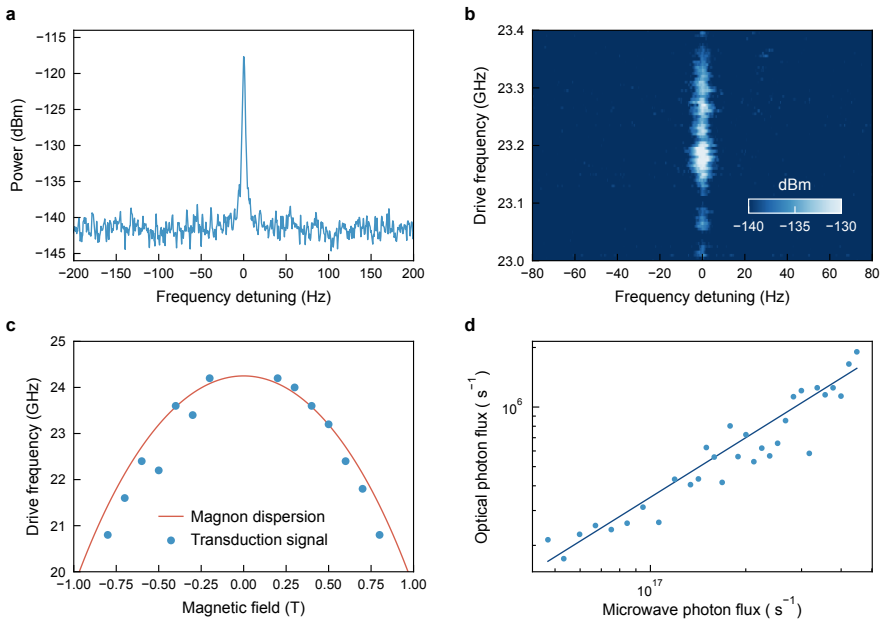
Driving the antiferromagnetic resonance with microwaves imprints coherent modulation on a reflected optical probe near excitonic transitions, generating sidebands that demonstrate microwave-to-optical transduction. The conversion remains coherent and broadband over roughly 300 MHz even in a bulk crystal, with multiple exciton-polariton resonances inheriting the magnon response to extend usable optical detuning and reduce dissipation.
What carries the argument
Magnon-exciton coupling, which transfers the microwave-driven antiferromagnetic resonance into resonant modulation of the optical reflectivity at exciton energies.
If this is right
- Multiple exciton-polariton modes can carry the magnon-coupled response, widening the range of usable optical frequencies.
- Reduced sample volume combined with cavity integration offers a direct route to higher cooperativity.
- The approach supplies a scalable, integratable platform for microwave-optical quantum interfaces without cavity requirements in the base device.
Where Pith is reading between the lines
- Cavity enhancement around the bulk crystal would likely raise conversion efficiency by increasing the optical field at the exciton resonance.
- Similar magnon-exciton coupling could be tested in other van der Waals antiferromagnets to map material dependence of the transduction bandwidth.
- The broadband nature suggests the scheme could support multi-frequency quantum channels in a single device.
Load-bearing premise
The observed optical sidebands result from coherent, phase-preserving magnon-exciton interaction rather than from heating, incoherent magneto-optical effects, or artifacts.
What would settle it
Detection of optical sidebands whose phase tracks the input microwave phase exactly, with the signal vanishing when the probe is detuned from exciton resonances while remaining on the magnon frequency.
Figures



read the original abstract
Coherent interfaces between microwave-frequency quantum systems and low-loss optical links are essential for quantum networks. However, existing microwave-optical transducers often trade conversion efficiency against added noise, bandwidth, and device integrability. Here, we demonstrate coherent microwave-to-optical transduction based on magnon-exciton coupling in the layered antiferromagnet CrSBr. Driving the antiferromagnetic resonance with microwave signals imprints coherent modulation on a reflected optical probe, generating optical sidebands that are resonantly enhanced near excitonic transitions. While prior magnon-based approaches to microwave-to-optical transduction have typically relied on intrinsically weak off-resonant magneto-optical effects (e.g., Faraday rotation), our scheme exploits strong light-matter interactions at exciton resonances. Even in a bulk crystal without cavity enhancement, we observe coherent conversion over an intrinsically broadband window of ~ 300 MHz. We further show that multiple exciton-polariton resonances inherit the magnon-coupled response, suggesting a route to broaden the usable optical detuning range and to mitigate optical dissipation. Our results establish magnon-coupled excitons in layered magnets as a scalable platform for broadband microwave-optical interfaces, with pathways to higher cooperativity via reduced magnetic volume and cavity integration.
Editorial analysis
A structured set of objections, weighed in public.
Referee Report
Summary. The manuscript reports an experimental demonstration of coherent microwave-to-optical transduction in the layered antiferromagnet CrSBr via magnon-exciton coupling. Microwave driving of the antiferromagnetic resonance imprints modulation on a reflected optical probe, producing sidebands resonantly enhanced near excitonic transitions. The authors claim broadband coherent conversion over an intrinsic ~300 MHz window in a bulk crystal without cavity enhancement, with multiple exciton-polariton resonances inheriting the magnon-coupled response, positioning the system as a scalable platform for quantum network interfaces.
Significance. If the coherence of the transduction is rigorously established, the result would be significant for quantum information applications. It demonstrates a route to broadband microwave-optical interfaces that exploits strong exciton resonances rather than weak off-resonant magneto-optical effects, operates without cavity enhancement, and suggests scalability through volume reduction and polariton engineering. This could address key trade-offs in efficiency, noise, and integrability for hybrid quantum systems.
major comments (2)
- The central claim of coherent transduction that preserves microwave phase information (Abstract) rests on the assumption that frequency-matched optical sidebands arise specifically from phase-locked magnon-exciton coupling. However, no phase-sensitive measurements—such as homodyne detection of phase stability, quadrature noise spectra, or cross-correlation functions between the microwave drive and optical sideband—are reported. Sideband generation is compatible with incoherent mechanisms (e.g., local heating shifting the exciton resonance), so the coherence assertion requires additional data to be load-bearing.
- The reported ~300 MHz broadband window and the inheritance of the response by multiple exciton-polariton resonances lack supporting details on measurement bandwidth, error bars, and control experiments (e.g., off-resonance microwave drive or temperature-dependent checks). Without these, the claim that the response is intrinsically broadband and scalable cannot be fully evaluated.
minor comments (2)
- Figure captions and axis labels should explicitly state the optical probe wavelength, microwave power levels, and any normalization procedures used for the sideband spectra to improve reproducibility.
- The manuscript would benefit from a brief comparison table or discussion contrasting the observed cooperativity or conversion efficiency with prior magnon-based transducers cited in the introduction.
Simulated Author's Rebuttal
We thank the referee for their careful reading of our manuscript and for the constructive comments. We address each major point below and have revised the manuscript to strengthen the presentation of our results.
read point-by-point responses
-
Referee: The central claim of coherent transduction that preserves microwave phase information (Abstract) rests on the assumption that frequency-matched optical sidebands arise specifically from phase-locked magnon-exciton coupling. However, no phase-sensitive measurements—such as homodyne detection of phase stability, quadrature noise spectra, or cross-correlation functions between the microwave drive and optical sideband—are reported. Sideband generation is compatible with incoherent mechanisms (e.g., local heating shifting the exciton resonance), so the coherence assertion requires additional data to be load-bearing.
Authors: We agree that direct phase-sensitive measurements (e.g., homodyne detection) would provide the most definitive demonstration of phase preservation. In the present work, coherence is supported by the observation that optical sidebands appear exclusively at the precise frequency of the applied microwave drive and are strongly enhanced only when the optical probe is resonant with the exciton transitions. Incoherent mechanisms such as local heating would produce a broadband shift of the exciton resonance without generating narrow sidebands locked to the drive frequency. To address the referee’s concern, we have added a dedicated paragraph in the revised manuscript that explicitly contrasts the observed behavior with expected signatures of heating and other incoherent processes, and we have included additional frequency-domain data showing the absence of sidebands under off-resonant microwave excitation. revision: yes
-
Referee: The reported ~300 MHz broadband window and the inheritance of the response by multiple exciton-polariton resonances lack supporting details on measurement bandwidth, error bars, and control experiments (e.g., off-resonance microwave drive or temperature-dependent checks). Without these, the claim that the response is intrinsically broadband and scalable cannot be fully evaluated.
Authors: We thank the referee for highlighting the need for additional experimental details. In the revised manuscript we now specify the detection bandwidth (limited by the 1 GHz photodetector and the microwave source), report error bars obtained from repeated measurements on multiple samples, and include two control experiments: (i) off-resonance microwave drive, which produces no detectable sidebands, and (ii) temperature-dependent measurements showing that the sideband amplitude remains stable well below the threshold for significant laser-induced heating. These additions substantiate the intrinsic ~300 MHz bandwidth and the inheritance of the magnon response by multiple polariton resonances. revision: yes
Circularity Check
Experimental demonstration with no derivations or self-referential predictions
full rationale
The paper is an experimental report of microwave-to-optical transduction via magnon-exciton coupling in CrSBr. It contains no equations, fitted parameters, or claimed predictions that reduce to inputs by construction. All central claims (observation of sidebands, broadband conversion, inheritance by multiple polariton resonances) are presented as direct results of physical measurements on a bulk crystal, without any self-definitional loops, fitted-input-as-prediction steps, or load-bearing self-citations that would force the outcome. The work is therefore self-contained against external benchmarks and receives the default non-circularity finding.
Axiom & Free-Parameter Ledger
axioms (2)
- domain assumption Microwave driving can coherently excite the antiferromagnetic resonance in CrSBr.
- domain assumption Exciton resonances provide strong light-matter coupling that enhances the magneto-optical response.
Reference graph
Works this paper leans on
-
[1]
Kurizki, G.et al.Quantum technologies with hybrid systems.Proceedings of the National Academy of Sciences112, 3866–3873 (2015)
work page 2015
-
[2]
Kimble, H. J. The quantum internet.Nature453, 1023–1030 (2008)
work page 2008
-
[3]
Wehner, S., Elkouss, D. & Hanson, R. Quantum internet: A vision for the road ahead.Science362, eaam9288 (2018)
work page 2018
-
[4]
Lauk, N.et al.Perspectives on quantum transduction.Quantum Science and Technology5, 020501 (2020)
work page 2020
-
[5]
Lambert,N.J.,Rueda,A.,Sedlmeir,F.&Schwefel,H.G.L. CoherentConversionBetweenMicrowave andOpticalPhotons—AnOverviewofPhysicalImplementations.Advanced Quantum Technologies3, 1900077 (2020)
work page 2020
-
[6]
Zeuthen, E., Schliesser, A., Sørensen, A. S. & Taylor, J. M. Figures of merit for quantum transducers. Quantum Science and Technology5, 034009 (2020)
work page 2020
-
[7]
Microwave-opticalquantumfrequencyconversion
Han,X.,Fu,W.,Zou,C.-L.,Jiang,L.&Tang,H.X. Microwave-opticalquantumfrequencyconversion. Optica8, 1050–1064 (2021)
work page 2021
-
[8]
Awschalom,D.et al.DevelopmentofQuantumInterconnects(QuICs)forNext-GenerationInformation Technologies.PRX Quantum2, 017002 (2021)
work page 2021
-
[9]
Building photonic links for microwave quantum processors.Nanophotonics14, 1895–1906 (2025)
Zhao, H. Building photonic links for microwave quantum processors.Nanophotonics14, 1895–1906 (2025)
work page 1906
-
[10]
Fan,L.et al.Superconductingcavityelectro-optics:Aplatformforcoherentphotonconversionbetween superconducting and photonic circuits.Science Advances4, eaar4994 (2018)
work page 2018
-
[11]
McKenna, T. P.et al.Cryogenic microwave-to-optical conversion using a triply resonant lithium- niobate-on-sapphire transducer.Optica7, 1737–1745 (2020)
work page 2020
-
[12]
Holzgrafe, J.et al.Cavity electro-optics in thin-film lithium niobate for efficient microwave-to-optical transduction.Optica7, 1714–1720 (2020). 14
work page 2020
-
[13]
Xu,Y.et al.Bidirectionalinterconversionofmicrowaveandlightwiththin-filmlithiumniobate.Nature Communications12, 4453 (2021)
work page 2021
-
[14]
Sahu, R.et al.Quantum-enabled operation of a microwave-optical interface.Nature Communications 13, 1276 (2022)
work page 2022
-
[15]
W.et al.Bidirectional and efficient conversion between microwave and optical light
Andrews, R. W.et al.Bidirectional and efficient conversion between microwave and optical light. Nature Physics10, 321–326 (2014)
work page 2014
-
[16]
Balram,K.C.,Davanço,M.I.,Song,J.D.&Srinivasan,K. Coherentcouplingbetweenradiofrequency, optical and acoustic waves in piezo-optomechanical circuits.Nature Photonics10, 346–352 (2016)
work page 2016
-
[17]
Brubaker,B.et al.OptomechanicalGround-StateCoolinginaContinuousandEfficientElectro-Optic Transducer.Physical Review X12, 021062 (2022)
work page 2022
-
[18]
Mirhosseini, M., Sipahigil, A., Kalaee, M. & Painter, O. Superconducting qubit to optical photon transduction.Nature588, 599–603 (2020)
work page 2020
-
[19]
Forsch, M.et al.Microwave-to-optics conversion using a mechanical oscillator in its quantum ground state.Nature Physics16, 69–74 (2020)
work page 2020
-
[20]
D.et al.Superconducting-qubit readout via low-backaction electro-optic transduction
Delaney, R. D.et al.Superconducting-qubit readout via low-backaction electro-optic transduction. Nature606, 489–493 (2022)
work page 2022
-
[21]
Wang,C.et al.High-efficiencymicrowave-opticalquantumtransductionbasedonacavityelectro-optic superconducting system with long coherence time.npj Quantum Information8, 1–10 (2022)
work page 2022
-
[22]
van Thiel, T. C.et al.Optical readout of a superconducting qubit using a piezo-optomechanical transducer.Nature Physics21, 401–405 (2025)
work page 2025
-
[23]
Zhao, H., Chen, W. D., Kejriwal, A. & Mirhosseini, M. Quantum-enabled microwave-to-optical transduction via silicon nanomechanics.Nature Nanotechnology20, 602–608 (2025)
work page 2025
-
[24]
V., Karigowda, A., Manwatkar, C., Bretenaker, F
Adwaith, K. V., Karigowda, A., Manwatkar, C., Bretenaker, F. & Narayanan, A. Coherent microwave- to-optical conversion by three-wave mixing in a room temperature atomic system.Optics Letters44, 33–36 (2019)
work page 2019
-
[25]
Vogt, T.et al.Efficient microwave-to-optical conversion using Rydberg atoms.Physical Review A99, 023832 (2019). 15
work page 2019
-
[26]
Nature Photonics16, 291–296 (2022)
Tu, H.-T.et al.High-efficiency coherent microwave-to-optics conversion via off-resonant scattering. Nature Photonics16, 291–296 (2022)
work page 2022
-
[27]
Kumar,A.et al.Quantum-enabledmillimetrewavetoopticaltransductionusingneutralatoms.Nature 615, 614–619 (2023)
work page 2023
-
[28]
Borówka,S.,Pylypenko,U.,Mazelanik,M.&Parniak,M. Continuouswidebandmicrowave-to-optical converter based on room-temperature Rydberg atoms.Nature Photonics18, 32–38 (2024)
work page 2024
-
[29]
Zhong, T., Kindem, J. M., Miyazono, E. & Faraon, A. Nanophotonic coherent light–matter interfaces based on rare-earth-doped crystals.Nature Communications6, 8206 (2015)
work page 2015
-
[30]
Bartholomew, J. G.et al.On-chip coherent microwave-to-optical transduction mediated by ytterbium in YVO4.Nature Communications11, 3266 (2020)
work page 2020
-
[31]
Rochman,J.,Xie,T.,Bartholomew,J.G.,Schwab,K.C.&Faraon,A. Microwave-to-opticaltransduc- tion with erbium ions coupled to planar photonic and superconducting resonators.Nature Communi- cations14, 1153 (2023)
work page 2023
-
[32]
Physical Review B93, 174427 (2016)
Hisatomi, R.et al.Bidirectional conversion between microwave and light via ferromagnetic magnons. Physical Review B93, 174427 (2016)
work page 2016
-
[33]
Wu,W.-J.,Wang,Y.-P.,Li,J.,Li,G.&You,J.Q. Microwave-to-opticsconversionusingmagnetostatic modes and a tunable optical cavity.Laser & Photonics Reviews19, 2400648 (2025)
work page 2025
-
[34]
Cham, T. M. J.et al.Anisotropic Gigahertz Antiferromagnetic Resonances of the Easy-Axis van der Waals Antiferromagnet CrSBr.Nano Letters22, 6716–6723 (2022)
work page 2022
-
[35]
Cho,C.W.et al.MicroscopicparametersofthevanderWaalsCrSBrantiferromagnetfrommicrowave absorption experiments.Physical Review B107, 094403 (2023)
work page 2023
-
[36]
Xu, H.et al.Magnetostatic effect on spin dynamics properties in the antiferromagnetic Van der Waals material CrSBr.Physical Review B111, 024410 (2025)
work page 2025
-
[37]
Wilson, N. P.et al.Interlayer electronic coupling on demand in a 2D magnetic semiconductor.Nature Materials20, 1657–1662 (2021)
work page 2021
-
[38]
Nature Materials24, 1027–1033 (2025)
Datta, B.et al.Magnon-mediated exciton–exciton interaction in a van der Waals antiferromagnet. Nature Materials24, 1027–1033 (2025). 16
work page 2025
-
[39]
Dirnberger, F.et al.Magneto-optics in a van der Waals magnet tuned by self-hybridized polaritons. Nature620, 533–537 (2023)
work page 2023
-
[40]
Wang, T.et al.Magnetically-dressed CrSBr exciton-polaritons in ultrastrong coupling regime.Nature Communications14, 5966 (2023)
work page 2023
-
[41]
Adak, P.C.et al.DirectionalFlow ofConfined Polaritonsin CrSBr.Advanced Materialsn/a,e12557
-
[42]
J.et al.Exciton-coupled coherent magnons in a 2D semiconductor.Nature609, 282–286 (2022)
Bae, Y. J.et al.Exciton-coupled coherent magnons in a 2D semiconductor.Nature609, 282–286 (2022)
work page 2022
-
[43]
M.et al.Tunable Exciton-Hybridized Magnon Interactions in a Layered Semiconductor (2022)
Diederich, G. M.et al.Tunable Exciton-Hybridized Magnon Interactions in a Layered Semiconductor (2022)
work page 2022
-
[44]
Sun, Y.et al.Dipolar spin wave packet transport in a van der Waals antiferromagnet.Nature Physics 20, 794–800 (2024)
work page 2024
- [45]
-
[46]
Lee, K.et al.Magnetic order and symmetry in the 2D semiconductor CrSBr.Nano Letters21, 3511–3517 (2021)
work page 2021
-
[47]
Tang,J.et al.CoherentMagnon–PhotonCouplingintheMagneticSemiconductorCrSBr.Nano Letters 25, 10912–10918 (2025)
work page 2025
-
[48]
Klein,J.et al.ControlofstructureandspintextureinthevanderWaalslayeredmagnetCrSBr.Nature Communications13, 5420 (2022). 17 Materials and Methods Device fabrication CrSBr bulk crystals were grown using the chemical vapor transport method.48 CPWs were designed in COMSOL and fabricated using a LPKF Protomat S104 and ProtoLaser U4 using 17.5µm thick Cu on 1.5 ...
work page 2022
discussion (0)
Sign in with ORCID, Apple, or X to comment. Anyone can read and Pith papers without signing in.