Recognition: 2 theorem links
· Lean TheoremSecureAFL: Secure Asynchronous Federated Learning
Pith reviewed 2026-05-13 16:52 UTC · model grok-4.3
The pith
SecureAFL secures asynchronous federated learning by detecting anomalous updates and estimating missing client contributions before robust aggregation.
A machine-rendered reading of the paper's core claim, the machinery that carries it, and where it could break.
Core claim
SecureAFL improves the robustness of asynchronous FL by detecting and discarding anomalous updates while estimating the contributions of missing clients, and it utilizes Byzantine-robust aggregation techniques such as coordinate-wise median to integrate the received and estimated updates.
What carries the argument
Anomaly detection for discarding bad updates combined with missing-client estimation followed by Byzantine-robust aggregation such as coordinate-wise median.
If this is right
- The global model updates immediately upon receiving any valid client update without waiting for stragglers.
- Poisoning attacks are mitigated by discarding detected anomalies while filling gaps from absent clients.
- Byzantine-robust methods integrate both received and estimated updates without requiring strong server assumptions.
- Model performance holds across real-world datasets even with partial client participation.
Where Pith is reading between the lines
- The detection-plus-estimation approach could extend to other decentralized training settings with unreliable participation.
- Adaptive attackers might require new detection heuristics beyond those evaluated in the current experiments.
- Refining the estimation step with client behavior models could further reduce the impact of long delays.
Load-bearing premise
That anomalous updates can be reliably detected and that estimates for missing clients are sufficiently accurate to not degrade global model performance.
What would settle it
An experiment showing that an advanced poisoning attack evades the anomaly detector and causes model accuracy to fall below that of undefended asynchronous FL.
Figures


read the original abstract
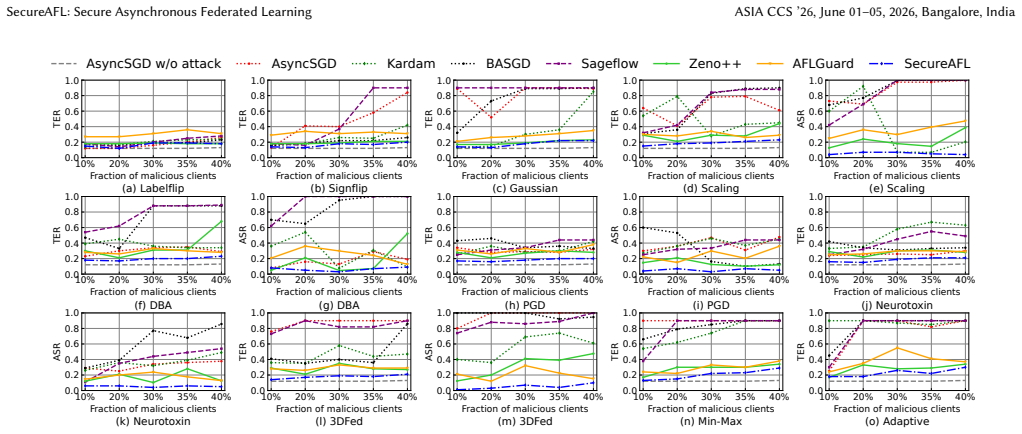
Federated learning (FL) enables multiple clients to collaboratively train a global machine learning model via a server without sharing their private training data. In traditional FL, the system follows a synchronous approach, where the server waits for model updates from numerous clients before aggregating them to update the global model. However, synchronous FL is hindered by the straggler problem. To address this, the asynchronous FL architecture allows the server to update the global model immediately upon receiving any client's local model update. Despite its advantages, the decentralized nature of asynchronous FL makes it vulnerable to poisoning attacks. Several defenses tailored for asynchronous FL have been proposed, but these mechanisms remain susceptible to advanced attacks or rely on unrealistic server assumptions. In this paper, we introduce SecureAFL, an innovative framework designed to secure asynchronous FL against poisoning attacks. SecureAFL improves the robustness of asynchronous FL by detecting and discarding anomalous updates while estimating the contributions of missing clients. Additionally, it utilizes Byzantine-robust aggregation techniques, such as coordinate-wise median, to integrate the received and estimated updates. Extensive experiments on various real-world datasets demonstrate the effectiveness of SecureAFL.
Editorial analysis
A structured set of objections, weighed in public.
Referee Report
Summary. The paper introduces SecureAFL, a framework for asynchronous federated learning that detects and discards anomalous (poisoned) client updates, estimates contributions from missing clients, and applies Byzantine-robust aggregation such as coordinate-wise median to produce the global model update. The abstract states that this combination improves robustness against poisoning attacks compared to prior asynchronous defenses, with effectiveness shown via extensive experiments on real-world datasets.
Significance. If the detection and estimation components prove reliable, the work would address a practical vulnerability in asynchronous FL (straggler tolerance without sacrificing security), extending standard robust aggregation techniques to the async setting. The use of real-world datasets is a positive element for empirical grounding.
major comments (3)
- [Abstract] Abstract: the central robustness claim rests on detecting and discarding anomalous updates, yet no detection rule (distance metric, statistical test, or threshold) is described. Without this, it is impossible to evaluate whether an adaptive adversary can craft updates that evade detection while still biasing the coordinate-wise median.
- [Abstract] Abstract: the estimation procedure for missing-client contributions is unspecified (e.g., no mention of similarity-based imputation, temporal prediction, or any other method). This step is load-bearing because inaccurate estimates can degrade the median aggregate, especially under non-IID data distributions that are common in FL.
- [Abstract] Abstract: the attack models considered are not stated (e.g., whether the adversary controls a fixed fraction of clients, can adapt to the detection heuristic, or targets the estimation step). The claim of effectiveness against “poisoning attacks” therefore cannot be assessed without knowing the threat model against which the heuristics were tested.
Simulated Author's Rebuttal
We thank the referee for the constructive comments on our manuscript. We address each major point below and will revise the abstract for greater specificity while preserving the technical content already present in the body of the paper.
read point-by-point responses
-
Referee: [Abstract] Abstract: the central robustness claim rests on detecting and discarding anomalous updates, yet no detection rule (distance metric, statistical test, or threshold) is described. Without this, it is impossible to evaluate whether an adaptive adversary can craft updates that evade detection while still biasing the coordinate-wise median.
Authors: We agree that the abstract is too high-level on this point. The detection rule (a distance-based metric with a median-absolute-deviation threshold) is fully specified in Section 3.2, together with analysis showing that adaptive updates exceeding the threshold are discarded before aggregation. In the revised manuscript we will add one sentence to the abstract summarizing the rule so that the robustness claim can be evaluated directly from the abstract. revision: yes
-
Referee: [Abstract] Abstract: the estimation procedure for missing-client contributions is unspecified (e.g., no mention of similarity-based imputation, temporal prediction, or any other method). This step is load-bearing because inaccurate estimates can degrade the median aggregate, especially under non-IID data distributions that are common in FL.
Authors: We accept the observation. The estimation procedure (similarity-based imputation from historical client updates) is described in Section 4.1 and evaluated under non-IID partitions in Section 5. We will revise the abstract to include a brief clause stating that missing contributions are estimated via similarity-based imputation, thereby clarifying the load-bearing step without altering the technical approach. revision: yes
-
Referee: [Abstract] Abstract: the attack models considered are not stated (e.g., whether the adversary controls a fixed fraction of clients, can adapt to the detection heuristic, or targets the estimation step). The claim of effectiveness against “poisoning attacks” therefore cannot be assessed without knowing the threat model against which the heuristics were tested.
Authors: The threat model (Byzantine adversary controlling up to 20 % of clients, with adaptive capability against the detection heuristic) is stated in Section 5.1. We will update the abstract to reference this threat model explicitly, allowing readers to assess the scope of the claimed robustness. revision: yes
Circularity Check
No significant circularity; SecureAFL applies standard robust aggregation without self-referential reduction
full rationale
The paper's core framework combines anomaly detection, missing-client estimation, and coordinate-wise median aggregation drawn from prior literature. No equations or steps in the abstract or description reduce any prediction or result to a fitted parameter or self-citation defined by the paper itself. The claims rest on experimental validation of these established techniques in the asynchronous setting rather than any tautological construction or load-bearing self-reference.
Axiom & Free-Parameter Ledger
free parameters (1)
- anomaly_detection_threshold
axioms (1)
- domain assumption Byzantine-robust aggregation methods such as coordinate-wise median effectively mitigate poisoning attacks in federated learning
Lean theorems connected to this paper
-
IndisputableMonolith/Cost/FunctionalEquation.leanwashburn_uniqueness_aczel unclear?
unclearRelation between the paper passage and the cited Recognition theorem.
the server calculates a Lipschitz factor for client i at round t, denoted as λ_t^i, which is defined as: λ_t^i = ||g^{t-τ_i}_i - g^φ_i|| / ||w^{t-τ_i} - w^φ||. ... a local model update g^{t-τ_i}_i is deemed benign if it satisfies: λ_t^i ≤ Q^α_t
-
IndisputableMonolith/Foundation/AlphaCoordinateFixation.leanalpha_pin_under_high_calibration unclear?
unclearRelation between the paper passage and the cited Recognition theorem.
we propose an approximation of the integrated Hessian matrix using the well-known L-BFGS algorithm ... ˆg^t_k = g^v_k + H^t_k (w^t - w^v)
What do these tags mean?
- matches
- The paper's claim is directly supported by a theorem in the formal canon.
- supports
- The theorem supports part of the paper's argument, but the paper may add assumptions or extra steps.
- extends
- The paper goes beyond the formal theorem; the theorem is a base layer rather than the whole result.
- uses
- The paper appears to rely on the theorem as machinery.
- contradicts
- The paper's claim conflicts with a theorem or certificate in the canon.
- unclear
- Pith found a possible connection, but the passage is too broad, indirect, or ambiguous to say the theorem truly supports the claim.
Reference graph
Works this paper leans on
-
[1]
d.].Federated Learning: Collaborative Machine Learning without Central- ized Training Data
[n. d.].Federated Learning: Collaborative Machine Learning without Central- ized Training Data. https://ai.googleblog.com/2017/04/federated-learning- collaborative.html
work page 2017
-
[2]
d.].Utilization of FATE in Risk Management of Credit in Small and Micro Enter- prises
[n. d.].Utilization of FATE in Risk Management of Credit in Small and Micro Enter- prises. https://www.fedai.org/cases/utilization-of-fate-in-risk-management-of- credit-in-small-and-micro-\enterprises/
-
[3]
Udacity Dataset.A vailable: https://github.com/udacity/self-driving-car/ (2018)
2018. Udacity Dataset.A vailable: https://github.com/udacity/self-driving-car/ (2018)
work page 2018
-
[4]
Martín Abadi, Ashish Agarwal, Paul Barham, Eugene Brevdo, Zhifeng Chen, Craig Citro, Greg S Corrado, Andy Davis, Jeffrey Dean, Matthieu Devin, et al
-
[5]
Tensorflow: Large-scale machine learning on heterogeneous distributed systems.arXiv preprint arXiv:1603.04467(2016)
work page Pith review arXiv 2016
-
[6]
Eugene Bagdasaryan, Andreas Veit, Yiqing Hua, Deborah Estrin, and Vitaly Shmatikov. 2020. How to backdoor federated learning. InAISTATS
work page 2020
-
[7]
Yulong Bai, Ying Wang, Xiangrui Xu, Yuhang Yang, Hina Batool, Zahid Iqbal, and Jiuyun Xu. 2025. AsyncDefender: Dynamic trust adaptation and collaborative defense for Byzantine-robust asynchronous federated learning. InComputer Networks
work page 2025
-
[8]
Peva Blanchard, El Mahdi El Mhamdi, Rachid Guerraoui, and Julien Stainer
-
[9]
Machine learning with adversaries: Byzantine tolerant gradient descent. In NeurIPS
-
[10]
Tom Brown, Benjamin Mann, Nick Ryder, Melanie Subbiah, Jared D Kaplan, Prafulla Dhariwal, Arvind Neelakantan, Pranav Shyam, Girish Sastry, Amanda Askell, et al. 2020. Language models are few-shot learners. InNeurIPS
work page 2020
-
[11]
Richard H Byrd, Peihuang Lu, Jorge Nocedal, and Ciyou Zhu. 1995. A limited memory algorithm for bound constrained optimization. InSIAM Journal on scientific computing
work page 1995
-
[12]
Richard H Byrd, Jorge Nocedal, and Robert B Schnabel. 1994. Representations of quasi-Newton matrices and their use in limited memory methods. InMathemati- cal Programming
work page 1994
-
[13]
Xiaoyu Cao, Minghong Fang, Jia Liu, and Neil Zhenqiang Gong. 2021. Fltrust: Byzantine-robust federated learning via trust bootstrapping. InNDSS
work page 2021
-
[14]
Xiaoyu Cao, Jinyuan Jia, and Neil Zhenqiang Gong. 2021. Provably secure federated learning against malicious clients. InAAAI
work page 2021
- [15]
-
[16]
Yujing Chen, Yue Ning, Martin Slawski, and Huzefa Rangwala. 2020. Asyn- chronous online federated learning for edge devices with non-iid data. InBig Data
work page 2020
-
[17]
Yudong Chen, Lili Su, and Jiaming Xu. 2017. Distributed Statistical Machine Learning in Adversarial Settings: Byzantine Gradient Descent. InPOMACS
work page 2017
- [18]
-
[19]
Georgios Damaskinos, Rachid Guerraoui, Rhicheek Patra, Mahsa Taziki, et al
-
[20]
Asynchronous Byzantine machine learning (the case of SGD). InICML
-
[21]
Jia Deng, Wei Dong, Richard Socher, Li-Jia Li, Kai Li, and Li Fei-Fei. 2009. Imagenet: A large-scale hierarchical image database. InCVPR
work page 2009
-
[22]
Zhihao Dou, Jiaqi Wang, Wei Sun, Zhuqing Liu, and Minghong Fang. 2025. Toward Malicious Clients Detection in Federated Learning. InASIACCS
work page 2025
-
[23]
Minghong Fang, Xiaoyu Cao, Jinyuan Jia, and Neil Gong. 2020. Local model poisoning attacks to Byzantine-robust federated learning. InUSENIX Security Symposium
work page 2020
-
[24]
Minghong Fang, Jia Liu, Neil Zhenqiang Gong, and Elizabeth S Bentley. 2022. Aflguard: Byzantine-robust asynchronous federated learning. InACSAC
work page 2022
-
[25]
Minghong Fang, Zhuqing Liu, Xuecen Zhao, and Jia Liu. 2025. Byzantine-Robust Federated Learning over Ring-All-Reduce Distributed Computing. InCompanion Proceedings of the ACM on Web Conference 2025
work page 2025
-
[26]
Minghong Fang, Seyedsina Nabavirazavi, Zhuqing Liu, Wei Sun, Sun- dararaja Sitharama Iyengar, and Haibo Yang. 2025. Do we really need to design new byzantine-robust aggregation rules?. InNDSS
work page 2025
-
[27]
Minghong Fang, Xilong Wang, and Neil Zhenqiang Gong. 2025. Provably Robust Federated Reinforcement Learning. InThe Web Conference
work page 2025
-
[28]
Minghong Fang, Zifan Zhang, Prashant Khanduri, Jia Liu, Songtao Lu, Yuchen Liu, Neil Gong, et al. 2024. Byzantine-robust decentralized federated learning. In CCS
work page 2024
-
[29]
Xiuwen Fang, Mang Ye, and Xiyuan Yang. 2023. Robust heterogeneous federated learning under data corruption. InICCV
work page 2023
-
[30]
Lei Feng, Yiqi Zhao, Shaoyong Guo, Xuesong Qiu, Wenjing Li, and Peng Yu. 2021. BAFL: A blockchain-based asynchronous federated learning framework. InIEEE Transactions on Computers
work page 2021
-
[31]
Hossein Fereidooni, Alessandro Pegoraro, Phillip Rieger, Alexandra Dmitrienko, and Ahmad-Reza Sadeghi. 2024. Freqfed: A frequency analysis-based approach for mitigating poisoning attacks in federated learning. InNDSS
work page 2024
-
[32]
Clement Fung, Chris JM Yoon, and Ivan Beschastnikh. 2020. The limitations of federated learning in sybil settings. InRAID
work page 2020
-
[33]
Rachid Guerraoui, Sébastien Rouault, et al . 2018. The hidden vulnerability of distributed learning in byzantium. InICML
work page 2018
- [34]
-
[35]
Kaiming He, Xiangyu Zhang, Shaoqing Ren, and Jian Sun. 2016. Deep residual learning for image recognition. InCVPR
work page 2016
-
[36]
Dzmitry Huba, John Nguyen, Kshitiz Malik, Ruiyu Zhu, Mike Rabbat, Ashkan Yousefpour, Carole-Jean Wu, Hongyuan Zhan, Pavel Ustinov, Harish Srinivas, et al. 2022. Papaya: Practical, private, and scalable federated learning. InMLSys
work page 2022
-
[37]
Ehsanul Kabir, Zeyu Song, Md Rafi Ur Rashid, and Shagufta Mehnaz. 2024. Flshield: a validation based federated learning framework to defend against poisoning attacks. InIEEE Symposium on Security and Privacy
work page 2024
-
[38]
Sai Praneeth Karimireddy, Lie He, and Martin Jaggi. 2021. Learning from history for byzantine robust optimization. InICML
work page 2021
-
[39]
Sai Praneeth Karimireddy, Lie He, and Martin Jaggi. 2022. Byzantine-robust learning on heterogeneous datasets via bucketing. InICLR
work page 2022
-
[40]
A. Krizhevsky and G. Hinton. 2009. Learning multiple layers of features from tiny images.Handbook of Systemic Autoimmune Diseases(2009)
work page 2009
-
[41]
Kavita Kumari, Phillip Rieger, Hossein Fereidooni, Murtuza Jadliwala, and Ahmad- Reza Sadeghi. 2023. Baybfed: Bayesian backdoor defense for federated learning. InIEEE Symposium on Security and Privacy
work page 2023
-
[42]
2012.Real and functional analysis
Serge Lang. 2012.Real and functional analysis. Vol. 142. Springer Science & Business Media
work page 2012
-
[43]
Haoyang Li, Qingqing Ye, Haibo Hu, Jin Li, Leixia Wang, Chengfang Fang, and Jie Shi. 2023. 3dfed: Adaptive and extensible framework for covert backdoor attack in federated learning. InIEEE Symposium on Security and Privacy
work page 2023
-
[44]
Liping Li, Wei Xu, Tianyi Chen, Georgios B Giannakis, and Qing Ling. 2019. RSA: Byzantine-robust stochastic aggregation methods for distributed learning from heterogeneous datasets. InAAAI
work page 2019
-
[45]
Songze Li and Yanbo Dai. 2024. BackdoorIndicator: Leveraging OOD Data for Proactive Backdoor Detection in Federated Learning. InUSENIX Security Sympo- sium
work page 2024
-
[46]
Ji Liu, Juncheng Jia, Tianshi Che, Chao Huo, Jiaxiang Ren, Yang Zhou, Huaiyu Dai, and Dejing Dou. 2024. Fedasmu: Efficient asynchronous federated learning with dynamic staleness-aware model update. InAAAI
work page 2024
-
[47]
H Brendan McMahan, Eider Moore, Daniel Ramage, Seth Hampson, et al. 2017. Communication-efficient learning of deep networks from decentralized data. In AISTATS
work page 2017
-
[48]
El Mahdi El Mhamdi, Rachid Guerraoui, and Sébastien Rouault. 2018. The hidden vulnerability of distributed learning in byzantium. InICML
work page 2018
-
[49]
Yinbin Miao, Ziteng Liu, Xinghua Li, Meng Li, Hongwei Li, Kim-Kwang Raymond Choo, and Robert H Deng. 2023. Robust asynchronous federated learning with time-weighted and stale model aggregation. InIEEE Transactions on Dependable and Secure Computing
work page 2023
-
[50]
Wenjin Mo, Zhiyuan Li, Minghong Fang, and Mingwei Fang. 2025. Find a Scape- goat: Poisoning Membership Inference Attack and Defense to Federated Learning. InICCV
work page 2025
-
[51]
Hamid Mozaffari, Virat Shejwalkar, and Amir Houmansadr. 2023. Every vote counts:{Ranking-Based} training of federated learning to resist poisoning attacks. InUSENIX Security Symposium
work page 2023
- [52]
-
[53]
John Nguyen, Kshitiz Malik, Hongyuan Zhan, Ashkan Yousefpour, Mike Rab- bat, Mani Malek, and Dzmitry Huba. 2022. Federated learning with buffered asynchronous aggregation. InAISTATS
work page 2022
-
[54]
Thien Duc Nguyen, Phillip Rieger, Roberta De Viti, Huili Chen, Björn B Bran- denburg, Hossein Yalame, Helen Möllering, Hossein Fereidooni, Samuel Marchal, Markus Miettinen, et al. 2022. FLAME: Taming backdoors in federated learning. InUSENIX Security Symposium
work page 2022
-
[55]
Xudong Pan, Mi Zhang, Duocai Wu, Qifan Xiao, Shouling Ji, and Min Yang. 2020. Justinian’s gaavernor: Robust distributed learning with gradient aggregation agent. InUSENIX Security Symposium
work page 2020
-
[56]
Xiaoyi Pang, Chenxu Zhao, Zhibo Wang, Jiahui Hu, Yinggui Wang, Lei Wang, Tao Wei, Kui Ren, and Chun Chen. 2025. PoiSAFL: Scalable Poisoning Attack Framework to Byzantine-resilient Semi-asynchronous Federated Learning. In USENIX Security Symposium
work page 2025
-
[57]
Jungwuk Park, Dong-Jun Han, Minseok Choi, and Jaekyun Moon. 2021. Sageflow: Robust federated learning against both stragglers and adversaries. InNeurIPS
work page 2021
-
[58]
Adam Paszke, Sam Gross, Francisco Massa, Adam Lerer, James Bradbury, Gregory Chanan, Trevor Killeen, Zeming Lin, Natalia Gimelshein, Luca Antiga, et al. 2019. Pytorch: An imperative style, high-performance deep learning library. InNeurIPS
work page 2019
-
[59]
Matthias Paulik, Matt Seigel, Henry Mason, Dominic Telaar, Joris Kluivers, Rogier van Dalen, Chi Wai Lau, Luke Carlson, Filip Granqvist, Chris Vandevelde, et al
-
[60]
ASIA CCS ’26, June 01–05, 2026, Bangalore, India Anjun Gao et al
Federated evaluation and tuning for on-device personalization: System design & applications.arXiv preprint arXiv:2102.08503(2021). ASIA CCS ’26, June 01–05, 2026, Bangalore, India Anjun Gao et al
-
[61]
Krishna Pillutla, Sham M Kakade, and Zaid Harchaoui. 2022. Robust aggregation for federated learning.IEEE Transactions on Signal Processing(2022)
work page 2022
-
[62]
Virat Shejwalkar and Amir Houmansadr. 2021. Manipulating the Byzantine: Optimizing Model Poisoning Attacks and Defenses for Federated Learning. In NDSS
work page 2021
-
[63]
Ziteng Sun, Peter Kairouz, Ananda Theertha Suresh, and H Brendan McMahan
- [64]
-
[65]
Rashish Tandon, Qi Lei, Alexandros G Dimakis, and Nikos Karampatziakis. 2017. Gradient coding: Avoiding stragglers in distributed learning. InICML
work page 2017
-
[66]
Vale Tolpegin, Stacey Truex, Mehmet Emre Gursoy, and Ling Liu. 2020. Data poisoning attacks against federated learning systems. InESORICS
work page 2020
- [67]
-
[68]
Ning Wang, Yang Xiao, Yimin Chen, Yang Hu, Wenjing Lou, and Y Thomas Hou
- [69]
-
[70]
Wenbin Wang, Qiwen Ma, Zifan Zhang, Yuchen Liu, Zhuqing Liu, and Minghong Fang. 2025. Poisoning attacks and defenses to federated unlearning. InCompanion Proceedings of the ACM on Web Conference 2025
work page 2025
- [71]
-
[72]
Zhongyu Wang, Zhaoyang Zhang, Yuqing Tian, Qianqian Yang, Hangguan Shan, Wei Wang, and Tony QS Quek. 2022. Asynchronous federated learning over wire- less communication networks. InIEEE Transactions on Wireless Communications
work page 2022
-
[73]
Fashion-MNIST: a Novel Image Dataset for Benchmarking Machine Learning Algorithms
Han Xiao, Kashif Rasul, and Roland Vollgraf. 2017.Fashion-MNIST: a Novel Image Dataset for Benchmarking Machine Learning Algorithms. arXiv:cs.LG/1708.07747 [cs.LG]
work page internal anchor Pith review Pith/arXiv arXiv 2017
-
[74]
Chulin Xie, Keli Huang, Pin-Yu Chen, and Bo Li. 2019. Dba: Distributed backdoor attacks against federated learning. InICLR
work page 2019
- [75]
-
[76]
Cong Xie, Sanmi Koyejo, and Indranil Gupta. 2019. Zeno: Distributed stochastic gradient descent with suspicion-based fault-tolerance. InICML
work page 2019
-
[77]
Cong Xie, Sanmi Koyejo, and Indranil Gupta. 2020. Zeno++: Robust fully asyn- chronous SGD. InICML
work page 2020
-
[78]
Yueqi Xie, Minghong Fang, and Neil Zhenqiang Gong. 2025. Model Poisoning Attacks to Federated Learning via Multi-Round Consistency. InCVPR
work page 2025
-
[79]
Chenhao Xu, Youyang Qu, Yong Xiang, and Longxiang Gao. 2023. Asynchronous federated learning on heterogeneous devices: A survey. InComputer Science Review
work page 2023
-
[80]
Jian Xu, Shao-Lun Huang, Linqi Song, and Tian Lan. 2022. Byzantine-robust federated learning through collaborative malicious gradient filtering. InICDCS
work page 2022
discussion (0)
Sign in with ORCID, Apple, or X to comment. Anyone can read and Pith papers without signing in.