Recognition: 2 theorem links
· Lean TheoremA Survey through Conformal Time
Pith reviewed 2026-05-10 18:51 UTC · model grok-4.3
The pith
Conformal time clarifies relations among cosmic time, scale factor, geodesics and curvature in flat FRW universes.
A machine-rendered reading of the paper's core claim, the machinery that carries it, and where it could break.
Core claim
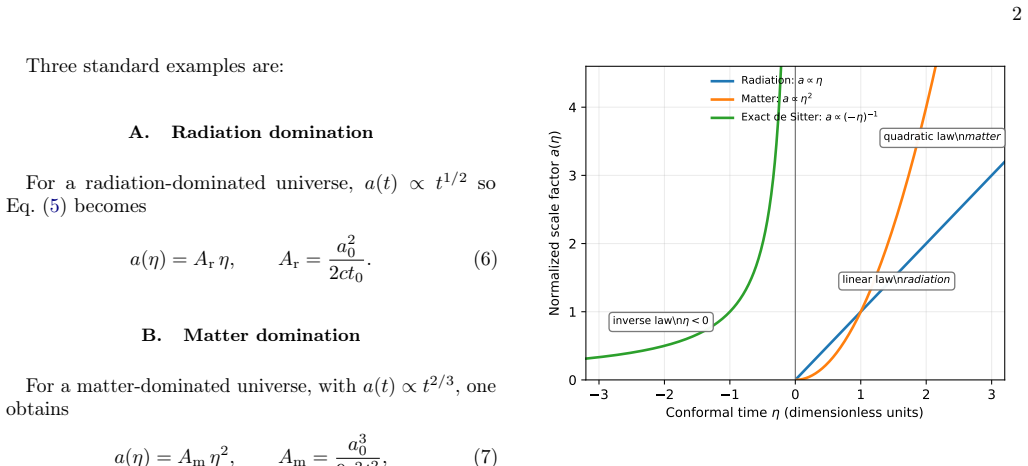
In a spatially flat FRW universe the coordinate change dη = dt/a(t) converts the metric into a(η) times a flat metric, so that geodesics and curvature become simple functions of the scale-factor profile a(η). Radiation domination gives a linear a(η), matter domination a quadratic profile, and exact de Sitter an inverse-linear profile; each case therefore yields characteristic null and timelike geodesics together with explicit expressions for the Ricci scalar and other curvature invariants.
What carries the argument
The conformal time coordinate η together with the rescaled line element ds² = a(η)² (-dη² + dx²) in 1+1 dimensions, which isolates the expansion from the underlying geometry so that geodesics can be read off directly.
If this is right
- In the radiation era free-particle paths become straight lines at constant coordinate speed in the η-x plane.
- Matter domination produces decelerating geodesics whose deviation is controlled by the quadratic a(η).
- Pure de Sitter expansion yields geodesics that approach the conformal horizon in finite η.
- The same affine-parameter equations apply unchanged to any scale factor and carry over directly to the 3+1 case.
Where Pith is reading between the lines
- The 1+1 treatment supplies a compact reference set of formulas that numerical codes for particle motion in cosmology can use for validation.
- The same conformal rescaling technique could be applied to linear perturbations around the background to simplify mode equations.
- Explicit curvature expressions derived for each era offer quick checks when comparing analytic and numerical solutions for light propagation.
Load-bearing premise
Reducing the flat FRW geometry to one spatial dimension plus time loses none of the essential relations that govern geodesics and curvature once conformal time is introduced.
What would settle it
An explicit integration of the geodesic equation in the standard 3+1-dimensional flat FRW metric for a chosen scale-factor evolution that yields trajectories different from those obtained by first reducing to the 1+1 conformal metric and then lifting the result.
Figures


read the original abstract
We revisit conformal time $\eta$ in a spatially flat Friedmann--Robertson--Walker universe and use a $1+1$-dimensional setting as a technically transparent pedagogical arena. Our purpose is to clarify the relation among cosmic time $t$, conformal time $\eta$, and the scale factor $a(t)$, and then to follow how this relation governs the geodesics of freely moving particles and the curvature of the corresponding manifold. The radiation-dominated, matter-dominated, and exact vacuum-only de Sitter cases are treated separately, because each of them produces a distinct conformal-time dependence and therefore a distinct geodesic structure. We then write the affine-parameter formalism in a form that is genuinely general for any spatially flat conformal metric, and we record the straightforward extension to the spatially flat $3+1$ case. The presentation remains elementary in spirit, but the notation, the curvature formulas, and the de Sitter interpretation are kept explicit.
Editorial analysis
A structured set of objections, weighed in public.
Referee Report
Summary. The manuscript revisits conformal time η in spatially flat FRW cosmologies using a 1+1-dimensional pedagogical arena. It clarifies relations between t, η, and a(t), derives geodesics and curvature for radiation, matter, and de Sitter eras, provides a general affine-parameter formalism for conformal metrics, and extends to 3+1 dimensions.
Significance. This pedagogical survey offers clear derivations of standard results in cosmology. Its value lies in the transparent presentation and separate era treatments, which can aid in teaching. No novel claims or proofs are made, but the explicit notation and formulas align with textbook cosmology.
minor comments (1)
- [Abstract] The assertion that the affine-parameter formalism is 'genuinely general for any spatially flat conformal metric' would be strengthened by referencing a specific prior work or textbook section on the topic.
Simulated Author's Rebuttal
We thank the referee for their review and positive assessment of the manuscript. The referee correctly notes that this is a pedagogical survey with no novel claims, focused on transparent derivations of standard results for conformal time in flat FRW cosmologies. We appreciate the recommendation for minor revision and will make any editorial improvements to enhance clarity and presentation in the revised version.
Circularity Check
No significant circularity; pedagogical survey of standard relations
full rationale
The manuscript presents a pedagogical walkthrough of the standard conformal-time transformation η = ∫ dt/a(t) in flat FRW, the resulting 1+1 metric, geodesic equations, and curvature scalars for the three eras, followed by the direct 3+1 extension. Every relation is derived from the input FRW line element and the definition of conformal time; no parameters are fitted to outputs, no uniqueness theorems are invoked via self-citation, and no ansatz is smuggled. The 1+1 reduction is a standard textbook device whose consequences are recoverable without reference to the present work, rendering the derivation self-contained against external benchmarks.
Axiom & Free-Parameter Ledger
axioms (2)
- domain assumption Spatially flat FRW metric ds² = -dt² + a(t)² dx² is the background geometry.
- standard math Conformal time is defined via dη = dt / a(t).
Lean theorems connected to this paper
-
IndisputableMonolith/Foundation/AlexanderDuality.leanalexander_duality_circle_linking unclear?
unclearRelation between the paper passage and the cited Recognition theorem.
We revisit conformal time η in a spatially flat Friedmann–Robertson–Walker universe and use a 1+1-dimensional setting... radiation-dominated, matter-dominated, and exact vacuum-only de Sitter cases... affine-parameter formalism... extension to the spatially flat 3+1 case.
-
IndisputableMonolith/Cost/FunctionalEquation.leanwashburn_uniqueness_aczel unclear?
unclearRelation between the paper passage and the cited Recognition theorem.
ds² = a²(η)(dη² − dx²)... Γ symbols = a′/a... R = −2c⁻² ä/a
What do these tags mean?
- matches
- The paper's claim is directly supported by a theorem in the formal canon.
- supports
- The theorem supports part of the paper's argument, but the paper may add assumptions or extra steps.
- extends
- The paper goes beyond the formal theorem; the theorem is a base layer rather than the whole result.
- uses
- The paper appears to rely on the theorem as machinery.
- contradicts
- The paper's claim conflicts with a theorem or certificate in the canon.
- unclear
- Pith found a possible connection, but the passage is too broad, indirect, or ambiguous to say the theorem truly supports the claim.
Reference graph
Works this paper leans on
-
[1]
Weinberg,Cosmology(Oxford University Press, Oxford, 2008)
S. Weinberg,Cosmology(Oxford University Press, Oxford, 2008)
2008
-
[2]
M. P. Hobson, G. P. Efstathiou, and A. N. Lasenby,Gen- eral Relativity: An Introduction for Physicists(Cambridge University Press, Cambridge, 2006)
2006
-
[3]
Mukhanov,Physical Foundations of Cosmology(Cam- bridge University Press, Cambridge, 2005)
V. Mukhanov,Physical Foundations of Cosmology(Cam- bridge University Press, Cambridge, 2005)
2005
-
[4]
Dodelson and F
S. Dodelson and F. Schmidt,Modern Cosmology, 2nd ed. (Academic Press, London, 2020)
2020
-
[5]
A. R. Liddle,An Introduction to Modern Cosmology, 3rd ed. (Wiley, Chichester, 2015)
2015
-
[6]
S. M. Carroll,Spacetime and Geometry: An Introduction to General Relativity(Addison-Wesley, San Francisco, 2004)
2004
-
[7]
R. M. Wald,General Relativity(University of Chicago Press, Chicago, 1984)
1984
-
[8]
N. D. Birrell and P. C. W. Davies,Quantum Fields in Curved Space(Cambridge University Press, Cambridge, 1982)
1982
- [9]
- [10]
- [11]
- [12]
- [13]
- [14]
-
[15]
Les Houches Lectures on De Sitter Space
M. Spradlin, A. Strominger, and A. Volovich, inUnity from Duality: Gravity, Gauge Theory and Strings, Les Houches - Ecole d’Ete de Physique Theorique, Vol. 76, edited by C. Bachas, A. Bilal, M. Douglas, N. Nekrasov, and F. David (Springer, Berlin, Heidelberg, 2003) pp. 423–453, arXiv:hep-th/0110007
work page Pith review arXiv 2003
- [16]
-
[17]
T. Padmanabhan, Physics Reports380, 235 (2003), arXiv:hep-th/0212290 [hep-th]
-
[18]
J. W. Anderson,Hyperbolic Geometry, 2nd ed. (Springer, London, 2005)
2005
-
[19]
Stahl,The Poincare Half-Plane: A Gateway to Modern Geometry(Jones and Bartlett Publishers, Boston, 1993)
S. Stahl,The Poincare Half-Plane: A Gateway to Modern Geometry(Jones and Bartlett Publishers, Boston, 1993)
1993
discussion (0)
Sign in with ORCID, Apple, or X to comment. Anyone can read and Pith papers without signing in.