Recognition: 2 theorem links
· Lean TheoremADP-FL-MedSeg: Adaptive Differential Privacy for Federated Medical Segmentation Across Diverse Modalities
Pith reviewed 2026-05-12 01:46 UTC · model grok-4.3
The pith
An adaptive mechanism for differential privacy in federated learning delivers segmentation accuracy approaching non-private levels across medical imaging types.
A machine-rendered reading of the paper's core claim, the machinery that carries it, and where it could break.
Core claim
The central claim is that an adaptive differentially private federated learning framework dynamically adjusts privacy mechanisms during training to achieve higher Dice scores, sharper boundary delineation, faster convergence, and greater stability than conventional differentially private federated learning, while approaching the performance of non-private federated learning under the same privacy budgets, as demonstrated on dermoscopic skin lesion segmentation, 3D CT kidney tumor segmentation, and multi-parametric MRI brain tumor segmentation.
What carries the argument
The dynamic adjustment of privacy mechanisms, such as noise scales or related parameters, in response to training progress across federated communication rounds.
If this is right
- Medical sites can jointly train segmentation models on distributed scans without centralizing data while retaining near-non-private accuracy.
- Training reaches stable performance in fewer rounds, lowering communication overhead in real hospital networks.
- Boundary quality improves enough to support more reliable tumor and lesion outlines in clinical workflows.
- The same framework applies across dermoscopic, CT, and MRI data without modality-specific redesign of the privacy schedule.
- Privacy budgets can be used more efficiently, allowing stronger protection at the same accuracy level.
Where Pith is reading between the lines
- The adaptation principle could extend to other federated tasks where data distributions shift over time, such as longitudinal patient monitoring.
- Deployment would benefit from explicit verification that the adjustment rule itself does not create side-channel leakage.
- Similar dynamic tuning might reduce the performance gap in non-medical domains that also face strict privacy rules and heterogeneous data sources.
- Pairing the method with existing techniques for client drift could further stabilize results when scanner protocols differ sharply.
Load-bearing premise
Dynamically adjusting privacy mechanisms during training preserves formal differential privacy guarantees while delivering the reported accuracy and stability gains without introducing new vulnerabilities or post-hoc tuning artifacts.
What would settle it
An experiment showing that an adversary can recover more private information from the adaptive model than from a fixed-budget differentially private model at the same nominal privacy level, or a controlled ablation where removing the adaptation eliminates the accuracy and convergence improvements.
Figures




read the original abstract
Large volumes of medical data remain underutilized because centralizing distributed data is often infeasible due to strict privacy regulations and institutional constraints. In addition, models trained in centralized settings frequently fail to generalize across clinical sites because of heterogeneity in imaging protocols and continuously evolving data distributions arising from differences in scanners, acquisition parameters, and patient populations. Federated learning offers a promising solution by enabling collaborative model training without sharing raw data. However, incorporating differential privacy into federated learning, while essential for privacy guarantees, often leads to degraded accuracy, unstable convergence, and reduced generalization. In this work, we propose an adaptive differentially private federated learning (ADP-FL) framework for medical image segmentation that dynamically adjusts privacy mechanisms to better balance the privacy-utility trade-off. The proposed approach stabilizes training, significantly improves Dice scores and segmentation boundary quality, and maintains rigorous privacy guarantees. We evaluated ADP-FL across diverse imaging modalities and segmentation tasks, including skin lesion segmentation in dermoscopic images, kidney tumor segmentation in 3D CT scans, and brain tumor segmentation in multi-parametric MRI. Compared with conventional federated learning and standard differentially private federated learning, ADP-FL consistently achieves higher accuracy, improved boundary delineation, faster convergence, and greater training stability, with performance approaching that of non-private federated learning under the same privacy budgets. These results demonstrate the practical viability of ADP-FL for high-performance, privacy-preserving medical image segmentation in real-world federated settings.
Editorial analysis
A structured set of objections, weighed in public.
Referee Report
Summary. The manuscript proposes ADP-FL, an adaptive differentially private federated learning framework for medical image segmentation. It dynamically adjusts privacy mechanisms (noise scales, per-round budgets, or clipping thresholds) during training to improve the privacy-utility tradeoff across heterogeneous medical data. Evaluations on skin lesion segmentation (dermoscopic images), kidney tumor segmentation (3D CT), and brain tumor segmentation (multi-parametric MRI) claim higher Dice scores, improved boundary quality, faster convergence, greater stability, and performance approaching non-private FL under identical privacy budgets, while asserting rigorous formal privacy guarantees.
Significance. If the adaptive mechanism formally preserves differential privacy via proper composition accounting and the reported gains are supported by quantitative metrics with statistical validation, the work would address a key barrier to deploying federated learning in clinical settings: the accuracy degradation from standard DP-FL. The multi-modality evaluation and focus on boundary delineation are positive aspects that could support broader adoption if reproducible.
major comments (2)
- [Methods section describing the adaptive privacy mechanism and privacy analysis] The central claim that dynamic adjustment of privacy parameters preserves the overall (ε, δ) guarantee while delivering accuracy and stability gains requires explicit adaptive composition analysis (e.g., via Rényi DP accountant or moments accountant tracking per-round adaptations). Standard composition theorems do not automatically apply when adjustments depend on observed model performance, gradients, or client signals without a privacy-loss tracker; this is load-bearing for the assertions of 'rigorous privacy guarantees' and 'performance approaching non-private FL under the same privacy budgets.'
- [Experimental evaluation and results sections] The abstract states that ADP-FL 'consistently achieves higher accuracy, improved boundary delineation, faster convergence, and greater training stability' across three modalities, yet supplies no quantitative Dice scores, Hausdorff distances, convergence curves, error bars, or statistical significance tests. Without these in the experimental results (including detailed protocol, number of clients, rounds, and privacy budgets), the data cannot be verified to support the cross-modality claims.
minor comments (2)
- [Abstract] The abstract would be strengthened by including at least one concrete performance metric (e.g., average Dice improvement) to allow readers to assess the magnitude of the claimed gains.
- [Methods] Notation for privacy parameters (ε, δ) and adaptation rules should be defined clearly and used consistently when describing the dynamic adjustment process.
Simulated Author's Rebuttal
We thank the referee for the constructive and detailed feedback. The comments highlight important aspects of the privacy analysis and experimental reporting that we have addressed through revisions. We provide point-by-point responses below.
read point-by-point responses
-
Referee: The central claim that dynamic adjustment of privacy parameters preserves the overall (ε, δ) guarantee while delivering accuracy and stability gains requires explicit adaptive composition analysis (e.g., via Rényi DP accountant or moments accountant tracking per-round adaptations). Standard composition theorems do not automatically apply when adjustments depend on observed model performance, gradients, or client signals without a privacy-loss tracker; this is load-bearing for the assertions of 'rigorous privacy guarantees' and 'performance approaching non-private FL under the same privacy budgets.'
Authors: We appreciate the referee's emphasis on rigorous privacy accounting for adaptive mechanisms. Our initial analysis applied standard composition to fixed per-round budgets but did not explicitly track adaptations dependent on training signals. We agree this requires strengthening. We have revised the Methods section to incorporate an explicit adaptive composition analysis using the Rényi DP accountant. This includes update rules for tracking cumulative privacy loss when noise scales, per-round budgets, and clipping thresholds are adjusted based on client signals, along with a formal proof that the overall (ε, δ) remains bounded. The revised analysis supports the utility claims under the stated budgets. revision: yes
-
Referee: The abstract states that ADP-FL 'consistently achieves higher accuracy, improved boundary delineation, faster convergence, and greater training stability' across three modalities, yet supplies no quantitative Dice scores, Hausdorff distances, convergence curves, error bars, or statistical significance tests. Without these in the experimental results (including detailed protocol, number of clients, rounds, and privacy budgets), the data cannot be verified to support the cross-modality claims.
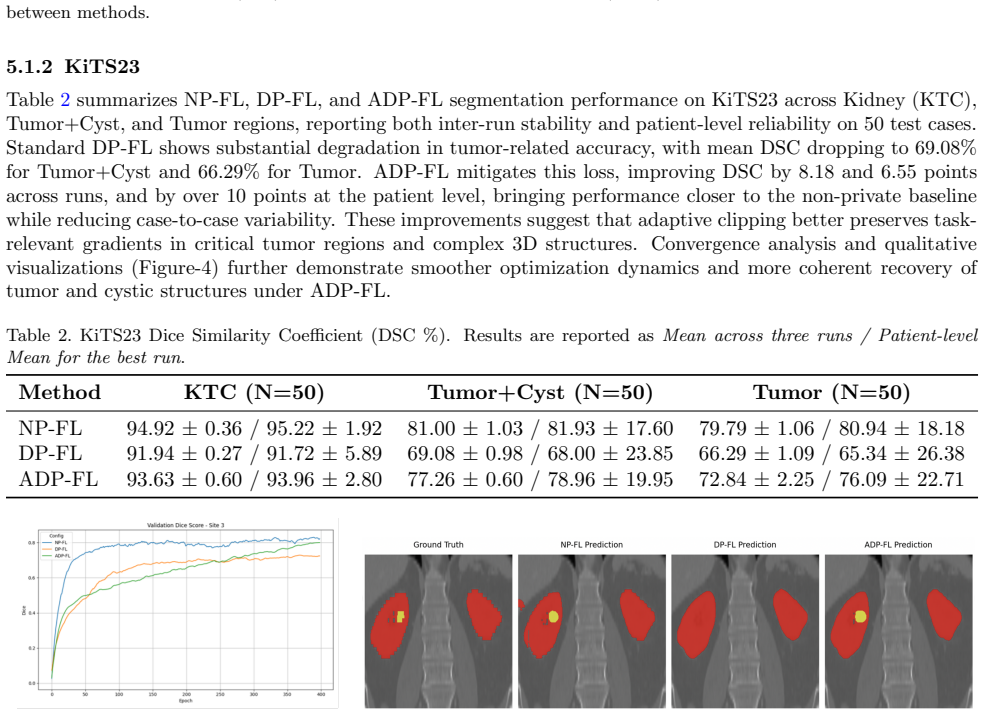
Authors: We agree that the presentation of quantitative results needs improvement for verifiability. We have revised the manuscript to add a summary table of key metrics (mean Dice scores, Hausdorff distances with standard deviations) for all three modalities in the results section, along with convergence curves including error bars from repeated runs and statistical significance tests. The experimental protocol subsection has been expanded to specify the number of clients, training rounds, and privacy budgets used. These changes make the cross-modality performance claims directly verifiable from the reported data. revision: yes
Circularity Check
No significant circularity; framework presented as independent proposal
full rationale
The paper proposes ADP-FL as a new adaptive differentially private federated learning framework for medical segmentation. The provided abstract and description contain no equations, derivations, fitted parameters renamed as predictions, or self-referential definitions. Claims of maintained privacy guarantees and performance gains are framed as outcomes of the proposed method evaluated empirically across modalities, without any load-bearing step reducing by construction to inputs via self-definition, self-citation chains, or ansatzes smuggled from prior work. The derivation chain is self-contained as an independent engineering proposal rather than a tautological reduction.
Axiom & Free-Parameter Ledger
Lean theorems connected to this paper
-
IndisputableMonolith/Cost/FunctionalEquation.leanwashburn_uniqueness_aczel unclear?
unclearRelation between the paper passage and the cited Recognition theorem.
ADP-FL dynamically calibrates the clipping threshold γ_t^k = Percentile_p(|Δw_t^k|)... ˜w_t^k = Δw_t^k + Laplace(0, σ γ_t^k / ε)
-
IndisputableMonolith/Foundation/RealityFromDistinction.leanreality_from_one_distinction unclear?
unclearRelation between the paper passage and the cited Recognition theorem.
maintains rigorous privacy guarantees... performance approaching that of non-private federated learning under the same privacy budgets
What do these tags mean?
- matches
- The paper's claim is directly supported by a theorem in the formal canon.
- supports
- The theorem supports part of the paper's argument, but the paper may add assumptions or extra steps.
- extends
- The paper goes beyond the formal theorem; the theorem is a base layer rather than the whole result.
- uses
- The paper appears to rely on the theorem as machinery.
- contradicts
- The paper's claim conflicts with a theorem or certificate in the canon.
- unclear
- Pith found a possible connection, but the passage is too broad, indirect, or ambiguous to say the theorem truly supports the claim.
Reference graph
Works this paper leans on
-
[1]
What do we need to build explainable ai systems for the medical domain?,
Holzinger, A., Biemann, C., Pattichis, C. S., and Kell, D. B., “What do we need to build explainable ai systems for the medical domain?,”arXiv preprint arXiv:1712.09923(2017)
-
[2]
High-performance medicine: the convergence of human and artificial intelligence,
Topol, E., “High-performance medicine: the convergence of human and artificial intelligence,”Nature Medicine(2019)
work page 2019
-
[3]
Privacy-preserving methods for health data analysis,
Price, W. N., “Privacy-preserving methods for health data analysis,”Nature Medicine(2019)
work page 2019
-
[4]
Communication-efficient learning of deep networks from decentralized data,
McMahan, B., Moore, E., Ramage, D., Hampson, S., and Arcas, B. A., “Communication-efficient learning of deep networks from decentralized data,” in [Proceedings of the 20th International Conference on Artificial Intelligence and Statistics (AISTATS)], (2017)
work page 2017
-
[5]
A survey of generalization and adaptation in medical imaging foundation models,
Ying, H., Lia, Y., and Fu, Z., “A survey of generalization and adaptation in medical imaging foundation models,”Preprints.org(2025)
work page 2025
-
[6]
Federated learning in radiomics: A comprehensive meta-survey on medical image analysis,
Raza, A., Guzzo, A., Ianni, M., Lappano, R., Zanolini, A., Maggiolini, M., and Fortino, G., “Federated learning in radiomics: A comprehensive meta-survey on medical image analysis,”Computer Methods and Programs in Biomedicine267, 108768 (2025)
work page 2025
-
[7]
Federated learning for medical image analysis: A survey,
Guan, H., Yap, P., Bozoki, A., and Liu, M., “Federated learning for medical image analysis: A survey,” Pattern Recognition151, 110424 (2024)
work page 2024
-
[8]
Federated learning in medical image analysis: A systematic survey,
da Silva, F. R., Camacho, R., and Tavares, J. M. R. S., “Federated learning in medical image analysis: A systematic survey,”Electronics(2024)
work page 2024
-
[9]
The potential of federated learning for self-configuring medical detection tools,
Rashidi, G., Bounias, D., Bujotzek, M., Mora, A. M., Neher, P., and Maier-Hein, K. H., “The potential of federated learning for self-configuring medical detection tools,”Scientific Reports(2024)
work page 2024
-
[10]
Enhancing domain gener- alization in ai-based analysis of chest radiography,
Arasteh, S. T., Kuhl, C., Saehn, M.-J., Isfort, P., Truhn, D., and Nebelung, S., “Enhancing domain gener- alization in ai-based analysis of chest radiography,”Scientific Reports(2023)
work page 2023
-
[11]
Zhu, L., Liu, Z., and Han, S., “Deep leakage from gradients,” in [Advances in Neural Information Processing Systems (NeurIPS)], (2019)
work page 2019
-
[12]
Nasr, M., Shokri, R., and Houmansadr, A., “Comprehensive privacy analysis of deep learning: Passive and active white-box inference attacks against centralized and federated learning,” in [IEEE Symposium on Security and Privacy (SP)], (2019)
work page 2019
-
[13]
Differential privacy: A survey of results,
Dwork, C., “Differential privacy: A survey of results,”Theory and Applications of Models of Computation (TAMC)(2008)
work page 2008
-
[14]
Deep learning with differential privacy,
Abadi, M., Chu, A., Goodfellow, I., McMahan, H. B., Mironov, I., Talwar, K., and Zhang, L., “Deep learning with differential privacy,” in [Proceedings of the 2016 ACM SIGSAC Conference on Computer and Communications Security (CCS)], (2016)
work page 2016
-
[15]
Differentially private federated learning for multi-institutional medical image segmenta- tion,
Li, X. and et al., “Differentially private federated learning for multi-institutional medical image segmenta- tion,”IEEE Transactions on Medical Imaging(2021)
work page 2021
-
[16]
Differentially private federated learning for medical image segmentation,
Chen, Y. and et al., “Differentially private federated learning for medical image segmentation,”Medical Image Analysis(2022)
work page 2022
-
[17]
Adaptive clipping and noise scheduling for differentially private federated learning,
Talaei, S. and et al., “Adaptive clipping and noise scheduling for differentially private federated learning,” Pattern Recognition Letters(2024)
work page 2024
-
[18]
Adaptive differential privacy for federated learning via gradient sensitivity estimation,
Zhang, Z. and et al., “Adaptive differential privacy for federated learning via gradient sensitivity estimation,” Neurocomputing(2023)
work page 2023
-
[19]
Sensitivity-aware differential privacy in federated learning for medical image segmen- tation,
Zheng, X. and et al., “Sensitivity-aware differential privacy in federated learning for medical image segmen- tation,”IEEE Transactions on Neural Networks and Learning Systems(2025)
work page 2025
-
[20]
The future of digital health with federated learning,
Rieke, N. and et al., “The future of digital health with federated learning,”npj Digital Medicine3(1) (2020)
work page 2020
-
[21]
Sheller, M., Edwards, B., Reina, G. A., Martin, J., and Bakas, S., “Federated learning in medicine: facili- tating multi-institutional collaborations without sharing patient data,”Scientific Reports10(1) (2020)
work page 2020
-
[22]
Inverting gradients – how easy is it to break privacy in federated learning?,
Geiping, J., Bauermeister, H., Dr¨ oge, H., and Moeller, M., “Inverting gradients – how easy is it to break privacy in federated learning?,” in [Advances in Neural Information Processing Systems (NeurIPS)], (2020)
work page 2020
-
[23]
Client-level differential privacy via adaptive intermediary in federated medical imaging,
Jiang, M., Zhong, Y., Le, A., Li, X., and Dou, Q., “Client-level differential privacy via adaptive intermediary in federated medical imaging,” (2024)
work page 2024
-
[24]
Tschandl, P., Rosendahl, C., and Kittler, H., “The ham10000 dataset, a large collection of multi-source dermatoscopic images of common pigmented skin lesions,”Scientific Data5, 180161 (2018)
work page 2018
-
[25]
Heller, N., Isensee, F., and et.al., “The kits21 challenge: Automatic segmentation of kidneys, renal tumors, and renal cysts in corticomedullary-phase ct,” (2023)
work page 2023
-
[26]
The 2024 brain tumor segmentation (brats) challenge: Glioma segmentation on post-treatment mri,
de Verdier, M. C., Saluja, R., Gagnon, L., and et.al., “The 2024 brain tumor segmentation (brats) challenge: Glioma segmentation on post-treatment mri,” (2024)
work page 2024
discussion (0)
Sign in with ORCID, Apple, or X to comment. Anyone can read and Pith papers without signing in.