Recognition: 3 theorem links
· Lean TheoremScientific Knowledge-driven Decoding Constraints Improving the Reliability of LLMs
Pith reviewed 2026-05-10 18:22 UTC · model grok-4.3
The pith
Turning scientific knowledge into strict decoding rules reduces LLM hallucinations by 12 percent on average.
A machine-rendered reading of the paper's core claim, the machinery that carries it, and where it could break.
Core claim
By having strong LLMs automatically convert domain-specific scientific theories and rules into multi-layered standardized constraints, the SciDC method effectively directs LLM generation on specialized tasks, reducing hallucinations and improving output accuracy by 12% on average across industrial formulation design, clinical tumor diagnosis, and retrosynthesis planning.
What carries the argument
SciDC, the framework that uses a strong LLM to translate flexible subject knowledge into multi-layered standardized rules which are then applied as decoding constraints on the target model's generation process.
If this is right
- LLM outputs on scientific tasks become more trustworthy without task-specific fine-tuning or retrieval.
- The same knowledge-to-rule conversion step can be reused across new domains once the knowledge base is supplied.
- Models can be guided toward expert-like behavior even when the underlying training data did not emphasize that domain.
- Post-generation checking effort drops because invalid outputs are blocked at the decoding stage rather than corrected afterward.
Where Pith is reading between the lines
- If LLMs prove good at summarizing knowledge into rules, the process could be looped so models iteratively refine their own constraint sets over time.
- The technique offers a structural alternative to prompt engineering for controlling model behavior in high-stakes settings.
- Similar rule-based constraints might transfer to other structured domains such as legal reasoning or engineering design where expert rules already exist in text form.
Load-bearing premise
That strong LLMs can reliably translate flexible domain knowledge into correct, error-free multi-layered rules without introducing omissions or biases that then shape the final outputs.
What would settle it
Running the full SciDC pipeline on one of the three tasks and obtaining accuracy equal to or lower than vanilla generation, or finding that human experts detect systematic errors introduced by the rule-conversion step.
Figures


read the original abstract
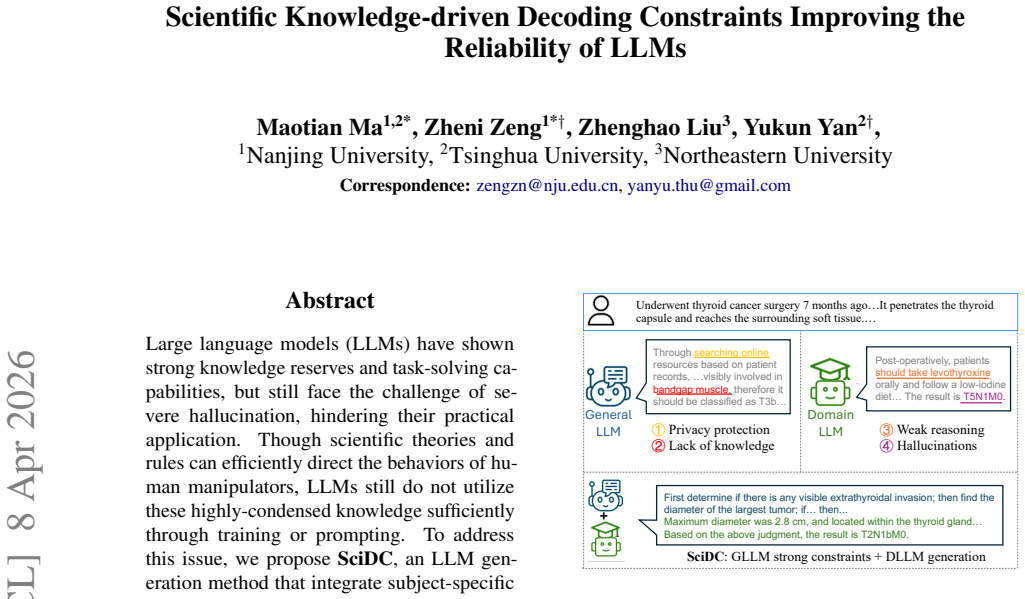
Large language models (LLMs) have shown strong knowledge reserves and task-solving capabilities, but still face the challenge of severe hallucination, hindering their practical application. Though scientific theories and rules can efficiently direct the behaviors of human manipulators, LLMs still do not utilize these highly-condensed knowledge sufficiently through training or prompting. To address this issue, we propose \textbf{SciDC}, an LLM generation method that integrate subject-specific knowledge with strong constraints. By adopting strong LLMs to automatically convert flexible knowledge into multi-layered, standardized rules, we build an extensible framework to effectively constrain the model generation on domain tasks. Experiments on scientific tasks including industrial formulation design, clinical tumor diagnosis and retrosynthesis planning, consistently demonstrate the effectiveness of our method, achieving a 12\% accuracy improvement on average compared with vanilla generation. We further discuss the potential of LLMs in automatically inductively summarizing highly-condensed knowledge, looking ahead to practical solutions for accelerating the overall scientific research process. All the code of this paper can be obtained (https://github.com/Maotian-Ma/SciDC).
Editorial analysis
A structured set of objections, weighed in public.
Referee Report
Summary. The manuscript proposes SciDC, a method that uses strong LLMs to automatically translate flexible scientific domain knowledge (e.g., theories for formulation design, tumor diagnosis, retrosynthesis) into multi-layered standardized rules, which are then enforced as decoding constraints to reduce hallucinations and improve reliability on scientific tasks. Experiments across industrial formulation design, clinical tumor diagnosis, and retrosynthesis planning report an average 12% accuracy improvement over vanilla generation. Code is released for reproducibility.
Significance. If the empirical gains are robust and the extracted rules are shown to be faithful, the framework could provide a practical, extensible way to inject structured scientific knowledge into LLM decoding without retraining, potentially aiding reliability in high-stakes domains. The open code release is a clear strength for verification and extension.
major comments (2)
- [Abstract] Abstract: the central claim of a consistent 12% average accuracy improvement is stated without any information on baselines, task-specific metrics, data splits, statistical tests, or controls for prompt-engineering effects. This leaves the primary empirical result unsupported by visible evidence and prevents assessment of whether gains arise from the constraints or from other factors.
- [Method] The rule-extraction step (described in the method) lacks any fidelity metrics, expert validation, or ablation showing that the LLM-generated multi-layered rules are accurate and complete. Because the method relies on these rules being correct to enforce reliable behavior, unvalidated extraction risks propagating LLM errors or omissions into the constrained outputs rather than mitigating hallucinations.
minor comments (1)
- The description of how multi-layered rules are converted into decoding constraints could be clarified with a concrete example or pseudocode showing the constraint application process during generation.
Simulated Author's Rebuttal
We thank the referee for their thoughtful and constructive comments. We address each major point below and outline the revisions we will make to strengthen the manuscript.
read point-by-point responses
-
Referee: [Abstract] Abstract: the central claim of a consistent 12% average accuracy improvement is stated without any information on baselines, task-specific metrics, data splits, statistical tests, or controls for prompt-engineering effects. This leaves the primary empirical result unsupported by visible evidence and prevents assessment of whether gains arise from the constraints or from other factors.
Authors: We agree that the abstract would benefit from greater specificity to support the reported gains. In the revised version we will update the abstract to explicitly name the baseline (vanilla generation), the three evaluation tasks, and the primary accuracy metric, while noting that full details on data splits, statistical significance tests, and prompt-engineering controls appear in Section 4 and the supplementary material. Because abstracts are length-constrained, we cannot embed every experimental detail, but the added phrasing will make the source of the 12 % average improvement clearer to readers. revision: partial
-
Referee: [Method] The rule-extraction step (described in the method) lacks any fidelity metrics, expert validation, or ablation showing that the LLM-generated multi-layered rules are accurate and complete. Because the method relies on these rules being correct to enforce reliable behavior, unvalidated extraction risks propagating LLM errors or omissions into the constrained outputs rather than mitigating hallucinations.
Authors: We acknowledge that the current description of the rule-extraction pipeline does not include quantitative fidelity assessment. In the revised manuscript we will add a new subsection that reports (i) expert-rated fidelity scores on sampled rules from each domain, (ii) inter-annotator agreement, and (iii) an ablation that compares constrained decoding with and without an explicit rule-validation filter. These additions will directly address the concern that unvalidated rules could introduce rather than reduce hallucinations. revision: yes
Circularity Check
No circularity; empirical method with external validation
full rationale
The paper proposes SciDC as a prompting-plus-constraint framework that uses LLMs to translate domain knowledge into decoding rules and then evaluates the resulting accuracy gains on three external scientific tasks against vanilla baselines. No equations, parameter fits, or derivations appear anywhere in the manuscript. The central claim is supported solely by reported experimental deltas (12% average) rather than any self-referential reduction of outputs to inputs. Self-citations, if present, are not load-bearing for the method's correctness, and the work remains falsifiable against independent benchmarks.
Axiom & Free-Parameter Ledger
axioms (1)
- domain assumption Strong LLMs can accurately convert flexible scientific knowledge into correct multi-layered standardized rules
Lean theorems connected to this paper
-
IndisputableMonolith/Foundation/RealityFromDistinction.leanreality_from_one_distinction unclear?
unclearRelation between the paper passage and the cited Recognition theorem.
By adopting strong LLMs to automatically convert flexible knowledge into multi-layered, standardized rules, we build an extensible framework to effectively constrain the model generation on domain tasks.
-
IndisputableMonolith/Cost/FunctionalEquation.leanwashburn_uniqueness_aczel unclear?
unclearRelation between the paper passage and the cited Recognition theorem.
Bottom-Layer Rules (RB): Token-level constraints that map directly into local modifications of the decoder logits.
-
IndisputableMonolith/Foundation/AlexanderDuality.leanalexander_duality_circle_linking unclear?
unclearRelation between the paper passage and the cited Recognition theorem.
Experiments on scientific tasks including industrial formulation design, clinical tumor diagnosis and retrosynthesis planning, consistently demonstrate the effectiveness of our method, achieving a 12% accuracy improvement on average compared with vanilla generation.
What do these tags mean?
- matches
- The paper's claim is directly supported by a theorem in the formal canon.
- supports
- The theorem supports part of the paper's argument, but the paper may add assumptions or extra steps.
- extends
- The paper goes beyond the formal theorem; the theorem is a base layer rather than the whole result.
- uses
- The paper appears to rely on the theorem as machinery.
- contradicts
- The paper's claim conflicts with a theorem or certificate in the canon.
- unclear
- Pith found a possible connection, but the passage is too broad, indirect, or ambiguous to say the theorem truly supports the claim.
Reference graph
Works this paper leans on
-
[1]
Reasoning-enhanced healthcare predictions with knowledge graph community retrieval.arXiv preprint arXiv:2410.04585. McDaid Kasper and 1 others. 2024. Evaluating llms for code generation in hri: A comparative study of chatgpt, gemini, and claude.Applied Artificial In- telligence. Found Claude 3.5 Sonnet achieved 95% success rate in robotic code generation ...
-
[2]
arXiv preprint arXiv:2410.13080 , year =
Springer. Linhao Luo, Zicheng Zhao, Gholamreza Haffari, Yuan- Fang Li, Chen Gong, and Shirui Pan. 2024. Graph- constrained reasoning: Faithful reasoning on knowl- edge graphs with large language models.arXiv preprint arXiv:2410.13080. Franklin Ma and Alan J Hu. 2025. Logically con- strained decoding. InProceedings of The 3rd Work- shop on Mathematical Nat...
-
[3]
Qwen3 technical report.arXiv preprint arXiv:2505.09388. Zheni Zeng, Yuxuan Chen, Shi Yu, Ruobing Wang, Yukun Yan, Zhenghao Liu, Shuo Wang, Xu Han, Zhiyuan Liu, and Maosong Sun. 2025. Kbalign: Ef- ficient self adaptation on specific textual knowledge bases. InFindings of the Association for Compu- tational Linguistics: EMNLP 2025, pages 13519– 13532. Tianj...
work page internal anchor Pith review Pith/arXiv arXiv 2025
discussion (0)
Sign in with ORCID, Apple, or X to comment. Anyone can read and Pith papers without signing in.