REVIEW 3 major objections 1 minor 2 cited by
Reviewed by Pith at T0; open to challenge.
T0 means a machine referee read the full paper against a public rubric. The mark states how deep the mechanical check went, never who wrote it. the ladder, T0–T4 →
T0 review · grok-4.3
Aegon extends JWT tokens with Merkle tree ledgers to enable third-party audits of AI content licensing.
2026-05-10 17:56 UTC
load-bearing objection Aegon sketches a workable audit layer on top of JWT and Merkle trees for AI licensing but stops short of any security analysis or numbers to support the hardware attestation claims. the 3 major comments →
Aegon: Auditable AI Content Access with Ledger-Bound Tokens and Hardware-Attested Mobile Receipts
The pith
A machine-rendered reading of the paper's core claim, the machinery that carries it, and where it could break.
Core claim
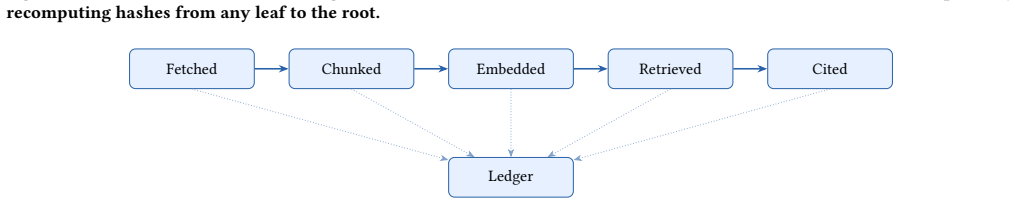
Aegon maintains a Certificate Transparency-style Merkle tree over an append-only transaction ledger, enabling third-party auditors to independently verify that specific content licensing transactions were recorded and have not been retroactively modified. Publishers validate tokens at the edge using standard JWKS with no broker dependency. A signed provenance event log tracks content through AI transformation stages bound to ledger entries by transaction ID, and hardware-attested compliance receipts are produced for on-device Android AI agents using StrongBox secure element attestation.
What carries the argument
Certificate Transparency-style Merkle tree over an append-only transaction ledger bound to extended JWT tokens and signed provenance event logs.
Load-bearing premise
The hardware attestation mechanism on Android StrongBox secure elements can reliably produce unforgeable compliance receipts for AI transformation stages without being bypassed or spoofed.
What would settle it
An experiment that forges a StrongBox attestation to create a false compliance receipt or retroactively alters a ledger entry without the Merkle tree detecting the change.
If this is right
- Publishers can validate tokens directly at the edge using standard JWKS with no broker in the content delivery path.
- Third-party auditors can independently verify the presence and integrity of specific licensing transactions.
- Signed provenance logs track content through AI stages such as chunking, embedding, retrieval, and citation, bound to ledger entries.
- Hardware-attested receipts provide verifiable compliance proof for on-device AI agents on Android.
Where Pith is reading between the lines
- This approach could allow regulators to check compliance with content licensing rules across AI systems without needing to trust a single provider.
- It might reduce disputes over unauthorized use of licensed material in AI training by creating immutable, auditable records.
- Combining the ledger with existing licensing declaration standards could create a complete chain from policy declaration to verified usage.
Editorial analysis
A structured set of objections, weighed in public.
Referee Report
Summary. The manuscript presents Aegon, a protocol extending standard JWT tokens with content-specific licensing claims, maintaining a Certificate Transparency-style Merkle tree over an append-only transaction ledger to enable third-party auditors to verify that licensing transactions were recorded and have not been retroactively modified. It incorporates signed provenance event logs tracking AI transformation stages (chunking, embedding, retrieval, citation) bound to ledger entries by transaction ID, and describes hardware-attested compliance receipts for on-device Android AI agents using StrongBox secure element attestation. The system runs over standard HTTPS with no broker dependency in the content delivery path, complements existing standards such as RSL, and includes a reference architecture plus an evaluation methodology for protocol overhead.
Significance. If the security and verifiability properties hold, Aegon would address a clear gap in AI content governance by supplying tamper-evident, independently auditable licensing and provenance infrastructure that existing DRM systems lack, particularly for mobile on-device transformations. The design's reliance on standard primitives (JWT, Merkle trees, JWKS) without introducing new trusted brokers is a strength, as is the novel application of hardware attestation to produce compliance receipts for AI licensing trails. This could have practical significance for policy enforcement and auditability in generative AI pipelines.
major comments (3)
- [Abstract] Abstract: the central claim that third-party auditors can independently verify licensing transactions and AI transformation provenance via ledger-bound tokens and hardware-attested receipts depends on StrongBox producing unforgeable signed receipts. No threat model is supplied, nor any analysis of attestation bypass vectors (e.g., OS-level exploits or attestation service compromise), which is load-bearing for the tamper-evidence guarantee.
- [Abstract] Abstract: the manuscript states that it describes 'an evaluation methodology for measuring protocol overhead' yet supplies no concrete performance numbers, security analysis, or proof sketches supporting the tamper-evidence and verifiability claims; this absence prevents assessment of whether the independent-verifiability guarantee is practically achievable.
- [Hardware-attested compliance receipts] Description of hardware-attested compliance receipts: no formal binding is specified between the attestation receipts and ledger transaction IDs, which is required to link on-device AI stages (chunking/embedding) to the auditable ledger entries and thereby support the provenance-tracking claim.
minor comments (1)
- [Abstract] Abstract: the phrase 'Ledger-bound tokens' is introduced without a concise definition of how the extension to JWT claims interacts with the Merkle-tree ledger; a short clarifying sentence would aid readers.
Simulated Author's Rebuttal
We thank the referee for their thorough review and valuable feedback on the Aegon protocol manuscript. We address each major comment below in detail, indicating where revisions will be incorporated to improve clarity and completeness while remaining faithful to the scope of the current work.
read point-by-point responses
-
Referee: [Abstract] Abstract: the central claim that third-party auditors can independently verify licensing transactions and AI transformation provenance via ledger-bound tokens and hardware-attested receipts depends on StrongBox producing unforgeable signed receipts. No threat model is supplied, nor any analysis of attestation bypass vectors (e.g., OS-level exploits or attestation service compromise), which is load-bearing for the tamper-evidence guarantee.
Authors: We agree that an explicit threat model is necessary to support the tamper-evidence and verifiability claims. The manuscript relies on the documented security properties of Android StrongBox attestation but does not enumerate adversary models or potential bypass vectors such as OS exploits or attestation service issues. In the revised version, we will add a dedicated threat model section that defines assumed adversary capabilities, discusses the role of hardware attestation in the compliance receipts, and acknowledges relevant limitations and assumptions. This will strengthen the presentation of the independent-verifiability guarantee without altering the core protocol design. revision: yes
-
Referee: [Abstract] Abstract: the manuscript states that it describes 'an evaluation methodology for measuring protocol overhead' yet supplies no concrete performance numbers, security analysis, or proof sketches supporting the tamper-evidence and verifiability claims; this absence prevents assessment of whether the independent-verifiability guarantee is practically achievable.
Authors: The manuscript presents a protocol design, reference architecture, and an evaluation methodology for overhead measurement, along with informal arguments for verifiability based on standard primitives (Merkle trees, JWT, JWKS). It does not include concrete performance measurements, formal security proofs, or sketches. We will revise the abstract and introduction to more accurately reflect this scope, emphasizing the methodology and design rationale rather than implying empirical or formal validation. A full security analysis and performance evaluation lie beyond the current design-focused contribution and are reserved for future work. revision: partial
-
Referee: [Hardware-attested compliance receipts] Description of hardware-attested compliance receipts: no formal binding is specified between the attestation receipts and ledger transaction IDs, which is required to link on-device AI stages (chunking/embedding) to the auditable ledger entries and thereby support the provenance-tracking claim.
Authors: We acknowledge that the current description does not explicitly formalize the binding between attestation receipts and ledger transaction IDs. The binding occurs by embedding the transaction ID within the signed provenance event log prior to StrongBox attestation. In the revised manuscript, we will add a precise specification of this binding, including the relevant data structures, the inclusion of the transaction ID in the attested payload, and the verification steps that allow auditors to link on-device stages to specific ledger entries. revision: yes
- Supplying concrete performance numbers or formal security proofs/sketches, as the manuscript is limited to protocol design and methodology description without executed evaluations or formal analysis.
Circularity Check
No significant circularity; protocol builds on external primitives
full rationale
The paper presents a protocol design extending JWT tokens with licensing claims, a Merkle tree ledger modeled on Certificate Transparency, and hardware-attested receipts using Android StrongBox. No equations, fitted parameters, or self-referential definitions appear in the provided text. Claims of independent verifiability derive directly from standard cryptographic constructions (JWT, append-only Merkle trees, hardware attestation) without reducing to self-citation chains or renaming known results as novel derivations. The 'first application' statement is a novelty assertion, not a load-bearing premise that collapses into prior self-work. The derivation chain remains self-contained against external benchmarks like existing JWT and CT standards.
Axiom & Free-Parameter Ledger
axioms (2)
- standard math Standard cryptographic assumptions for JWT signatures and Merkle tree collision resistance hold
- domain assumption Android StrongBox secure element attestation cannot be forged or bypassed by the device owner or malware
invented entities (2)
-
Ledger-bound tokens
no independent evidence
-
Hardware-attested compliance receipts
no independent evidence
read the original abstract
Recent standards such as RSL address AI content policy declaration -- telling AI systems what the licensing terms are. However, no existing system provides audit infrastructure -- tamper-evident licensing transaction records with independently verifiable proofs that those records have not been retroactively modified. We describe Aegon, a protocol that extends standard JWT tokens with content-specific licensing claims and maintains a Certificate Transparency-style Merkle tree over an append-only transaction ledger, enabling third-party auditors to independently verify that specific content licensing transactions were recorded and have not been retroactively modified. Publishers validate tokens at the edge using standard JWKS with no broker dependency in the content delivery path. A signed provenance event log tracks content through AI transformation stages (chunking, embedding, retrieval, citation), bound to ledger entries by transaction ID. We further describe hardware-attested compliance receipts for on-device Android AI agents using StrongBox secure element attestation -- to our knowledge, the first application of hardware-attested compliance receipts to AI content licensing. Existing DRM systems use hardware-backed keys for content decryption but do not produce verifiable compliance receipts for audit trails. We describe a reference architecture and an evaluation methodology for measuring protocol overhead. The protocol runs entirely over standard HTTPS and is designed to complement existing licensing standards rather than replace them.
Figures



Forward citations
Cited by 2 Pith papers
-
Behavioral Governance for Autonomous AI Agents: The AgentBound Framework
AgentBound composes decisions from delegated authorization, owner-signed constitutions, and site contracts via a formal model, producing verifiable governance receipts for AI agent actions.
-
Behavioral Governance for Autonomous AI Agents: The AgentBound Framework
AgentBound is a governance framework that composes delegated authorization, behavioral constitutions, and action contracts to produce cryptographically verifiable decisions on AI agent actions.
Reference graph
Works this paper leans on
-
[1]
Android Compatibility Definition Document. 2024. Section 9.11: Keys and Cre- dentials. source.android.com
work page 2024
-
[2]
Android Developers. 2024. Hardware-backed Keystore: StrongBox. devel- oper.android.com
work page 2024
-
[3]
Android Developers. 2024. Key Attestation. developer.android.com
work page 2024
-
[4]
Android Developers. 2024. KeyMint HAL. source.android.com
work page 2024
-
[5]
Anthropic. 2025. Model Context Protocol (MCP) Specification. modelcontextpro- tocol.io
work page 2025
-
[6]
Apple. 2024. App Attest. developer.apple.com
work page 2024
-
[7]
AuthorsGuild 2023. Authors Guild et al. v. OpenAI Inc. et al. Case No. 1:23-cv- 08292 (S.D.N.Y. 2023)
work page 2023
-
[8]
C2PA. 2025. C2PA Technical Specification v2.2. c2pa.org
work page 2025
-
[9]
Cashmere. 2026. AI Content Management for Premium Publishers. cashmere.io
work page 2026
-
[10]
Cloudflare. 2025. Pay-Per-Crawl: AI Bot Content Monetization. blog.cloudflare.com
work page 2025
- [11]
-
[12]
FetchRight. 2025. Peek-Then-Pay: HTTP 203-Based Content Licensing Protocol. fetchright.ai. Accessed March 2026. No formal IETF draft or arXiv specification; citation refers to working implementation documentation
work page 2025
-
[13]
FG-Trac: Fine-Grained Traceability for ML Pipelines with Crypto- graphic Commitments
FG-Trac 2025. FG-Trac: Fine-Grained Traceability for ML Pipelines with Crypto- graphic Commitments. arXiv
work page 2025
-
[14]
Getty 2023. Getty Images (US), Inc. v. Stability AI, Inc. Case No. 1:23-cv-00135 (D. Del. 2023)
work page 2023
-
[15]
Google. 2024. Gemini Nano: On-Device AI. Android Developers Blog
work page 2024
-
[16]
Google. 2024. Play Integrity API. developer.android.com
work page 2024
-
[17]
Google. 2024. Widevine DRM Architecture Overview. widevine.com
work page 2024
-
[18]
arXiv preprint arXiv:2509.13597 (2025).https://doi.org/10
S. Goswami et al. 2025. Agentic JWT. IETF Internet-Draft draft-goswami-agentic- jwt-00. arXiv:2509.13597
-
[19]
Stuart Haber and W. Scott Stornetta. 1991. How to Time-Stamp a Digital Docu- ment.Journal of Cryptology3, 2 (1991), 99–111
work page 1991
-
[20]
Dick Hardt. 2012. The OAuth 2.0 Authorization Framework. RFC 6749, IETF
work page 2012
-
[21]
A. Jewell. 2025. AI Boundary Declaration Protocol (AIBDP). IETF Internet-Draft draft-jewell-aibdp-00
work page 2025
-
[22]
Michael Jones. 2015. JSON Web Key (JWK). RFC 7517, IETF
work page 2015
-
[23]
Michael Jones, John Bradley, and Nat Sakimura. 2015. JSON Web Signature (JWS). RFC 7515, IETF
work page 2015
-
[24]
Michael Jones, John Bradley, and Nat Sakimura. 2015. JSON Web Token (JWT). RFC 7519, IETF
work page 2015
-
[25]
Martijn Koster, Gary Illyes, Henner Zeller, and Lizzi Sassman. 2022. Robots Exclusion Protocol. RFC 9309, IETF
work page 2022
-
[26]
Ben Laurie, Adam Langley, and Emilia Kasper. 2013. Certificate Transparency. RFC 6962, IETF
work page 2013
-
[27]
Meta. 2024. Llama 3: Open Foundation and Fine-Tuned Models
work page 2024
-
[28]
Microsoft Research. 2026. VeriTrail: DAG-Based Provenance Tracing for LLM Hallucination Detection. ICLR 2026
work page 2026
-
[29]
Benjamin Mullin and Keach Hagey. 2024. News Corp Signs AI Deal With OpenAI Worth More Than $250 Million. Wall Street Journal
work page 2024
-
[30]
NYT 2023. The New York Times Company v. Microsoft Corporation et al. Case No. 1:23-cv-11195 (S.D.N.Y. 2023)
work page 2023
-
[31]
OpenAttribution. 2025. AIMS: AI Manifest Standard and Telemetry. openattri- bution.dev
work page 2025
-
[32]
PEAC Protocol. 2025. Verifiable Interaction Records for AI Content Compli- ance. peacprotocol.org. Accessed March 2026. No formal IETF draft or arXiv specification; citation refers to working implementation documentation
work page 2025
-
[33]
Qi et al. 2026. Information Isotopes: Auditing AI Training Data with Crypto- graphic Markers. Nature Communications
work page 2026
-
[34]
Mohamed Sabt, Mohammed Achemlal, and Abdelmadjid Bouabdallah. 2015. Trusted Execution Environments: A Survey. IEEE Communications Surveys and Tutorials
work page 2015
-
[35]
Nat Sakimura et al. 2014. OpenID Connect Core 1.0. OpenID Foundation
work page 2014
-
[36]
TollBit. 2024. AI Content Licensing Platform. tollbit.com
work page 2024
- [37]
-
[38]
Eckart Walther and R.V. Guha. 2025. RSL 1.0: Really Simple Licensing. RSL Collective, rslstandard.org
work page 2025
- [39]
discussion (0)
Sign in with ORCID, Apple, or X to comment. Anyone can read and Pith papers without signing in.