Recognition: 1 theorem link
· Lean TheoremHow acausal equations emerge from causal dynamics
Pith reviewed 2026-05-10 18:01 UTC · model grok-4.3
The pith
Causal kinetic models can reproduce any rest-frame stable dissipative dispersion relation at real wavenumbers through suitable initialization of microscopic degrees of freedom.
A machine-rendered reading of the paper's core claim, the machinery that carries it, and where it could break.
Core claim
We construct a causal and covariantly stable kinetic model whose spectrum at real wavenumbers k reproduces any rest-frame stable dissipative dispersion relation ω(k) via suitable initialization of the microscopic degrees of freedom. Macroscopic observables can therefore obey arbitrary linear evolution equations (including forms that would be acausal if taken as fundamental), while the underlying dynamics remains causal, and all apparent propagation is encoded in the initial data. This provides an explicit counterexample to the idea that microscopic causality alone constrains the analytic form of dispersion relations at real k. In particular, bounds on transport coefficients based solely on ω
What carries the argument
The causal and covariantly stable kinetic model that encodes all apparent propagation inside the choice of initial data for the microscopic degrees of freedom.
If this is right
- Macroscopic linear evolution equations can take acausal-looking forms without violating causality at the microscopic level.
- All propagation effects in the macroscopic description are carried entirely by the initial data rather than by the time-evolution operator.
- Analytic bounds on transport coefficients that rely only on the shape of ω(k) at real k, such as hydrohedron bounds, require additional assumptions about which complex-k regions correspond to physical modes.
- The spectrum at real k can be chosen arbitrarily as long as the chosen relation is stable in the rest frame.
Where Pith is reading between the lines
- Effective macroscopic descriptions in nuclear or fluid systems may appear to violate causality while still descending from fully causal underlying dynamics.
- Similar constructions could be attempted in other domains where effective equations are written down first and then checked for consistency with a presumed microscopic theory.
- Numerical simulations that initialize kinetic models with non-equilibrium microscopic distributions may inadvertently produce apparently superluminal signals that are artifacts of the initial slice rather than true propagation.
Load-bearing premise
Arbitrary initial conditions can be imposed on the microscopic degrees of freedom without destroying the overall causality or covariant stability of the kinetic model, and the macroscopic observables extracted from those data remain physical modes.
What would settle it
An explicit example of a rest-frame stable dissipative dispersion relation ω(k) at real k that cannot be reproduced by any choice of initial data inside a causal, covariantly stable kinetic model.
Figures
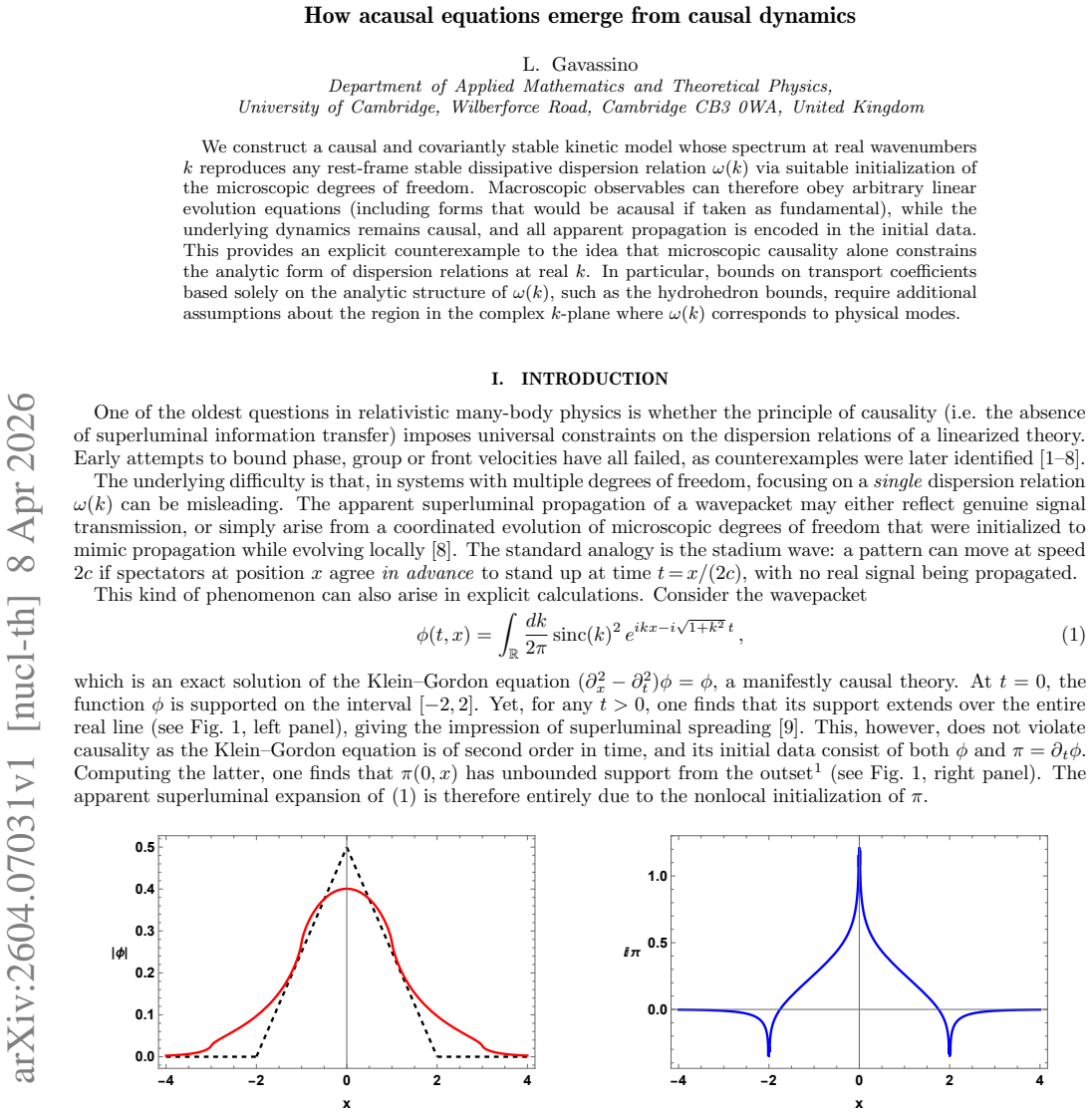

read the original abstract
We construct a causal and covariantly stable kinetic model whose spectrum at real wavenumbers $k$ reproduces any rest-frame stable dissipative dispersion relation $\omega(k)$ via suitable initialization of the microscopic degrees of freedom. Macroscopic observables can therefore obey arbitrary linear evolution equations (including forms that would be acausal if taken as fundamental), while the underlying dynamics remains causal, and all apparent propagation is encoded in the initial data. This provides an explicit counterexample to the idea that microscopic causality alone constrains the analytic form of dispersion relations at real $k$. In particular, bounds on transport coefficients based solely on the analytic structure of $\omega(k)$, such as the hydrohedron bounds, require additional assumptions about the region in the complex $k$-plane where $\omega(k)$ corresponds to physical modes.
Editorial analysis
A structured set of objections, weighed in public.
Referee Report
Summary. The paper constructs a causal and covariantly stable kinetic model whose real-wavenumber spectrum reproduces any given rest-frame stable dissipative dispersion relation ω(k) through suitable choice of initial microscopic distributions. Macroscopic observables can thus follow arbitrary linear evolution equations (including acausal forms) while the underlying dynamics remains causal, with all apparent propagation encoded in the initial data. This is presented as an explicit counterexample to the claim that microscopic causality alone constrains the analytic structure of real-k dispersion relations, with implications for bounds such as the hydrohedron bounds that rely on analyticity assumptions.
Significance. If the construction is fully rigorous and general, the result would be significant for relativistic kinetic theory and hydrodynamics: it decouples the causality of the microscopic model from the form of effective macroscopic dispersion relations at real k, showing that apparent acausality can arise purely from initial-condition encoding rather than from the dynamics. This directly challenges analyticity-based constraints on transport coefficients and could affect how effective theories are validated against causality requirements. The paper supplies an explicit counterexample rather than an abstract argument, which strengthens its potential impact if the details hold.
major comments (2)
- [Abstract and central construction] The central construction—that arbitrary rest-frame stable ω(k) can always be reproduced by admissible initial microscopic distributions while preserving covariant stability under Lorentz boosts—is asserted in the abstract but requires explicit verification. For target relations with poles or branch cuts that may conflict with the kinetic model's characteristic structure, it is not shown that the required initial data remain stable and admissible for all times and boosts. This is load-bearing for the claim that the counterexample is general.
- [Central construction] The manuscript must demonstrate that the extracted macroscopic observables correspond to physical modes without additional restrictions in the complex-k plane, and that the initialization procedure does not introduce instabilities when the target ω(k) would be acausal if taken as a fundamental equation. Without this, the assertion that 'all apparent propagation is encoded in the initial data' remains unverified for the full class of dissipative relations.
minor comments (2)
- Clarify the precise definition of 'covariantly stable' and how it is verified for the chosen initial data across Lorentz frames.
- Provide at least one concrete example with explicit equations for the kinetic model, the target ω(k), and the corresponding initial distribution to illustrate the matching procedure.
Simulated Author's Rebuttal
We thank the referee for their careful reading and constructive comments. The two major comments raise valid points about the explicitness of our general construction and the need for additional verification in specific cases. We address each below and indicate where the manuscript will be revised for clarity while maintaining that the core claims hold as presented.
read point-by-point responses
-
Referee: [Abstract and central construction] The central construction—that arbitrary rest-frame stable ω(k) can always be reproduced by admissible initial microscopic distributions while preserving covariant stability under Lorentz boosts—is asserted in the abstract but requires explicit verification. For target relations with poles or branch cuts that may conflict with the kinetic model's characteristic structure, it is not shown that the required initial data remain stable and admissible for all times and boosts. This is load-bearing for the claim that the counterexample is general.
Authors: The manuscript develops a general procedure (detailed in Sections 3 and 4) in which any rest-frame stable ω(k) at real k is encoded by constructing an admissible initial microscopic distribution whose moments evolve according to the target relation under the causal kinetic dynamics. Covariant stability under boosts is inherited from the underlying causal model and does not depend on the particular form of ω(k) beyond real-k stability in the rest frame. For dispersion relations containing poles or branch cuts, the construction operates exclusively at real k; the analytic continuation is not required to match the microscopic characteristic structure. We acknowledge that an explicit worked example for a branch-cut case would strengthen the presentation and will add one in the revised manuscript, together with a brief verification that the corresponding initial data remain admissible and stable under the causal evolution. revision: partial
-
Referee: [Central construction] The manuscript must demonstrate that the extracted macroscopic observables correspond to physical modes without additional restrictions in the complex-k plane, and that the initialization procedure does not introduce instabilities when the target ω(k) would be acausal if taken as a fundamental equation. Without this, the assertion that 'all apparent propagation is encoded in the initial data' remains unverified for the full class of dissipative relations.
Authors: The macroscopic observables are defined as moments of the microscopic distribution; their real-k spectrum is fixed by construction to match the target ω(k). These modes are physical because they arise from admissible initial data evolved under a causal microscopic theory. The initialization encodes the desired propagation but does not alter the causal character of the dynamics, so no instabilities are introduced even when the target relation would be acausal if interpreted as a fundamental equation. Our claim concerns only the real-k spectrum and does not assert reproduction of the analytic structure in the complex-k plane. To address the referee's concern we will expand the discussion in Section 5 to clarify the distinction between real-k matching and complex-k analyticity, and to note explicitly that the counterexample applies to the class of rest-frame stable dissipative relations at real k. revision: partial
Circularity Check
No circularity: explicit construction from standard causal kinetics
full rationale
The paper presents a direct construction of a causal, covariantly stable kinetic model (standard Boltzmann-type dynamics) whose real-k spectrum is made to match arbitrary rest-frame stable ω(k) solely by admissible choice of initial microscopic distributions. No step defines the target dispersion relation in terms of itself, fits parameters to a subset and renames the output as prediction, or invokes a self-citation chain as the load-bearing justification for uniqueness or stability. The result is an existence demonstration, not a reduction of the claimed counterexample to the paper's own fitted inputs or prior self-referential theorems. The derivation remains self-contained against external benchmarks of kinetic theory causality.
Axiom & Free-Parameter Ledger
Forward citations
Cited by 2 Pith papers
-
Topological Charge of Causality at a PT-Symmetric Exceptional Point
Causality in PT-symmetric systems carries a topological charge at exceptional points, causing a pole migration that produces a Lorentzian residual in Kramers-Kronig relations whose magnitude scales as |gamma - gamma_c...
-
Kramers-Kronig Relations and Causality in Non-Markovian Open Quantum Dynamics: Kernel, State, and Effective Kernel
The Nakajima-Zwanzig memory kernel belongs to the operator-valued Hardy space and obeys Kramers-Kronig relations under a real-axis spectral hypothesis, while effective kernels can show upper-half-plane poles from unca...
Reference graph
Works this paper leans on
-
[1]
Sommerfeld, Annalen der Physik327, 177 (1907)
A. Sommerfeld, Annalen der Physik327, 177 (1907)
1907
-
[2]
Brillouin,Wave Propagation and Group Velocity(Academic Press, 1960)
L. Brillouin,Wave Propagation and Group Velocity(Academic Press, 1960)
1960
-
[3]
S. A. Bludman and M. A. Ruderman, Physical Review170, 1176 (1968)
1968
-
[4]
Aharonov, A
Y. Aharonov, A. Komar, and L. Susskind, Phys. Rev.182, 1400 (1969)
1969
-
[5]
R. Fox, C. G. Kuper, and S. G. Lipson, Proceedings of the Royal Society of London A316, 515 (1970)
1970
-
[6]
Krotscheck and W
E. Krotscheck and W. Kundt, Communications in Mathematical Physics60, 171 (1978)
1978
- [7]
-
[8]
Dispersion Relations Alone Cannot Guarantee Causality,
L. Gavassino, M. M. Disconzi, and J. Noronha, Phys. Rev. Lett.132, 162301 (2024), arXiv:2307.05987 [hep-th]
-
[9]
G. C. Hegerfeldt, Physical Review D10, 3320 (1974)
1974
- [10]
- [11]
-
[12]
Bounds on transport from hydrodynamic stability,
L. Gavassino, Phys. Lett. B840, 137854 (2023), arXiv:2301.06651 [hep-th]
- [13]
-
[14]
Stability and causality criteria in linear mode analysis: Stability means causality,
D.-L. Wang and S. Pu, Phys. Rev. D109, L031504 (2024), arXiv:2309.11708 [hep-th]
-
[15]
Gavassino, (2026), arXiv:2601.19464 [gr-qc]
L. Gavassino, (2026), arXiv:2601.19464 [gr-qc]
-
[16]
Gavassino, (2026), arXiv:2601.19474 [nucl-th]
L. Gavassino, (2026), arXiv:2601.19474 [nucl-th]
-
[17]
Cutting through the frequency plane to save causality,
R. Brants, “Cutting through the frequency plane to save causality,” (2025), conference presentation at Quantum Dynamics at Ghent 2025
2025
-
[18]
Dudynski and M
M. Dudynski and M. L. Ekiel-Jez`ewska, Phys. Rev. Lett.55, 2831 (1985)
1985
-
[19]
F. S. Bemfica, M. M. Disconzi, and J. Noronha, Phys. Rev. D100, 104020 (2019)
2019
-
[20]
Can We Make Sense of Dissipation without Causality?,
L. Gavassino, Phys. Rev. X12, 041001 (2022), arXiv:2111.05254 [gr-qc]
- [21]
-
[22]
W. A. Hiscock and L. Lindblom, Annals of Physics151, 466 (1983)
1983
-
[23]
L. Gavassino, M. Antonelli, and B. Haskell, Physical Review D102(2020), 10.1103/physrevd.102.043018
-
[24]
Gavassino, Classical and Quantum Gravity38, 21LT02 (2021), arXiv:2104.09142 [gr-qc]
L. Gavassino, Classical and Quantum Gravity38, 21LT02 (2021), arXiv:2104.09142 [gr-qc]
-
[25]
Thermodynamic Stability Implies Causality,
L. Gavassino, M. Antonelli, and B. Haskell, Phys. Rev. Lett.128, 010606 (2022), arXiv:2105.14621 [gr-qc]
-
[26]
LaSalle and S
J. LaSalle and S. Lefschetz,Stability by Liapunov’s Direct Method: With Applications, Mathematics in science andengi- neering, v.4 (Academic Press, 1961)
1961
-
[27]
S. R. de Groot, W. A. van Leeuwen, and C. G. van Weert,Relativistic kinetic theory: principles and applications(1980)
1980
-
[28]
G. I. Barenblatt, I. P. Zheltov, and I. N. Kochina, Journal of Applied Mathematics and Mechanics24, 1286 (1960)
1960
-
[29]
G. I. Barenblatt, Journal of Applied Mathematics and Mechanics27, 513 (1963)
1963
-
[30]
E. C. Aifantis, Acta Mechanica37, 265 (1980)
1980
-
[31]
T. W. Ting, Journal of Mathematical Analysis and Applications45, 23 (1974)
1974
-
[32]
Dudy´ nski, Journal of Statistical Physics57, 199 (1989)
M. Dudy´ nski, Journal of Statistical Physics57, 199 (1989)
1989
-
[33]
Geroch, Journal of Mathematical Physics36, 4226 (1995)
R. Geroch, Journal of Mathematical Physics36, 4226 (1995)
1995
-
[34]
Lindblom, Annals of Physics247, 1 (1996), arXiv:gr-qc/9508058 [gr-qc]
L. Lindblom, Annals of Physics247, 1 (1996), arXiv:gr-qc/9508058 [gr-qc]
-
[35]
Lectures on non-equilibrium effective field theories and fluctuating hydrodynamics
P. Glorioso and H. Liu, arXiv e-prints , arXiv:1805.09331 (2018), arXiv:1805.09331 [hep-th]
work page Pith review arXiv 2018
-
[36]
L. Gavassino, Phys. Rev. Res.6, L042043 (2024), arXiv:2404.12327 [nucl-th]
-
[37]
Gavassino, (2026), arXiv:2602.21254 [math-ph]
L. Gavassino, (2026), arXiv:2602.21254 [math-ph]
discussion (0)
Sign in with ORCID, Apple, or X to comment. Anyone can read and Pith papers without signing in.