Recognition: 2 theorem links
· Lean TheoremLatent Structure of Affective Representations in Large Language Models
Pith reviewed 2026-05-10 18:50 UTC · model grok-4.3
The pith
Large language models develop coherent latent representations of emotions that align with psychological valence-arousal dimensions.
A machine-rendered reading of the paper's core claim, the machinery that carries it, and where it could break.
Core claim
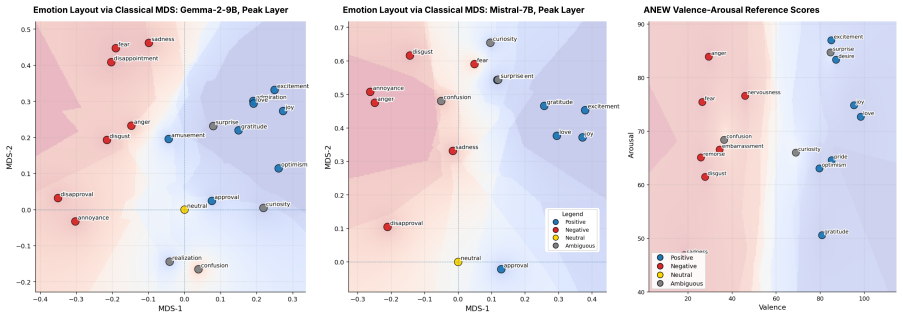
LLMs learn coherent latent representations of affective emotions that align with widely used valence-arousal models from psychology. These representations exhibit nonlinear geometric structure that can nonetheless be well-approximated linearly, providing empirical support for the linear representation hypothesis. The learned latent representation space can be leveraged to quantify uncertainty in emotion processing tasks. The findings indicate that LLMs acquire affective representations with geometric structure paralleling established models of human emotion.
What carries the argument
Geometric data analysis tools applied to the latent embeddings produced by LLMs when processing emotion stimuli.
If this is right
- Emotion-related outputs in LLMs can be interpreted by projecting them onto established valence-arousal coordinates.
- Standard linear techniques for model transparency remain applicable even when the underlying geometry is mildly nonlinear.
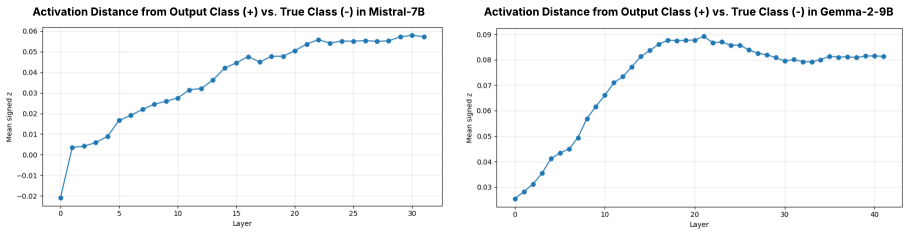
- Uncertainty estimates for affective tasks can be read directly from distances or spreads in the representation space.
Where Pith is reading between the lines
- The same geometric approach could be applied to other continuous attributes such as sentiment strength or moral valence to test for similar structure.
- If the representations prove stable across model scales, targeted edits in the valence-arousal plane might offer a route to controlled changes in emotional tone of generated text.
Load-bearing premise
The chosen geometric analysis methods and emotion stimuli correctly recover the true underlying geometry of affective representations inside the models.
What would settle it
Finding no consistent alignment between the model's latent positions of emotion words and independent valence-arousal ratings from psychology, or discovering that the structure resists linear approximation, would undermine the central claims.
Figures





read the original abstract
The geometric structure of latent representations in large language models (LLMs) is an active area of research, driven in part by its implications for model transparency and AI safety. Existing literature has focused mainly on general geometric and topological properties of the learnt representations, but due to a lack of ground-truth latent geometry, validating the findings of such approaches is challenging. Emotion processing provides an intriguing testbed for probing representational geometry, as emotions exhibit both categorical organization and continuous affective dimensions, which are well-established in the psychology literature. Moreover, understanding such representations carries safety relevance. In this work, we investigate the latent structure of affective representations in LLMs using geometric data analysis tools. We present three main findings. First, we show that LLMs learn coherent latent representations of affective emotions that align with widely used valence--arousal models from psychology. Second, we find that these representations exhibit nonlinear geometric structure that can nonetheless be well-approximated linearly, providing empirical support for the linear representation hypothesis commonly assumed in model transparency methods. Third, we demonstrate that the learned latent representation space can be leveraged to quantify uncertainty in emotion processing tasks. Our findings suggest that LLMs acquire affective representations with geometric structure paralleling established models of human emotion, with practical implications for model interpretability and safety.
Editorial analysis
A structured set of objections, weighed in public.
Referee Report
Summary. The manuscript investigates the latent geometric structure of affective emotion representations in large language models using geometric data analysis tools applied to emotion stimuli. It presents three main findings: (1) LLMs learn coherent latent representations of affective emotions that align with valence-arousal models from psychology, (2) these representations exhibit nonlinear geometric structure that can nonetheless be well-approximated linearly, providing empirical support for the linear representation hypothesis, and (3) the learned latent representation space can be leveraged to quantify uncertainty in emotion processing tasks. The work positions these results as relevant to model transparency and AI safety.
Significance. If the central claims hold after addressing specificity concerns, the paper would provide useful empirical evidence that LLMs encode affective information with geometric structure paralleling established psychological models of emotion. This could strengthen the case for using geometric analysis in interpretability work and offer practical tools for uncertainty quantification in emotion-related tasks. The support for linear approximations in an affective domain is a modest but concrete addition to the linear representation hypothesis literature.
major comments (2)
- [Results section presenting the first finding] The first main finding (alignment of LLM latent representations with valence-arousal dimensions) is load-bearing for the central claim that LLMs acquire specifically affective geometry. The reported alignment metrics are not accompanied by controls such as frequency-matched non-affective word sets, shuffled emotion labels, or non-emotion semantic categories. Without these, it is not possible to rule out that the observed geometry reflects general semantic clustering rather than dedicated affective structure.
- [Section on nonlinear geometric structure and linear approximation] The claim that nonlinear structure is 'well-approximated linearly' (second finding) requires quantitative detail on approximation quality. The manuscript should report the specific error metric, the fraction of variance captured by the linear model versus nonlinear baselines, and whether this holds after correcting for the number of dimensions used.
minor comments (2)
- [Abstract] The abstract summarizes the three findings without any quantitative values, error bars, or brief description of validation procedures; adding one or two key numbers would improve readability.
- [Methods] Notation for the geometric analysis tools (e.g., specific manifold learning or dimensionality reduction methods) should be introduced with a short equation or reference in the methods section to aid reproducibility.
Simulated Author's Rebuttal
We thank the referee for their constructive comments on our manuscript investigating the latent structure of affective representations in LLMs. We address each of the major comments point by point below and outline the revisions we will make to strengthen the paper.
read point-by-point responses
-
Referee: [Results section presenting the first finding] The first main finding (alignment of LLM latent representations with valence-arousal dimensions) is load-bearing for the central claim that LLMs acquire specifically affective geometry. The reported alignment metrics are not accompanied by controls such as frequency-matched non-affective word sets, shuffled emotion labels, or non-emotion semantic categories. Without these, it is not possible to rule out that the observed geometry reflects general semantic clustering rather than dedicated affective structure.
Authors: We agree that demonstrating the specificity of the affective geometry is crucial. While our stimuli consist of emotion-related terms and the alignment is measured against established psychological models, we acknowledge that explicit controls are necessary to rule out general semantic effects. In the revised version, we will add control experiments including: (1) shuffled emotion labels to assess if the structure is label-dependent, (2) frequency-matched non-affective word sets, and (3) comparisons with other semantic categories. These additions will provide stronger evidence that the observed valence-arousal alignment reflects dedicated affective representations rather than broad semantic clustering. revision: yes
-
Referee: [Section on nonlinear geometric structure and linear approximation] The claim that nonlinear structure is 'well-approximated linearly' (second finding) requires quantitative detail on approximation quality. The manuscript should report the specific error metric, the fraction of variance captured by the linear model versus nonlinear baselines, and whether this holds after correcting for the number of dimensions used.
Authors: We appreciate this suggestion for greater rigor. The original manuscript described the linear approximation qualitatively. In the revision, we will include quantitative details such as the reconstruction error (e.g., mean squared error) of the linear model, the fraction of variance explained by the linear approximation compared to the full nonlinear structure, and comparisons with nonlinear baselines like kernel methods or neural network-based dimensionality reduction. We will also address dimensionality correction by reporting results normalized by the number of dimensions or using appropriate statistical controls. This will better support the claim regarding the linear representation hypothesis. revision: yes
Circularity Check
No circularity: empirical geometric analysis on activations
full rationale
The paper applies standard geometric data analysis tools (e.g., dimensionality reduction, distance metrics) directly to LLM hidden states for emotion stimuli and compares the resulting structure to independently established valence-arousal dimensions from psychology. No equations, parameters, or predictions are defined in terms of the target alignments; the reported coherence is a measured outcome rather than a fitted or self-referential construct. The derivation chain is self-contained against external benchmarks and does not reduce to self-citation or ansatz smuggling.
Axiom & Free-Parameter Ledger
axioms (2)
- standard math Geometric data analysis tools can reveal meaningful structure in high-dimensional embedding spaces.
- domain assumption Valence-arousal models from psychology provide a valid ground-truth organization for affective states.
Lean theorems connected to this paper
-
IndisputableMonolith/Cost/FunctionalEquation.leanwashburn_uniqueness_aczel unclear?
unclearRelation between the paper passage and the cited Recognition theorem.
We employ two manifold learning methods... classical multidimensional scaling (MDS) and Isometric Feature Mapping (Isomap)... pairwise logistic regression classifier... dissimilarity matrix D_ij = acc_ij... Procrustes R^2... valence-arousal model
-
IndisputableMonolith/Foundation/AlexanderDuality.leanalexander_duality_circle_linking unclear?
unclearRelation between the paper passage and the cited Recognition theorem.
nonlinear geometric structure... parabolic 'V'-shaped... Isomap recovers the expected parabolic structure
What do these tags mean?
- matches
- The paper's claim is directly supported by a theorem in the formal canon.
- supports
- The theorem supports part of the paper's argument, but the paper may add assumptions or extra steps.
- extends
- The paper goes beyond the formal theorem; the theorem is a base layer rather than the whole result.
- uses
- The paper appears to rely on the theorem as machinery.
- contradicts
- The paper's claim conflicts with a theorem or certificate in the canon.
- unclear
- Pith found a possible connection, but the passage is too broad, indirect, or ambiguous to say the theorem truly supports the claim.
Reference graph
Works this paper leans on
-
[1]
Classify this text into exactly one emotion from this list: . . . Text:{text}Emotion:
Springer, 2001. 15 Chen Xiong, Zhiyuan He, Pin-Yu Chen, Ching-Yun Ko, and Tsung-Yi Ho. Steering externalities: Benign activation steering unintentionally increases jailbreak risk for large language models. arXiv preprint arXiv:2602.04896, 2026. Bo Zhao, Maya Okawa, Eric J Bigelow, Rose Yu, Tomer Ullman, Ekdeep Singh Lubana, and Hidenori Tanaka. Emergence ...
-
[2]
emotion vectors
The probe directions identified in our earlier analyses are indeed causally efficacious axes in representation space that reliably shift the emotional register of generated text. D.5.3 Secondary Analysis: Coherence and the Neutral-First Hypothesis Coherence degrades asymmetrically.Steering toward joy leads to mildly perturbed flu- ency: pooled positive co...
2026
discussion (0)
Sign in with ORCID, Apple, or X to comment. Anyone can read and Pith papers without signing in.