Recognition: unknown
Vacuum-induced current density from a magnetic flux threading a cosmic dispiration in (D+1)-dimensional spacetime
Pith reviewed 2026-05-10 16:58 UTC · model grok-4.3
The pith
A helical cosmic dispiration threaded by magnetic flux induces both azimuthal and axial vacuum currents for charged scalar fields.
A machine-rendered reading of the paper's core claim, the machinery that carries it, and where it could break.
Core claim
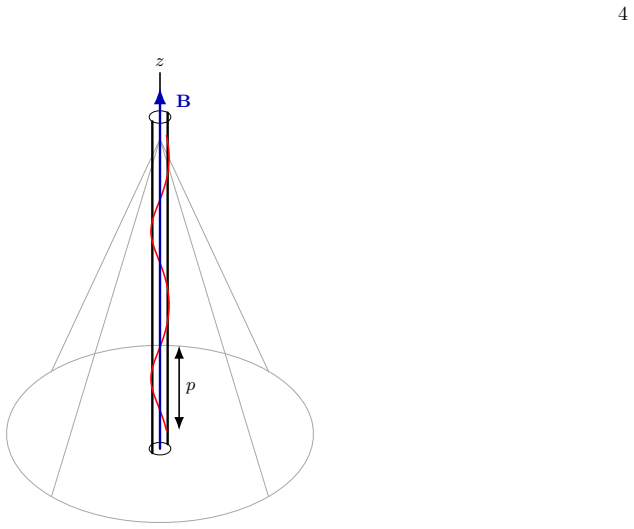
By constructing the normalized mode functions of the Klein-Gordon equation in the cosmic dispiration metric and building the Wightman function, the vacuum current density acquires a nonvanishing axial component directly induced by the helical structure, together with the expected azimuthal persistent current; both components are periodic in the magnetic flux parameter and depend only on its fractional part.
What carries the argument
The normalized mode functions of the Klein-Gordon equation that allow construction of the Wightman function and extraction of the current vacuum expectation value in the helical metric.
If this is right
- The induced currents are periodic functions of the magnetic flux depending only on its fractional part.
- The screw dislocation parameter regularizes the axial current at the origin and controls its magnitude.
- Closed expressions exist for both massive and massless fields in arbitrary dimensions.
- Results reduce exactly to known cosmic-string expressions when the screw dislocation is absent.
- Asymptotic behavior of both current components can be analyzed explicitly, including nontrivial features in 3+1 dimensions.
Where Pith is reading between the lines
- The helical twisting provides a geometric mechanism that can generate a preferred direction for vacuum currents without external fields beyond the flux.
- Analog condensed-matter systems with combined dislocation and flux threading might exhibit measurable axial current signatures.
- The same mode-construction technique could be applied to other helical or twisted topological defects to test for similar axial effects.
Load-bearing premise
The Klein-Gordon equation in the given cosmic dispiration metric admits a complete set of normalized modes that permit unambiguous construction of the Wightman function.
What would settle it
Direct evaluation of the axial current component in the limit where the screw dislocation parameter is set to zero, which must vanish if the claim holds.
Figures


read the original abstract
We investigate the vacuum-induced current density for a charged scalar field in a $(D+1)$-dimensional cosmic dispiration spacetime threaded by a magnetic flux. This background combines a cosmic string and a screw dislocation, yielding a nontrivial helical geometry. By constructing the normalized mode functions of the Klein--Gordon equation, we evaluate the Wightman function and obtain the vacuum expectation value of the current density. We show that, in addition to the azimuthal component describing a persistent current around the defect, a nonvanishing axial component is induced as a direct consequence of the helical structure of the spacetime. Both components are periodic functions of the magnetic flux, depending only on its fractional part, reflecting the Aharonov--Bohm nature of the effect. Closed expressions are obtained for both massive and massless fields in arbitrary dimensions. We demonstrate that the screw dislocation parameter plays a crucial role in the behavior of the induced currents, leading to the regularization of the axial component at the origin and controlling its magnitude. The asymptotic behavior of both components is analyzed in detail. Our results reduce to known expressions in the absence of the screw dislocation, providing a consistency check. In particular, we examine the physically relevant $(3+1)$-dimensional case, where numerical analysis reveals nontrivial features arising from the interplay between topology and gauge effects.
Editorial analysis
A structured set of objections, weighed in public.
Referee Report
Summary. The paper constructs normalized mode functions for a charged scalar field obeying the Klein-Gordon equation in a (D+1)-dimensional cosmic dispiration metric (cosmic string plus screw dislocation) threaded by a magnetic flux. From these it builds the Wightman function and extracts closed-form expressions for the vacuum expectation value of the current density vector. The central results are an azimuthal persistent current (Aharonov-Bohm periodic in the fractional flux) together with a non-vanishing axial current component generated by the helical off-diagonal metric term; both components are regularized by the dislocation parameter, reduce to the pure cosmic-string case when that parameter vanishes, and are analyzed asymptotically and numerically in the physically relevant (3+1)-dimensional setting for massive and massless fields.
Significance. If the mode construction and normalization are valid, the work supplies a concrete, higher-dimensional example of how a helical topological defect induces a qualitatively new vacuum current component. The provision of closed expressions valid for arbitrary D, the explicit demonstration that the screw-dislocation parameter both regularizes the axial current at the origin and controls its magnitude, and the reduction to known cosmic-string results constitute genuine technical strengths. The numerical study in 3+1 dimensions further illustrates the interplay between topology and gauge flux. These features make the manuscript a useful reference for studies of vacuum polarization on defects in curved spacetime.
minor comments (2)
- The abstract states that 'numerical analysis reveals nontrivial features' in the (3+1)D case; a single sentence summarizing the most salient numerical observation (e.g., the dependence on the dislocation parameter or the location of extrema) would improve readability without lengthening the abstract appreciably.
- In the discussion of the asymptotic regimes, the transition between the near-core and far-field behaviors of the axial current could be illustrated by a single additional plot or a compact table of scaling exponents for representative values of the dislocation parameter.
Simulated Author's Rebuttal
We thank the referee for the positive and constructive report, which recognizes the technical contributions of our work on vacuum currents in a higher-dimensional cosmic dispiration background. We appreciate the acknowledgment of the closed-form expressions, the role of the screw-dislocation parameter, and the consistency with known cosmic-string results. The recommendation for minor revision is noted; we will address any editorial or presentational suggestions in the revised manuscript.
Circularity Check
No significant circularity: derivation proceeds from KG modes to Wightman to current VEV without self-referential reduction
full rationale
The paper constructs normalized Klein-Gordon modes on the given dispiration metric (with external magnetic flux), builds the Wightman function, and extracts the current VEV via standard curved-space QFT. No step reduces the final expressions to fitted parameters, self-definitions, or load-bearing self-citations. The reduction to the pure cosmic-string case is presented only as a consistency check after the general result is obtained. The axial current arises from the helical metric term coupling phi and z, which is an input of the background, not smuggled in via ansatz or prior self-work. This is the most common honest non-finding for a standard QFT calculation on a fixed background.
Axiom & Free-Parameter Ledger
axioms (2)
- domain assumption The background is exactly the cosmic-dispiration metric combining a cosmic string and screw dislocation
- standard math Canonical quantization via mode expansion and Wightman function yields the vacuum current VEV
Reference graph
Works this paper leans on
-
[1]
By setting D= 3 in Eq
CaseD= 3 We now turn to the analysis of the induced current in the (3 + 1)-dimensional spacetime. By setting D= 3 in Eq. (35), we obtain the corresponding expression for the azimuthal current associated with a massive scalar field. This particular case allows for a more direct inspection of the induced current in a physically relevant system. In this case...
-
[2]
(44), we obtain the corresponding expression in four-dimensional spacetime
CaseD= 3 For the massive axial current, by specifyingD= 3 in Eq. (44), we obtain the corresponding expression in four-dimensional spacetime. Analogously to the azimuthal current, this case is also of particular physical interest, as it allows for a more direct comparison with realistic models and facilitates the analysis of the 12 0.4 0.2 0.0 0.2 0.4 0 1....
2023
-
[3]
Bordag, G
M. Bordag, G. L. Klimchitskaya, U. Mohideen and V. M. Mostepanenko,Advances in the Casimir effect, vol. 145. OUP Oxford, 2009
2009
-
[4]
Mostepanenko, N
V. Mostepanenko, N. Trunov and R. Znajek,The Casimir Effect and Its Applications. Oxford science publica- tions. Clarendon Press, 1997
1997
-
[5]
E. Elizalde, S. D. Odintsov, A. Romeo, A. A. Bytsenko and S. Zerbini,Zeta regularization techniques with applications. World Scientific Publishing, Singapore, 1994, 10.1142/2065
-
[6]
K. A. Milton,The Casimir effect: physical manifestations of zero-point energy. World Scientific, 2001
2001
-
[7]
Vilenkin and E
A. Vilenkin and E. P. S. Shellard,Cosmic Strings and Other Topological Defects. Cambridge University Press, Cambridge, 1994
1994
- [8]
- [9]
- [10]
- [11]
- [12]
- [13]
- [14]
- [15]
- [16]
- [17]
- [18]
-
[19]
M. Souto Maior de Sousa, R. F. Ribeiro and E. R. Bezerra de Mello,Azimuthal fermionic current in the cosmic string spacetime induced by a magnetic tube,Particles1(2018) 82–96, [1801.01344]
-
[20]
A. Mohammadi, E. R. Bezerra de Mello and A. A. Saharian,Finite temperature fermionic charge and current densities induced by a cosmic string with magnetic flux,J. Phys. A48(2015) 185401, [1412.3273]
-
[21]
J. Spinally, E. R. Bezerra de Mello and V. B. Bezerra,Relativistic quantum scattering on a cone,Class. Quant. Grav.18(2001) 1555–1566, [gr-qc/0012103]
-
[22]
Aharonov and D
Y. Aharonov and D. Bohm,Significance of electromagnetic potentials in the quantum theory,Phys. Rev.115 (1959) 485–491
1959
-
[23]
C. Filgueiras and F. Moraes,The Bound state Aharonov-Bohm effect around a cosmic string revisited,Phys. Lett. A361(2007) 13–15, [gr-qc/0509100]
- [24]
-
[25]
N. D. Birrell and P. C. W. Davies,Quantum Fields in Curved Space. Cambridge Monographs on Mathematical Physics. Cambridge University Press, 1982, 10.1017/CBO9780511622632
-
[26]
Abramowitz and I
M. Abramowitz and I. A. Stegun,Handbook of Mathematical Functions with Formulas, Graphs, and Mathematical Tables, vol. 55 ofNational Bureau of Standards Applied Mathematics Series. Dover Publications, New York, 1965
1965
discussion (0)
Sign in with ORCID, Apple, or X to comment. Anyone can read and Pith papers without signing in.