Recognition: no theorem link
Hard to shock DBI: wave propagation on planar domain walls
Pith reviewed 2026-05-10 18:05 UTC · model grok-4.3
The pith
The DBI model for planar domain walls prevents caustic formation from smooth waves in the hyperbolic regime.
A machine-rendered reading of the paper's core claim, the machinery that carries it, and where it could break.
Core claim
Generic waves propagating on planar domain walls in the DBI scalar model do not develop singularities from smooth initial conditions in the hyperbolic case. Although characteristic curves are parallel only in the simplest 2D flat setup and become non-parallel in D greater than 2, expanding cosmologies, and deformed DBI, they never cross. This implies that caustics appear solely when hyperbolicity is lost, producing a cusp profile, and that the detailed structure of characteristics influences cusp formation.
What carries the argument
The characteristic curves of the quasilinear PDE for DBI wave dynamics, which do not intersect in the hyperbolic regime.
Load-bearing premise
The analysis assumes the DBI effective theory remains a valid description and the system stays within the regime where the equations are hyperbolic.
What would settle it
A numerical simulation starting from smooth initial data for the DBI wave equation in one of the extended setups that produces a crossing of characteristics or a shock while the equation is still hyperbolic would contradict the result.
Figures


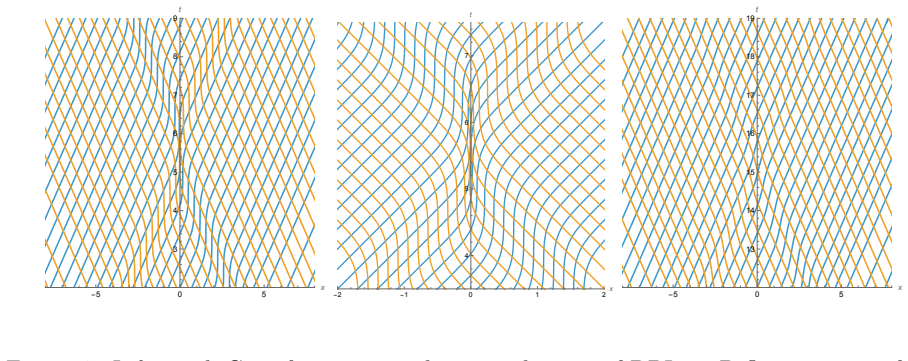
read the original abstract
We investigate propagation of generic waves on thin planar domain walls effectively described by the scalar DBI model. We pay a particular attention to the possibility of caustic (shock) formation - the process, which may lead to intensive particle emission by domain walls. It is demonstrated that no singularities arise in DBI in 2D flat spacetime in the hyperbolic case, if one starts from smooth initial conditions. Technically, this happens because the same family characteristics of the relevant PDE remain parallel at all the times, albeit not being straight lines generically. Crucially, characteristic curves cease to be parallel beyond the simplified setup of DBI in 2D flat spacetime. In particular, this is shown to be the case in $D>2$ for spherical waves, in an expanding Universe, and in the case of a minimal deformation of DBI necessary for avoiding the domain wall problem in cosmology. However, we prove that DBI remains shock free in the hyperbolic case in all these physically relevant situations. This strongly suggests that caustics can form on planar domain walls only due to the loss of hyperbolicity, and they have a cusp profile. We demonstrate, how the non-trivial structure of DBI characteristics beyond the 2D flat spacetime setup uncovered in this work can significantly affect cusp formation.
Editorial analysis
A structured set of objections, weighed in public.
Referee Report
Summary. The paper analyzes wave propagation on planar domain walls in the scalar DBI model, with emphasis on caustic formation. In 2D flat spacetime the relevant characteristic family remains parallel for smooth initial data in the hyperbolic regime, precluding shocks. The analysis is extended to D>2 spherical waves, expanding cosmological backgrounds, and a minimal DBI deformation; in each case the characteristics are shown to be non-parallel yet non-intersecting while hyperbolicity is preserved. The authors conclude that caustics on such walls arise only upon loss of hyperbolicity and exhibit cusp profiles, and that the non-trivial characteristic structure beyond 2D flat space affects cusp formation.
Significance. If the central claim holds, the work supplies a concrete, characteristic-based criterion linking shock formation in DBI domain walls specifically to the breakdown of hyperbolicity rather than to generic nonlinearity. The explicit treatment of characteristic families in spherical, cosmological, and deformed settings is a technical strength that clarifies the robustness of the DBI effective description inside its hyperbolic domain and has direct relevance to cosmological domain-wall dynamics and possible particle emission.
minor comments (2)
- The abstract states that characteristics 'cease to be parallel' beyond 2D flat space but 'DBI remains shock free'; a brief parenthetical reference to the relevant section or equation defining the characteristic ODEs would help readers locate the explicit verification for the D>2 and cosmological cases.
- In the discussion of the minimal deformation, the precise form of the added term and its effect on the principal symbol of the PDE could be stated explicitly (e.g., by quoting the modified Lagrangian or the resulting characteristic speed) to make the non-intersection argument fully self-contained.
Simulated Author's Rebuttal
We thank the referee for their positive and insightful report, which accurately captures the main results of our work on wave propagation and caustic formation in DBI domain walls. We are pleased that the referee recognizes the technical analysis of characteristic families across different setups and the implications for the robustness of the DBI effective description.
Circularity Check
No significant circularity; derivation self-contained
full rationale
The paper's central result follows from direct derivation of the characteristic equations for the DBI scalar PDE in the hyperbolic regime, followed by explicit analysis showing non-intersection of characteristics (parallel in 2D flat space; non-parallel but non-crossing in D>2, expanding, and deformed cases). No step reduces a prediction to a fitted input, self-citation, or definitional tautology; the proofs are internal to the PDE structure obtained from the Lagrangian and hold under the stated assumptions without external load-bearing references or renamings.
Axiom & Free-Parameter Ledger
axioms (2)
- domain assumption The DBI action produces a hyperbolic system of PDEs in the regime under study.
- domain assumption Initial data are smooth.
Reference graph
Works this paper leans on
-
[1]
Yu. A. Kravtsov, Yu. I. Orlov,Caustics, Catastrophes and Wave Fields, Springer-Verlag Berlin Heidelberg 1993
1993
-
[2]
Y. B. Zeldovich,Gravitational instability: An Approximate theory for large density perturbations, Astron. Astrophys.5(1970), 84-89
1970
-
[3]
I., Shandarin S
Arnold V. I., Shandarin S. F., Zeldovich Ia. B.,The large scale structure of the universe I. General properties. One-and two-dimensional models, 1982, Geophys. and Astrophys. Fluid Dynamics, 20, no. 1-2, 111
1982
-
[4]
Born and L
M. Born and L. Infeld,Foundations of the new field theory, Proc. Roy. Soc. Lond. A 144(1934) no.852, 425-451. 26
1934
-
[5]
P. A. M. Dirac,An Extensible model of the electron, Proc. Roy. Soc. Lond. A268(1962), 57-67
1962
-
[6]
Barbashov and N
B. Barbashov and N. Chernikov,Solution and Quantization of a Nonlinear Two- dimensional Model for a Born-Infeld Type Field, Sov. Phys. JETP23(1966) no.5, 861-868
1966
-
[7]
B. M. Barbashov and N. A. Chernikov,Solution of the Two Plane Wave Scattering Problem in a Nonlinear Scalar Field Theory of the Born-Infeld Type, Sov. Phys. JETP 24(1967) no.2, 437-442
1967
- [8]
-
[9]
Y. B. Zeldovich, I. Y. Kobzarev and L. B. Okun,Cosmological Consequences of the Spontaneous Breakdown of Discrete Symmetry, Zh. Eksp. Teor. Fiz.67(1974), 3-11 SLAC-TRANS-0165
1974
-
[10]
Vilenkin and E
A. Vilenkin and E. P. S. Shellard,Cosmic Strings and Other Topological Defects, Cam- bridge University Press, 2000
2000
-
[11]
Vachaspati,Kinks and Domain Walls : An Introduction to Classical and Quantum Solitons, Oxford University Press, 2007
T. Vachaspati,Kinks and Domain Walls : An Introduction to Classical and Quantum Solitons, Oxford University Press, 2007
2007
- [12]
-
[13]
M. Alishahiha, E. Silverstein and D. Tong,DBI in the sky, Phys. Rev. D70(2004), 123505; [arXiv:hep-th/0404084 [hep-th]]
-
[14]
W. H. Press, B. S. Ryden and D. N. Spergel,Dynamical Evolution of Domain Walls in an Expanding Universe, Astrophys. J.347(1989), 590-604
1989
-
[15]
On the estimation of gravitational wave spectrum from cosmic domain walls
T. Hiramatsu, M. Kawasaki and K. Saikawa,On the estimation of gravitational wave spectrum from cosmic domain walls, JCAP02(2014), 031; [arXiv:1309.5001 [astro- ph.CO]]
work page Pith review arXiv 2014
-
[16]
I. Dankovsky, S. Ramazanov, E. Babichev, D. Gorbunov and A. Vikman,Cosmic do- main walls on a lattice: Illusive effects of initial conditions, Phys. Rev. D112(2025) no.12, 123521; [arXiv:2509.25367 [hep-ph]]
- [17]
-
[18]
I. Dankovsky, E. Babichev, D. Gorbunov, S. Ramazanov and A. Vikman,Revisiting evolution of domain walls and their gravitational radiation with CosmoLattice, JCAP 09(2024), 047; [arXiv:2406.17053 [astro-ph.CO]]
-
[19]
T. W. B. Kibble,Topology of Cosmic Domains and Strings, J. Phys. A9(1976), 1387- 1398
1976
-
[20]
Vachaspati and A
T. Vachaspati and A. Vilenkin,Gravitational Radiation from Cosmic Strings, Phys. Rev. D31(1985), 3052
1985
-
[21]
Vilenkin and T
A. Vilenkin and T. Vachaspati,Radiation of Goldstone Bosons From Cosmic Strings, Phys. Rev. D35(1987), 1138
1987
- [22]
-
[23]
J. Baeza-Ballesteros, E. J. Copeland, D. G. Figueroa and J. Lizarraga,Particle and gravitational wave emission by local string loops: Lattice calculation, Phys. Rev. D112 (2025) no.4, 4; [arXiv:2408.02364 [astro-ph.CO]]
- [24]
-
[25]
Eggers and J
J. Eggers and J. Hoppe,Singularity formation for time-like extremal hypersurfaces, Phys. Lett. B680(2009), 274-278
2009
-
[26]
M. J. Eggers, J. Hoppe, N. Suramlishvili,Singularities of relativistic membranes, Geo- metric Flows12015 17-33
- [27]
-
[28]
E. Babichev,Formation of caustics in k-essence and Horndeski theory, JHEP04(2016), 129; [arXiv:1602.00735 [hep-th]]
-
[29]
S. Mukohyama, R. Namba and Y. Watanabe,Is the DBI scalar field as fragile as other k-essence fields?, Phys. Rev. D94(2016) no.2, 023514; [arXiv:1605.06418 [hep-th]]
- [30]
-
[31]
Boillat,Nonlinear electrodynamics - Lagrangians and equations of motion, J
G. Boillat,Nonlinear electrodynamics - Lagrangians and equations of motion, J. Math. Phys.11(1970) no.3, 941-951
1970
-
[32]
D. I. Blokhintsev and V. V. Orlov, Zh. Eksp. Teor. Fiz.25(1953) no.5, 513-526
1953
-
[33]
N. Tanahashi and S. Ohashi,Wave propagation and shock formation in the most general scalar–tensor theories, Class. Quant. Grav.34(2017) no.21, 215003; [arXiv:1704.02757 [hep-th]]
-
[34]
Gregory, D
R. Gregory, D. Haws and D. Garfinkle,The Dynamics of Domain Walls and Strings, Phys. Rev. D42(1990), 343-348
1990
-
[35]
F. Bonjour, C. Charmousis and R. Gregory,The Dynamics of curved gravitating walls, Phys. Rev. D62(2000), 083504; [arXiv:gr-qc/0002063 [gr-qc]]
- [36]
-
[37]
Courant and K
R. Courant and K. O. Friedrichs,Supersonic Flow and Shock Waves, Interscience Pub- lishers Inc., New York, 1948
1948
-
[38]
Courant and D
R. Courant and D. Hilbert,Methods of Mathematical Physics: Volume II: Partial Dif- ferential Equations, Interscience Publishers (Wiley), New York, 1962
1962
-
[39]
V. S. Vladimirov,Equations of mathematical physics, MIR, 1984
1984
-
[40]
J. Garriga and V. F. Mukhanov, Phys. Lett. B458(1999), 219-225; [arXiv:hep- th/9904176 [hep-th]]
-
[41]
Majda,Compressible Fluid Flow and Systems of Conservation Laws in Several Space Variables; Springer New York, NY
A. Majda,Compressible Fluid Flow and Systems of Conservation Laws in Several Space Variables; Springer New York, NY
-
[42]
N. Afshordi, D. J. H. Chung and G. Geshnizjani, Phys. Rev. D75(2007), 083513; [arXiv:hep-th/0609150 [hep-th]]
-
[43]
Pasmatsiou,Caustic Formation upon Shift Symmetry Breaking, Phys
K. Pasmatsiou,Caustic Formation upon Shift Symmetry Breaking, Phys. Rev. D97 (2018) no.3, 036008; [arXiv:1712.02888 [hep-th]]
-
[44]
P. D. Lax,Development of singularities of solutions of nonlinear hyperbolic partial dif- ferential equations, Journal of Mathematical Physics5(5) (1964), 611–613
1964
-
[45]
P. D. Lax,Hyperbolic systems of conservation laws and the mathematical theory of shock waves, SIAM, 1973. 29
1973
-
[46]
P. D. Lax,XII. The Initial Value Problem for Nonlinear Hyperbolic Equations in Two Independent Variables, in Contributions to the Theory of Partial Differential Equations (AM-33), Princeton University Press, 1955, pp. 211–230
1955
-
[47]
Babichev,Emergence of ghosts in Horndeski theory,JHEP07(2020), 038; [arXiv:2001.11784 [hep-th]]
E. Babichev,Emergence of ghosts in Horndeski theory,JHEP07(2020), 038; [arXiv:2001.11784 [hep-th]]
-
[48]
C. de Rham and H. Motohashi,Caustics for Spherical Waves, Phys. Rev. D95(2017) no.6, 064008; [arXiv:1611.05038 [hep-th]]
-
[49]
E. Babichev and S. Ramazanov,Caustic free completion of pressureless perfect fluid and k-essence, JHEP08(2017), 040; [arXiv:1704.03367 [hep-th]]
- [50]
-
[51]
L. M. Widrow,Dynamics of Thick Domain Walls, Phys. Rev. D40(1989), 1002
1989
-
[52]
S. Ramazanov, E. Babichev, D. Gorbunov and A. Vikman,Beyond freeze-in: Dark matter via inverse phase transition and gravitational wave signal,Phys. Rev. D105 (2022) no.6, 063530; [arXiv:2104.13722 [hep-ph]]
-
[53]
E. Babichev, D. Gorbunov, S. Ramazanov and A. Vikman,Gravitational shine of dark domain walls, JCAP04(2022) no.04, 028; [arXiv:2112.12608 [hep-ph]]
-
[54]
I. Dankovsky, S. Ramazanov, E. Babichev, D. Gorbunov and A. Vikman,Numerical analysis of melting domain walls and their gravitational waves, JCAP02(2025), 064; [arXiv:2410.21971 [hep-ph]]
-
[55]
E. Babichev, S. Ramazanov and A. Vikman,RecoveringP(X)from a canonical complex field,JCAP11(2018), 023; [arXiv:1807.10281 [gr-qc]]
-
[56]
Israel,Singular hypersurfaces and thin shells in general relativity, Nuovo Cim
W. Israel,Singular hypersurfaces and thin shells in general relativity, Nuovo Cim. B 44S10(1966), 1 [Erratum: Nuovo Cim.B 48, 463 (1967)]
1966
-
[57]
V. A. Berezin, V. A. Kuzmin and I. I. Tkachev,Dynamics of Bubbles in General Rela- tivity, Phys. Rev. D36(1987), 2919
1987
-
[58]
Primordial black hole formation by vacuum bubbles
H. Deng and A. Vilenkin,Primordial black hole formation by vacuum bubbles, JCAP 12(2017), 044; [arXiv:1710.02865 [gr-qc]]
work page Pith review arXiv 2017
-
[59]
Deng, JCAP09, 023 (2020), arXiv:2006.11907 [astro-ph.CO]
H. Deng,Primordial black hole formation by vacuum bubbles. Part II, JCAP09(2020), 023; [arXiv:2006.11907 [astro-ph.CO]]. 30
-
[60]
Poisson,A Relativist’s Toolkit: The Mathematics of Black-Hole Mechanics, Cam- bridge University Press, 2009
E. Poisson,A Relativist’s Toolkit: The Mathematics of Black-Hole Mechanics, Cam- bridge University Press, 2009
2009
-
[61]
Garriga and A
J. Garriga and A. Vilenkin,Perturbations on domain walls and strings: A Covariant theory, Phys. Rev. D44(1991), 1007-1014. 31
1991
discussion (0)
Sign in with ORCID, Apple, or X to comment. Anyone can read and Pith papers without signing in.