Recognition: 3 theorem links
· Lean TheoremSPASM: Stable Persona-driven Agent Simulation for Multi-turn Dialogue Generation
Pith reviewed 2026-05-10 17:48 UTC · model grok-4.3
The pith
Projecting a shared neutral dialogue history into each agent's own viewpoint keeps personas consistent and stops echoing across long LLM conversations.
A machine-rendered reading of the paper's core claim, the machinery that carries it, and where it could break.
Core claim
By storing dialogue history in a perspective-agnostic form and then deterministically projecting that history into each agent's egocentric view before every generation step, the method substantially reduces persona drift and, according to human validation, eliminates echoing while still producing coherent multi-turn exchanges.
What carries the argument
Egocentric Context Projection (ECP): a deterministic process that maintains one shared, perspective-neutral dialogue history and projects it into each agent's individual viewpoint at generation time.
If this is right
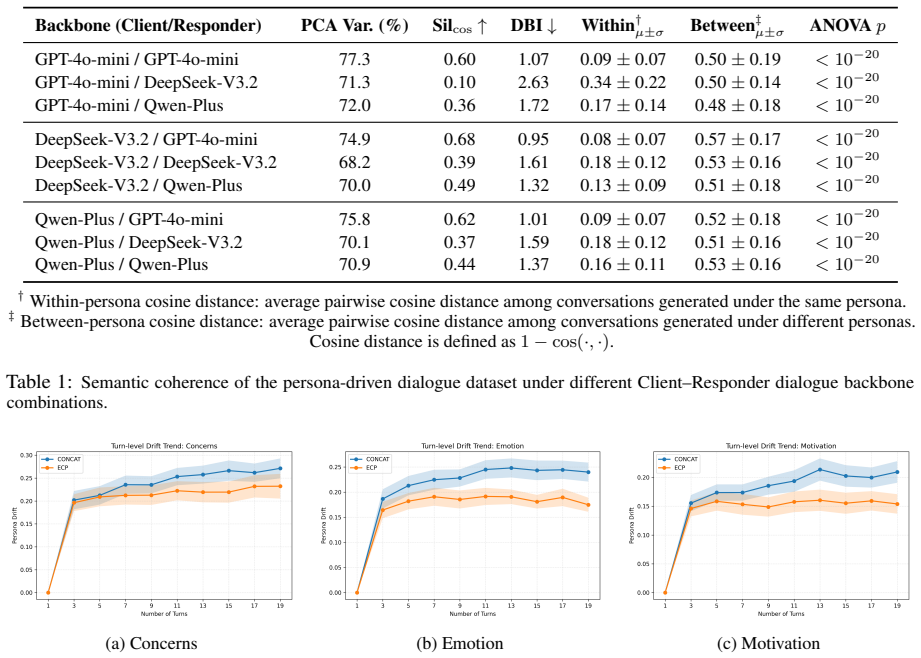
- The method produces 4,500 personas and 45,000 conversations with lower drift across three LLM backbones and nine client-responder pairings.
- Ablations confirm that removing ECP increases both drift and echoing, while keeping it removes echoing under human review.
- Embedding analyses recover the intended persona structure and show clear responder-driven interaction patterns.
- The modular design separates persona creation, generation, and termination so each part can be inspected or swapped independently.
Where Pith is reading between the lines
- The neutral-history approach could extend to non-dialogue multi-agent tasks where agents must maintain distinct goals over long sequences.
- If the projection step scales, it might reduce the need for post-hoc correction or fine-tuning when building synthetic training corpora for role-based models.
- Strong interaction geometry recovered in embeddings suggests the method captures emergent dynamics that could be studied for better agent design.
Load-bearing premise
Storing dialogue history in a perspective-agnostic representation and deterministically projecting it into each agent's egocentric view preserves all necessary context for coherent, non-repetitive generation without introducing new inconsistencies.
What would settle it
Human judges or embedding metrics detecting repeated persona drift or echoing in ECP-generated dialogues that last twenty or more turns would falsify the stability improvement.
Figures



read the original abstract
Large language models are increasingly deployed in multi-turn settings such as tutoring, support, and counseling, where reliability depends on preserving consistent roles, personas, and goals across long horizons. This requirement becomes critical when LLMs are used to generate synthetic dialogues for training and evaluation, since LLM--LLM conversations can accumulate identity-related failures such as persona drift, role confusion, and "echoing", where one agent gradually mirrors its partner. We introduce SPASM (Stable Persona-driven Agent Simulation for Multi-turn dialogue generation), a modular, stability-first framework that decomposes simulation into (i) persona creation via schema sampling, plausibility validation, and natural-language persona crafting, (ii) Client--Responder dialogue generation, and (iii) termination detection for coherent stopping. To improve long-horizon stability without changing model weights, we propose Egocentric Context Projection (ECP): dialogue history is stored in a perspective-agnostic representation and deterministically projected into each agent's egocentric view before generation. Across three LLM backbones (GPT-4o-mini, DeepSeek-V3.2, Qwen-Plus) and nine Client--Responder pairings, we construct a dataset of 4,500 personas and 45,000 conversations (500 personas X 10 conversations per pairing). Ablations show ECP substantially reduces persona drift and, under human validation, eliminates echoing; embedding analyses recover persona structure and reveal strong responder-driven interaction geometry. Our code is available at https://github.com/lhannnn/SPASM.
Editorial analysis
A structured set of objections, weighed in public.
Referee Report
Summary. The manuscript presents SPASM, a framework for stable persona-driven multi-turn dialogue generation using LLMs. It consists of persona creation through schema sampling and validation, dialogue generation between Client and Responder agents enhanced by Egocentric Context Projection (ECP) that uses a perspective-agnostic history representation projected egocentrically, and a termination detection module. The authors generate a large-scale dataset comprising 4,500 personas and 45,000 conversations across three LLM backbones and nine pairings, with ablations and human evaluations demonstrating that ECP reduces persona drift and eliminates echoing, supported by embedding analyses of interaction geometry.
Significance. If the central claims hold, this work offers a valuable, training-free approach to mitigating common failure modes in LLM-simulated dialogues, which is highly relevant for generating reliable synthetic data in NLP and AI applications. The scale of the experiments, including ablations over multiple models and human validation, provides robust evidence for the effectiveness of ECP. The public release of the code further adds to the significance by enabling reproducibility and extension by the community. The stress-test concern about potential context loss in the agnostic representation does not land, as the ablations and human validation on long trajectories empirically support the no-echoing and drift-reduction results.
minor comments (3)
- Abstract: The parenthetical explanation for the dataset size ('500 personas X 10 conversations per pairing') does not account for the nine pairings; please clarify the exact calculation yielding 45,000 conversations from 4,500 personas.
- Evaluation section: Additional details on the human validation protocol, including exact annotation criteria for 'echoing elimination' and inter-annotator agreement statistics, would strengthen the evidence presentation.
- Methods: A pseudocode or explicit example of the perspective-agnostic storage format and deterministic projection step would improve clarity and allow readers to verify context preservation.
Simulated Author's Rebuttal
We thank the referee for their thorough and positive review of our manuscript. We are pleased that the referee recognizes the significance of SPASM as a training-free approach to mitigating persona drift and echoing in LLM-simulated multi-turn dialogues, as well as the robustness of our experiments across three backbones, nine pairings, and human validation. The recommendation for minor revision is appreciated, and we note that no specific major comments requiring changes were raised in the report.
Circularity Check
No circularity: framework and evaluations are independent of self-referential definitions or fitted inputs.
full rationale
The paper describes a modular simulation framework (persona creation, ECP projection, termination) evaluated via constructed datasets (4,500 personas, 45k conversations), ablations, embedding analyses, and external human validation. No equations, fitted parameters renamed as predictions, or load-bearing self-citations appear in the provided text. The central stability claims rest on empirical measurements against independently constructed test cases rather than reducing to input definitions by construction.
Axiom & Free-Parameter Ledger
axioms (1)
- domain assumption LLMs can generate plausible and consistent personas and dialogues when provided with structured prompts and validation steps.
Lean theorems connected to this paper
-
IndisputableMonolith/Cost/FunctionalEquation.lean (Jcost uniqueness)washburn_uniqueness_aczel unclear?
unclearRelation between the paper passage and the cited Recognition theorem.
Egocentric Context Projection (ECP): dialogue history is stored in a perspective-agnostic representation and deterministically projected into each agent's egocentric view before generation.
-
IndisputableMonolith/Foundation/AbsoluteFloorClosure.leanabsolute_floor_iff_bare_distinguishability unclear?
unclearRelation between the paper passage and the cited Recognition theorem.
Perspective-Agnostic History. Let the global interaction history at turn t be an ordered sequence H_t = (u_k)_{k=1}^t, u_k = (s_k, c_k)
-
IndisputableMonolith/Foundation/ArithmeticFromLogic.leanembed_injective unclear?
unclearRelation between the paper passage and the cited Recognition theorem.
Ablations show ECP substantially reduces persona drift and, under human validation, eliminates echoing
What do these tags mean?
- matches
- The paper's claim is directly supported by a theorem in the formal canon.
- supports
- The theorem supports part of the paper's argument, but the paper may add assumptions or extra steps.
- extends
- The paper goes beyond the formal theorem; the theorem is a base layer rather than the whole result.
- uses
- The paper appears to rely on the theorem as machinery.
- contradicts
- The paper's claim conflicts with a theorem or certificate in the canon.
- unclear
- Pith found a possible connection, but the passage is too broad, indirect, or ambiguous to say the theorem truly supports the claim.
Reference graph
Works this paper leans on
-
[1]
Amanda Askell, Yuntao Bai, Anna Chen, Dawn Drain, Deep Ganguli, Tom Henighan, Andy Jones, Nicholas Joseph, Ben Mann, Nova DasSarma, and 1 others. 2021. A general language assistant as a laboratory for alignment. arXiv preprint arXiv:2112.00861
work page internal anchor Pith review arXiv 2021
-
[2]
Yuntao Bai, Andy Jones, Kamal Ndousse, Amanda Askell, Anna Chen, Nova DasSarma, Dawn Drain, Stanislav Fort, Deep Ganguli, Tom Henighan, Nicholas Joseph, Saurav Kadavath, Jackson Kernion, Tom Conerly, Sheer El-Showk, Nelson Elhage, Zac Hatfield-Dodds, Danny Hernandez, Tristan Hume, and 12 others. 2022 a . https://arxiv.org/pdf/2204.05862 Training a helpful...
work page internal anchor Pith review Pith/arXiv arXiv 2022
-
[3]
Yuntao Bai, Saurav Kadavath, Sandipan Kundu, Amanda Askell, Jackson Kernion, Andy Jones, Anna Chen, Anna Goldie, Azalia Mirhoseini, Cameron McKinnon, Carol Chen, Catherine Olsson, Christopher Olah, Danny Hernandez, Dawn Drain, Deep Ganguli, Dustin Li, Eli Tran-Johnson, Ethan Perez, and 32 others. 2022 b . https://arxiv.org/pdf/2212.08073 Constitutional ai...
work page internal anchor Pith review Pith/arXiv arXiv 2022
-
[4]
Emily M Bender, Timnit Gebru, Angelina McMillan-Major, and Shmargaret Shmitchell. 2021. On the dangers of stochastic parrots: Can language models be too big? In Proceedings of the 2021 ACM conference on fairness, accountability, and transparency, pages 610--623
2021
-
[5]
Tom Brown, Benjamin Mann, Nick Ryder, Melanie Subbiah, Jared D Kaplan, Prafulla Dhariwal, Arvind Neelakantan, Pranav Shyam, Girish Sastry, Amanda Askell, and 1 others. 2020. Language models are few-shot learners. Advances in neural information processing systems, 33:1877--1901
2020
-
[6]
Nicholas Carlini, Florian Tramer, Eric Wallace, Matthew Jagielski, Ariel Herbert-Voss, Katherine Lee, Adam Roberts, Tom Brown, Dawn Song, Ulfar Erlingsson, and 1 others. 2021. Extracting training data from large language models. In 30th USENIX security symposium (USENIX Security 21), pages 2633--2650
2021
-
[7]
Runjin Chen, Andy Arditi, Henry Sleight, Owain Evans, and Jack Lindsey. 2025. Persona vectors: Monitoring and controlling character traits in language models. arXiv preprint arXiv:2507.21509
work page internal anchor Pith review arXiv 2025
-
[8]
Yulin Chen, Ning Ding, Hai-Tao Zheng, Zhiyuan Liu, Maosong Sun, and Bowen Zhou. 2024. Empowering private tutoring by chaining large language models. In Proceedings of the 33rd ACM International Conference on Information and Knowledge Management, pages 354--364
2024
-
[9]
Ning Ding, Yulin Chen, Bokai Xu, Yujia Qin, Shengding Hu, Zhiyuan Liu, Maosong Sun, and Bowen Zhou. 2023. Enhancing chat language models by scaling high-quality instructional conversations. In Proceedings of the 2023 Conference on Empirical Methods in Natural Language Processing, pages 3029--3051
2023
- [10]
-
[11]
Hyerim Han, Bogyeom Park, and Kyoungwon Seo. 2025. A self-determination theory-based career counseling chatbot: Motivational interactions to address career decision-making difficulties and enhance engagement. In Proceedings of the Extended Abstracts of the CHI Conference on Human Factors in Computing Systems, pages 1--9
2025
-
[12]
Kai He, Rui Mao, Qika Lin, Yucheng Ruan, Xiang Lan, Mengling Feng, and Erik Cambria. 2025. A survey of large language models for healthcare: from data, technology, and applications to accountability and ethics. Information Fusion, 118:102963
2025
-
[13]
Peter Henderson, Koustuv Sinha, Nicolas Angelard-Gontier, Nan Rosemary Ke, Genevieve Fried, Ryan Lowe, and Joelle Pineau. 2018. Ethical challenges in data-driven dialogue systems. In Proceedings of the 2018 AAAI/ACM Conference on AI, Ethics, and Society, pages 123--129
2018
-
[14]
Mengze Hong, Chen Jason Zhang, Di Jiang, and Yuanqin He. 2025. Augmenting compliance-guaranteed customer service chatbots: Context-aware knowledge expansion with large language models. In Proceedings of the 2025 Conference on Empirical Methods in Natural Language Processing: Industry Track, pages 753--765
2025
-
[15]
Guy Laban. 2024. Studying and eliciting self-disclosure: Interdisciplinary review of research methodologies and behavioural paradigms. PsyArxiv
2024
-
[16]
Guy Laban and Emily S Cross. 2024. Sharing our emotions with robots: Why do we do it and how does it make us feel? IEEE Transactions on Affective Computing
2024
-
[17]
Guy Laban, Julie Wang, and Hatice Gunes. 2026. https://doi.org/10.1109/TAFFC.2026.3657604 A robot-led intervention for emotion regulation: from expression to reappraisal . IEEE Transactions on Affective Computing, pages 1--15
-
[18]
Guohao Li, Hasan Hammoud, Hani Itani, Dmitrii Khizbullin, and Bernard Ghanem. 2023. Camel: Communicative agents for" mind" exploration of large language model society. Advances in Neural Information Processing Systems, 36:51991--52008
2023
- [19]
-
[20]
Percy Liang, Rishi Bommasani, Tony Lee, Dimitris Tsipras, Dilara Soylu, Michihiro Yasunaga, Yian Zhang, Deepak Narayanan, Yuhuai Wu, Ananya Kumar, and 1 others. 2022. Holistic evaluation of language models. arXiv preprint arXiv:2211.09110
work page internal anchor Pith review Pith/arXiv arXiv 2022
-
[21]
Stephanie Lin, Jacob Hilton, and Owain Evans. 2022. Truthfulqa: Measuring how models mimic human falsehoods. In Proceedings of the 60th annual meeting of the association for computational linguistics (volume 1: long papers), pages 3214--3252
2022
- [22]
-
[23]
Long Ouyang, Jeff Wu, Xu Jiang, Diogo Almeida, Carroll L. Wainwright, Pamela Mishkin, Chong Zhang, Sandhini Agarwal, Katarina Slama, Alex Ray, John Schulman, Jacob Hilton, Fraser Kelton, Luke Miller, Maddie Simens, Amanda Askell, Peter Welinder, Paul Christiano, Jan Leike, and Ryan Lowe. 2022. https://arxiv.org/pdf/2203.02155 Training language models to f...
work page internal anchor Pith review Pith/arXiv arXiv 2022
-
[24]
Joon Sung Park, Joseph O'Brien, Carrie Jun Cai, Meredith Ringel Morris, Percy Liang, and Michael S Bernstein. 2023. Generative agents: Interactive simulacra of human behavior. In Proceedings of the 36th annual acm symposium on user interface software and technology, pages 1--22
2023
- [25]
-
[26]
Aarohi Srivastava, Abhinav Rastogi, Abhishek Rao, Abu Awal Md Shoeb, Abubakar Abid, Adam Fisch, Adam R Brown, Adam Santoro, Aditya Gupta, Adri \`a Garriga-Alonso, and 1 others. 2023. Beyond the imitation game: Quantifying and extrapolating the capabilities of language models. Transactions on machine learning research
2023
-
[27]
Rohan Taori, Ishaan Gulrajani, Tianyi Zhang, Yann Dubois, Xuechen Li, Carlos Guestrin, Percy Liang, and Tatsunori B Hashimoto. 2023. Alpaca: A strong, replicable instruction-following model. Stanford Center for Research on Foundation Models. https://crfm. stanford. edu/2023/03/13/alpaca. html, 3(6):7
2023
- [28]
-
[29]
Yizhong Wang, Yeganeh Kordi, Swaroop Mishra, Alisa Liu, Noah A Smith, Daniel Khashabi, and Hannaneh Hajishirzi. 2023. Self-instruct: Aligning language models with self-generated instructions. In Proceedings of the 61st annual meeting of the association for computational linguistics (volume 1: long papers), pages 13484--13508
2023
- [30]
- [31]
-
[32]
Aijia Yuan, Edlin Garcia Colato, Bernice Pescosolido, Hyunju Song, and Sagar Samtani. 2025. Improving workplace well-being in modern organizations: A review of large language model-based mental health chatbots. ACM Transactions on Management Information Systems, 16(1):1--26
2025
-
[33]
online" 'onlinestring :=
ENTRY address archivePrefix author booktitle chapter edition editor eid eprint eprinttype howpublished institution journal key month note number organization pages publisher school series title type volume year doi pubmed url lastchecked label extra.label sort.label short.list INTEGERS output.state before.all mid.sentence after.sentence after.block STRING...
-
[34]
write newline
" write newline "" before.all 'output.state := FUNCTION n.dashify 't := "" t empty not t #1 #1 substring "-" = t #1 #2 substring "--" = not "--" * t #2 global.max substring 't := t #1 #1 substring "-" = "-" * t #2 global.max substring 't := while if t #1 #1 substring * t #2 global.max substring 't := if while FUNCTION word.in bbl.in capitalize " " * FUNCT...
discussion (0)
Sign in with ORCID, Apple, or X to comment. Anyone can read and Pith papers without signing in.