Recognition: 2 theorem links
· Lean TheoremAssessing Privacy Preservation and Utility in Online Vision-Language Models
Pith reviewed 2026-05-10 19:44 UTC · model grok-4.3
The pith
Vision-language models can leak personal information from uploaded images via contextual clues, but privacy techniques can reduce this exposure while keeping images useful.
A machine-rendered reading of the paper's core claim, the machinery that carries it, and where it could break.
Core claim
The central discovery is that privacy-preserving image modifications can block both explicit and implicit PII disclosure in online VLMs, with evaluations confirming that the modified images maintain high utility for typical vision-language applications.
What carries the argument
The privacy protection methods that target and alter contextual relationships in images to prevent PII extraction while preserving essential visual content for model utility.
If this is right
- Users of OVLMs can apply these techniques to protect their privacy in image uploads.
- The balance between privacy and utility allows continued practical use of online VLM services.
- Both direct and indirect forms of PII can be addressed through image-level interventions.
- Evaluation shows the techniques work across the tested scenarios without major loss in performance.
Where Pith is reading between the lines
- Similar protection strategies could be developed for other types of media like videos or audio.
- Service providers might incorporate these methods automatically to build user trust.
- There is a need to study long-term effects if attackers adapt to the protection techniques.
- The findings suggest potential for regulatory guidelines on privacy in AI image processing.
Load-bearing premise
The methods will consistently prevent PII disclosure in real-world images and the evaluation metrics will accurately measure both privacy protection and utility preservation.
What would settle it
A test where images with known PII are processed by the proposed methods and then fed to an OVLM that still successfully identifies or infers the PII, or where utility metrics show unacceptable degradation on standard tasks.
Figures


read the original abstract
The increasing use of Online Vision Language Models (OVLMs) for processing images has introduced significant privacy risks, as individuals frequently upload images for various utilities, unaware of the potential for privacy violations. Images contain relationships that relate to Personally Identifiable Information (PII), where even seemingly harmless details can indirectly reveal sensitive information through surrounding clues. This paper explores the critical issue of PII disclosure in images uploaded to OVLMs and its implications for user privacy. We investigate how the extraction of contextual relationships from images can lead to direct (explicit) or indirect (implicit) exposure of PII, significantly compromising personal privacy. Furthermore, we propose methods to protect privacy while preserving the intended utility of the images in Vision Language Model (VLM)-based applications. Our evaluation demonstrates the efficacy of these techniques, highlighting the delicate balance between maintaining utility and protecting privacy in online image processing environments. Index Terms-Personally Identifiable Information (PII), Privacy, Utility, privacy concerns, sensitive information
Editorial analysis
A structured set of objections, weighed in public.
Referee Report
Summary. The paper investigates privacy risks in Online Vision-Language Models (OVLMs), where uploaded images may disclose Personally Identifiable Information (PII) directly or indirectly through contextual relationships. It proposes methods to protect privacy while preserving utility for VLM applications and states that an evaluation demonstrates the efficacy of these techniques in balancing the two.
Significance. The topic addresses a timely concern as OVLMs see wider online use. A substantiated set of practical privacy techniques with measurable trade-offs could inform system design and policy. However, the manuscript supplies no methods, datasets, metrics, or results, so its potential contribution cannot be evaluated.
major comments (2)
- Abstract: The central claim that 'Our evaluation demonstrates the efficacy of these techniques' is unsupported. The text provides no description of the proposed privacy-protection methods, no image datasets or benchmarks, no metrics for direct/indirect PII leakage or utility (e.g., task accuracy or caption quality), and no quantitative results or baselines. This absence is load-bearing for the paper's title and contribution.
- Evaluation section (or equivalent): No technical details, experimental protocol, or data are presented to allow verification of the claimed balance between privacy preservation and utility. Without these elements the assessment promised by the title cannot be performed.
minor comments (1)
- Index Terms: The list contains redundant entries ('privacy concerns' and 'sensitive information' overlap with 'Privacy' and 'Personally Identifiable Information (PII)'). Streamlining would improve clarity.
Simulated Author's Rebuttal
We thank the referee for their review. We agree that the submitted manuscript lacks the detailed methods, datasets, metrics, and results needed to support the abstract claims and title. We will revise the paper to include these elements.
read point-by-point responses
-
Referee: Abstract: The central claim that 'Our evaluation demonstrates the efficacy of these techniques' is unsupported. The text provides no description of the proposed privacy-protection methods, no image datasets or benchmarks, no metrics for direct/indirect PII leakage or utility (e.g., task accuracy or caption quality), and no quantitative results or baselines. This absence is load-bearing for the paper's title and contribution.
Authors: We agree that the current manuscript does not include descriptions of the privacy-protection methods, datasets, benchmarks, metrics for PII leakage or utility, or quantitative results. This is a clear omission in the submitted version. In the revision we will add these details to the abstract and body, including the specific techniques proposed, evaluation datasets, metrics for direct and indirect PII exposure as well as utility measures such as task accuracy and caption quality, and all results with baselines. revision: yes
-
Referee: Evaluation section (or equivalent): No technical details, experimental protocol, or data are presented to allow verification of the claimed balance between privacy preservation and utility. Without these elements the assessment promised by the title cannot be performed.
Authors: We acknowledge the absence of technical details, experimental protocol, and data in the evaluation section. The revised manuscript will contain a complete evaluation section with the full experimental protocol, datasets, metrics, and results to enable verification of the privacy-utility balance. revision: yes
Circularity Check
No derivation chain present; evaluation claim is empirical only
full rationale
The provided manuscript text consists of an abstract that describes privacy risks in online vision-language models, proposes protection methods, and asserts that an evaluation demonstrates efficacy. No equations, parameters, fitted inputs, self-citations as uniqueness theorems, ansatzes, or renamings of known results appear. The central claim is presented as the outcome of an empirical evaluation rather than a mathematical derivation that could reduce to its own inputs by construction. Without any load-bearing derivation steps, circularity cannot occur.
Axiom & Free-Parameter Ledger
Lean theorems connected to this paper
-
IndisputableMonolith/Cost/FunctionalEquation.leanwashburn_uniqueness_aczel unclear?
unclearRelation between the paper passage and the cited Recognition theorem.
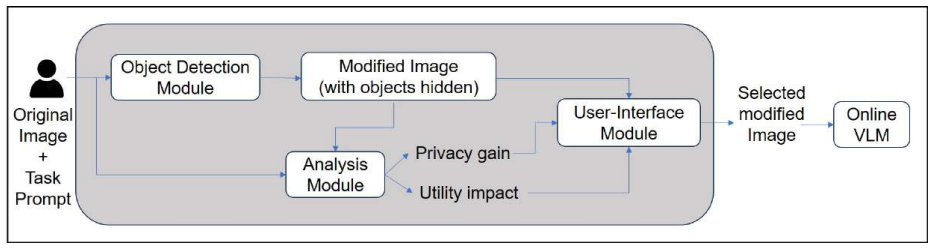
We propose a Privacy Preserving Assistant (PPA) ... Object Detection Module ... Analysis Module ... privacy gain Gp(Rmod) = P(Rorig) - P(Rmod) ... utility impact Ui(Rmod) = 1 - U(Rmod)
-
IndisputableMonolith/Foundation/RealityFromDistinction.leanreality_from_one_distinction unclear?
unclearRelation between the paper passage and the cited Recognition theorem.
blurring and masking ... 736 images ... LLaVA-1.5 ... privacy gain vs. PII-based Question
What do these tags mean?
- matches
- The paper's claim is directly supported by a theorem in the formal canon.
- supports
- The theorem supports part of the paper's argument, but the paper may add assumptions or extra steps.
- extends
- The paper goes beyond the formal theorem; the theorem is a base layer rather than the whole result.
- uses
- The paper appears to rely on the theorem as machinery.
- contradicts
- The paper's claim conflicts with a theorem or certificate in the canon.
- unclear
- Pith found a possible connection, but the passage is too broad, indirect, or ambiguous to say the theorem truly supports the claim.
Reference graph
Works this paper leans on
-
[1]
PAPILLON: Privacy Preservation from Internet-based and Local Language Model Ensembles
S. Li, V . C. Raghuram, O. Khattab, J. Hirschberg, and Z. Yu, “Papillon: Privacy preservation from internet-based and local language model ensembles,”arXiv preprint arXiv:2410.17127, 2024
-
[2]
Privacy implications of user prompts: The wildchat benchmark,
F. Mireshghallahet al., “Privacy implications of user prompts: The wildchat benchmark,”arXiv preprint arXiv:2401.00212, 2024
-
[3]
Private attribute inference from images with vision-language models,
B. Tmeke, M. Vero, R. Staab, and M. Vechev, “Private attribute inference from images with vision-language models,”arXiv preprint arXiv:2404.10618, 2024
-
[4]
Wildvision: Evaluating vision-language models in the wild with human preferences,
Y . Lu, D. Jiang, W. Chen, W. Y . Wang, Y . Choi, and B. Y . Lin, “Wildvision: Evaluating vision-language models in the wild with human preferences,”arXiv preprint arXiv:2406.11069, 2024
-
[5]
Exploiting privacy preserving prompt techniques for online large language model usage,
Y . Zhu, N. Gao, X. Liang, and H. Zhang, “Exploiting privacy preserving prompt techniques for online large language model usage,” inIEEE Conference on Privacy in AI, 2024
2024
-
[6]
Identifying and mitigating privacy risks stemming from language models: A survey
V . Smith, A. Shamsabadi, C. Ashurst, and A. Weller, “Identifying and mitigating privacy risks stemming from language models,”arXiv preprint arXiv:2310.01424, 2024
-
[7]
Dp-image: Differential privacy for image data in feature space,
H. Xue, B. Liu, M. Dinget al., “Dp-image: Differential privacy for image data in feature space,”arXiv preprint arXiv:2103.07073, 2023
-
[8]
Gan-based differential private image privacy protection framework for the internet of multimedia things,
J. Yu, H. Xue, B. Liu, Y . Wanget al., “Gan-based differential private image privacy protection framework for the internet of multimedia things,”Sensors, vol. 21, no. 1, p. 58, 2021
2021
-
[9]
Privacynet: Semi-adversarial net- works for multi-attribute face privacy,
V . Mirjalili, S. Raschka, and A. Ross, “Privacynet: Semi-adversarial net- works for multi-attribute face privacy,”arXiv preprint arXiv:2001.00561, 2020
-
[10]
Extracting training data from large language models,
N. Carlini, F. Tramer, E. Wallace, M. Jagielski, A. Herbert-V oss, K. Lee, A. Roberts, T. Brown, D. Song, C. Raffelet al., “Extracting training data from large language models,” inUSENIX Security Symposium, 2021
2021
-
[11]
Quantifying memorization across neural language models,
N. Carlini, C. Liu, . Erlingsson, D. Song, and F. Lee, “Quantifying memorization across neural language models,” inIEEE Symposium on Security and Privacy, 2023
2023
-
[12]
Generative visual commonsense answering and explaining with generative scene graph constructing,
F. Yuan, X. Fang, R. Quan, J. Li, W. Bi, X. Xu, and P. Li, “Generative visual commonsense answering and explaining with generative scene graph constructing,”Conference25, 2025, arXiv:2501.09041. [Online]. Available: https://arxiv.org/abs/2501.09041
-
[13]
Descriptive image quality assessment in the wild,
Z. You, J. Gu, Z. Liet al., “Descriptive image quality assessment in the wild,”arXiv preprint arXiv:2405.18842, 2024
discussion (0)
Sign in with ORCID, Apple, or X to comment. Anyone can read and Pith papers without signing in.