A Consistent Treatment of Final-State Interactions in NuWro Quasielastic Channel
Pith reviewed 2026-05-10 16:27 UTC · model grok-4.3
The pith
A consistent mapping of final-state interactions between cross-section convolutions and event-level cascade classifications in NuWro improves agreement with inclusive electron-scattering and exclusive MicroBooNE quasielastic data.
A machine-rendered reading of the paper's core claim, the machinery that carries it, and where it could break.
Core claim
The central claim is that a convolution formalism at the inclusive cross-section level can be placed in one-to-one correspondence with an event-level classification of transparent versus non-transparent interactions inside the NuWro intranuclear cascade, thereby realizing final-state interaction effects consistently across inclusive and exclusive descriptions of quasielastic scattering.
What carries the argument
The unified framework that equates a convolution-based inclusive calculation with an event-by-event transparent/non-transparent classification performed inside the NuWro intranuclear cascade.
If this is right
- Final-state interaction effects become applicable to both inclusive observables and exclusive final states within the same quasielastic simulation.
- Predictions for lepton-nucleus quasielastic scattering can be compared simultaneously to inclusive electron data and to exclusive neutrino measurements such as those from MicroBooNE.
- The treatment removes the previous separation between inclusive and exclusive final-state interaction modeling inside NuWro.
- Hadron propagation inside the nucleus is now governed by a single set of rules that operates at both the cross-section and event levels.
Where Pith is reading between the lines
- The same mapping technique could be tested in other Monte Carlo generators or extended to resonant and deep-inelastic channels to check whether consistency improves data agreement more broadly.
- If the consistency holds, nuclear-effect uncertainties in neutrino oscillation experiments that rely on quasielastic samples may be reduced because inclusive and exclusive constraints can be applied together.
- The approach highlights that any mismatch between inclusive and exclusive final-state interaction modeling can bias the interpretation of measured cross sections on nuclear targets.
Load-bearing premise
The assumption that the convolution formalism at the cross-section level can be mapped onto an event-level classification of transparent versus non-transparent interactions without introducing inconsistencies.
What would settle it
A direct numerical comparison in which the inclusive cross section obtained from the convolution formula differs measurably from the cross section obtained by reweighting the same events according to the transparent/non-transparent classification would falsify the claimed consistency.
Figures
read the original abstract
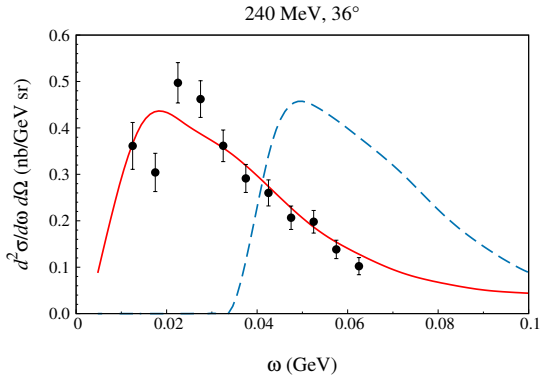
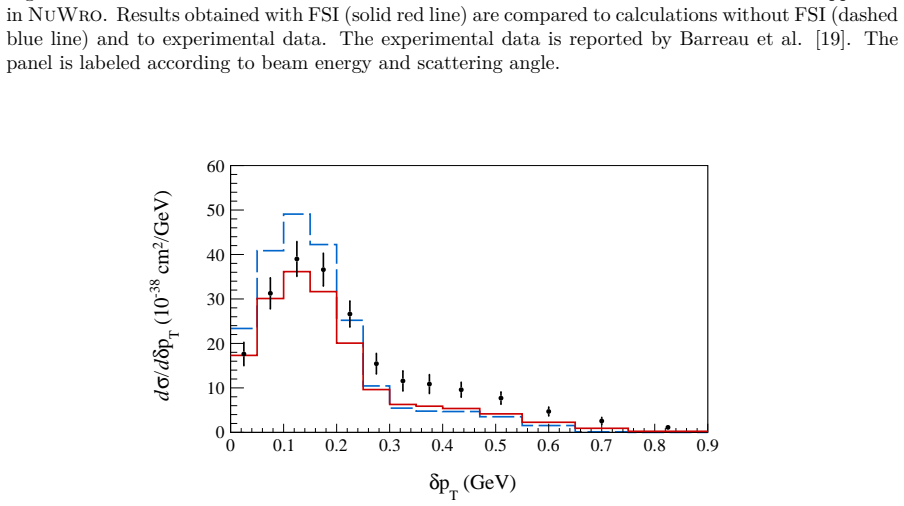
In this proceeding, I present a modified treatment of final-state interactions (FSI) in quasielastic (QE) lepton-nucleus scattering within the spectra function (SF) framework of the NuWro Monte Carlo generator. Our approach establishes a consistent correspondence between inclusive cross-section calculations and exclusive descriptions of hadron-propagation by combining a convolution-based formalism at the cross-section level with an event-level implementation in which interactions are classified as transparent or non-transparent within the NuWro intranuclear cascade. This unified framework enables realization of FSI effects across inclusive observables and exclusive final states. We demonstrate the impact of this implementation by comparing predictions to both inclusive electron-scattering data and exclusive MicroBooNE measurements of CCQE-dominated observable, showing that the inclusion of FSI leads to a significant improvement in agreement with the data.
Editorial analysis
A structured set of objections, weighed in public.
Referee Report
Summary. The manuscript presents a modified treatment of final-state interactions (FSI) in quasielastic lepton-nucleus scattering within the spectral function (SF) framework of the NuWro Monte Carlo generator. It combines a convolution-based formalism at the inclusive cross-section level with an event-level classification of interactions as transparent or non-transparent inside the NuWro intranuclear cascade. The goal is to establish consistency between inclusive observables and exclusive final-state descriptions. The authors compare predictions to inclusive electron-scattering data and exclusive MicroBooNE CCQE-dominated observables, claiming that inclusion of FSI yields significant improvement in data agreement.
Significance. If the hybrid mapping is validated as consistent, the work could provide a practical bridge between inclusive SF calculations and realistic exclusive event generation in neutrino Monte Carlo tools, with direct relevance to MicroBooNE and other short-baseline experiments. The proceeding offers no quantitative metrics of improvement or parameter-free derivations, limiting its immediate impact.
major comments (1)
- The central consistency claim requires that the new hybrid treatment produces inclusive cross sections identical to the prior SF convolution while modifying only exclusive final states. No direct numerical comparison between the modified NuWro inclusive result and the original convolution result is reported; any mismatch would undermine the reported data improvements (see skeptic note on convolution-to-event-level mapping).
Simulated Author's Rebuttal
We thank the referee for the careful reading of our manuscript and for highlighting the importance of explicitly validating the consistency between the hybrid FSI treatment and the original SF convolution. We address the major comment below and will incorporate the requested comparison in the revised version.
read point-by-point responses
-
Referee: The central consistency claim requires that the new hybrid treatment produces inclusive cross sections identical to the prior SF convolution while modifying only exclusive final states. No direct numerical comparison between the modified NuWro inclusive result and the original convolution result is reported; any mismatch would undermine the reported data improvements (see skeptic note on convolution-to-event-level mapping).
Authors: We agree that a direct numerical demonstration of inclusive equivalence is essential to substantiate the consistency claim. By construction, the hybrid implementation classifies interactions as transparent or non-transparent inside the NuWro cascade such that the inclusive cross section is recovered from the same SF convolution used in the original formalism; only the exclusive final-state kinematics are altered. In the revised manuscript we will add a figure (or table) comparing the inclusive differential cross sections (e.g., dσ/dQ² or dσ/dω) obtained with the new NuWro implementation against the pure convolution result, confirming numerical agreement within Monte Carlo statistics. This will also address any potential mapping concerns by showing that the event-level classification preserves the inclusive level while enabling realistic exclusive predictions. revision: yes
Circularity Check
No significant circularity; hybrid mapping presented as independent combination validated externally
full rationale
The paper's derivation combines a pre-existing convolution-based SF formalism for inclusive cross sections with an event-level transparent/non-transparent classification inside the NuWro cascade. No equation or claim reduces a prediction to a fitted input, self-defined quantity, or self-citation chain by construction. The central result (improved data agreement) is tested against external inclusive electron-scattering and MicroBooNE exclusive observables rather than being forced by internal redefinition. This satisfies the self-contained benchmark criterion; the absence of an explicit numerical cross-check between modified generator and original convolution is a validation gap but does not constitute circularity under the enumerated patterns.
Axiom & Free-Parameter Ledger
Reference graph
Works this paper leans on
-
[1]
Hyper-Kamiokande Proto-Collaboration, K. Abe, et al. Physics potential of a long- baseline neutrino oscillation experiment using a j-parc neutrino beam and hyper- kamiokande.Progress of Theoretical and Experimental Physics, 2015(5):053C02, 05 2015
work page 2015
-
[2]
V. Hewes et al. Deep Underground Neutrino Experiment (DUNE) Near Detector Conceptual Design Report.Instruments, 5(4):31, 2021
work page 2021
-
[3]
Ankowski, Rwik Dharmapal Banerjee, Jan T
Artur M. Ankowski, Rwik Dharmapal Banerjee, Jan T. Sobczyk, José L. Bonilla, Krzysztof M. Graczyk, Beata E. Kowal, and Hemant Prasad. Spectral function approach in NuWro: modeling of multinucleon final states in quasielastic scattering, arXiV 2508.10101 [hep-ph]
-
[4]
Jan T. Sobczyk, Jarosław A. Nowak, and Krzysztof M. Graczyk. Wrong – wrocław neutrino generator of events for single pion production.Nuclear Physics B - Pro- ceedings Supplements, 139:266–271, 2005. Proceedings of the Third International Workshop on Neutrino-Nucleus Interactions in the Few-GeV Region
work page 2005
-
[5]
NuWro Monte Carlo Event Generator.https://github.com/NuWro/nuwro
-
[6]
Rwik Dharmapal Banerjee, Artur M. Ankowski, Krzysztof M. Graczyk, Beata E. Kowal, Hemant Prasad, and Jan T. Sobczyk. Jlab spectral functions of argon in nuwro and their implications for microboone.Phys. Rev. D, 109:073004, Apr 2024
work page 2024
-
[7]
FirstmeasurementoftheAr(e,e ′ )xcrosssectionatjeffersonlaboratory
H.Daietal. FirstmeasurementoftheAr(e,e ′ )xcrosssectionatjeffersonlaboratory. Phys. Rev. C, 99:054608, May 2019
work page 2019
-
[8]
L. Jiang et al. Determination of the argon spectral function from(e,e ′ p)data.Phys. Rev. D, 105:112002, Jun 2022
work page 2022
-
[9]
L. Jiang et al. Determination of the titanium spectral function from(e, e ′ p)data. Phys. Rev. D, 107:012005, Jan 2023. 6
work page 2023
- [10]
-
[11]
Tomasz Golan, Cezary Juszczak, and Jan T. Sobczyk. Effects of final-state inter- actions in neutrino-nucleus interactions.Phys. Rev. C, 86:015505, Jul 2012
work page 2012
-
[12]
Nuclear response beyond the Fermi gas model
Omar Benhar. Nuclear response beyond the Fermi gas model. In2nd International Workshop on Neutrino-Nucleus Interactions in the Few GeV Region, 7 2003
work page 2003
-
[13]
D. Rohe et al. Nuclear transparency from quasielastic12C(e,e ′ p).Phys. Rev. C, 72:054602, Nov 2005
work page 2005
-
[14]
Inclusive quasielastic electron-nucleus scattering.Rev
Omar Benhar, Donal Day, and Ingo Sick. Inclusive quasielastic electron-nucleus scattering.Rev. Mod. Phys., 80:189–224, Jan 2008
work page 2008
-
[15]
Ankowski, Omar Benhar, and Makoto Sakuda
Artur M. Ankowski, Omar Benhar, and Makoto Sakuda. Improving the accuracy of neutrino energy reconstruction in charged-current quasielastic scattering off nuclear targets.Phys. Rev. D, 91:033005, Feb 2015
work page 2015
-
[16]
E. D. Cooper, S. Hama, B. C. Clark, and R. L. Mercer. Global dirac phenomenology for proton-nucleus elastic scattering.Phys. Rev. C, 47:297–311, Jan 1993
work page 1993
-
[17]
Rwik Dharmapal Banerjee et. al. Modified Cascade Algorithm in NuWro Quasielas- tic Channel ("in preparation")
-
[18]
C. Ciofi degli Atti and S. Simula. Realistic model of the nucleon spectral function in few- and many-nucleon systems.Phys. Rev. C, 53:1689–1710, Apr 1996
work page 1996
-
[19]
P. Barreau et al. Deep-inelastic electron scattering from carbon.Nuclear Physics A, 402(3):515–540, 1983
work page 1983
-
[20]
P. Abratenko et al. First double-differential measurement of kinematic imbalance in neutrino interactions with the microboone detector.Phys. Rev. Lett., 131:101802, Sep 2023. 7
work page 2023
discussion (0)
Sign in with ORCID, Apple, or X to comment. Anyone can read and Pith papers without signing in.