Continuous PT-Symmetry Breaking as a Design Variable for Giant Altermagnetic Spin Splitting
Pith reviewed 2026-05-10 16:27 UTC · model grok-4.3
The pith
Treating PT-symmetry breaking as a continuous scalar allows quantitative design of altermagnets with giant spin-splitting energies from crystal coordinates alone.
A machine-rendered reading of the paper's core claim, the machinery that carries it, and where it could break.
Core claim
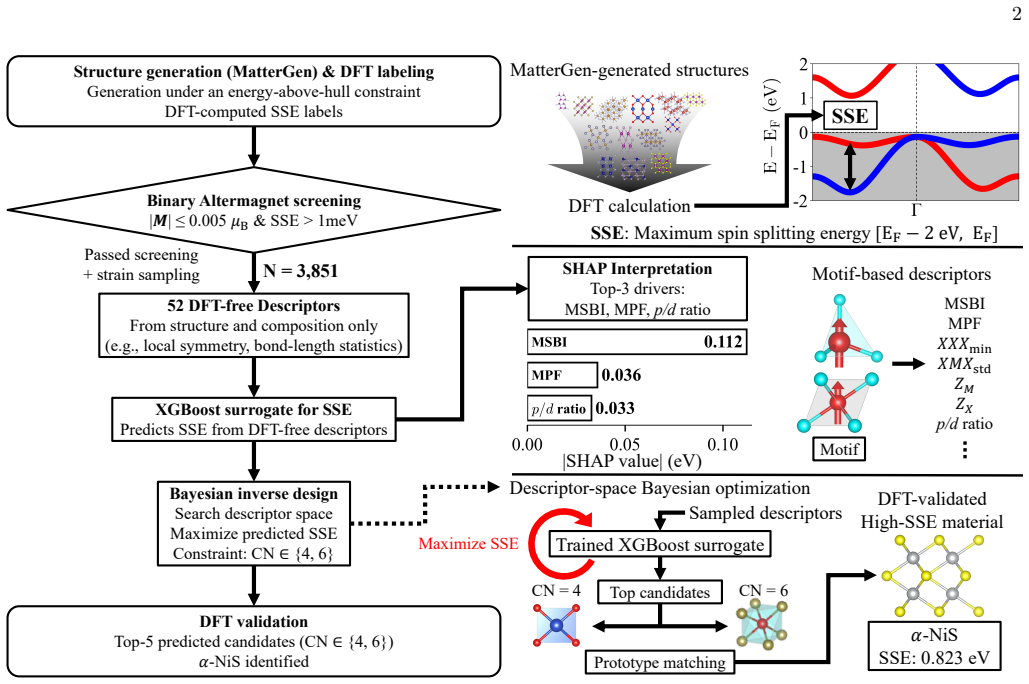
Sublattice symmetry breaking is promoted to the Motif Symmetry-Breaking Index, a continuous DFT-free scalar that quantifies PT-symmetry breaking between antiparallel magnetic motifs directly from crystal coordinates. SHAP analysis of an XGBoost surrogate trained on 3,851 DFT-labeled structures identifies MSBI, motif packing fraction, and p/d electron ratio as the dominant axes, each tied to a tunable experimental handle. Bayesian optimization over this space recovers alpha-NiS and proposes square-planar FeS (1.297 eV), octahedral CoS (1.103 eV), and FeAs (1.089 eV) as materials whose spin-splitting energies match or exceed that of CrSb.
What carries the argument
The Motif Symmetry-Breaking Index (MSBI), a continuous scalar that quantifies the degree of PT-symmetry breaking between antiparallel magnetic motifs using only crystal coordinates and thereby replaces binary symmetry classification with a tunable design variable.
Load-bearing premise
The three descriptors identified by SHAP analysis are sufficient to predict spin-splitting energy across material families and the XGBoost surrogate trained on binary structures generalizes reliably to new compositions.
What would settle it
Independent spin-polarized DFT calculations on the predicted square-planar FeS structure returning a spin-splitting energy substantially below 1.297 eV, or a new set of structures where MSBI shows no correlation with actual spin-splitting energy.
Figures


read the original abstract
Magnetic point-group analysis classifies altermagnets but returns only a binary symmetry verdict, leaving spin-splitting energy (SSE) inaccessible without spin-polarized density functional theory (DFT). This binary ceiling is not fundamental. Sublattice symmetry breaking is promoted here to a continuous, DFT-free scalar -- the Motif Symmetry-Breaking Index (MSBI) -- that quantifies $\mathcal{PT}$-symmetry breaking between antiparallel magnetic motifs directly from crystal coordinates. SHAP analysis of an XGBoost surrogate trained on 3,851 DFT-labeled binary structures identifies three dominant descriptors: MSBI (symmetry-breaking axis), motif packing fraction MPF (superexchange axis), and the $p/d$ electron ratio (covalency axis), each mapping onto a directly tunable experimental handle. A controlled VO--CrSb comparison within the same P$6_3$/mmc host lattice demonstrates that composition alone boosts SSE sevenfold. Bayesian optimization over this three-axis space, followed by independent DFT validation, recovers $\alpha$-NiS (SSE $= 0.823$\,eV) as cross-validation against an independent symmetry-based prediction and identifies three previously unrecognized high-SSE candidates -- square-planar FeS (1.297\,eV), octahedral CoS (1.103\,eV), and FeAs (1.089\,eV) -- all matching or exceeding CrSb. Square-planar Fe--S is proposed as a transferable coordination motif for giant altermagnetic spin splitting, advancing altermagnet design from symmetry classification to continuous quantitative optimization.
Editorial analysis
A structured set of objections, weighed in public.
Referee Report
Summary. The manuscript promotes sublattice symmetry breaking to a continuous, DFT-free scalar called the Motif Symmetry-Breaking Index (MSBI) that quantifies PT-symmetry breaking between antiparallel magnetic motifs directly from crystal coordinates. An XGBoost surrogate trained on 3,851 DFT-labeled binary structures, with SHAP analysis, identifies MSBI, motif packing fraction (MPF), and p/d electron ratio as dominant descriptors. Bayesian optimization over this three-axis space, followed by independent DFT validation, recovers α-NiS and proposes new high-SSE candidates (square-planar FeS at 1.297 eV, octahedral CoS at 1.103 eV, FeAs at 1.089 eV), while a controlled VO-CrSb comparison in the same P6₃/mmc lattice claims a sevenfold SSE boost from composition tuning alone.
Significance. If the central results hold, the work advances altermagnet design from binary magnetic point-group classification to quantitative, continuous optimization using directly tunable experimental handles. The independent DFT validation of ML-optimized candidates and the explicit mapping of descriptors to physical axes (symmetry breaking, superexchange, covalency) provide a practical framework for materials discovery. The introduction of MSBI as a scalar design variable is a clear conceptual contribution that could accelerate spintronic material development.
major comments (2)
- [Machine-learning methodology and optimization section] The reliability of the Bayesian optimization step depends on the XGBoost surrogate's generalization. No train/test split details, R², MAE, or cross-validation scores on held-out structures are provided (abstract and apparent methods description), making it impossible to quantify extrapolation risk for motifs such as square-planar Fe-S outside the binary training distribution. This directly affects the trustworthiness of the three new high-SSE candidates.
- [Results (VO-CrSb comparison paragraph)] The sevenfold SSE boost is attributed to composition tuning in the controlled VO-CrSb comparison within the same P6₃/mmc host. Without the explicit SSE values for both compounds, the precise definition of the 'controlled' variables, or a table showing the decomposition into MSBI/MPF/p-d contributions, it is unclear whether the factor of seven is fully explained by the three-descriptor model or partly by other unaccounted structural differences.
minor comments (2)
- [Abstract] The space-group notation P$6_3$/mmc in the abstract should be rendered consistently with the full-text LaTeX (e.g., P6₃/mmc) to avoid minor typesetting inconsistencies.
- [Abstract] The abstract states that the three descriptors 'map onto directly tunable experimental handles,' but a brief sentence linking each handle (e.g., how MSBI is tuned by motif distortion) would improve immediate readability.
Simulated Author's Rebuttal
We thank the referee for the constructive comments, which have helped us identify areas where the manuscript can be clarified and strengthened. We address each major comment below and will incorporate the suggested revisions.
read point-by-point responses
-
Referee: [Machine-learning methodology and optimization section] The reliability of the Bayesian optimization step depends on the XGBoost surrogate's generalization. No train/test split details, R², MAE, or cross-validation scores on held-out structures are provided (abstract and apparent methods description), making it impossible to quantify extrapolation risk for motifs such as square-planar Fe-S outside the binary training distribution. This directly affects the trustworthiness of the three new high-SSE candidates.
Authors: We agree that explicit performance metrics for the XGBoost surrogate are necessary to evaluate generalization. In the revised manuscript we will add a dedicated Methods subsection reporting the train/test split (80/20 random split on the 3,851 structures), test-set R² and MAE, and 5-fold cross-validation scores. These metrics will quantify extrapolation risk for motifs such as square-planar Fe-S. We note that all three proposed high-SSE candidates were subsequently validated by independent DFT calculations, providing an orthogonal confirmation of the surrogate predictions. revision: yes
-
Referee: [Results (VO-CrSb comparison paragraph)] The sevenfold SSE boost is attributed to composition tuning in the controlled VO-CrSb comparison within the same P6₃/mmc host. Without the explicit SSE values for both compounds, the precise definition of the 'controlled' variables, or a table showing the decomposition into MSBI/MPF/p-d contributions, it is unclear whether the factor of seven is fully explained by the three-descriptor model or partly by other unaccounted structural differences.
Authors: We accept that the current text does not supply the numerical SSE values or the requested decomposition. The revised version will state the explicit SSE values for both VO and CrSb in the P6₃/mmc lattice, define the controlled variables (identical space group and closely matched lattice parameters, differing only by composition), and include a table that decomposes the SSE difference into the individual contributions from MSBI, MPF, and p/d electron ratio. This will demonstrate that the sevenfold enhancement is accounted for by the three-descriptor model. revision: yes
Circularity Check
No significant circularity; MSBI and surrogate optimization remain independent of DFT labels by construction
full rationale
MSBI is explicitly constructed as a DFT-free scalar from crystal coordinates alone, quantifying PT-symmetry breaking between motifs without reference to spin-splitting energies. The XGBoost model is trained on 3,851 DFT-computed SSE values to rank descriptors via SHAP, after which Bayesian optimization proposes candidates that receive separate, independent DFT validation (including recovery of α-NiS against an external symmetry-based benchmark). No equation or step reduces a reported prediction to a fitted parameter by construction, nor does any load-bearing claim rest on self-citation or an imported uniqueness theorem. The derivation therefore uses external DFT computations as an independent benchmark rather than tautologically reproducing its inputs.
Axiom & Free-Parameter Ledger
free parameters (1)
- XGBoost hyperparameters
axioms (1)
- domain assumption PT-symmetry breaking between antiparallel magnetic motifs can be quantified as a scalar directly from crystal coordinates without electronic-structure calculations.
invented entities (1)
-
Motif Symmetry-Breaking Index (MSBI)
no independent evidence
Reference graph
Works this paper leans on
-
[1]
Motif Symmetry Breaking Index (MSBI) Altermagnetism requires the absence of degeneracy- protecting symmetry operations that map one magnetic sublattice onto the other while preserving the crystal potential[2, 7]. In collinear antiferromagnets, spin de- generacy is protected byPTsymmetry, which requires the spatial environments of the two sublattices to be...
-
[2]
Motif Packing Fraction (MPF) MPF measures the fractional unit-cell space occu- pied by the ligand cage. The motif dimensionality is determined by SVD of the mean-centered ligand coor- dinates: a motif is classified as planar (D motif = 2) when the singular-value spectrum has effective rank two, and as polyhedral (Dmotif = 3) otherwise. For three- dimensio...
-
[3]
L. Šmejkal, R. González-Hernández, T. Jungwirth, and J. Sinova, Crystal time-reversal symmetry breaking and spontaneous hall effect in collinear antiferromagnets, Sci- ence advances6, eaaz8809 (2020)
work page 2020
-
[4]
L. Šmejkal, J. Sinova, and T. Jungwirth, Beyond conven- tional ferromagnetism and antiferromagnetism: A phase with nonrelativistic spin and crystal rotation symmetry, Physical Review X12, 031042 (2022)
work page 2022
-
[5]
T. Jungwirth, R. M. Fernandes, E. Fradkin, A. H. Mac- Donald, J. Sinova, and L. Šmejkal, Altermagnetism: an unconventional spin-ordered phase of matter, Newton (2025)
work page 2025
-
[6]
I. Mazin and P. editors, Altermagnetism—a new punch line of fundamental magnetism (2022)
work page 2022
- [7]
-
[8]
A. Hirohata, K. Yamada, Y. Nakatani, I.-L. Prejbeanu, B. Diény, P. Pirro, and B. Hillebrands, Review on spin- tronics: Principles and device applications, Journal of Magnetism and Magnetic Materials509, 166711 (2020)
work page 2020
-
[9]
L. Šmejkal, J. Sinova, and T. Jungwirth, Emerging re- search landscape of altermagnetism, Physical Review X 12, 040501 (2022)
work page 2022
- [10]
-
[11]
S. Bhowal and N. A. Spaldin, Ferroically ordered mag- netic octupoles in d-wave altermagnets, Physical Review X14, 011019 (2024)
work page 2024
-
[12]
S. Reimers, L. Odenbreit, L. Šmejkal, V. N. Strocov, P. Constantinou, A. B. Hellenes, R. Jaeschke Ubiergo, W. H. Campos, V. K. Bharadwaj, A. Chakraborty,et al., Direct observation of altermagnetic band splitting in crsb thin films, Nature Communications15, 2116 (2024)
work page 2024
-
[13]
J. Ding, Z. Jiang, X. Chen, Z. Tao, Z. Liu, T. Li, J. Liu, J. Sun, J. Cheng, J. Liu,et al., Large band splitting in g-wave altermagnet crsb, Physical Review Letters133, 206401 (2024)
work page 2024
-
[14]
J. Krempask` y, L. Šmejkal, S. D’souza, M. Hajlaoui, G. Springholz, K. Uhlířová, F. Alarab, P. Constantinou, V. Strocov, D. Usanov,et al., Altermagnetic lifting of kramers spin degeneracy, Nature626, 517 (2024)
work page 2024
- [15]
-
[16]
S. Lee, S. Lee, S. Jung, J. Jung, D. Kim, Y. Lee, B. Seok, J. Kim, B. G. Park, L. Šmejkal,et al., Broken kramers degeneracyinaltermagneticmnte,Physicalreviewletters 132, 036702 (2024)
work page 2024
-
[17]
Z. Feng, X. Zhou, L. Šmejkal, L. Wu, Z. Zhu, H. Guo, R. González-Hernández, X. Wang, H. Yan, P. Qin,et al., An anomalous hall effect in altermagnetic ruthenium dioxide, Nature Electronics5, 735 (2022)
work page 2022
-
[18]
X. Peng, Y. Wang, S. Zhang, Y. Zhou, Y. Sun, Y. Su, C. Wu, T. Zhou, L. Liu, H. Wang,et al., Scaling behavior of magnetoresistance and hall resistivity in the altermag- net crsb, Physical Review B111, 144402 (2025)
work page 2025
-
[19]
Y. Bai, X. Xiang, S. Pan, S. Zhang, H. Chen, X. Chen, Z. Han, G. Xu, and F. Xu, Nonlinear field dependence of hall effect and high-mobility multi-carrier transport in an altermagnet crsb, Applied Physics Letters126(2025)
work page 2025
-
[20]
K. Kluczyk, K. Gas, M. Grzybowski, P. Skupiński, M. Borysiewicz, T. Fąs, J. Suffczyński, J. Domagala, K. Grasza, A. Mycielski,et al., Coexistence of anoma- lous hall effect and weak magnetization in a nominally collinear antiferromagnet mnte, Physical Review B110, 155201 (2024)
work page 2024
-
[21]
Z. Li, Z. Zhang, Y. Chen, S. Hu, Y. Ji, Y. Yan, J. Du, Y. Li, L. He, X. Wang,et al., Fully field-free spin-orbit torque switching induced by spin splitting effect in alter- magnetic ruo2, Advanced Materials37, 2416712 (2025)
work page 2025
-
[22]
M. Dong, Z.-X. Guo, and X.-G. Gong, Field-free per- pendicularmagnetizationswitchingbyaltermagnetswith collinear spin current, Physical Review B112, 094447 (2025)
work page 2025
-
[23]
P. Kapri, Spin currents in rashba altermagnets: From equilibriumtononlinearregimes,PhysicalReviewB112, 155422 (2025). 14
work page 2025
-
[24]
C. Song, H. Bai, Z. Zhou, L. Han, H. Reichlova, J. H. Dil, J. Liu, X. Chen, and F. Pan, Altermagnets as a new class of functional materials, Nature Reviews Materials 10, 473 (2025)
work page 2025
-
[25]
L. Bai, W. Feng, S. Liu, L. Šmejkal, Y. Mokrousov, and Y.Yao,Altermagnetism: Exploringnewfrontiersinmag- netism and spintronics, Advanced Functional Materials 34, 2409327 (2024)
work page 2024
-
[26]
S.-W. Cheong and F.-T. Huang, Altermagnetism classi- fication, npj Quantum Materials10, 38 (2025)
work page 2025
-
[27]
P. G. Radaelli, Tensorial approach to altermagnetism, Physical Review B110, 214428 (2024)
work page 2024
-
[28]
L.-D. Yuan and A. Zunger, Degeneracy removal of spin bands in collinear antiferromagnets with non- interconvertible spin-structure motif pair, Advanced Ma- terials35, 2211966 (2023)
work page 2023
-
[29]
W. Li, C. Xu, M. Wang, M. Zou, W. Li, H. Wang, W. Jiang, and B. Wang, Large anomalous nernst effect in a metallic altermagnet crsb single crystal, Physical Re- view B112, L100401 (2025)
work page 2025
-
[30]
B. Rai, K. Patra, S. Bera, S. Kalimuddin, K. Deb, M. Mondal, P. Mahadevan, and N. Kumar, Direction- dependent conduction polarity in altermagnetic crsb, Ad- vanced Science , 2502226 (2025)
work page 2025
- [31]
-
[32]
O. Amin, A. Dal Din, E. Golias, Y. Niu, A. Zakharov, S. Fromage, C. Fields, S. Heywood, R. Cousins, F. Mac- cherozzi,et al., Nanoscale imaging and control of alter- magnetism in mnte, Nature636, 348 (2024)
work page 2024
-
[33]
Z. Liu, M. Ozeki, S. Asai, S. Itoh, and T. Masuda, Chi- ral split magnon in altermagnetic mnte, Physical Review Letters133, 156702 (2024)
work page 2024
-
[34]
V. C. Morano, Z. Maesen, S. E. Nikitin, J. Lass, D. G. Mazzone, and O. Zaharko, Absence of altermagnetic magnon band splitting in mnf 2, Physical Review Let- ters134, 226702 (2025)
work page 2025
- [35]
-
[36]
Y. Guo, H. Liu, O. Janson, I. C. Fulga, J. van den Brink, and J. I. Facio, Spin-split collinear antiferromagnets: A large-scale ab-initio study, Materials Today Physics32, 100991 (2023)
work page 2023
-
[37]
J. Sødequist and T. Olsen, Two-dimensional altermag- nets from high throughput computational screening: Symmetry requirements, chiral magnons, and spin-orbit effects, Applied Physics Letters124(2024)
work page 2024
-
[38]
Z.-F. Gao, S. Qu, B. Zeng, Y. Liu, J.-R. Wen, H. Sun, P.-J.Guo,andZ.-Y.Lu,Ai-accelerateddiscoveryofalter- magneticmaterials,NationalScienceReview12,nwaf066 (2025)
work page 2025
-
[39]
H. W. Kuhn, The hungarian method for the assignment problem, Naval research logistics quarterly2, 83 (1955)
work page 1955
-
[40]
P. W. Anderson, New approach to the theory of superex- change interactions, Physical Review115, 2 (1959)
work page 1959
-
[41]
J. M. Coey,Magnetism and magnetic materials(Cam- bridge university press, 2010)
work page 2010
- [42]
-
[43]
S. M. Lundberg and S.-I. Lee, A unified approach to in- terpreting model predictions, Advances in neural infor- mation processing systems30(2017)
work page 2017
-
[44]
Chen, Xgboost: A scalable tree boosting system, Cor- nell University (2016)
T. Chen, Xgboost: A scalable tree boosting system, Cor- nell University (2016)
work page 2016
-
[45]
C. Zeni, R. Pinsler, D. Zügner, A. Fowler, M. Horton, X. Fu, Z. Wang, A. Shysheya, J. Crabbé, S. Ueda,et al., A generative model for inorganic materials design, Na- ture639, 624 (2025)
work page 2025
- [46]
-
[47]
T. E. Gore, Growth of single crystals of crowningshieldite (α-nis) by chemical-vapour transport, Journal of Crystal Growth648, 127912 (2024)
work page 2024
-
[48]
C. Sun, M. Ma, J. Yang, Y. Zhang, P. Chen, W. Huang, and X. Dong, Phase-controlled synthesis of α-nis nanoparticles confined in carbon nanorods for high performance supercapacitors, Scientific reports4, 7054 (2014)
work page 2014
- [49]
-
[50]
S. Liu, Q. Shi, J. Tong, S. Li, and M. Li, Controlled synthesis of sphericalα-nis and urchin-likeβ-nis mi- crostructures, Journal of Experimental Nanoscience9, 475 (2014)
work page 2014
-
[51]
K. Chun,Inverse Design of Altermagnetic Materials us- ing Coupled DFT-Machine Learning, Master’s thesis, Se- jong University, Seoul (2025)
work page 2025
-
[52]
G. Kresse and J. Hafner, Ab initio molecular dynamics for liquid metals, Physical review B47, 558 (1993)
work page 1993
-
[53]
G. Kresse and J. Furthmüller, Efficiency of ab-initio total energy calculations for metals and semiconductors using a plane-wave basis set, Computational materials science 6, 15 (1996)
work page 1996
-
[54]
G. Kresse and J. Furthmüller, Efficient iterative schemes for ab initio total-energy calculations using a plane-wave basis set, Physical review B54, 11169 (1996)
work page 1996
-
[55]
P. E. Blöchl, Projector augmented-wave method, Physi- cal review B50, 17953 (1994)
work page 1994
-
[56]
G. Kresse and D. Joubert, From ultrasoft pseudopoten- tials to the projector augmented-wave method, Physical review b59, 1758 (1999)
work page 1999
-
[57]
J. P. Perdew, K. Burke, and M. Ernzerhof, Generalized gradientapproximationmadesimple,Physicalreviewlet- ters77, 3865 (1996)
work page 1996
-
[58]
S. L. Dudarev, G. A. Botton, S. Y. Savrasov, C. Humphreys, and A. P. Sutton, Electron-energy-loss spectra and the structural stability of nickel oxide: An lsda+ u study, Physical Review B57, 1505 (1998)
work page 1998
-
[59]
M. Cococcioni and S. De Gironcoli, Linear response approach to the calculation of the effective interaction parameters in the lda+ u method, Physical Review B—Condensed Matter and Materials Physics71, 035105 (2005)
work page 2005
-
[60]
A. Jain, G. Hautier, S. P. Ong, C. J. Moore, C. C. Fis- cher, K. A. Persson, and G. Ceder, Formation enthalpies by mixing gga and gga+ u calculations, Physical Review B—Condensed Matter and Materials Physics84, 045115 (2011). 15
work page 2011
-
[61]
S. Kirklin, J. E. Saal, B. Meredig, A. Thompson, J. W. Doak, M. Aykol, S. Rühl, and C. Wolverton, The open quantum materials database (oqmd): assessing the accu- racy of dft formation energies, npj Computational Mate- rials1, 1 (2015)
work page 2015
-
[62]
H. Pan, A. M. Ganose, M. Horton, M. Aykol, K. A. Persson, N. E. Zimmermann, and A. Jain, Benchmarking coordination number prediction algorithms on inorganic crystal structures, Inorganic chemistry60, 1590 (2021)
work page 2021
-
[63]
S. P. Ong, W. D. Richards, A. Jain, G. Hautier, M. Kocher, S. Cholia, D. Gunter, V. L. Chevrier, K. A. Persson, and G. Ceder, Python materials genomics (py- matgen): A robust, open-source python library for mate- rials analysis, Computational Materials Science68, 314 (2013)
work page 2013
-
[64]
J. Bergstra, R. Bardenet, Y. Bengio, and B. Kégl, Al- gorithms for hyper-parameter optimization, Advances in neural information processing systems24(2011)
work page 2011
-
[65]
A. Bocquet, T. Mizokawa, T. Saitoh, H. Namatame, and A. Fujimori, Electronic structure of 3d-transition-metal compounds by analysis of the 2p core-level photoemission spectra, Physical Review B46, 3771 (1992)
work page 1992
- [66]
- [67]
-
[68]
H. Wang, A. Pring, Y. Ngothai, and B. O’Neill, The ki- netics of theα→βtransition in synthetic nickel mono- sulfide, American Mineralogist91, 171 (2006)
work page 2006
- [69]
discussion (0)
Sign in with ORCID, Apple, or X to comment. Anyone can read and Pith papers without signing in.