REVIEW 2 major objections 2 minor 82 references
"bot lane noob" Towards Deployment of NLP-based Toxicity Detectors in Video Games
T0 review · 2 major / 2 minor · reviewed 2026-05-10 · grok-4.3
Pith's one-line read A dataset of messages labeled by expert League of Legends players produces a toxicity detector that outperforms general-purpose NLP tools.
desk verdict The paper releases a new dataset of live League of Legends chat messages labeled by eight expert players and shows a detector trained on it beats general toxicity tools, but the labeling process has thin validation. read the letter →
The pith
A machine-rendered reading of the paper's core claim, the machinery that carries it, and where it could break.
The reading
What carries the argument
The L2DTnH dataset of expert-labeled in-game chat messages from League of Legends, used to train a specialized NLP toxicity detector that is then compared against general models.
What would settle it
Independent expert labeling of a new set of recent League of Legends match messages shows the detector performing no better than general-purpose NLP toxicity detectors.
Extended reading notes
Core claim
Through a systematic review of 1,039 works, the paper finds limited prior efforts on ML/NLP detectors for toxicity in live matches. It introduces L2DTnH, a dataset of 1.4k toxic and 13.8k non-toxic messages labeled by eight expert LoL players. A detector trained on L2DTnH is shown to outperform general-purpose and state-of-the-art NLP toxicity detectors. The approach is validated on additional game-related data, and a web browser extension is developed to flag toxic content locally without third-party AI servers. All resources are released publicly to support further applied research against toxicity in video games.
Load-bearing premise
The labels assigned by eight expert players accurately capture what counts as toxicity in live matches and the detector generalizes to new game data without overfitting.
Signed reviews
Editorial analysis
A structured set of objections, weighed in public.
Referee Report
Summary. The paper conducts a systematic literature review (n=1,039) showing scarcity of NLP/ML-based toxicity detectors for live video-game matches. It introduces the L2DTnH dataset of 15.2k League of Legends chat messages (1.4k toxic) labeled by 8 expert players, trains an NLP detector claimed to outperform general-purpose and SOTA toxicity detectors, validates it on external game data, releases a local browser extension for flagging toxic content, and makes all resources public.
Significance. If the outperformance and generalization claims are supported by reliable labels and transparent evaluation, the work supplies a domain-specific dataset and practical deployment artifact for toxicity mitigation during active matches, directly addressing the gap identified in the literature review. The public release of the dataset, detector, and serverless extension is a clear strength enabling reproducibility.
major comments (2)
- [Dataset construction] Dataset construction section: the labeling procedure by the 8 expert players is described only at high level. No annotation protocol, definition of toxicity, independence of labels, majority-vote rule, or inter-annotator agreement statistic (Cohen/Fleiss kappa) is reported. Because the central outperformance claim rests on the quality of these 1.4k toxic labels, missing reliability metrics constitute a load-bearing gap.
- [Empirical results] Empirical results section: the abstract asserts that the L2DTnH-trained detector outperforms general-purpose and SOTA NLP toxicity detectors, yet no concrete metrics (precision, recall, F1, AUC), baseline models, train/test split details, or cross-validation procedure are supplied in the provided text. With only 1.4k positive examples, these omissions prevent assessment of whether the reported gains are robust or artifactual.
minor comments (2)
- [Title] The title's use of quotation marks around 'bot lane noob' is stylistically unclear and does not immediately convey the paper's focus on deployable detectors.
- [Literature review] The literature-review methodology would benefit from explicit search strings, databases queried, and inclusion/exclusion criteria to substantiate the n=1,039 count.
Simulated Author's Rebuttal
We thank the referee for their careful and constructive review of our manuscript. The comments identify important gaps in transparency that we have addressed through targeted revisions. We respond to each major comment below.
read point-by-point responses
-
Referee: [Dataset construction] Dataset construction section: the labeling procedure by the 8 expert players is described only at high level. No annotation protocol, definition of toxicity, independence of labels, majority-vote rule, or inter-annotator agreement statistic (Cohen/Fleiss kappa) is reported. Because the central outperformance claim rests on the quality of these 1.4k toxic labels, missing reliability metrics constitute a load-bearing gap.
Authors: We agree that the original Dataset construction section provided only a high-level description and omitted key details on the labeling process. In the revised manuscript we have expanded this section to include: the complete annotation protocol followed by the eight expert players, the operational definition of toxicity used during labeling, confirmation that annotations were performed independently, the majority-vote aggregation rule applied to produce final labels, and the inter-annotator agreement statistic (Fleiss' kappa). These additions directly improve transparency and allow readers to assess the reliability of the 1.4k toxic labels that underpin our detector. revision: yes
-
Referee: [Empirical results] Empirical results section: the abstract asserts that the L2DTnH-trained detector outperforms general-purpose and SOTA NLP toxicity detectors, yet no concrete metrics (precision, recall, F1, AUC), baseline models, train/test split details, or cross-validation procedure are supplied in the provided text. With only 1.4k positive examples, these omissions prevent assessment of whether the reported gains are robust or artifactual.
Authors: We acknowledge that the Empirical results section lacked the concrete methodological details needed for proper evaluation. In the revised version we have added: the full set of performance metrics (precision, recall, F1, and AUC) for both our detector and all baselines, the identities of the baseline models (general-purpose and SOTA toxicity detectors), the train/test split procedure, and the cross-validation protocol employed. We also describe how class imbalance was handled. These changes enable readers to assess the robustness of the reported outperformance given the limited number of positive examples. revision: yes
Circularity Check
No circularity: empirical dataset creation and supervised learning pipeline
full rationale
The paper contains no equations, derivations, or first-principles predictions. Its core contribution is the collection of a new labeled dataset (L2DTnH) via expert annotation followed by standard supervised training of an NLP toxicity classifier, with empirical comparisons to external baselines. No step reduces a claimed result to its own inputs by construction, self-definition, or load-bearing self-citation. The work is self-contained against external benchmarks and does not invoke uniqueness theorems, ansatzes, or renamings that would trigger circularity patterns.
Assumptions & free parameters
Cite this review
Pith. "Pith review of "bot lane noob" Towards Deployment of NLP-based Toxicity Detectors in Video Games." pith.science (2026). https://pith.science/paper/2604.10175
@misc{pith2026260410175,
  author       = {Pith},
  title        = {Pith review of: "bot lane noob" Towards Deployment of NLP-based Toxicity Detectors in Video Games},
  year         = {2026},
  howpublished = {\url{https://pith.science/paper/2604.10175}},
  note         = {Machine review of arXiv:2604.10175}
}
read the original abstract
Toxicity and harassment are widespread in the video-gaming context. Especially in competitive online multiplayer scenarios, gamers oftentimes send harmful messages to other players (teammates or opponents) whose consequences span from mild annoyance to withdrawal and depression. Abundant prior work tackled these problems, e.g., pointing out the negative effects of toxic interactions. However, few works proposed countermeasures specifically developed and tested on textual messages sent during a match -- i.e., when the "harassment" actually occurs. We posit that such a scarcity stems from the lack of high-quality datasets that can be used to devise "automated" detectors based on natural-language processing (NLP) and machine learning (ML), and which can -- ideally -- mitigate the harm of toxic comments during a gaming session. This work provides a foundation for addressing the problem of toxicity and harassment in video games. First, through a systematic literature review (n=1,039), we provide evidence that only few works proposed ML/NLP-based detectors of toxicity/harassment during live matches. Then, we partner-up with 8 expert League of Legend (LoL) players and create a fine-grained labelled dataset, L2DTnH, containing 1.4k toxic and 13.8k non-toxic messages exchanged during LoL matches. We use L2DTnH to develop a detector that we then empirically show outperforms general-purpose and state-of-the-art toxicity detectors reliant on NLP. To further demonstrate the practicality of our resources, we test our detector on game-related data beyond that included in L2DTnH; and we develop a Web-browser extension that flags toxic content in Webpages -- without querying third-party servers owned by AI companies. We publicly release all of our resources. Our contributions pave the way for more applied research devoted to fighting the spread of toxicity and harassment in video games.
Figures


Reference graph
Works this paper leans on
-
[1]
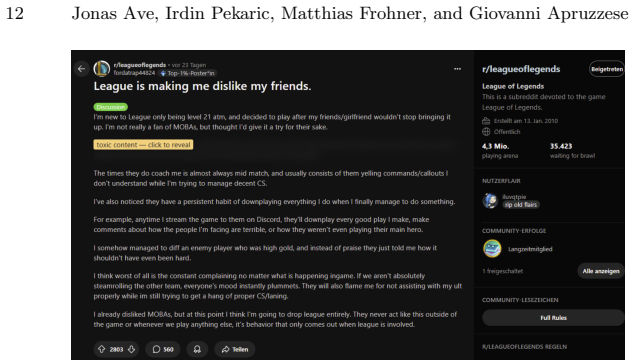
Accessed on October 7th, 2025,https://www.reddit.com/r/leagueoflegends/c omments/1ngnf9b/league_is_making_me_dislike_my_friends/
work page 2025
-
[2]
Reddit gaming,https://www.reddit.com/r/gaming/
-
[3]
Sensitive personal data.https://home.treasury.gov/taxonomy/term/7651
- [4]
-
[5]
Accessed on October 6th, 2025 (2025),https://leagueoflegends
The tribunal. Accessed on October 6th, 2025 (2025),https://leagueoflegends. fandom.com/wiki/The_Tribunal
work page 2025
-
[6]
Accessed on Oc- tober 6th, 2025 (2025),https://activeplayer.io/league-of-legends/
ActivePlayer: League of legends live player count and statistics. Accessed on Oc- tober 6th, 2025 (2025),https://activeplayer.io/league-of-legends/
work page 2025
-
[7]
Accessed on October 6th, 2025 (2025),https://activeplayer.io/world-of-tanks/
ActivePlayer: World of tanks (wot) live player count and game statistics. Accessed on October 6th, 2025 (2025),https://activeplayer.io/world-of-tanks/
work page 2025
-
[8]
ADL: Free to play? hate, harassment and positive social experience in online games
Show all 82 references
-
[9]
2025 (2020),https://adl.org/resources/report/free-p lay-hate-harassment-and-positive-social-experience-online-games-2020
Accessed: 6 Oct. 2025 (2020),https://adl.org/resources/report/free-p lay-hate-harassment-and-positive-social-experience-online-games-2020
2025
-
[10]
In: Companion Proceedings of TheWebConf (2019)
Aroyo, L., Dixon, L., Thain, N., Redfield, O., Rosen, R.: Crowdsourcing subjective tasks: the case study of understanding toxicity in online discussions. In: Companion Proceedings of TheWebConf (2019)
2019
-
[11]
IEEE Security & Privacy (2012)
Bailey, M., Dittrich, D., Kenneally, E., Maughan, D.: The Menlo report. IEEE Security & Privacy (2012)
2012
-
[12]
In: CHI (2021)
Beres, N.A., Frommel, J., Reid, E., Mandryk, R.L., Klarkowski, M.: Don’t you know that you’re toxic: Normalization of toxicity in online gaming. In: CHI (2021)
2021
-
[13]
In: WWW (2014)
Blackburn, J., Kwak, H.: Stfu noob! predicting crowdsourced decisions on toxic behavior in online games. In: WWW (2014)
2014
-
[14]
In: ICSCSS (2024)
Bonthu, B., Abhay, P., Gottipati, L.S., Vamsi, G.K.: Civilitycheck: An integrated natural language processing and machine learning framework to detect hateful and offensive language. In: ICSCSS (2024)
2024
-
[15]
In: Science and Information Conference
Bowker, J., Ophoff, J.: Reducing exposure to hateful speech online. In: Science and Information Conference. Springer (2022)
2022
-
[16]
In: ACM/SIGAPP SAC
Braun, T., Pekaric, I., Apruzzese, G.: Understanding the process of data labeling in cybersecurity. In: ACM/SIGAPP SAC. pp. 1596–1605 (2024)
2024
-
[17]
In: CHI-PLAY (2021)
Canossa, A., Salimov, D., Azadvar, A., Harteveld, C., Yannakakis, G.: For honor, for toxicity: Detecting toxic behavior through gameplay. In: CHI-PLAY (2021)
2021
-
[18]
In: CIPR
Chakrabarty, N.: A machine learning approach to comment toxicity classification. In: CIPR. Springer (2019)
2019
-
[19]
Commission, E.: Sensitive data.https://ec.europa.eu/info/law/law-topic/d ata-protection/reform/rules-business-and-organisations/legal-grounds -processing-data/sensitive-data_en
-
[20]
In: IEEE HNICEM (2019)
Cornel, J.A., Pablo, C.C., Marzan, J.A., Mercado, V.J., Fabito, B., Rodriguez, R., Octaviano, M., Oco, N., De La Cruz, A.: Cyberbullying detection for online games chat logs using deep learning. In: IEEE HNICEM (2019)
2019
-
[21]
Corrˆ ea, N.K.: Aira (2023).https://doi.org/10.5281/zenodo.6989727,https: //github.com/Nkluge-correa/Aira 18 Jonas Ave, Irdin Pekaric, Matthias Frohner, and Giovanni Apruzzese
2023 doi
-
[22]
In: ACL (2024)
Costa-juss` a, M., Meglioli, M., Andrews, P., Dale, D., Hansanti, P., Kalbassi, E., Mourachko, A., Ropers, C., Wood, C.: Mutox: Universal multilingual audio-based toxicity dataset and zero-shot detector. In: ACL (2024)
2024
-
[23]
In: Inter- national Conference on Networking and Communications (2024)
Deep, S., Singh, S., Yadav, S., Shedge, Y., Khade, A.: Creating an integrated browser plug-in for detecting and blocking obscene image/text content. In: Inter- national Conference on Networking and Communications (2024)
2024
-
[24]
In: IEEE CoG (2023)
Dreier, L., Pirker, J.: Toxicity in twitch live stream chats: Towards understanding the impact of gender, size of community and game genre. In: IEEE CoG (2023)
2023
-
[25]
In: IEEE OCTA (2020)
d’Sa, A.G., Illina, I., Fohr, D.: Bert and fasttext embeddings for automatic detec- tion of toxic speech. In: IEEE OCTA (2020)
2020
-
[26]
In: ACDSA (2024)
Du Toit, J.L., Kotz´ e, E.: The automatic detection of abusive language in dota 2 chat messages. In: ACDSA (2024)
2024
-
[27]
In: DATE Friday Workshop on System-level Design Methods for Deep Learning on Heterogeneous Architectures (2021)
Ducasse, Q., Cotret, P., Lagadec, L., Stewart, R.: Benchmarking quantized neural networks on fpgas with finn. In: DATE Friday Workshop on System-level Design Methods for Deep Learning on Heterogeneous Architectures (2021)
2021
-
[28]
Accessed: 6 Oct
ExplodingTopics: Amount of data created daily. Accessed: 6 Oct. 2025 (2025), https://explodingtopics.com/blog/data-generated-per-day
2025
-
[29]
2025 (2025),ht tps://explodingtopics.com/blog/number-of-gamers
ExplodingTopics: How many gamers are there? Accessed: 6 Oct. 2025 (2025),ht tps://explodingtopics.com/blog/number-of-gamers
2025
-
[30]
Accessed: 6 Oct
ExplodingTopics: Internet traffic from mobile devices. Accessed: 6 Oct. 2025 (2025),https://explodingtopics.com/blog/mobile-internet-traffic
2025
-
[31]
Quality & Quan- tity (2015)
Falotico, R., Quatto, P.: Fleiss’ kappa statistic without paradoxes. Quality & Quan- tity (2015)
2015
-
[32]
In: CHI (2020)
Frommel, J., Sagl, V., Depping, A.E., Johanson, C., Miller, M.K., Mandryk, R.L.: Recognizing affiliation: Using behavioural traces to predict the quality of social interactions in online games. In: CHI (2020)
2020
-
[33]
In: Proc
Ghosh, S., Lepcha, S., Sakshi, S., Shah, R.R., Umesh, S.: Detoxy: A large-scale multimodal dataset for toxicity classification in spoken utterances. In: Proc. Inter- speech (2022)
2022
-
[34]
Hanu, L., Unitary team: Detoxify. Github. https://github.com/unitaryai/detoxify
-
[35]
In: Proc
Hartvigsen, T., Gabriel, S., Palangi, H., Sap, M., Ray, D., Kamar, E.: Toxigen: A large-scale machine-generated dataset for adversarial and implicit hate speech detection. In: Proc. ACL (2022)
2022
-
[36]
In: Proc
Hsieh, C.Y., Li, C.L., YEH, C.K., Nakhost, H., Fujii, Y., Ratner, A.J., Krishna, R., Lee, C.Y., Pfister, T.: Distilling step-by-step! outperforming larger language models with less training data and smaller model sizes. In: Proc. ACL (2023)
2023
-
[37]
Jahanbakhsh, F., Zhang, A.X., Karahalios, K., Karger, D.R.: Our browser exten- sion lets readers change the headlines on news articles, and you won’t believe what they did! Proceedings of the ACM on Human-Computer Interaction (2022)
2022
-
[38]
In: SOICT (2023)
Kazimierczak, M., Thanapattheerakul, T., Chan, J.H.: Enhancing security in what- sapp: a system for detecting malicious and inappropriate content. In: SOICT (2023)
2023
-
[39]
Games and Culture (2024)
Kilmer, E.D., Aslan, Z., Kowert, R.: Addressing toxicity and extremism in games: Conversations with the video game industry. Games and Culture (2024)
2024
-
[40]
Online Social Networks and Media (2022)
Kim, J., Wohn, D.Y., Cha, M.: Understanding and identifying the use of emotes in toxic chat on twitch. Online Social Networks and Media (2022)
2022
-
[41]
Kordyaka, B., Karaosmanoglu, S., Laato, S.: Defining toxicity in multiplayer online games: A systematic literature review. Comp. Human Behavior Reports (2025)
2025
-
[42]
In: CHI-PLAY (2020)
Kou, Y.: Toxic behaviors in team-based competitive gaming: The case of league of legends. In: CHI-PLAY (2020)
2020
-
[43]
In: CHI (2015) Towards Deployment of NLP-based Toxicity Detectors in Video Games 19
Kwak, H., Blackburn, J., Han, S.: Exploring cyberbullying and other toxic behavior in team competition online games. In: CHI (2015) Towards Deployment of NLP-based Toxicity Detectors in Video Games 19
2015
-
[44]
In: CSCSC (2018)
Kwon, S., Liang, P., Tandon, S., Berman, J., Chang, P.j., Gilbert, E.: Tweety holmes: A browser extension for abusive twitter profile detection. In: CSCSC (2018)
2018
-
[45]
In: CHI (2024)
Laato, S., Kordyaka, B., Hamari, J.: Traumatizing or just annoying? unveiling the spectrum of gamer toxicity in the StarCraft II community. In: CHI (2024)
2024
-
[46]
In: AAAI ICWSM (2022)
Lobo, P.R., Daga, E., Alani, H.: Supporting online toxicity detection with knowl- edge graphs. In: AAAI ICWSM (2022)
2022
-
[47]
In: ACL (2022)
Logacheva, V., Dementieva, D., Ustyantsev, S., Moskovskiy, D., Dale, D., Krotova, I., Semenov, N., Panchenko, A.: ParaDetox: Detoxification with parallel data. In: ACL (2022)
2022
-
[48]
In: Extended Abstracts of CHI (2023)
Mandryk, R.L., Frommel, J., Goyal, N., Freeman, G., Lampe, C., Vieweg, S., Wohn, D.Y.: Combating toxicity, harassment, and abuse in online social spaces: A work- shop at chi 2023. In: Extended Abstracts of CHI (2023)
2023
-
[49]
In: NetGames (2015)
M¨ artens, M., Shen, S., Iosup, A., Kuipers, F.: Toxicity detection in multiplayer online games. In: NetGames (2015)
2015
-
[50]
Merayo, N., Cotelo, R., Carratal´ a-S´ aez, R., And´ ujar, F.J.: Applying machine learn- ing to assess emotional reactions to video game content streamed on spanish twitch channels. Comp. Speech & Language (2024)
2024
-
[51]
In: SLSP (2019)
Miok, K., Nguyen-Doan, D., ˇSkrlj, B., Zaharie, D., Robnik-ˇSikonja, M.: Prediction uncertainty estimation for hate speech classification. In: SLSP (2019)
2019
-
[52]
Computers & Security (2018)
Murnion, S., Buchanan, W.J., Smales, A., Russell, G.: Machine learning and se- mantic analysis of in-game chat for cyberbullying. Computers & Security (2018)
2018
-
[53]
In: ACL (2025)
Naseem, U., Shiwakoti, S., Shah, S.B., Thapa, S., Zhang, Q.: Gametox: A com- prehensive dataset and analysis for enhanced toxicity detection in online gaming communities. In: ACL (2025)
2025
-
[54]
In: WI-IAT (2017)
Neto, J.A., Yokoyama, K.M., Becker, K.: Studying toxic behavior influence and player chat in an online video game. In: WI-IAT (2017)
2017
-
[55]
In: SBP-BRiMS (2019)
Obadimu, A., Mead, E., Hussain, M.N., Agarwal, N.: Identifying toxicity within youtube video comment. In: SBP-BRiMS (2019)
2019
-
[56]
BMJ (2021)
Page, M.J., McKenzie, J.E., Bossuyt, P.M., Boutron, I., Hoffmann, T.C., Mulrow, C.D., Shamseer, L., Tetzlaff, J.M., Akl, E.A., Brennan, S.E., et al.: The PRISMA 2020 statement: an updated guideline for reporting systematic reviews. BMJ (2021)
2020
-
[57]
Journal of Gaming & Virtual Worlds (2015)
Paul, H.L., Bowman, N.D., Banks, J.: The enjoyment of griefing in online games. Journal of Gaming & Virtual Worlds (2015)
2015
-
[58]
In: ICETI4T (2025)
Pawale, S., Pingat, V., Petkar, T., Patil, A., Waykar, S.: Toxiguard-a system that guides your vision towards toxic text. In: ICETI4T (2025)
2025
-
[59]
In: CHI PLAY (2023)
Poeller, S., Dechant, M.J., Klarkowski, M., Mandryk, R.L.: Suspecting sarcasm: how league of legends players dismiss positive communication in toxic environ- ments. In: CHI PLAY (2023)
2023
-
[60]
bad vibra- tions
Reid, E., Mandryk, R.L., Beres, N.A., Klarkowski, M., Frommel, J.: “bad vibra- tions”: Sensing toxicity from in-game audio features. IEEE ToG (2022)
2022
-
[61]
In: 2025 EuroS&PW
Schr¨ oer, S.L., Canevascini, N., Pekaric, I., Widmer, P., Laskov, P.: The dark side of the web: Towards understanding various data sources in cyber threat intelligence. In: 2025 EuroS&PW. pp. 79–89. IEEE (2025)
2025
-
[62]
In: ACM CHI (2019)
Seng¨ un, S., Salminen, J., Jung, S.g., Mawhorter, P., Jansen, B.J.: Analyzing hate speech toward players from the mena in league of legends. In: ACM CHI (2019)
2019
-
[63]
In: CHI (2017)
Shaer, O., Westendorf, L., Knouf, N.A., Pederson, C.: Understanding gaming per- ceptions and experiences in a women’s college community. In: CHI (2017)
2017
-
[64]
IEEE Access (2022) 20 Jonas Ave, Irdin Pekaric, Matthias Frohner, and Giovanni Apruzzese
Shannaq, F., Hammo, B., Faris, H., Castillo-Valdivieso, P.A.: Offensive language detection in arabic social networks using evolutionary-based classifiers learned from fine-tuned embeddings. IEEE Access (2022) 20 Jonas Ave, Irdin Pekaric, Matthias Frohner, and Giovanni Apruzzese
2022
-
[65]
Sikiandani, N.M.D., Suarjaya, I.M.A.D., Putra, Y.P.: Browser-based detection of harmful content with deep learning model. J. Appl. Inf. Comp. (2025)
2025
-
[66]
In: CHI PLAY
Sparrow, L.A., Galwey, R., Jovic, D., Hardwick, T., Butt, M.A.: Towards ethical ai moderation in multiplayer games. In: CHI PLAY
-
[67]
Accessed October 6th 2025 (2024),https://www
Statista: Esports - worldwide. Accessed October 6th 2025 (2024),https://www. statista.com/outlook/amo/esports/worldwide
2025
-
[68]
Accessed: 6 Oct
Statista: Video game worldwide - statistics & facts. Accessed: 6 Oct. 2025 (2025), https://www.statista.com/topics/1680/gaming/
2025
-
[69]
Steam: Community discussion,https://steamcommunity.com/discussions/
-
[70]
In: PETRA (2021)
Stepanova, N., Muthemba, W., Todrzak, R., Cross, M., Ames, N., Raiti, J.: Nat- ural language processing and sentiment analysis for verbal aggression detection; a solution for cyberbullying during live video gaming. In: PETRA (2021)
2021
-
[71]
Accessed: 6 Oct
StreamHatchet: Most watched games on youtube gaming. Accessed: 6 Oct. 2025 (2025),https://streamhatchet.com/rankings/youtube/games/
2025
-
[72]
Aggressive Behav
Tang, W.Y., Reer, F., Quandt, T.: Investigating sexual harassment in online video games: How personality and context factors are related to toxic sexual behaviors against fellow players. Aggressive Behav. (2020)
2020
-
[73]
In: CODASPY (2023)
Tricomi, P.P., Facciolo, L., Apruzzese, G., Conti, M.: Attribute inference attacks in online multiplayer video games: A case study on dota2. In: CODASPY (2023)
2023
-
[74]
Accessed: 6 Oct
TwitchTracker: Twitch top streamers. Accessed: 6 Oct. 2025 (2025),https://tw itchtracker.com/channels/ranking
2025
-
[75]
Viggiato, M., Lin, D., Hindle, A., Bezemer, C.P.: What causes wrong sentiment classifications of game reviews? IEEE TOG (2021)
2021
-
[76]
In: RIVF (2021)
Vo, H.H.P., Tran, H.T., Luu, S.T.: Automatically detecting cyberbullying com- ments on online game forums. In: RIVF (2021)
2021
-
[77]
arXiv preprint arXiv:2106.06213 (2021)
Weld, H., Huang, G., Lee, J., Zhang, T., Wang, K., Guo, X., Long, S., Poon, J., Han, S.C.: Conda: a contextual dual-annotated dataset for in-game toxicity understanding and detection. arXiv preprint arXiv:2106.06213 (2021)
2021
-
[78]
In: ICSI
Wijesiriwardene, T., Inan, H., Kursuncu, U., Gaur, M., Shalin, V.L., Thirunarayan, K., Sheth, A., Arpinar, I.B.: Alone: A dataset for toxic behavior among adolescents on twitter. In: ICSI. Springer (2020)
2020
-
[79]
In: CHI-PLAY (2024)
Wijkstra, M., Rogers, K., Mandryk, R.L., Veltkamp, R.C., Frommel, J.: How to tame a toxic player? a systematic literature review on intervention systems for toxic behaviors in online video games. In: CHI-PLAY (2024)
2024
-
[80]
Xue, S.S.: League of legends tribunal chatlogs (2020),https://www.kaggle.com /datasets/simshengxue/league-of-legends-tribunal-chatlogs
2020
-
[81]
ACM Games: Research and Practice (2024)
Yang, Z., Grenon-Godbout, N., Rabbany, R.: Game on, hate off: A study of toxicity in online multiplayer environments. ACM Games: Research and Practice (2024)
2024
-
[82]
Aggressive Behavior (2022) Fig
Zsila, ´A., Shabahang, R., Aruguete, M.S., Orosz, G.: Toxic behaviors in online multiplayer games: Prevalence, perception, risk factors of victimization, and psy- chological consequences. Aggressive Behavior (2022) Fig. 3: The graphical interface of our browser extension. The ...
2022
Reviewed May 10, 2026 · model on record in the stance chip above.
Discussion (0). Continue with ORCID to comment.