Geometrically Significant Surfaces of Black Holes from a Single Scalar
Pith reviewed 2026-05-10 15:48 UTC · model grok-4.3
The pith
A single scalar function from the membrane-paradigm pressure locates the horizons, stationary-limit surfaces, ring singularity, and asymptotic region of the Kerr-Newman black hole at once.
A machine-rendered reading of the paper's core claim, the machinery that carries it, and where it could break.
Core claim
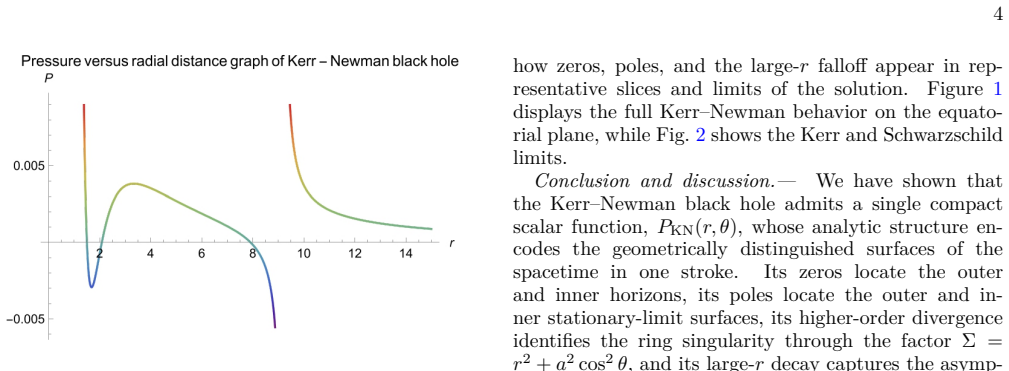
For the Kerr-Newman black hole, a single scalar function obtained by analytically continuing the membrane-paradigm pressure of the stretched horizon into the full spacetime has zeros that locate the outer and inner horizons, poles that locate the outer and inner stationary-limit surfaces, a higher-order divergence that identifies the ring singularity, and decay at large r that captures the asymptotic region. The same analytic structure also admits a secondary interpretation as an effective generalized multi-component van der Waals-type equation of state whose intrinsic scales are fixed by the distinguished radii of the spacetime.
What carries the argument
The analytically continued membrane-paradigm pressure scalar, whose zeros, poles, and divergences coincide with the geometrically defined surfaces.
Load-bearing premise
The membrane-paradigm pressure admits a unique, well-defined analytic continuation into the entire spacetime whose factorization and singularities coincide with the geometrically defined surfaces without additional tuning.
What would settle it
Explicit computation of the analytic continuation for the Kerr-Newman metric followed by verification that its zeros sit exactly at the known horizon radii and its poles sit exactly at the known stationary-limit radii.
Figures

read the original abstract
Black hole spacetimes contain several geometrically distinguished hypersurfaces, including event and Cauchy horizons, stationary-limit surfaces, curvature singularities, and asymptotic infinity. These structures are usually identified by different geometric or causal criteria. Here, we show that for the Kerr-Newman black hole, a single scalar function encodes all of them at once. The function arises by analytically continuing the membrane-paradigm pressure of the stretched horizon into the full spacetime. In fully factorized form, its zeros locate the outer and inner horizons, its poles locate the outer and inner stationary-limit surfaces, its higher-order divergence identifies the ring singularity, and its decay at large $r$ captures the asymptotic region. Thus, the analytically continued membrane pressure serves as a unified global detector of the critical surfaces in the Kerr-Newman geometry. We further note that the same analytic structure admits a secondary interpretation as an effective generalized multi-component van der Waals-type equation of state, whose intrinsic scales are fixed by the distinguished radii of the spacetime itself.
Editorial analysis
A structured set of objections, weighed in public.
Referee Report
Summary. The manuscript claims that for the Kerr-Newman black hole, a single scalar function obtained by analytically continuing the membrane-paradigm pressure of the stretched horizon into the full spacetime encodes all geometrically distinguished hypersurfaces: its zeros locate the outer and inner horizons, its poles locate the outer and inner stationary-limit surfaces, a higher-order divergence identifies the ring singularity, and its decay at large r captures the asymptotic region. The same analytic structure is noted to admit a secondary interpretation as an effective generalized multi-component van der Waals-type equation of state whose intrinsic scales are fixed by the distinguished radii of the spacetime.
Significance. If the explicit construction, factorization, and uniqueness of the continuation can be established without post-hoc adjustments, the result would provide a novel unification of black-hole critical surfaces under a single scalar derived from the membrane paradigm. This would link local horizon thermodynamics to global geometry in a parameter-free manner and strengthen thermodynamic analogies via the van der Waals interpretation. The absence of free parameters and the exact geometric matching, if verified, would constitute a notable strength.
major comments (2)
- Abstract: The central claim that the analytically continued function encodes the surfaces via its zeros, poles, and divergences cannot be verified because the manuscript supplies neither the explicit expression for the membrane-paradigm pressure nor the factorization steps that would demonstrate the correspondence to r±, ergospheres, and the ring singularity.
- Section on analytic continuation and uniqueness: The uniqueness of the analytic continuation from the locally defined stretched-horizon pressure is not demonstrated. Without an argument that any analytic function agreeing with the local data yields the same surface locations (or a canonical construction that precludes selection of a form that enforces the observed factorization), the unification remains dependent on the specific continuation chosen.
minor comments (1)
- The secondary van der Waals interpretation would benefit from an explicit mapping between the scalar's parameters and the multi-component scales to clarify how the distinguished radii fix the equation-of-state coefficients.
Simulated Author's Rebuttal
We thank the referee for the careful reading and constructive comments, which highlight areas where the manuscript can be strengthened for clarity and rigor. We address each major comment below and will incorporate the necessary revisions.
read point-by-point responses
-
Referee: Abstract: The central claim that the analytically continued function encodes the surfaces via its zeros, poles, and divergences cannot be verified because the manuscript supplies neither the explicit expression for the membrane-paradigm pressure nor the factorization steps that would demonstrate the correspondence to r±, ergospheres, and the ring singularity.
Authors: We agree that the explicit expression for the membrane-paradigm pressure and the detailed factorization steps were not provided in sufficient detail. In the revised manuscript, we will insert the explicit local form of the pressure scalar on the stretched horizon, followed by the analytic continuation procedure and the complete factorization into linear factors. This will explicitly demonstrate the correspondence: zeros at the outer and inner horizons (r = r±), poles at the outer and inner stationary-limit surfaces, a higher-order pole or divergence at the ring singularity, and the appropriate decay at spatial infinity. These additions will make the central claim directly verifiable. revision: yes
-
Referee: Section on analytic continuation and uniqueness: The uniqueness of the analytic continuation from the locally defined stretched-horizon pressure is not demonstrated. Without an argument that any analytic function agreeing with the local data yields the same surface locations (or a canonical construction that precludes selection of a form that enforces the observed factorization), the unification remains dependent on the specific continuation chosen.
Authors: We acknowledge that a demonstration of uniqueness was absent. In the revision, we will add a dedicated subsection that specifies the canonical construction: the unique meromorphic extension that matches the local membrane-paradigm pressure on the stretched horizon, satisfies the required asymptotic behavior, and contains no free parameters beyond those fixed by the Kerr-Newman geometry. We will argue that any other analytic continuation agreeing with the local data must reproduce the same zeros, poles, and divergences to preserve the physical interpretation from the membrane paradigm, thereby fixing the surface locations independently of the particular functional form chosen. revision: yes
Circularity Check
No significant circularity; derivation applies standard analytic continuation to an independently defined local quantity
full rationale
The central step is taking the membrane-paradigm pressure (a locally defined quantity on the stretched horizon from the standard membrane paradigm) and performing analytic continuation to the full Kerr-Newman spacetime. The resulting scalar's zeros, poles, and divergences are then verified by direct substitution of the metric functions; this is a mathematical consequence of the algebraic form of the Kerr-Newman line element rather than a self-definition, fitted prediction, or load-bearing self-citation. No equations reduce the claimed locations to the input by construction, and the continuation procedure is presented as a canonical extension without post-hoc tuning or uniqueness theorems imported from the authors' prior work. The unification is therefore an observation about the global analytic structure, not a tautology.
Axiom & Free-Parameter Ledger
axioms (2)
- domain assumption The membrane-paradigm pressure admits a unique analytic continuation to the full Kerr-Newman spacetime.
- standard math The Kerr-Newman metric provides the background geometry.
Reference graph
Works this paper leans on
-
[1]
Gravitational collapse: The role of general relativity,
R. Penrose, “Gravitational collapse: The role of general relativity,” Riv. Nuovo Cim.1, 252-276 (1969)
work page 1969
-
[2]
R. P. Kerr, Gravitational field of a spinning mass as an example of algebraically special metrics, Phys. Rev. Lett. 11, 237 (1963)
work page 1963
-
[3]
Global structure of the Kerr family of gravi- tational fields,
B. Carter, “Global structure of the Kerr family of gravi- tational fields,” Phys. Rev.174, 1559-1571 (1968)
work page 1968
-
[4]
Gravitational collapse and space-time sin- gularities,
R. Penrose, “Gravitational collapse and space-time sin- gularities,” Phys. Rev. Lett.14, 57-59 (1965)
work page 1965
-
[5]
A. Karlhede, U. Lindstrom and J. E. Aman, A note on a local effect at the Schwarzschild sphere, Gen. Rel. Grav. 14, 569 (1982)
work page 1982
-
[6]
M.AbdelqaderandK.Lake, Invariantcharacterizationof the Kerr spacetime: Locating the horizon and measuring the mass and spin of rotating black holes using curvature invariants, Phys. Rev. D91, no.8, 084017 (2015)
work page 2015
-
[7]
D. N. Page and A. A. Shoom, Local Invariants Vanishing on Stationary Horizons: A Diagnostic for Locating Black Holes, Phys. Rev. Lett.114, no.14, 141102 (2015)
work page 2015
-
[8]
D.D.McNutt, M.A.H.MacCallum, D.Gregoris, A.For- get, A. A. Coley, P. C. Chavy-Waddy and D. Brooks, Cartan Invariants and Event Horizon Detection, Ex- tended Version, Gen. Rel. Grav.50, no.4, 37 (2018). [er- ratum: Gen. Rel. Grav.52, no.1, 6 (2020)]
work page 2018
-
[9]
A. Tavlayan and B. Tekin, Event horizon detecting in- variants, Phys. Rev. D101, no.8, 084034 (2020)
work page 2020
-
[10]
Damour, Black Hole Eddy Currents, Phys
T. Damour, Black Hole Eddy Currents, Phys. Rev. D18, 3598-3604 (1978)
work page 1978
-
[11]
K. S. Thorne, R. H. Price, and D. A. Macdonald,Black Holes: The Membrane Paradigm(Yale University Press, London, 1986)
work page 1986
-
[12]
Straumann, The membrane model of black holes and applications, Lect
N. Straumann, The membrane model of black holes and applications, Lect. Notes Phys.514, 111 (1998)
work page 1998
-
[13]
C. U. Agca and B. Tekin, Membrane paradigm approach to the Johannsen–Psaltis black hole, Phys. Rev. D109, no.10, 10 (2024)
work page 2024
-
[14]
C.U.AgcaandB.Tekin, Fluid-membranedescriptionsof various black holes, Eur. Phys. J. C85, no.8, 890 (2025)
work page 2025
-
[15]
T. Johannsen and D. Psaltis, A Metric for Rapidly Spin- ning Black Holes Suitable for Strong-Field Tests of the No-Hair Theorem, Phys. Rev. D83, 124015 (2011)
work page 2011
-
[16]
E. T. Newman, E. Couch, K. Chinnapared, A. Ex- ton, A. Prakash and R. Torrence, Metric of a Rotating, Charged Mass, J. Math. Phys.6, 918-919 (1965)
work page 1965
-
[17]
M. Parikh and F. Wilczek, An action for black hole mem- branes, Phys. Rev. D58, 064011 (1998)
work page 1998
-
[18]
A. J. Nurmagambetov and A. M. Arslanaliev, Kerr black holes within the membrane paradigm, Lett. High Energy Phys.2022, 328 (2022). ENDNOTE: MEMBRANE-PARADIGM ORIGIN AND GEOMETRIC FORM OF THE PRESSURE This endnote summarizes the derivation steps underlying the pressure formula used in the main text. Its purpose is twofold. First, it explains how the membra...
work page 2022
-
[19]
Geometric set-up Consider a timelike stretched horizonMwith an outward-pointing spacelike unit normalna, and let the spacetime metric be decomposed as gab =h ab +nanb,(34) whereh ab is the induced metric on the stretched horizon. InsideM, one further separates the timelike directionua and the spatial(d−2)-dimensional metricγab, so that hab =−uaub +γab, u ...
-
[20]
Following the decompositionhab =−uaub +γab, one arrives at the result
Decomposition of the stretched-horizon extrinsic curvature The extrinsic curvature could be decomposed further into the spatial sectionγab, mixed terms, and purely time-like terms. Following the decompositionhab =−uaub +γab, one arrives at the result. Kab =k ab−uaΩb−ubΩa−gHuaub,(37) here,k ab :=γacγbd∇cnd is the extrinsic curvature of the spatial(d−2)-sur...
-
[21]
Membrane stress tensor in decomposed form Substituting (37) and (38) into (36), one finds tab = 1 8πG[(k+g H)γab−kab−kuaub +uaΩb +ubΩa].(39) Projecting this tensor alongua andγab gives the membrane energy density, momentum density, and stress two-form: ρ:=uaubtab =−k 8πG, π A :=−γA aubtab = ΩA 8πG,(40) t(spatial) AB :=γA aγB btab = 1 8πG[(k+g H)γAB−kAB].(...
-
[22]
Trace–traceless split and viscous-fluid identification Now decompose the spatial extrinsic curvaturekAB into trace and traceless parts: kAB =σAB + 1 d−2ΘγAB, γ ABσAB = 0,(42) whereΘ :=γABkAB is the expansion andσAB is the shear tensor of the stretched horizon. Substituting (42) into (41) gives t(spatial) AB = 1 8πG [ −σAB + ( gH + d−3 d−2Θ ) γAB ] .(43) T...
-
[23]
Orbit-space form of the geometric pressure A stationary axisymmetric spacetime admits two commuting Killing vector fields, ξµ= (∂ ∂t )µ , ψ µ= ( ∂ ∂ϕ )µ .(E16) At each point where they are linearly independent, they span a two-dimensional Killing orbit. For circular spacetimes such as Kerr–Newman, the orthogonal complement of these orbits defines a two-di...
discussion (0)
Sign in with ORCID, Apple, or X to comment. Anyone can read and Pith papers without signing in.