Recognition: no theorem link
Neural Stochastic Processes for Satellite Precipitation Refinement
Pith reviewed 2026-05-10 16:12 UTC · model grok-4.3
The pith
Neural Stochastic Processes that condition on gauge data and evolve spatial fields with a latent Neural SDE produce more accurate precipitation estimates than prior fusion methods.
A machine-rendered reading of the paper's core claim, the machinery that carries it, and where it could break.
Core claim
By pairing a Neural Process encoder conditioning on arbitrary sets of gauge observations with a latent Neural SDE on a 2D spatial representation and training under a single variational objective with simulation-free cost, the NSP produces refined precipitation fields that outperform thirteen baselines and an operational product on the QPEBench benchmark of 43,756 hourly samples over the contiguous United States, with further confirmation of generalization on independent Kyushu data.
What carries the argument
Neural Stochastic Process (NSP) formed by a Neural Process encoder for gauge conditioning together with a latent Neural SDE that evolves the 2D spatial precipitation representation over time.
Load-bearing premise
The temporal patterns learned by the latent Neural SDE from 2021-2025 US gauge-satellite alignments will continue to hold for precipitation fields observed in other time periods and geographic regions.
What would settle it
New hourly samples from 2026 or later in the US, or from a different continent, on which the NSP fails to exceed the best of the thirteen baselines or the operational gauge-calibrated product across the six metrics would falsify the claimed advantage.
Figures


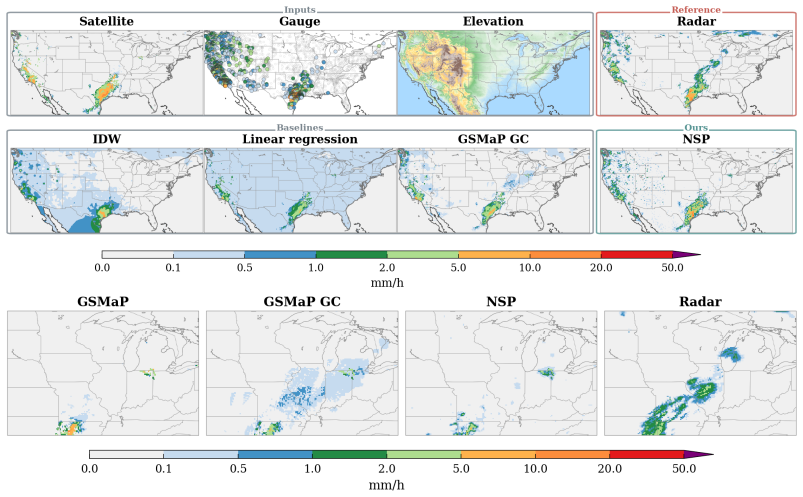
read the original abstract
Accurate precipitation estimation is critical for flood forecasting, water resource management, and disaster preparedness. Satellite products provide global hourly coverage but contain systematic biases; ground-based gauges are accurate at point locations but too sparse for direct gridded correction. Existing methods fuse these sources by interpolating gauge observations onto the satellite grid, but treat each time step independently and therefore discard temporal structure in precipitation fields. We propose Neural Stochastic Process (NSP), a model that pairs a Neural Process encoder conditioning on arbitrary sets of gauge observations with a latent Neural SDE on a 2D spatial representation. NSP is trained under a single variational objective with simulation-free cost. We also introduce QPEBench, a benchmark of 43{,}756 hourly samples over the Contiguous United States (2021--2025) with four aligned data sources and six evaluation metrics. On QPEBench, NSP outperforms 13 baselines across all six metrics and surpasses JAXA's operational gauge-calibrated product. An additional experiment on Kyushu, Japan confirms generalization to a different region with independent data sources.
Editorial analysis
A structured set of objections, weighed in public.
Referee Report
Summary. The manuscript proposes Neural Stochastic Processes (NSP) that combine a Neural Process encoder (conditioning on arbitrary gauge sets) with a latent Neural SDE operating on 2D spatial representations of precipitation fields. The model is trained end-to-end under a single variational objective with simulation-free cost. The authors introduce QPEBench, a new benchmark of 43,756 hourly aligned samples over the contiguous US (2021–2025) with four data sources and six metrics, and report that NSP outperforms 13 baselines on all metrics while also surpassing JAXA’s operational gauge-calibrated product; a secondary experiment on Kyushu, Japan, is offered as evidence of regional generalization.
Significance. If the reported gains are shown to arise from the temporal structure captured by the latent Neural SDE rather than from evaluation artifacts, the work would constitute a meaningful advance in spatiotemporal data fusion for quantitative precipitation estimation. The creation of QPEBench itself supplies a reusable, multi-source benchmark that could standardize future comparisons in satellite precipitation refinement.
major comments (2)
- [§4 (QPEBench and Experimental Setup)] The manuscript does not specify the train–test partitioning strategy for the 43,756 QPEBench samples (all drawn from the single 2021–2025 window). Without explicit temporal blocking (e.g., year-wise or multi-week hold-out periods), information from nearby time steps can leak into the test set, rendering the comparison to the 13 time-independent baselines inconclusive and undermining the central claim that performance gains derive from the Neural SDE’s modeling of temporal structure.
- [§5 (Results)] No ablation studies isolate the contribution of the latent Neural SDE component versus the Neural Process encoder alone, and no error bars or statistical significance tests accompany the six-metric results on QPEBench. These omissions make it impossible to determine whether the headline outperformance is robust or sensitive to post-hoc modeling choices.
minor comments (2)
- [§3.2] The description of the 2D spatial representation on which the Neural SDE operates would benefit from an explicit diagram or equation showing how the latent state is discretized and evolved.
- [§5.1] The abstract states that NSP “surpasses JAXA’s operational gauge-calibrated product,” yet the main text does not clarify whether this comparison uses the same gauge network or an independent validation set.
Simulated Author's Rebuttal
We are grateful to the referee for their thorough review and constructive feedback on our manuscript. We address each of the major comments in detail below, outlining how we plan to revise the paper to incorporate these suggestions.
read point-by-point responses
-
Referee: [§4 (QPEBench and Experimental Setup)] The manuscript does not specify the train–test partitioning strategy for the 43,756 QPEBench samples (all drawn from the single 2021–2025 window). Without explicit temporal blocking (e.g., year-wise or multi-week hold-out periods), information from nearby time steps can leak into the test set, rendering the comparison to the 13 time-independent baselines inconclusive and undermining the central claim that performance gains derive from the Neural SDE’s modeling of temporal structure.
Authors: We thank the referee for pointing out the lack of explicit detail on the train-test partitioning. This was an omission in the original manuscript. In the revision, we will specify and employ a year-based temporal split: training on samples from 2021 to 2023, validation on 2024, and testing on 2025. This blocking strategy eliminates the possibility of temporal leakage. We will re-conduct the experiments with this split and report the updated results, which we expect to show that the outperformance holds, attributing it to the temporal modeling in NSP. revision: yes
-
Referee: [§5 (Results)] No ablation studies isolate the contribution of the latent Neural SDE component versus the Neural Process encoder alone, and no error bars or statistical significance tests accompany the six-metric results on QPEBench. These omissions make it impossible to determine whether the headline outperformance is robust or sensitive to post-hoc modeling choices.
Authors: We agree that the absence of ablation studies and statistical analyses limits the interpretability of the results. In the revised manuscript, we will include an ablation study in §5 that compares the full NSP model (with both Neural Process encoder and latent Neural SDE) against a baseline variant consisting of only the Neural Process encoder without the SDE component. This will isolate the contribution of the latent Neural SDE to capturing temporal structure in precipitation fields. Furthermore, we will augment the six-metric results with error bars representing variability across multiple training runs or bootstrap resampling, and include p-values from appropriate statistical tests (e.g., paired t-tests) to assess the significance of the improvements over baselines. These additions will provide evidence for the robustness of our findings and address concerns about sensitivity to modeling choices. revision: yes
Circularity Check
No circularity in model derivation or benchmark claims
full rationale
The paper defines NSP as a composition of a Neural Process encoder and latent Neural SDE trained end-to-end under a single variational objective with simulation-free cost. Performance claims rest on outperformance against 13 baselines and an operational product on the introduced QPEBench (43,756 held-out hourly samples) plus an independent regional experiment on Kyushu with separate data sources. No step equates a derived quantity to its own fitted parameters by construction, renames a known result, or relies on a load-bearing self-citation whose content is unverified outside the present work. The evaluation uses external benchmarks and metrics, rendering the central claims self-contained against the provided inputs.
Axiom & Free-Parameter Ledger
Reference graph
Works this paper leans on
-
[1]
GloFAS–global ensemble streamflow forecasting and flood early warning.Hydrology and Earth System Sciences, 17(3):1161–1175, 2013
Lorenzo Alfieri, Peter Burek, Emanuel Dutra, Blazej Krzeminski, David Muraro, Jutta Thielen, and Florian Pappenberger. GloFAS–global ensemble streamflow forecasting and flood early warning.Hydrology and Earth System Sciences, 17(3):1161–1175, 2013
2013
-
[2]
End- to-end data-driven weather prediction.Nature, 641(8065):1172–1179, 2025
Anna Allen, Stratis Markou, Will Tebbutt, James Requeima, Wessel P Bruinsma, Tom R Andersson, Michael Herzog, Nicholas D Lane, Matthew Chantry, J Scott Hosking, et al. End- to-end data-driven weather prediction.Nature, 641(8065):1172–1179, 2025
2025
-
[3]
Neural continuous-discrete state space models for irregularly-sampled time series
Abdul Fatir Ansari, Alvin Heng, Andre Lim, and Harold Soh. Neural continuous-discrete state space models for irregularly-sampled time series. InProceedings of the International Conference on Machine Learning (ICML), volume 202, pages 926–951. PMLR, 2023
2023
-
[4]
Gridded transformer neural processes for spatio-temporal data
Matthew Ashman, Cristiana Diaconu, Eric Langezaal, Adrian Weller, et al. Gridded transformer neural processes for spatio-temporal data. InProceedings of the International Conference on Machine Learning (ICML), volume 267, pages 1722–1761. PMLR, 2025
2025
-
[5]
Improving precipitation forecasts with convolutional neural networks.Weather and Forecasting, 38(2):291–306, 2023
Anirudhan Badrinath, Luca Delle Monache, Negin Hayatbini, Will Chapman, Forest Cannon, and Marty Ralph. Improving precipitation forecasts with convolutional neural networks.Weather and Forecasting, 38(2):291–306, 2023
2023
-
[6]
From bias to accuracy: Transforming satellite precipitation data in arid regions with machine learning and topographical insights.Journal of Hydrology, 653:132801, 2025
Faisal Baig, Luqman Ali, Muhammad Abrar Faiz, Haonan Chen, and Mohsen Sherif. From bias to accuracy: Transforming satellite precipitation data in arid regions with machine learning and topographical insights.Journal of Hydrology, 653:132801, 2025
2025
-
[7]
SDE matching: Scalable and simulation-free training of latent stochastic differential equations
Grigory Bartosh, Dmitry Vetrov, et al. SDE matching: Scalable and simulation-free training of latent stochastic differential equations. InProceedings of the International Conference on Machine Learning (ICML), volume 267, pages 3054–3070. PMLR, 2025
2025
-
[8]
Accurate medium-range global weather forecasting with 3D neural networks.Nature, 619:533–538, 2023
Kaifeng Bi, Lingxi Xie, Hengheng Zhang, Xin Chen, Xiaotao Gu, et al. Accurate medium-range global weather forecasting with 3D neural networks.Nature, 619:533–538, 2023
2023
-
[9]
Wessel Bruinsma, Stratis Markou, James Requiema, Andrew Y . K. Foong, Tom Andersson, Anna Vaughan, Anthony Buonomo, Scott Hosking, et al. Autoregressive conditional neural processes. InInternational Conference on Learning Representations (ICLR), 2023
2023
-
[10]
Convolutional conditional neural processes.arXiv preprint arXiv:2408.09583, 2024
Wessel P Bruinsma. Convolutional conditional neural processes.arXiv preprint arXiv:2408.09583, 2024
-
[11]
Geographically weighted regression: a method for exploring spatial nonstationarity.Geographical analysis, 28(4):281–298, 1996
Chris Brunsdon, A Stewart Fotheringham, et al. Geographically weighted regression: a method for exploring spatial nonstationarity.Geographical analysis, 28(4):281–298, 1996
1996
-
[12]
Deep learning for bias correction of satellite retrievals of orographic precipitation.IEEE Transactions on Geoscience and Remote Sensing, 60:1–11, 2022
Haonan Chen, Luyao Sun, Robert Cifelli, and Pingping Xie. Deep learning for bias correction of satellite retrievals of orographic precipitation.IEEE Transactions on Geoscience and Remote Sensing, 60:1–11, 2022
2022
-
[13]
Neural ordinary differential equations
Ricky TQ Chen, Yulia Rubanova, Jesse Bettencourt, et al. Neural ordinary differential equations. Advances in Neural Information Processing Systems (NeurIPS), 31, 2018
2018
-
[14]
Xgboost: A scalable tree boosting system
Tianqi Chen and Carlos Guestrin. Xgboost: A scalable tree boosting system. InProceedings of the ACM SIGKDD International Conference on Knowledge Discovery and Data Mining, pages 785–794, 2016
2016
-
[15]
RainNet: A large- scale imagery dataset and benchmark for spatial precipitation downscaling
Xuanhong Chen, Kairui Feng, Naiyuan Liu, Bingbing Ni, Yifan Lu, et al. RainNet: A large- scale imagery dataset and benchmark for spatial precipitation downscaling. InAdvances in Neural Information Processing Systems, volume 35, pages 15152–15164, 2022
2022
-
[16]
John Wiley & Sons, 1993
Noel Cressie.Statistics for spatial data. John Wiley & Sons, 1993
1993
-
[17]
RainBench: Towards data-driven global precipitation forecasting from satellite imagery
Christian Schroeder de Witt, Catherine Tong, Valentina Zantedeschi, et al. RainBench: Towards data-driven global precipitation forecasting from satellite imagery. InProceedings of the AAAI Conference on Artificial Intelligence (AAAI), volume 35, pages 14902–14910, 2021. 10
2021
-
[18]
An image is worth 16x16 words: Transformers for image recognition at scale
Alexey Dosovitskiy, Lucas Beyer, Alexander Kolesnikov, Dirk Weissenborn, Xiaohua Zhai, Thomas Unterthiner, et al. An image is worth 16x16 words: Transformers for image recognition at scale. InInternational Conference on Learning Representations (ICLR), 2021
2021
-
[19]
Elizabeth E Ebert. Fuzzy verification of high-resolution gridded forecasts: a review and proposed framework.Meteorological Applications: a Journal of Forecasting, Practical Applications, Training Techniques and Modelling, 15(1):51–64, 2008
2008
-
[20]
Meta-learning stationary stochastic process prediction with convolutional neural processes
Andrew Foong, Wessel Bruinsma, Jonathan Gordon, Yann Dubois, James Requeima, et al. Meta-learning stationary stochastic process prediction with convolutional neural processes. Advances in Neural Information Processing Systems (NeurIPS), 33:8284–8295, 2020
2020
-
[21]
ETOPO 2022 15 arc-second global relief model, 2022
NOAA National Centers for Environmental Information. ETOPO 2022 15 arc-second global relief model, 2022
2022
-
[22]
Conditional neural processes
Marta Garnelo, Dan Rosenbaum, Christopher Maddison, Tiago Ramalho, David Saxton, Murray Shanahan, Yee Whye Teh, Danilo Rezende, et al. Conditional neural processes. InProceedings of the International Conference on Machine Learning (ICML), pages 1704–1713. PMLR, 2018
2018
-
[23]
Marta Garnelo, Jonathan Schwarz, Dan Rosenbaum, Fabio Viola, Danilo J Rezende, SM Eslami, and Yee Whye Teh. Neural processes.arXiv preprint arXiv:1807.01622, 2018
-
[24]
Calibrated probabilistic forecasting using ensemble model output statistics and minimum crps estimation
Tilmann Gneiting, Adrian E Raftery, Anton H Westveld III, and Tom Goldman. Calibrated probabilistic forecasting using ensemble model output statistics and minimum crps estimation. Monthly weather review, 133(5):1098–1118, 2005
2005
-
[25]
Bruinsma, Andrew Y
Jonathan Gordon, Wessel P. Bruinsma, Andrew Y . K. Foong, James Requeima, Yann Dubois, and Richard E. Turner. Convolutional conditional neural processes. InInternational Conference on Learning Representations (ICLR), 2020
2020
-
[26]
Flow matching neural processes.Advances in Neural Information Processing Systems (NeurIPS), pages 1–24, 2025
Hussen Abu Hamad and Dan Rosenbaum. Flow matching neural processes.Advances in Neural Information Processing Systems (NeurIPS), pages 1–24, 2025
2025
-
[27]
Paula Harder, Luca Schmidt, Francis Pelletier, Nicole Ludwig, Matthew Chantry, Christian Lessig, Alex Hernandez-Garcia, and David Rolnick. RainShift: A benchmark for precipitation downscaling across geographies.arXiv preprint arXiv:2507.04930, 2025
-
[28]
Integrated multi-satellite retrievals for the global precipitation measurement (GPM) mission (IMERG)
George J Huffman, David T Bolvin, Dan Braithwaite, Kuo-Lin Hsu, Robert J Joyce, et al. Integrated multi-satellite retrievals for the global precipitation measurement (GPM) mission (IMERG). InSatellite Precipitation Measurement: Volume 1, pages 343–353. Springer, 2020
2020
-
[29]
Status of satellite precipitation retrievals.Hydrology and Earth System Sciences, 15(4):1109–1116, 2011
Chris Kidd and Vincenzo Levizzani. Status of satellite precipitation retrievals.Hydrology and Earth System Sciences, 15(4):1109–1116, 2011
2011
- [30]
-
[31]
Efficient and accurate gradients for neural sdes.Advances in Neural Information Processing Systems (NeurIPS), 34:18747–18761, 2021
Patrick Kidger, James Foster, Xuechen Chen Li, and Terry Lyons. Efficient and accurate gradients for neural sdes.Advances in Neural Information Processing Systems (NeurIPS), 34:18747–18761, 2021
2021
-
[32]
Attentive neural processes
Hyunjik Kim, Andriy Mnih, Jonathan Schwarz, Marta Garnelo, Ali Eslami, Dan Rosenbaum, Oriol Vinyals, and Yee Whye Teh. Attentive neural processes. InInternational Conference on Learning Representations (ICLR), 2019
2019
-
[33]
Auto-Encoding Variational Bayes
Diederik P Kingma and Max Welling. Auto-encoding variational Bayes.arXiv preprint arXiv:1312.6114, 2014
work page internal anchor Pith review Pith/arXiv arXiv 2014
-
[34]
A probabilistic u-net for segmentation of ambiguous images.Advances in Neural Information Processing Systems (NeurIPS), 31, 2018
Simon Kohl, Bernardino Romera-Paredes, Clemens Meyer, Jeffrey De Fauw, Joseph R Ledsam, Klaus Maier-Hein, SM Eslami, et al. A probabilistic u-net for segmentation of ambiguous images.Advances in Neural Information Processing Systems (NeurIPS), 31, 2018
2018
-
[35]
Global satellite mapping of precipitation (GSMaP) products in the GPM era
Takuji Kubota, Kazumasa Aonashi, Tomoo Ushio, Shoichi Shige, Yukari N Takayabu, Misako Kachi, Yoriko Arai, et al. Global satellite mapping of precipitation (GSMaP) products in the GPM era. InSatellite precipitation measurement: Volume 1, pages 355–373. Springer, 2020. 11
2020
-
[36]
Jussi Leinonen, Daniele Nerini, and Alexis Berne. Stochastic super-resolution for downscaling time-evolving atmospheric fields with a generative adversarial network.IEEE Transactions on Geoscience and Remote Sensing, 59(9):7211–7223, 2021
2021
-
[37]
Scalable gradi- ents for stochastic differential equations
Xuechen Li, Ting-Kam Leonard Wong, Ricky TQ Chen, and David Duvenaud. Scalable gradi- ents for stochastic differential equations. InInternational Conference on Artificial Intelligence and Statistics (AISTATS), pages 3870–3882. PMLR, 2020
2020
-
[38]
Precipitation estima- tion with nwp model and generative diffusion model.Geophysical Research Letters, 52(7):e2024GL110625, 2025
Haolin Liu, Jimmy CH Fung, Alexis KH Lau, and Zhenning Li. Precipitation estima- tion with nwp model and generative diffusion model.Geophysical Research Letters, 52(7):e2024GL110625, 2025
2025
-
[39]
Springer, 2017
Daniel P Loucks and Eelco Van Beek.Water resource systems planning and management: An introduction to methods, models, and applications. Springer, 2017
2017
-
[40]
Evaluation of GSMaP version 8 precipitation products on an hourly timescale over mainland China.Remote Sensing, 16(1):210, 2024
Xiaoyu Lv, Hao Guo, Yunfei Tian, Xiangchen Meng, Anming Bao, and Philippe De Maeyer. Evaluation of GSMaP version 8 precipitation products on an hourly timescale over mainland China.Remote Sensing, 16(1):210, 2024
2024
-
[41]
Viviana Maggioni, Patrick C Meyers, and Monique D Robinson. A review of merged high- resolution satellite precipitation product accuracy during the tropical rainfall measuring mission (trmm) era.Journal of Hydrometeorology, 17(4):1101–1117, 2016
2016
-
[42]
Gauge-adjusted global satellite mapping of precipitation.IEEE Transactions on Geoscience and Remote Sensing, 57(4):1928–1935, 2019
Tomoaki Mega, Tomoo Ushio, Matsuda Takahiro, Takuji Kubota, Misako Kachi, and Riko Oki. Gauge-adjusted global satellite mapping of precipitation.IEEE Transactions on Geoscience and Remote Sensing, 57(4):1928–1935, 2019
1928
-
[43]
Spectral convolutional conditional neural process.Advances in Neural Information Processing Systems (NeurIPS), pages 1–31, 2025
Peiman Mohseni and Nick Duffield. Spectral convolutional conditional neural process.Advances in Neural Information Processing Systems (NeurIPS), pages 1–31, 2025
2025
-
[44]
ChaosBench: A multi-channel, physics-based benchmark for subseasonal-to-seasonal climate prediction
Juan Nathaniel, Yongquan Qu, Tung Nguyen, Sungduk Yu, Julius Busecke, et al. ChaosBench: A multi-channel, physics-based benchmark for subseasonal-to-seasonal climate prediction. Advances in Neural Information Processing Systems (NeurIPS), 37:43715–43729, 2024
2024
-
[45]
NOAA National Centers for Environmental Information. U.s. billion-dollar weather and climate disasters, 2025
2025
-
[46]
Stable neural stochastic differential equa- tions in analyzing irregular time series data
YongKyung Oh, Dongyoung Lim, and Sungil Kim. Stable neural stochastic differential equa- tions in analyzing irregular time series data. InInternational Conference on Learning Represen- tations (ICLR), 2024
2024
-
[47]
Amortized control of continuous state space feynman-kac model for irregular time series
Byoungwoo Park, Hyungi Lee, and Juho Lee. Amortized control of continuous state space feynman-kac model for irregular time series. InInternational Conference on Learning Repre- sentations (ICLR), 2025
2025
-
[48]
Jaideep Pathak, Shashank Subramanian, Peter Harrington, Sanjeev Raja, Ashesh Chattopadhyay, Morteza Mardani, Thorsten Kurth, et al. Fourcastnet: A global data-driven high-resolution weather model using adaptive fourier neural operators.arXiv preprint arXiv:2202.11214, 2022
work page internal anchor Pith review arXiv 2022
-
[49]
A benchmark dataset for satellite-based estimation and detection of rain.Scientific Data, 13(1):244, 2026
Simon Pfreundschuh, Malarvizhi Arulraj, Ali Behrangi, Linda Bogerd, Alan James Peixoto Calheiros, Daniele Casella, Neda Dolatabadi, Clement Guilloteau, et al. A benchmark dataset for satellite-based estimation and detection of rain.Scientific Data, 13(1):244, 2026
2026
-
[50]
Carl Edward Rasmussen and Christopher K. I. Williams.Gaussian Processes for Machine Learning. MIT Press, 2006
2006
-
[51]
WeatherBench 2: A benchmark for the next generation of data-driven global weather models.Journal of Advances in Modeling Earth Systems, 16(6):e2023MS004019, 2024
Stephan Rasp, Stephan Hoyer, Alexander Merose, Ian Langmore, Peter Battaglia, Tyler Russell, et al. WeatherBench 2: A benchmark for the next generation of data-driven global weather models.Journal of Advances in Modeling Earth Systems, 16(6):e2023MS004019, 2024
2024
-
[52]
Scale-selective verification of rainfall accumulations from high-resolution forecasts of convective events.Monthly Weather Review, 136(1):78–97, 2008
Nigel M Roberts et al. Scale-selective verification of rainfall accumulations from high-resolution forecasts of convective events.Monthly Weather Review, 136(1):78–97, 2008. 12
2008
-
[53]
U-net: Convolutional networks for biomedical image segmentation
Olaf Ronneberger, Philipp Fischer, and Thomas Brox. U-net: Convolutional networks for biomedical image segmentation. InMedical Image Computing and Computer-Assisted Inter- vention – MICCAI 2015, pages 234–241, Cham, 2015. Springer International Publishing
2015
-
[54]
A two-dimensional interpolation function for irregularly-spaced data
Donald Shepard. A two-dimensional interpolation function for irregularly-spaced data. In Proceedings of the ACM National Conference, pages 517–524, 1968
1968
-
[55]
The global precipitation measurement (GPM) mission for science and society.Bulletin of the American Meteorological Society, 98(8):1679–1695, 2017
Gail Skofronick-Jackson, Walter A Petersen, Wesley Berg, Chris Kidd, Erich F Stocker, Dalia B Kirschbaum, Ramesh Kakar, et al. The global precipitation measurement (GPM) mission for science and society.Bulletin of the American Meteorological Society, 98(8):1679–1695, 2017
2017
-
[56]
Multi-radar multi-sensor (MRMS) severe weather and aviation products: Initial operating capabilities.Bulletin of the American Meteorological Society, 97(9):1617–1630, 2016
Travis M Smith, Valliappa Lakshmanan, Gregory J Stumpf, Kiel L Ortega, Kurt Hondl, et al. Multi-radar multi-sensor (MRMS) severe weather and aviation products: Initial operating capabilities.Bulletin of the American Meteorological Society, 97(9):1617–1630, 2016
2016
-
[57]
Precipitation downscaling with spatiotemporal video diffusion.Advances in Neural Information Processing Systems (NeurIPS), 37:56374–56400, 2024
Prakhar Srivastava, Ruihan Yang, Gavin Kerrigan, Gideon Dresdner, Jeremy McGibbon, Christo- pher Bretherton, et al. Precipitation downscaling with spatiotemporal video diffusion.Advances in Neural Information Processing Systems (NeurIPS), 37:56374–56400, 2024
2024
-
[58]
A review of global precipitation data sets: Data sources, estimation, and intercomparisons.Reviews of Geophysics, 56(1):79–107, 2018
Qiaohong Sun, Chiyuan Miao, Qingyun Duan, Hamed Ashouri, Soroosh Sorooshian, and Kuo-Lin Hsu. A review of global precipitation data sets: Data sources, estimation, and intercomparisons.Reviews of Geophysics, 56(1):79–107, 2018
2018
-
[59]
Synoptic weather api
Synoptic Data PBC. Synoptic weather api. Data access platform, 2026. Accessed for station observations across the CONUS domain
2026
-
[60]
Peters-Lidard, John B
Yudong Tian, Christa D. Peters-Lidard, John B. Eylander, Robert J. Joyce, George J. Huffman, Robert F. Adler, Kuo-lin Hsu, et al. Component analysis of errors in satellite-based precipitation estimates.Journal of Geophysical Research: Atmospheres, 114(D24), 2009
2009
-
[61]
The changing character of precipitation
Kevin E Trenberth, Aiguo Dai, Roy M Rasmussen, et al. The changing character of precipitation. Bulletin of the American Meteorological Society, 84(9):1205–1218, 2003
2003
-
[62]
Trenberth et al
Kevin E. Trenberth et al. Intermittency in precipitation: Duration, frequency, intensity, and amounts using hourly data.Journal of Hydrometeorology, 18(5):1393–1412, 2017
2017
-
[63]
Belinda Tzen and Maxim Raginsky. Neural stochastic differential equations: Deep latent gaussian models in the diffusion limit.arXiv preprint arXiv:1905.09883, 2019
-
[64]
Convolutional conditional neural processes for local climate downscaling.Geoscientific Model Development, 15(1):251–268, 2022
Anna Vaughan, Will Tebbutt, et al. Convolutional conditional neural processes for local climate downscaling.Geoscientific Model Development, 15(1):251–268, 2022
2022
-
[65]
ClimODE: Climate and weather forecasting with physics-informed neural ODEs
Yogesh Verma et al. ClimODE: Climate and weather forecasting with physics-informed neural ODEs. InInternational Conference on Learning Representations (ICLR), 2024
2024
-
[66]
Hydrologic implications of dynamical and statistical approaches to downscaling climate model outputs
Andrew W Wood, Lai R Leung, Venkataramana Sridhar, and Dennis P Lettenmaier. Hydrologic implications of dynamical and statistical approaches to downscaling climate model outputs. Climatic change, 62(1):189–216, 2004
2004
-
[67]
Atlas of mortality and economic losses from weather, climate and water-related hazards (1970–2021)
World Meteorological Organization. Atlas of mortality and economic losses from weather, climate and water-related hazards (1970–2021). https://wmo.int/publication-series/ atlas-of-mortality-and-economic-losses-from-weather-climate-and-water -related-hazards-1970-2021, May 2023. Published 22 May 2023; accessed 2026-03-18
1970
-
[68]
Correcting the bias of daily satellite precipitation estimates in tropical regions using deep neural network.Journal of Hydrology, 608:127656, 2022
Xiaoying Yang, Shuai Yang, Mou Leong Tan, Hengyang Pan, Hongliang Zhang, Guoqing Wang, Ruimin He, and Zimeng Wang. Correcting the bias of daily satellite precipitation estimates in tropical regions using deep neural network.Journal of Hydrology, 608:127656, 2022
2022
-
[69]
Neural jump-diffusion temporal point processes
Shuai Zhang, Chuan Zhou, Yang Aron Liu, Peng Zhang, Xixun Lin, and Zhi-Ming Ma. Neural jump-diffusion temporal point processes. InProceedings of the International Conference on Machine Learning (ICML), volume 235, pages 60541–60557. PMLR, 2024. 13 A Additional Related Work Neural Process variants.Beyond the core NP family [ 22, 23], cross-attention mechan...
discussion (0)
Sign in with ORCID, Apple, or X to comment. Anyone can read and Pith papers without signing in.