Discussion on the equivalence of two relativistic point-particle Lagrangians
Pith reviewed 2026-05-10 16:29 UTC · model grok-4.3
The pith
Two relativistic Lagrangians for particles in gravity plus external potentials agree only when the potential is electromagnetic or zero.
A machine-rendered reading of the paper's core claim, the machinery that carries it, and where it could break.
Core claim
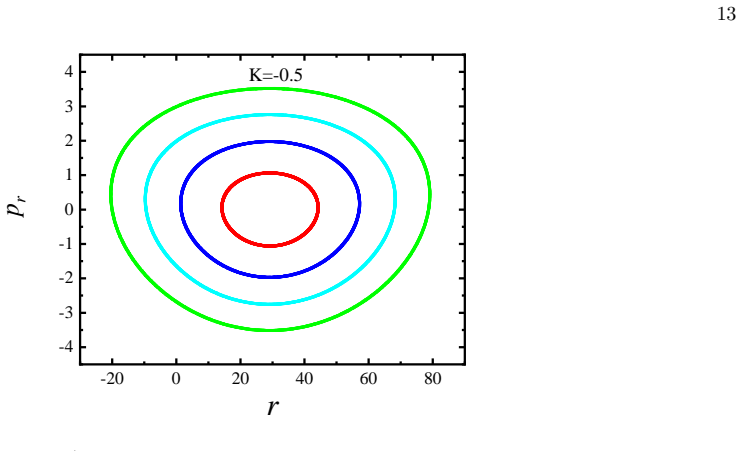
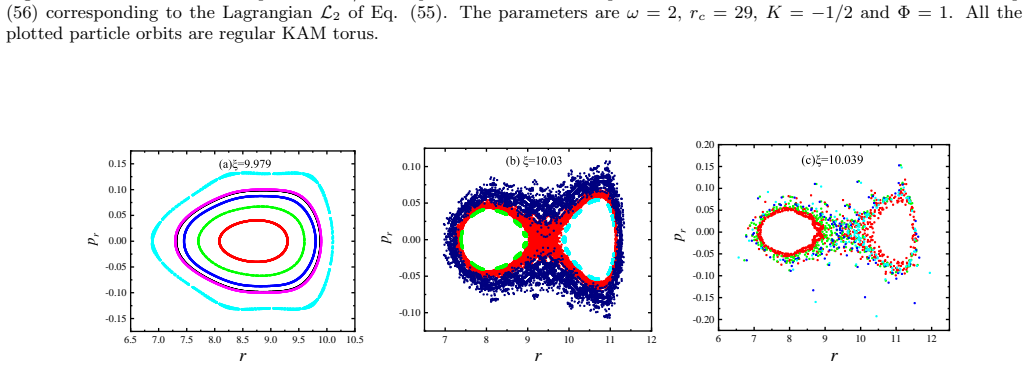
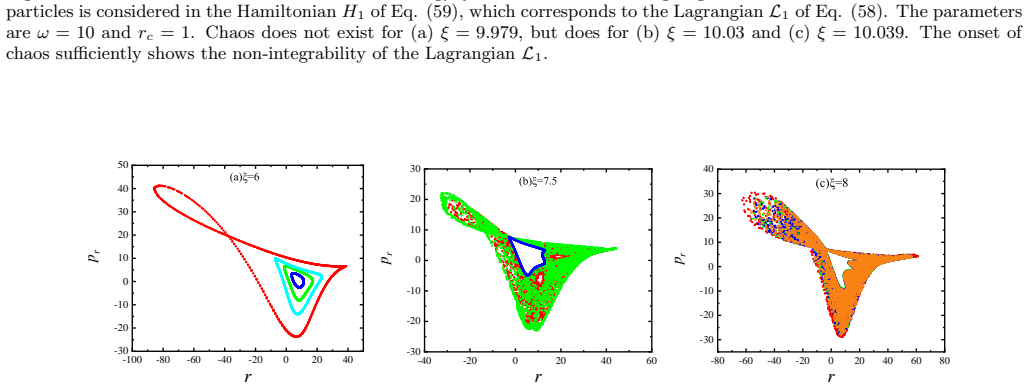
The Lagrangians L1 = -mc sqrt(-g_mu nu dot x^mu dot x^nu) - V and L2 = (1/2)m g_mu nu dot x^mu dot x^nu - V are equivalent, yielding identical Hamiltonians that satisfy the mass-shell constraint, exactly when V is zero or electromagnetic. For generic external potentials they correspond to different Hamiltonian formulations; the Hamiltonian from L1 inherently enforces the constraint while the one from L2 does not. In the Schwarzschild metric with an artificial mechanical potential, numerical work shows L1 yields chaotic non-integrable dynamics whereas L2 yields integrable dynamics free of chaos.
What carries the argument
The two distinct Hamiltonian formulations obtained from each Lagrangian, and the presence or absence of automatic enforcement of the mass-shell constraint.
If this is right
- When the potential is electromagnetic both Lagrangians can be used interchangeably without changing the physics.
- For generic potentials the first Lagrangian is the theoretically consistent choice because it automatically respects the relativistic mass-shell condition.
- The second Lagrangian remains useful for low-energy or weak-field approximations where computational simplicity matters more than strict constraint enforcement.
- Near black holes the second Lagrangian can still be employed for charged or neutral particles if an extra constraint is added to its Hamiltonian.
Where Pith is reading between the lines
- The integrability of the second formulation may allow closed-form solutions in spacetimes where the first requires only numerical integration.
- Predictions for particle trajectories in strong gravity could change depending on which Lagrangian is chosen when the potential is neither electromagnetic nor zero.
- The distinction may affect modeling of charged-particle motion in astrophysical environments that include both gravitational and non-electromagnetic forces.
Load-bearing premise
The Schwarzschild metric with one artificial mechanical potential is representative of the behavior that occurs for arbitrary external potentials.
What would settle it
A direct calculation showing that the Hamiltonian from the second Lagrangian also enforces the mass-shell constraint for a non-electromagnetic potential, or a numerical orbit integration in which the second Lagrangian produces chaos in the same toy model.
Figures
read the original abstract
In 2021, Lei et al. claimed the equivalence between the two Lagrangians $\mathcal{L}_1 =-mc\sqrt{-g_{\mu\nu}{\dot{x}}^\mu{\dot{x}}^\nu}-V$ and $\mathcal{L}_2 = \frac{1}{2}mg_{\mu\nu} {\dot{x}}^\mu{\dot{x}}^\nu-V$ for describing particle dynamics in combined gravitational and matter fields. In the present work, we rigorously demonstrate that their equivalence depends critically on the external potential V. Both Lagrangians yield identical Hamiltonians that strictly satisfy the mass shell constraint, and are therefore equivalent when V vanishes or corresponds to an electromagnetic potential. However, they are generally not equivalent for generic external potentials excluding the electromagnetic ones. This discrepancy arises because L1 and L2 correspond to different Hamiltonian formulations. The Hamiltonian derived from L1 inherently enforces the mass shell constraint, whereas the Hamiltonian from L2 does not. When the Schwarzschild metric supplemented with an artificial mechanical potential is taken as a toy model, numerical investigations reveal that L1 leads to chaotic behavior, which signifies non-integrable dynamics. By contrast, L2 can be shown analytically to produce integrable dynamics free of chaos. In many scenarios, L1 is strongly recommended due to its theoretical superiority and universality. L2 is generally suitable for classical approximate problems involving low energy and weak gravity. Nevertheless, it is the preferred choice for strong field problems concerning the dynamics of charged (or neutral) particles near black holes with (or without) external electromagnetic fields, owing to its mathematical simplicity and computational efficiency. Moreover, it can still satisfy the mass shell constraint when an additional constraint is imposed on its corresponding Hamiltonian.
Editorial analysis
A structured set of objections, weighed in public.
Referee Report
Summary. The paper claims that the two Lagrangians L1 = -mc sqrt(-g_μν ẋ^μ ẋ^ν) - V and L2 = (1/2)m g_μν ẋ^μ ẋ^ν - V are equivalent only when V=0 or V is an electromagnetic potential, since both then produce identical Hamiltonians obeying the mass-shell constraint. For generic external potentials they are inequivalent because the Hamiltonian from L1 enforces the constraint while that from L2 does not. Using the Schwarzschild metric plus an artificial mechanical potential as a toy model, numerical evidence shows chaotic (non-integrable) motion for L1 while L2 is shown analytically to be integrable; the authors recommend L1 for theoretical reasons and L2 for computational simplicity in certain regimes.
Significance. If the claimed non-equivalence for generic V holds, the work would clarify Lagrangian choice for relativistic particles in combined gravitational and external fields, with direct implications for integrability and chaos near black holes. The analytic demonstration of integrability for L2 and the numerical contrast with L1 are concrete strengths; however, the generality of the non-equivalence rests on a single artificial-potential example rather than a general derivation.
major comments (2)
- [Abstract and Hamiltonian derivation section] Abstract and the section deriving the Hamiltonians: the claim that the Lagrangians are 'generally not equivalent for generic external potentials' is not backed by an analytic proof that the Legendre transforms differ for arbitrary V; the distinction is shown only for the specific Schwarzschild-plus-artificial-potential toy model.
- [Toy-model numerical section] Toy-model section: the numerical evidence for chaos (non-integrability) in L1 is obtained with an unspecified 'artificial mechanical potential'; without its explicit functional form, the parameter values used, and the integration scheme, it is impossible to assess whether the observed chaos is generic or an artifact of that particular choice.
minor comments (2)
- [Abstract] The abstract states that L2 'can still satisfy the mass shell constraint when an additional constraint is imposed'; the precise form of that constraint and how it is implemented should be stated explicitly.
- [Introduction] Notation for the metric signature and the definition of the four-velocity normalization should be stated once at the beginning to avoid ambiguity when comparing the two Lagrangians.
Simulated Author's Rebuttal
We thank the referee for the careful reading and constructive feedback on our manuscript. We address each major comment point by point below. Where the comments identify areas needing greater clarity or detail, we have revised the manuscript accordingly while preserving the core arguments.
read point-by-point responses
-
Referee: [Abstract and Hamiltonian derivation section] Abstract and the section deriving the Hamiltonians: the claim that the Lagrangians are 'generally not equivalent for generic external potentials' is not backed by an analytic proof that the Legendre transforms differ for arbitrary V; the distinction is shown only for the specific Schwarzschild-plus-artificial-potential toy model.
Authors: We appreciate the referee highlighting the need for a clearer separation between the general analytic argument and the illustrative example. In the Hamiltonian derivation section we show that the Legendre transform of L1, owing to its square-root structure and reparametrization invariance, always produces a Hamiltonian that enforces the mass-shell constraint independently of the explicit form of the scalar potential V. By contrast, the Legendre transform of L2 yields an unconstrained Hamiltonian whose level sets coincide with the mass shell only for special choices of V (V=0 or electromagnetic-type potentials that effectively restore the constraint). This general distinction is analytic and does not rely on the toy model; the Schwarzschild-plus-artificial-potential example is used solely to exhibit the resulting dynamical difference (chaos versus integrability). We have added an explicit paragraph in the revised Section 2 that writes the two Hamiltonians side-by-side for arbitrary V, making the proof independent of any specific metric or potential. revision: yes
-
Referee: [Toy-model numerical section] Toy-model section: the numerical evidence for chaos (non-integrability) in L1 is obtained with an unspecified 'artificial mechanical potential'; without its explicit functional form, the parameter values used, and the integration scheme, it is impossible to assess whether the observed chaos is generic or an artifact of that particular choice.
Authors: We agree that the original presentation of the toy model lacked sufficient technical detail. In the revised manuscript we now specify the explicit functional form of the artificial mechanical potential, the numerical values of all parameters (including the Schwarzschild mass and the potential strength), and the integration algorithm together with its step-size control and accuracy tolerances. We have also added a short convergence study showing that the reported chaotic indicators remain robust under moderate variations of these parameters, indicating that the non-integrability is not an artifact of the particular choice. revision: yes
Circularity Check
No significant circularity; derivations use standard Legendre transforms independent of claims
full rationale
The paper's core steps consist of applying the standard Legendre transform to obtain Hamiltonians from L1 and L2, then comparing the resulting expressions for different classes of V. These transforms follow directly from the given Lagrangian definitions without any fitted parameters, self-referential definitions, or renaming of known results. Equivalence is demonstrated by explicit algebraic identity when V=0 or V is electromagnetic (both yield the same mass-shell-constrained Hamiltonian). Non-equivalence for generic V is asserted from the structural difference in the Hamiltonian formulations (constraint enforcement vs. non-enforcement), with the Schwarzschild-plus-artificial-potential case serving only as a numerical illustration of integrability differences rather than a load-bearing proof or fitted input. The citation to Lei et al. (2021) is to the claim being critiqued and carries no self-citation load. No uniqueness theorems, ansatzes smuggled via prior work, or self-definitional loops appear in the derivation chain.
Axiom & Free-Parameter Ledger
axioms (2)
- standard math Standard derivation of Hamiltonian from Lagrangian via Legendre transform in relativistic mechanics
- domain assumption Mass shell constraint p^2 = m^2 for relativistic particles
Reference graph
Works this paper leans on
-
[1]
The event horizon isr g = 2. Set the external potential as an artificially constructed mechanical potential unlike the electromagnetic potential: V(r, θ) =ψ 1 = ω r2 [(r−r c)2 +r 2 gθ2],(54) wherer c is a parameter representing the center of the harmonic potential ˜V= (r−r c)2 + 4θ2 andωis another parameter. For the dynamics of massive particles,m= 1 is t...
-
[2]
Goldstein,Classical Mechanics(Addison-Wesley Pub- lishing Company, Reading, MA, 1980), 2nd ed
H. Goldstein,Classical Mechanics(Addison-Wesley Pub- lishing Company, Reading, MA, 1980), 2nd ed
work page 1980
-
[3]
Arnold,Mathematical Methods of Classical Mechan- ics(Springer, New York, 1978)
V.I. Arnold,Mathematical Methods of Classical Mechan- ics(Springer, New York, 1978)
work page 1978
- [4]
-
[5]
K. Feng and M.Z. Qin,Symplectic Geometric Algorithms for Hamiltonian Systems(Hangzhou, Zhejiang Science and Technology Publishing House; Springer, New York, 2009)
work page 2009
-
[6]
A.J. Lichtenberg and M.A. Lieberman,Regular and Chaotic Dynamics(Springer-Verlag, New York, 1983)
work page 1983
-
[7]
J. Binney and S. Tremaine,Galactic Dynamics(Prince- ton University Press, Princeton, NJ, 2008), 2nd ed
work page 2008
-
[8]
S. Weinberg,Gravitation and Cosmology: Priniciples and Applications of the General Theory of Relativity(John Wiley & Sons, 1972)
work page 1972
-
[9]
C.W. Misner, K.S. Thorne, and J.A. Wheeler,Gravita- tion(W.H. Freeman and Company, 1973)
work page 1973
-
[10]
Wald, General Relativity (University of Chicago Press, 1984)
R.M. Wald, General Relativity (University of Chicago Press, 1984)
work page 1984
-
[11]
Carroll, Spacetime and Geometry: An Introduction to General Relativity (Addison-Wesley, 2004)
S.M. Carroll, Spacetime and Geometry: An Introduction to General Relativity (Addison-Wesley, 2004)
work page 2004
-
[12]
K. Hashimoto and N. Tanahashi, Universality in chaos of particle motion near black hole horizon, Phys. Rev. D 95, 024007 (2017)
work page 2017
-
[13]
Q.-Q. Zhao, Y.-Z. Li, and H. Lu, Static equilibria of charged particles around charged black holes: Chaos 11 bound and its violations, Phys. Rev. D98, 124001 (2018)
work page 2018
- [14]
-
[15]
S. Rahvar, Hamiltonian formalism for dynamics of parti- cles in MOG, Monthly Notices of the Royal Astronomical Society514, 4601-4605 (2022)
work page 2022
-
[16]
S. Dalui, B.R. Majhi, and P. Mishra, Presence of horizon makes particle motion chaotic, Physics Letters B788, 486-493 (2019)
work page 2019
-
[17]
A. Bera, S. Dalui, S. Ghosh, E.C. Vagenas, Quantum corrections enhance chaos: Study of particle motion near a generalized Schwarzschild black hole, Physics Letters B 829, 137033 (2022)
work page 2022
- [18]
-
[19]
B. Carter, Global structure of the Kerr family of gravi- tational fields, Physical Review174, 1559 (1968)
work page 1968
-
[20]
M. Takahashi and H. Koyama, Chaotic motion of charged particles in an electromagnetic field surrounding a rotat- ing black hole, Astrophys. J.693, 472 (2009)
work page 2009
-
[21]
O. Kop´ aˇ cek, V. Karas, K. Kov´ aˇ r, and Z. Stuchl´ ık, Transtion from regular to chaotic circulation in magne- tized coronae near compact objects, Astrophys. J.722, 1240 (2010)
work page 2010
-
[22]
O. Kop´ aˇ cek and V. Karas, Inducing chaos by breaking axil symmetry in a black hole magenetosphere, Astro- phys. J.787, 117 (2014)
work page 2014
-
[23]
Z. Stuchl´ ıka and M. Koloˇ s, Acceleration of the charged particles due to chaotic scattering in the combined black hole gravitational field and asymptotically uniform mag- netic field, Eur. Phys. J. C83, 789 (2016)
work page 2016
-
[24]
O. Kop´ aˇ cek and V. Karas, Near-horizon structure of es- cape zones of electrically charged particles around weakly magnetized rotating black hole, Astrophys. J.853, 53 (2018)
work page 2018
-
[25]
R. P´ anis, M. Koloˇ s, and Z. Stuchl´ ık, Determination of chaotic behaviour in time series generated by charged particle motion around magnetized Schwarzschild black holes, Eur. Phys. J. C79, 479 (2019)
work page 2019
-
[26]
O. Kop´ aˇ cek and V. Karas, Near-horizon structure of es- cape zones of electrically charged particles around weakly magnetized rotating black hole. II. Acceleration and es- cape in the oblique magnetosphere, arXiv: 2008.04630 (2020)
-
[27]
S. Mukherjee, O. Kop´ aˇ cek, and G. Lukes-Gerakopoulos, Resonance crossing of a charged body in a magnetized Kerr background: an analogue of extreme mass ratio in- spiral, Physical Review D107, 064005 (2022)
work page 2022
-
[28]
W. Cao, W. Liu, and X. Wu, Integrability of Kerr- Newman spacetime with cloud strings, quintessence and electromagnetic field, Phys. Rev. D105, 124039 (2022)
work page 2022
-
[29]
Z. Stuchl´ ık, J. Vrba, M. Koloˇ s, A. Tursunov, Radiative Back-Reaction on Charged Particle Motion in the Dipole Magnetosphere of Neutron Stars, Journal of High Energy Astrophysics,44, 500-530 (2024)
work page 2024
-
[30]
W. Sun, Y. Wang, F. Liu, and X. Wu, Applying explicit symplectic integrator to study chaos of charged particles around magnetized Kerr black hole, Eur. Phys. J. C81, 785 (2021)
work page 2021
-
[31]
W. F. Cao, X. Wu, and J. Lyu, Electromagnetic field and chaotic charged-particle motion around hairy black holes in Horndeski gravity, Eur. Phys. J. C84, 435 (2024)
work page 2024
- [32]
-
[33]
Z. Xu, D. Ma, W. Cao, and K. Li, Chaotic motion of charged test particles in a Kerr-MOG black hole with explicit symplectic algorithms, Eur. Phys. J. C85, 770 (2025)
work page 2025
- [34]
- [35]
-
[36]
B. Gwak, N. Kan, B.-H. Lee, H. Lee, Violation of bound on chaos for charged probe in Kerr-Newman-AdS black hole, J. High Energy Phys.09, 026 (2022)
work page 2022
-
[37]
N. Kan, B. Gwak, Bound on the Lyapunov exponent in Kerr-Newman black holes via a charged particle, Phys. Rev. D105, 026006 (2022)
work page 2022
- [38]
- [39]
-
[40]
J. Park, B. Gwak, Bound on Lyapunov exponent in Kerr- Newman-de Sitter black holes by a charged particle, J. High Energy Phys.04, 023 (2024)
work page 2024
-
[41]
Wald, Black hole in a uniform magnetic field, Phys
R.M. Wald, Black hole in a uniform magnetic field, Phys. Rev. D10, 1680 (1974)
work page 1974
-
[42]
A. Tursunov, Z. Stuchl´ ık, and M. Koloˇ s, Circular orbits and related quasiharmonic oscillatory motion of charged particles around weakly magnetized rotating black holes, Phys. Rev. D93, 084012 (2016)
work page 2016
-
[43]
Azreg-A¨ ınou, Vacuum and nonvacuum black holes in a uniform magnetic field, Eur
M. Azreg-A¨ ınou, Vacuum and nonvacuum black holes in a uniform magnetic field, Eur. Phys. J. C76, 414 (2016)
work page 2016
- [44]
-
[45]
Q. Zhang and X. Wu, Chaos of Charged Particles in Quadrupole Magnetic Fields Under Schwarzschild Back- grounds, Universe11, 234 (2025)
work page 2025
-
[46]
S. Mikkola, Practical Symplectic Methods with Time Transformation for the Few-Body Problem, Celestial Me- chanics and Dynamical Astronomy67, 145 (1997)
work page 1997
-
[47]
M. Preto and S. Tremaine, A Class of Symplectic Integra- tors with Adaptive Time Step for Separable Hamiltonian Systems, Astron. J.118, 2532 (1999)
work page 1999
-
[48]
K. Ye, Z. Cai, M. Wang, K. Yang, and X. Liu, An adap- tive symplectic integrator for gravitational dynamics, As- tron. & Astrophys.,699, A170 (2025)
work page 2025
-
[49]
X. Wu, Y. Wang, W. Sun, and F. Liu, Construction of explicit symplectic integrators in general relativity. IV. Kerr black holes, Astrophys. J.914, 63 (2021)
work page 2021
-
[50]
X. Wu, Y. Wang, W. Sun, F. Liu, and W. Han, Explicit symplectic methods in black hole spacetimes, Astrophys. J.940, 166, (2022)
work page 2022
-
[51]
X. Wu, Y. Wang, W. Sun, F. Liu, and D. Ma, Explicit symplectic integrators with adaptive time steps in curved spacetimes, Astrophys. J. Suppl. Ser.275, 31 (2024). 12
work page 2024
-
[52]
E. Hackmann and H. Xu, Charged particle motion in Kerr-Newmann space-times, Phys. Rev. D87, 124030 (2013)
work page 2013
-
[53]
Y. Wang, W. Sun, F. Liu, and X. Wu, Construction of explicit symplectic integrators in general relativity. I. Schwarzschild black holes, Astrophys. J.907, 66 (2021)
work page 2021
-
[54]
Y. Wang, W. Sun, F. Liu, and X. Wu, Construction of explicit symplectic integrators in general relativity. II. Reissner-Nordstr¨ om black holes, Astrophys. J.909, 22 (2021)
work page 2021
-
[55]
Y. Wang, W. Sun, F. Liu, and X. Wu, Construction of explicit symplectic integrators in general relativity. III. Reissner-Nordstr¨ om-(anti)–de Sitter black holes, Astro- phys. J. Suppl. Ser.254, 8 (2021)
work page 2021
- [56]
- [57]
-
[58]
M.-Y. Wang, S.-W. Li, D. Hou, D. Yan, and Y.-Q. Zhao, Chaos in the near-horizon dynamics of the dyonic AdS4-Reissner-Nordstr¨ om black hole, arXiv: 2601.22549 (2026)
-
[59]
A.-R. Hu and G.-Q. Huang, Dynamics of charged parti- cles in the magnetizedγspacetime, Eur. Phys. J. Plus 136, 1210 (2021)
work page 2021
-
[60]
Z. Huang, G. Huang, and A. Hu, Application of Ex- plicit Symplectic Integrators in a Magnetized Deformed Schwarzschild Black Spacetime, Astrophys. J925: 15 (2022). 13 - 200 2 04 06 08 0-4-3-2-101234pr r K =-0.5 Fig. 1: Poincar´ e section at the planeθ=π/2 withp θ >0. The motion of particles is considered in the HamiltonianKof Eq. (56) corresponding to the...
work page 2022
discussion (0)
Sign in with ORCID, Apple, or X to comment. Anyone can read and Pith papers without signing in.