Surface correlation functions of dead-leaves models
Pith reviewed 2026-05-10 16:05 UTC · model grok-4.3
The pith
Exact expressions for pore-surface and surface-surface correlation functions are derived for dead-leaves models in any dimension and for arbitrary grain shapes.
A machine-rendered reading of the paper's core claim, the machinery that carries it, and where it could break.
Core claim
Within dead-leaves models a two-phase structure is built by sequential random placement of pore-like or solid-like grains that completely overlap any pre-existing material. The pore-surface and surface-surface correlation functions are obtained by enumerating the probabilities that two points lie on particular combinations of pore and solid boundaries. The resulting formulas are exact, contain no further approximations, and remain valid for grains of any shape in any dimension. As a byproduct the same counting argument supplies closed expressions for the Boolean model.
What carries the argument
The dead-leaves process of sequential random grain placement that completely overlaps prior structure, from which correlation functions follow by direct probabilistic geometry.
If this is right
- The expressions apply without change to grains of any shape or to any spatial dimension.
- A general closed-form result for the Boolean model follows immediately from the same derivation.
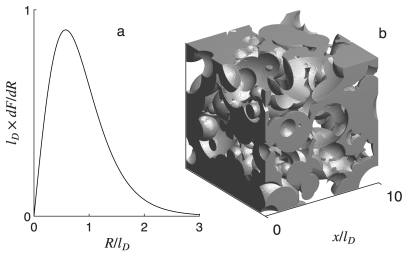
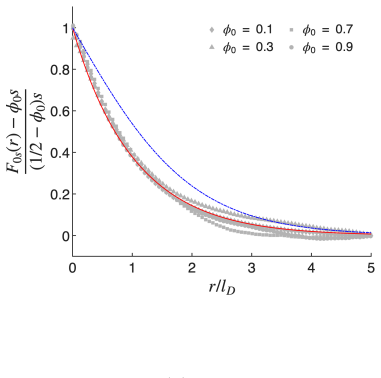
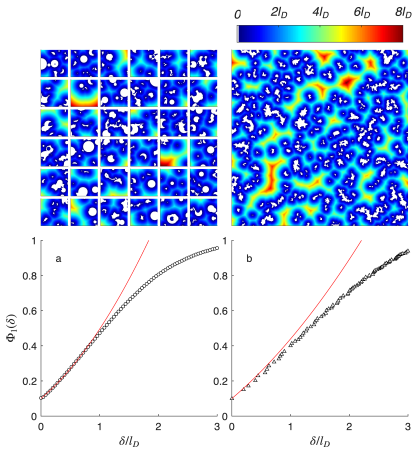
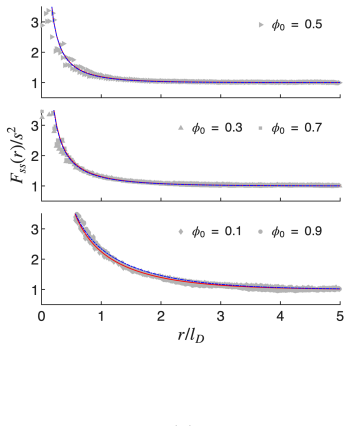
- Dead-leaves realizations engineered to have exponential two-point correlations differ from numerically reconstructed Debye media in their pore-surface functions while sharing nearly identical surface-surface functions.
- Grain size distributions can be chosen to produce structures whose correlation functions match any prescribed target.
Where Pith is reading between the lines
- The analytic forms could be inserted directly into scattering inversion routines to test whether a given experimental pattern is consistent with a dead-leaves geometry.
- Because the pore-surface function distinguishes dead-leaves models from other random-media constructions, measurements sensitive to that function could discriminate among competing microstructural hypotheses.
- The same probabilistic counting may extend without modification to related overlapping-grain models that add a finite lifetime or a growth rule to each grain.
Load-bearing premise
The only rule governing the structure is that each new grain is placed at random and erases every part of the previous structure it covers.
What would settle it
Generate a large three-dimensional dead-leaves realization with spherical grains of known radius, measure the pore-surface and surface-surface correlation functions by direct counting on the voxelized structure, and compare the numerical values to the closed-form expressions.
Figures
read the original abstract
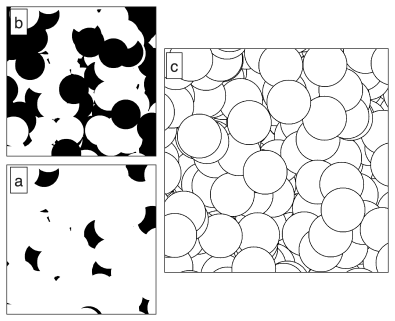
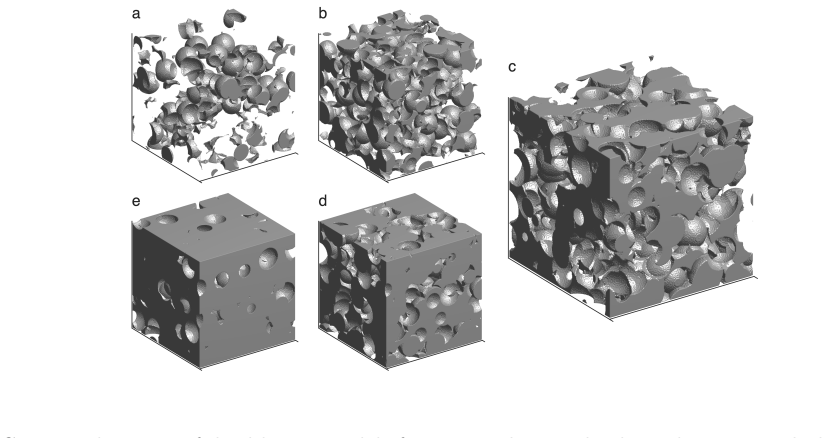
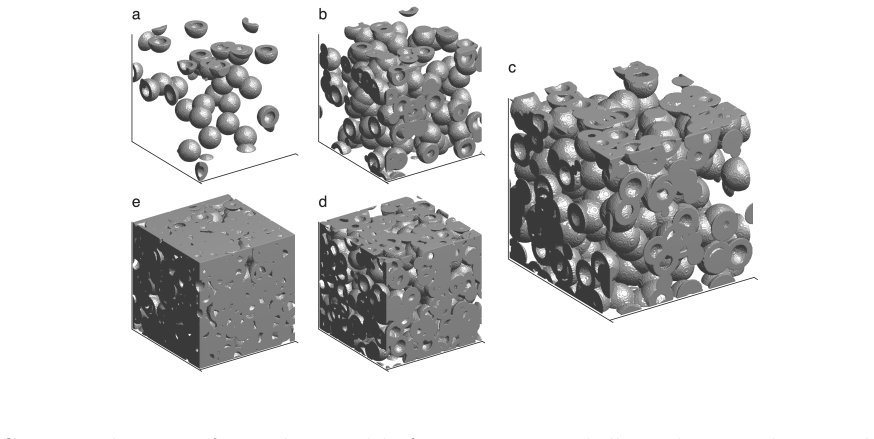
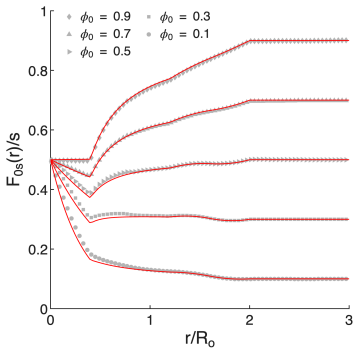
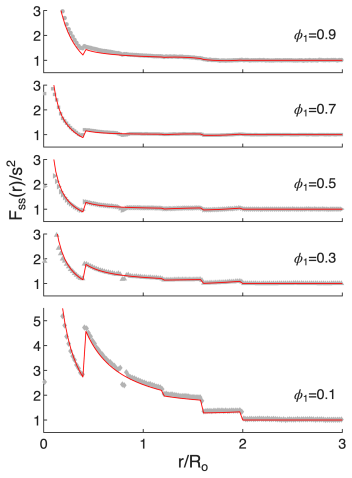
The pore-surface and surface-surface correlation functions are structural characteristics that play an important role in theoretical materials science and in small-angle scattering theory. Exact analytical expressions for the surface correlation functions are available only for very few models, and we here derive such expressions for the general class of dead-leaves models. Within these models, a two-phase pore/solid structure is created by sequentially and randomly filling space with pore-like or solid-like grains that overlap any pre-existing structure, in the same way as dead leaves fall on the ground. The obtained mathematical expressions are valid for any grain shape, in arbitrary dimension. The results are illustrated with monodispersed spherical grains,as well as with a dead-leaves realization of a Debye random medium. In the latter case, the size distribution of the grains is designed to produce a structure having exponential two-point correlation function. Compared to Debye random media obtained by numerical reconstruction, the dead-leaves structure has almost identical surface-surface correlation function, but distinctly different pore-surface correlation function. As a byproduct of our analysis, we also submit a general expression for the pore-surface and surface-surface correlation functions of the Boolean model, valid for arbitrary grains.
Editorial analysis
A structured set of objections, weighed in public.
Referee Report
Summary. The manuscript derives exact analytical expressions for the pore-surface and surface-surface correlation functions of general dead-leaves models, which generate two-phase pore/solid structures via sequential random grain placement with complete overlap of pre-existing material. The expressions are stated to hold for arbitrary grain shapes and dimensions without approximations, illustrated for monodisperse spheres and a dead-leaves realization of a Debye random medium (with grain size distribution chosen to yield exponential two-point correlations). A general expression for the Boolean model is obtained as a byproduct.
Significance. If the derivations are correct, this provides closed-form, parameter-free results for key structural descriptors used in materials modeling and small-angle scattering, extending the small set of models with known exact surface correlations. The direct probabilistic derivation from the dead-leaves process definition, validity for arbitrary grains/dimensions, and explicit contrast with numerical Debye reconstructions (identical surface-surface but different pore-surface functions) are notable strengths.
minor comments (3)
- The abstract and introduction could more explicitly reference prior exact results for Boolean models to clarify the incremental novelty of the dead-leaves generalization.
- In the Debye-medium illustration, the quantitative difference between the dead-leaves and reconstructed pore-surface functions should be reported with a specific metric (e.g., integrated absolute deviation) rather than described qualitatively.
- Notation for the grain-size distribution and the resulting two-point function in the Debye case should be cross-referenced to the general expressions to aid readability.
Simulated Author's Rebuttal
We thank the referee for the positive assessment of our manuscript, the recognition of its strengths (including the direct probabilistic derivation, validity for arbitrary grains and dimensions, and the explicit contrast with numerical Debye reconstructions), and the recommendation for minor revision. No specific major comments were raised in the report.
Circularity Check
No significant circularity; direct probabilistic derivation
full rationale
The paper's central results are exact analytical expressions for the pore-surface and surface-surface correlation functions of dead-leaves models, obtained directly from the model's definition as a sequential random placement process in which grains completely overlap prior structure. The derivation applies to arbitrary grain shapes and dimensions with no fitted parameters, no predictions of quantities that are inputs by construction, and no load-bearing self-citations or uniqueness theorems invoked from prior author work. The Boolean model appears only as a special case. The provided abstract and description contain no steps that reduce the claimed results to tautological inputs.
Axiom & Free-Parameter Ledger
axioms (1)
- domain assumption A two-phase structure is formed by sequentially placing grains that overlap any pre-existing structure in a random manner.
Reference graph
Works this paper leans on
-
[1]
III B 1, based on a recursive approach
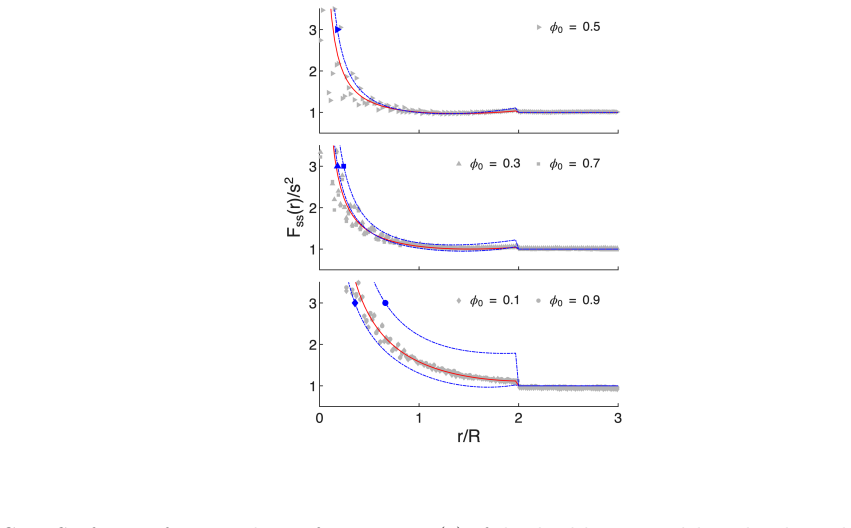
The two-point correlation function of the dead-leaves model is then [26] C00(r) =ϕ 0ϕ1 Kv(r) 2Kv(0)−K v(r) +ϕ 2 0 (18) An independent derivation of this equation is provided in Sec. III B 1, based on a recursive approach. Anticipating on the discussion section, various grains are considered in the paper with different covariogramsK v(r) : for monodisperse...
-
[2]
Recursive formalism We propose here an alternative formalism for the dead-leaves model, which enables one to obtain analytical expressions for the surface correlation functionsF 0s(r) andF ss(r) as the stable point of an iteration relation. As a validation, we first show that this procedure 8 provides the same expressions for the volume fractions, the cor...
-
[3]
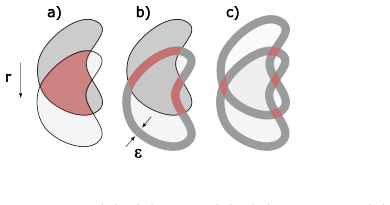
Pore-surface correlation function The pore-surface correlation function can be calculated starting from the two-point cor- relation functionC 0Sϵ(r) between the pore space and the surface layerS ϵ(x), as defined in Eq. (5). Combining the recursion relations forI(x) andS ϵ(x) - from Eq. (21) and (33) , respectively - one obtains the following recursion rel...
-
[4]
Surface-surface correlation function The surface-surface correlation function can be calculated starting from the two-point correlation function of the surface layer,C SϵSϵ(r) defined in Eq. (11). From the recursion relation forS ϵ(x) in Eq. (33), one obtains the following recursion relation C (n+1) SϵSϵ (r) = [1−2Φ + Γ(r)]C (n) SϵSϵ(r) +∂ 2Γϵ(r)C (n) 00 ...
-
[5]
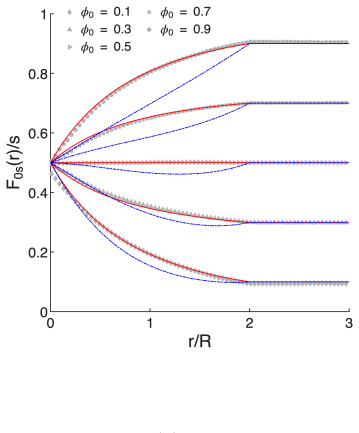
They nicely match the numerical values evaluated from the realizations, which supports the general validity of Eq. (51) for arbitrary grains. 28 To further compare the numerically evaluated values of the surface-surface correlation functionF ss(r) with Eq. (52), one needs to calculate the covariogramK ss(r) of the hollow sphere. The value is K (H) ss (r) ...
-
[6]
Matheron, ´El´ ements pour une Th´ eorie des Milieux Poreux (Masson, Paris, 1967)
G. Matheron, ´El´ ements pour une Th´ eorie des Milieux Poreux (Masson, Paris, 1967)
work page 1967
-
[7]
Serra, Image Analysis and Mathematical Morphology (Academic Press, San Dirego, 1982)
J. Serra, Image Analysis and Mathematical Morphology (Academic Press, San Dirego, 1982)
work page 1982
-
[8]
J. Ohser and M. M¨ ucklich, Statistical Analysis of Microstructures in Materials Science (Springer, New York, 2000)
work page 2000
-
[9]
Torquato, Random Heterogeneous Materials (Springer, New York, 2002)
S. Torquato, Random Heterogeneous Materials (Springer, New York, 2002)
work page 2002
-
[10]
Lantu´ ejoul,Geostatistical Simulations (Springer, Berlin, 2002)
C. Lantu´ ejoul,Geostatistical Simulations (Springer, Berlin, 2002)
work page 2002
- [11]
-
[12]
P. Lindner and J. Oberdisse, eds., Neutrons, X-rays, and light: Scattering Methods Applied to Soft Condensed Matter, 2nd ed. (Elsevier - Health Sciences Division, Philadelphia, 2024)
work page 2024
-
[13]
C. Gommes, Y. Jiao, and S. Torquato, Phys. Rev. E85(2012), 10.1103/PhysRevE.85.051140
-
[14]
Y. Jiao, F. Stillinger, and S. Torquato, Proc. Nat. Acad. Sci. USA106, 17634 (2009)
work page 2009
- [15]
- [16]
-
[17]
A. P. Roberts and S. Torquato, Phys. Rev. E59, 4953 (1999)
work page 1999
-
[18]
C. J. Gommes, Y. Jiao, A. P. Roberts, and D. Jeulin, J. Appl. Crystallogr.53, 127 (2020)
work page 2020
-
[19]
M. Skolnick and S. Torquato, Phys. Rev. E104(2021), 10.1103/PhysRevE.104.045306. 29
-
[20]
M. Doi, J. Phys. Soc. Jap.40, 567 (1976)
work page 1976
- [21]
-
[22]
C. J. Gommes, R. Zorn, S. Jaksch, H. Frielinghaus, and O. Holderer, J. Chem. Phys.155, 024121 (2021)
work page 2021
-
[23]
H. Frielinghaus and C. J. Gommes, J. Appl. Crystallogr.58, 1553 (2025)
work page 2025
-
[24]
N. A. Seaton and E. D. Glandt, J. Chem. Phys.85, 5262 (1986)
work page 1986
- [25]
- [26]
-
[27]
A. Samarin, V. Postnicov, M. V. Karsanina, E. V. Lavrukhin, D. Gafurova, N. M. Evstigneev, A. Khlyupin, and K. M. Gerke, Phys.l Rev. E107, 065306 (2023)
work page 2023
-
[28]
V. Postnicov, A. Samarin, M. V. Karsanina, M. Gravey, A. Khlyupin, and K. M. Gerke, Comput. Phys. Commun.299, 109134 (2024)
work page 2024
-
[29]
C. J. Gommes, T. Asset, and J. Drnec, J. Appl. Crystallogr.52, 507 (2019)
work page 2019
-
[30]
A. Cherkasov, K. M. Gerke, and A. Khlyupin, Phys. Rev. Lett. , in press (2026)
work page 2026
-
[31]
G. Matheron, Sch´ ema Bool´ een s´ equentiel de partition al´ eatoire, Note g´ eostatistique 89 (´Ecole des Mines de Paris, Centre de Morphologie Math´ ematique, Fontainebleau, 1968)https:// cg.ensmp.fr/bibliotheque/public/MATHERON_Rapport_00121.pdf
work page 1968
- [32]
- [33]
- [34]
- [35]
-
[36]
C. L. Y. Yeong and S. Torquato, Phys. Rev. E57, 495 (1998)
work page 1998
- [37]
-
[38]
C. J. Gommes, Microp. Mesop. Mater.257, 62 (2018)
work page 2018
-
[39]
A. L. Patterson, Nature143, 939 (1939)
work page 1939
-
[40]
Y. Jiao, F. H. Stillinger, and S. Torquato, Physical Review E82, 011106 (2010). 30
work page 2010
discussion (0)
Sign in with ORCID, Apple, or X to comment. Anyone can read and Pith papers without signing in.