Improved quasiparticle nuclear Hamiltonians for quantum computing
Pith reviewed 2026-05-10 15:50 UTC · model grok-4.3
The pith
Brillouin-Wigner perturbation theory refines quasiparticle Hamiltonians for open-shell nuclei to below 0.2 percent error against the shell model.
A machine-rendered reading of the paper's core claim, the machinery that carries it, and where it could break.
Core claim
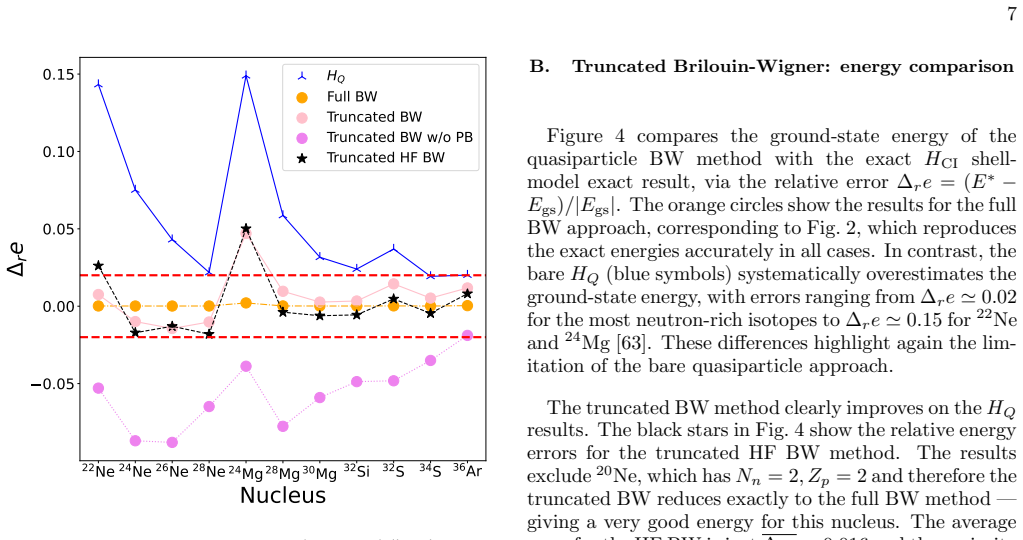
We apply Brillouin-Wigner perturbation theory to systematically improve the quasiparticle description of open-shell nuclei in the sd shell, reaching an energy relative error below 0.2% compared to the nuclear shell model. Furthermore, to make the effective Hamiltonian suitable for quantum simulation, we introduce a mean-field Hartree-Fock approximation of the non-quasiparticle resolvent, achieving ground-state energies typically within 2% of the exact shell-model result. This represents a systematic improvement over the bare quasiparticle Hamiltonian while remaining within the reach of near-term quantum devices.
What carries the argument
The Brillouin-Wigner perturbation series applied to the quasiparticle pairing modes, together with the Hartree-Fock mean-field approximation to the resolvent that excludes quasiparticle excitations.
Load-bearing premise
The mean-field Hartree-Fock approximation of the non-quasiparticle resolvent remains accurate enough that the resulting effective Hamiltonian still captures the essential physics of open-shell nuclei while staying implementable on near-term quantum hardware.
What would settle it
Exact diagonalization of an open-shell sd-shell nucleus such as 28Si using the full Brillouin-Wigner effective Hamiltonian and finding that the Hartree-Fock approximated version deviates by more than 2% from the exact shell-model ground-state energy.
Figures




read the original abstract
Quantum computing is increasingly offering concrete solutions toward the simulation of nuclear structure, with the potential to overcome the exponential scaling that limits classical diagonalization methods in large spaces. A particularly efficient encoding scheme, based on collective like-nucleon pairing modes, reduces the qubit requirements by half and avoids the non-local operator strings of standard fermion-to-qubit mappings. While this quasiparticle framework provides accurate results for semimagic nuclei, it does not adequately describe open-shell systems where proton-neutron correlations become important. In this work, we apply Brillouin-Wigner perturbation theory to systematically improve the quasiparticle description of open-shell nuclei in the $sd$ shell, reaching an energy relative error below $0.2\%$ compared to the nuclear shell model. Furthermore, to make the effective Hamiltonian suitable for quantum simulation, we introduce a mean-field Hartree-Fock approximation of the non-quasiparticle resolvent, achieving ground-state energies typically within $2\%$ of the exact shell-model result. This represents a systematic improvement over the bare quasiparticle Hamiltonian while remaining within the reach of near-term quantum devices.
Editorial analysis
A structured set of objections, weighed in public.
Referee Report
Summary. The manuscript proposes improving quasiparticle nuclear Hamiltonians for quantum computing of open-shell nuclei by applying Brillouin-Wigner perturbation theory to incorporate proton-neutron correlations in the sd shell, claiming relative energy errors below 0.2% versus the nuclear shell model. It further replaces the exact non-quasiparticle resolvent with a mean-field Hartree-Fock approximation to ensure the effective Hamiltonian remains suitable for near-term quantum simulation, achieving ground-state energies typically within 2% of exact shell-model results.
Significance. If substantiated, the work would provide a systematic extension of pairing-mode quasiparticle encodings (which already halve qubit requirements) to open-shell systems while preserving hardware feasibility, addressing a clear limitation of prior quasiparticle approaches that are accurate only for semimagic nuclei.
major comments (2)
- [Abstract] Abstract: the central quantitative claims (relative error below 0.2% with Brillouin-Wigner perturbation theory and typically within 2% after the Hartree-Fock resolvent approximation) are stated without any accompanying numerical results, tables of energies for specific sd-shell nuclei, derivation steps, or error-bar analysis, so the robustness of the reported improvements cannot be assessed from the manuscript.
- [Resolvent approximation] The section introducing the mean-field Hartree-Fock approximation of the non-quasiparticle resolvent: this replacement is load-bearing for the quantum-simulability claim, yet no separate validation, error bound, or comparison isolating the effect of the approximation on pairing and collective correlations in open-shell nuclei is provided; the jump from <0.2% to ~2% error is noted but not analyzed.
minor comments (1)
- [Abstract] The abstract would be clearer if it specified the particular sd-shell nuclei or mass range for which the quoted error figures were obtained.
Simulated Author's Rebuttal
We thank the referee for the careful and constructive review of our manuscript. We address each major comment below and will revise the paper accordingly to improve the presentation of results and validation of the approximation.
read point-by-point responses
-
Referee: [Abstract] Abstract: the central quantitative claims (relative error below 0.2% with Brillouin-Wigner perturbation theory and typically within 2% after the Hartree-Fock resolvent approximation) are stated without any accompanying numerical results, tables of energies for specific sd-shell nuclei, derivation steps, or error-bar analysis, so the robustness of the reported improvements cannot be assessed from the manuscript.
Authors: We agree that the abstract, as a concise overview, does not embed specific numerical tables or error bars. The full manuscript details the Brillouin-Wigner derivations in the methods section and presents numerical comparisons for multiple sd-shell nuclei in the results section. In revision we will (i) augment the abstract with one or two concrete examples (e.g., relative errors for ^{24}Mg and ^{28}Si), (ii) insert a compact summary table of ground-state energies, exact shell-model references, and relative errors, and (iii) add a short paragraph on the numerical error analysis already performed. These changes will make the quantitative claims directly verifiable from the revised manuscript. revision: yes
-
Referee: [Resolvent approximation] The section introducing the mean-field Hartree-Fock approximation of the non-quasiparticle resolvent: this replacement is load-bearing for the quantum-simulability claim, yet no separate validation, error bound, or comparison isolating the effect of the approximation on pairing and collective correlations in open-shell nuclei is provided; the jump from <0.2% to ~2% error is noted but not analyzed.
Authors: We acknowledge that an explicit isolation of the Hartree-Fock resolvent approximation is needed. In the revised manuscript we will add a new subsection that (a) compares ground-state energies obtained with the exact non-quasiparticle resolvent versus the Hartree-Fock approximation for representative open-shell nuclei, (b) quantifies the additional error introduced on pairing and quadrupole correlations, and (c) supplies a perturbative error bound consistent with the Brillouin-Wigner framework. This analysis will explain the observed increase from <0.2% to ~2% and directly support the claim that the approximated Hamiltonian remains suitable for near-term quantum simulation. revision: yes
Circularity Check
No circularity: derivation uses standard perturbation theory and mean-field approximation on prior quasiparticle basis
full rationale
The paper applies Brillouin-Wigner perturbation theory to improve an existing quasiparticle Hamiltonian for open-shell sd-shell nuclei and replaces the exact non-quasiparticle resolvent with a mean-field Hartree-Fock form to enable quantum simulation. These are conventional many-body techniques whose outputs are compared to independent shell-model benchmarks rather than being defined in terms of the target energies or fitted parameters. No equation reduces the final effective Hamiltonian or reported errors to the inputs by construction, and no load-bearing self-citation or uniqueness theorem is invoked in the provided text. The derivation chain remains self-contained against external validation.
Axiom & Free-Parameter Ledger
axioms (2)
- domain assumption The nuclear shell model supplies the exact reference energies for sd-shell nuclei
- domain assumption Brillouin-Wigner perturbation theory is applicable to the quasiparticle Hamiltonian for open-shell systems
Reference graph
Works this paper leans on
-
[1]
I. M. Georgescu, S. Ashhab, and F. Nori, Quantum sim- ulation, Reviews of Modern Physics86, 153 (2014)
work page 2014
-
[2]
E. Altman, K. R. Brown, G. Carleo, L. D. Carr, E. Dem- ler, C. Chin, B. DeMarco, S. E. Economou, M. A. Eriks- son, K.-M. C. Fu, M. Greiner, K. R. Hazzard, R. G. Hulet, A. J. Koll´ ar, B. L. Lev, M. D. Lukin, R. Ma, X. Mi, S. Misra, C. Monroe, K. Murch, Z. Nazario, K.-K. Ni, A. C. Potter, P. Roushan, M. Saffman, M. Schleier- Smith, I. Siddiqi, R. Simmonds,...
work page 2021
-
[3]
Preskill, Quantum Computing in the NISQ era and beyond, Quantum2, 79 (2018)
J. Preskill, Quantum Computing in the NISQ era and beyond, Quantum2, 79 (2018)
work page 2018
-
[4]
Y. Cao, J. Romero, J. P. Olson, M. Degroote, P. D. Johnson, M. Kieferov´ a, I. D. Kivlichan, T. Menke, B. Peropadre, N. P. D. Sawaya, S. Sim, L. Veis, and A. Aspuru-Guzik, Quantum chem- istry in the age of quantum computing, Chemi- cal Reviews119, 10856 (2019), pMID: 31469277, https://doi.org/10.1021/acs.chemrev.8b00803
-
[5]
A. J. Daley, I. Bloch, C. Kokail, S. Flannigan, N. Pearson, M. Troyer, and P. Zoller, Practical quantum advantage in quantum simulation, Nature607, 667 (2022)
work page 2022
-
[6]
N. Klco and M. J. Savage, Digitization of scalar fields for quantum computing, Physical Review A99, 052335 (2019)
work page 2019
- [7]
-
[8]
A. Shajan, D. Kaliakin, A. Mitra, J. R. Moreno, Z. Li, M. Motta, C. Johnson, A. A. Saki, S. Das, I. Sitdikov, A. Mezzacapo, and K. M. M. Jr, Towards quantum- centric simulations of extended molecules: sample-based quantum diagonalization enhanced with density matrix embedding theory (2024), arXiv:2411.09861 [quant-ph]
-
[9]
A. Kandala, A. Mezzacapo, K. Temme, M. Takita, M. Brink, J. M. Chow, and J. M. Gambetta, Hardware- efficient variational quantum eigensolver for small molecules and quantum magnets, Nature549, 242 (2017)
work page 2017
-
[10]
S. McArdle, S. Endo, A. Aspuru-Guzik, S. C. Benjamin, and X. Yuan, Quantum computational chemistry, Re- views of Modern Physics92, 015003 (2020)
work page 2020
-
[11]
C. Cade, L. Mineh, A. Montanaro, and S. Stanisic, Strategies for solving the fermi-hubbard model on near- 10 term quantum computers, Physical Review B102, 235122 (2020)
work page 2020
-
[12]
N. Yoshioka, T. Okubo, Y. Suzuki, Y. Koizumi, and W. Mizukami, Hunting for quantum-classical crossover in condensed matter problems, npj Quantum Informa- tion10, 45 (2024)
work page 2024
-
[13]
A. Di Meglio, K. Jansen, I. Tavernelli, C. Alexandrou, S. Arunachalam, C. W. Bauer, K. Borras, S. Carrazza, A. Crippa, V. Croft, R. de Putter, A. Delgado, V. Dun- jko, D. J. Egger, E. Fern´ andez-Combarro, E. Fuchs, L. Funcke, D. Gonz´ alez-Cuadra, M. Grossi, J. C. Hal- imeh, Z. Holmes, S. K¨ uhn, D. Lacroix, R. Lewis, D. Luc- chesi, M. L. Martinez, F. Me...
work page 2024
-
[14]
C. W. Bauer, Z. Davoudi, A. B. Balantekin, T. Bhat- tacharya, M. Carena, W. A. de Jong, P. Draper, A. El-Khadra, N. Gemelke, M. Hanada, D. Kharzeev, H. Lamm, Y.-Y. Li, J. Liu, M. Lukin, Y. Meurice, C. Monroe, B. Nachman, G. Pagano, J. Preskill, E. Ri- naldi, A. Roggero, D. I. Santiago, M. J. Savage, I. Sid- diqi, G. Siopsis, D. Van Zanten, N. Wiebe, Y. Ya...
work page 2023
-
[15]
Z. Davoudi, M. Hafezi, C. Monroe, G. Pagano, A. Seif, and A. Shaw, Towards analog quantum simulations of lattice gauge theories with trapped ions, Physical Review Research2, 023015 (2020)
work page 2020
- [16]
- [17]
-
[18]
P. Stevenson, C. Sarma, R. Giles, L. La Ronde, and B. Maheshwari, Quantum computing for nuclear struc- ture, Quantum2, 1
- [19]
-
[20]
E. F. Dumitrescu, A. J. McCaskey, G. Hagen, and et al., Cloud quantum computing of an atomic nucleus, Physical Review Letters120, 210501 (2018)
work page 2018
-
[21]
P. Siwach and P. Arumugam, Quantum simulation of nuclear Hamiltonian with a generalized transformation for Gray code encoding, Physical Review C104, 034301 (2021)
work page 2021
-
[22]
A. M. Romero, J. Engel, H. L. Tang, and S. E. Economou, Solving nuclear structure problems with the adaptive variational quantum algorithm, Physics Review C105, 064317 (2022)
work page 2022
-
[23]
O. Kiss, M. Grossi, P. Lougovski, F. Sanchez, S. Val- lecorsa, and T. Papenbrock, Quantum computing of the 6Li nucleus via ordered unitary coupled clusters, Physical Review C106, 034325 (2022)
work page 2022
- [24]
-
[25]
A. P´ erez-Obiol, A. Romero, J. Men´ endez, A. Rios, A. Garc´ ıa-S´ aez, and B. Juli´ a-D´ ıaz, Nuclear shell-model simulation in digital quantum computers, Scientific Re- ports13, 12291 (2023)
work page 2023
- [26]
-
[27]
B. Bhoy and P. Stevenson, Shell-model study of 58Ni using quantum computing algorithm, New Journal of Physics26, 075001 (2024)
work page 2024
- [28]
-
[29]
J. Zhang and D. Lacroix, Excited States from ADAPT-VQE convergence path in Many-Body Prob- lems: application to nuclear pairing problem and H 4 molecule dissociation, Physics Letters B139841, 10.1016/j.physletb.2025.139841 (2025)
- [30]
-
[31]
M. Carrasco-Codina, E. Costa, A. M´ arquez Romero, J. Men´ endez, and A. Rios, Comparison of variational quantum eigensolvers in light nuclei, Phys. Rev. C113, 024332 (2026)
work page 2026
-
[32]
A. P´ erez-Obiol, S. Masot-Llima, A. M. Romero, J. Men´ endez, A. Rios, A. Garc´ ıa-S´ aez, and B. Juli´ a-D´ ıaz, Entropy-driven entanglement forging, arXiv:2409.04510 [quant-ph] (2024)
-
[33]
Quantum simulations of Green's functions for small superfluid systems
S. Aychet-Claisse, D. Lacroix, V. Som` a, and J. Zhang, Quantum simulations of Green’s functions for small superfluid systems, arXiv preprint (2025), arXiv:2509.02272, arXiv:2509.02272 [nucl-th]
work page internal anchor Pith review Pith/arXiv arXiv 2025
-
[34]
E. A. Ruiz Guzman and D. Lacroix, Accessing ground- state and excited-state energies in a many-body system after symmetry restoration using quantum computers, Physical Review C105, 024324 (2022)
work page 2022
- [35]
- [36]
-
[37]
Y. H. Li, J. Al-Khalili, and P. Stevenson, Quantum sim- ulation approach to implementing nuclear density func- tional theory via imaginary time evolution, Physical Re- view C109, 044322 (2024)
work page 2024
- [38]
- [39]
- [40]
- [41]
-
[42]
P. Wang, W. Du, W. Zuo, and J. P. Vary, Nuclear scat- tering via quantum computing, Physical Review C109, 11 064623 (2024)
work page 2024
-
[43]
M. Yusf, L. Gan, C. Moffat, and G. Rupak, Elastic scat- tering on a quantum computer, Physical Review C111, 034001 (2025)
work page 2025
-
[44]
E. Rule and I. Stetcu, A time-dependent wave-packet approach to reactions for quantum computation (2026), arXiv:2603.26881 [nucl-th]
-
[45]
I. Chernyshev, C. E. P. Robin, and M. J. Savage, Quan- tum magic and computational complexity in the neutrino sector, Phys. Rev. Res.7, 023228 (2025)
work page 2025
- [46]
-
[47]
A. P´ erez-Obiol, S. Masot-Llima, A. M. Romero, J. Men´ endez, A. Rios, A. Garc´ ıa-S´ aez, and B. Juli´ a- D´ ıaz, Quantum entanglement patterns in the structure of atomic nuclei within the nuclear shell model, Euro- pean Physical Journal A59, 240 (2023)
work page 2023
-
[48]
F. Br¨ okemeier, S. M. Hengstenberg, J. W. Keeble, C. E. Robin, F. Rocco, and M. J. Savage, Quantum magic and multipartite entanglement in the structure of nuclei, Physical Review C111, 034317 (2025)
work page 2025
- [49]
- [50]
-
[51]
E. Caurier, G. Mart´ ınez-Pinedo, F. Nowacki, A. Poves, and A. P. Zuker, The shell model as a unified view of nuclear structure, Reviews of Modern Physics77, 427 (2005)
work page 2005
- [52]
-
[53]
B. A. Brown and B. H. Wildenthal, Status of the nuclear shell model, Annual Review of Nuclear and Particle Sci- ence38, 29 (1988)
work page 1988
-
[54]
S. R. Stroberg, H. Hergert, S. K. Bogner, and J. D. Holt, Nonempirical interactions for the nuclear shell model: An update, Annual Review of Nuclear and Particle Science 69, 307 (2019)
work page 2019
- [55]
-
[56]
A low-circuit-depth quantum computing approach to the nuclear shell model
C. Sarma and P. Stevenson, Quantum simulation of nu- clear shell model: bridging theory and hardware limita- tions, 2510.02124 (2025)
work page internal anchor Pith review Pith/arXiv arXiv 2025
- [57]
-
[58]
C. E. P. Robin and M. J. Savage, Quantum simulations in effective model spaces: Hamiltonian-learning variational quantum eigensolver using digital quantum computers and application to the Lipkin-Meshkov-Glick model, Physics Review C108, 024313 (2023), arXiv:2301.05976 [quant-ph]
- [59]
- [60]
-
[61]
S. Yoshida, T. Sato, T. Ogata, and M. Kimura, Bridg- ing quantum computing and nuclear structure: Atomic nuclei on a trapped-ion quantum computer, Phys. Rev. Res.8, 013134 (2026)
work page 2026
-
[62]
S. Yoshida, T. Sato, T. Ogata, T. Naito, and M. Kimura, Accurate and precise quantum computation of valence two-neutron systems, Physical Review C109, 064305 (2024)
work page 2024
- [63]
-
[64]
C. Chen, G. Emperauger, G. Bornet, F. Caleca, B. G´ ely, M. Bintz, S. Chatterjee, V. Liu, D. Barredo, N. Y. Yao, T. Lahaye, F. Mezzacapo, T. Roscilde, and A. Browaeys, Spectroscopy of elementary excitations from quench dynamics in a dipolar xy rydberg simulator (2024), arXiv:2311.11726 [cond-mat.quant-gas]
work page internal anchor Pith review Pith/arXiv arXiv 2024
- [65]
-
[66]
Preskill, Quantum computing in the nisq era and be- yond, Quantum2, 79 (2018)
J. Preskill, Quantum computing in the nisq era and be- yond, Quantum2, 79 (2018)
work page 2018
-
[67]
L. N. Brillouin, Les probl` emes de perturbations et les champs self-consistents, Journal De Physique Et Le Ra- dium3, 373 (1932)
work page 1932
-
[68]
E. P. Wigner, Application of the rayleigh-schr¨ odinger perturbation theory to the hydrogen atom, Phys. Rev. 94, 77 (1954)
work page 1954
-
[69]
I. Hubaˇ c, P. Mach, and S. Wilson, Multireference Brillouin-Wigner methods for many-body systems, in New Perspectives in Quantum Systems in Chemistry and Physics, Part 1, Advances in Quantum Chemistry, Vol. 39 (Academic Press, 2001) pp. 225–240
work page 2001
-
[70]
I. Hubaˇ c and S. Wilson, On the use of Brillouin-Wigner perturbation theory for many-body systems, Journal of Physics B: Atomic, Molecular and Optical Physics33, 365 (2000)
work page 2000
-
[71]
I. Shavitt and R. J. Bartlett,Many-Body Methods in Chemistry and Physics: MBPT and Coupled-Cluster Theory, Cambridge Molecular Science (Cambridge Uni- versity Press, 2009)
work page 2009
- [72]
-
[73]
Kelly, Perturbation theory with hartree-fock states, Physics Letters A25, 6 (1967)
H. Kelly, Perturbation theory with hartree-fock states, Physics Letters A25, 6 (1967)
work page 1967
-
[74]
C. Møller and M. S. Plesset, Note on an approximation treatment for many-electron systems, Physical Review 46, 618 (1934)
work page 1934
- [75]
-
[76]
G. R. Jansen, J. Engel, G. Hagen, P. Navratil, and A. Sig- noracci, Ab Initio Coupled-Cluster Effective Interactions for the Shell Model: Application to Neutron-Rich Oxy- 12 gen and Carbon Isotopes, Physical Review Letters113, 142502 (2014)
work page 2014
-
[77]
J. A. de Gracia Trivi˜ no, M. G. Delcey, and G. Wendin, Complete active space methods for nisq devices: The importance of canonical orbital optimization for accu- racy and noise resilience, Journal of Chemical Theory and Computation19, 2863 (2023), pMID: 37103120, https://doi.org/10.1021/acs.jctc.3c00123
-
[78]
B. A. Brown and W. A. Richter, New “USD” Hamil- tonians for thesdshell, Physical Review C74, 034315 (2006)
work page 2006
-
[79]
F. J. del Arco Santos and J. S. Kottmann, A hybrid qubit encoding: splitting Fock space into Fermionic and Bosonic subspaces, Quantum Science and Technology10, 035018 (2025)
work page 2025
-
[80]
D. J. Dean and M. Hjorth-Jensen, Pairing in nuclear sys- tems: from neutron stars to finite nuclei, Review of Mod- ern Physics75, 607 (2003)
work page 2003
discussion (0)
Sign in with ORCID, Apple, or X to comment. Anyone can read and Pith papers without signing in.