Recognition: unknown
METRO: Towards Strategy Induction from Expert Dialogue Transcripts for Non-collaborative Dialogues
Pith reviewed 2026-05-10 15:06 UTC · model grok-4.3
The pith
METRO uses large language models to induce strategies and planning logic from expert dialogue transcripts, forming a Strategy Forest for non-collaborative agents.
A machine-rendered reading of the paper's core claim, the machinery that carries it, and where it could break.
Core claim
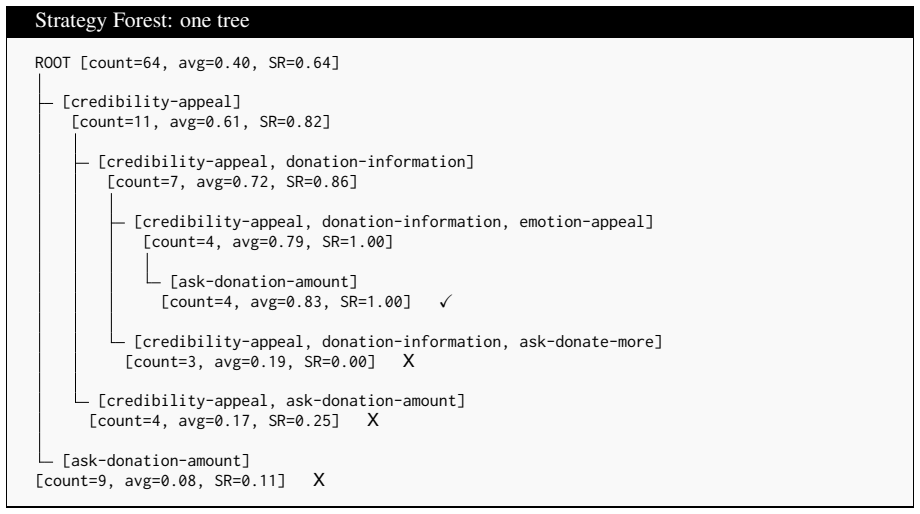
METRO formalizes expert knowledge into a Strategy Forest, a hierarchical structure that captures both short-term responses as nodes and long-term strategic foresight as branches, by using large language models to autonomously induce strategy actions and planning logic directly from raw transcripts.
What carries the argument
The Strategy Forest: a hierarchical structure with nodes for short-term responses and branches for long-term strategic foresight.
If this is right
- Non-collaborative dialogue agents can be developed without unscalable manual codification of strategies.
- Performance on dialogue benchmarks improves by an average of 9-10%.
- The approach exhibits robust cross-task transferability.
- Strategic behavioral diversity and foresight contribute to the success of the induced strategies.
Where Pith is reading between the lines
- If the extraction process scales, it could enable rapid development of agents for new non-collaborative domains like negotiations or games.
- Combining the Strategy Forest with other planning methods might further enhance long-term coherence in conversations.
- The method suggests that LLMs can serve as a bridge from observational data to structured strategic knowledge in dialogue systems.
Load-bearing premise
Large language models can accurately extract short-term actions and valid long-term planning logic from raw transcripts without errors or hallucinations that degrade the agent's performance.
What would settle it
Observing that agents using the METRO-induced Strategy Forest perform worse than hand-crafted strategies or produce inconsistent behaviors in held-out dialogue scenarios.
Figures


read the original abstract
Developing non-collaborative dialogue agents traditionally requires the manual, unscalable codification of expert strategies. We propose \ours, a method that leverages large language models to autonomously induce both strategy actions and planning logic directly from raw transcripts. METRO formalizes expert knowledge into a Strategy Forest, a hierarchical structure that captures both short-term responses (nodes) and long-term strategic foresight (branches). Experimental results across two benchmarks show that METRO demonstrates promising performance, outperforming existing methods by an average of 9%-10%. Our further analysis not only reveals the success behind METRO (strategic behavioral diversity and foresight), but also demonstrates its robust cross-task transferability. This offers new insights into building non-collaborative agents in a cost-effective and scalable way. Our code is available at https://github.com/Humphrey-0125/METRO.
Editorial analysis
A structured set of objections, weighed in public.
Referee Report
Summary. The paper proposes METRO, a method that uses large language models to induce both short-term strategy actions (as nodes) and long-term planning logic (as branches) from raw expert dialogue transcripts, formalizing them into a hierarchical Strategy Forest structure for non-collaborative dialogue agents. It reports that this yields an average 9-10% performance improvement over existing methods across two benchmarks, supported by further analysis of strategic behavioral diversity, foresight, and cross-task transferability. The code is released publicly.
Significance. If the performance gains prove robust under controlled conditions and the induced Strategy Forest accurately reflects expert strategies rather than LLM artifacts, the work would provide a scalable alternative to manual strategy engineering for non-collaborative agents. The public code release is a clear strength that aids reproducibility and follow-up work.
major comments (2)
- [Abstract / Experimental results] The headline claim of a 9-10% average improvement (Abstract) is presented without any description of the baseline methods, statistical significance tests, run-to-run variance, or precise experimental protocol. This information is load-bearing for assessing whether the reported gains are reliable or attributable to the Strategy Forest.
- [Strategy Forest induction] The core assumption that the LLM reliably extracts valid short-term actions and long-term planning logic into the Strategy Forest (Methods and § on induction) is untested: no human validation, inter-annotator agreement, or ground-truth comparison of the induced nodes and branches is reported. Downstream agent performance therefore rests on an unverified premise that the forest captures expert strategy rather than systematic LLM hallucinations or omissions.
minor comments (2)
- [Abstract] The two benchmarks are referenced but not named in the abstract; explicit identification and brief description would improve clarity.
- The term 'Strategy Forest' is introduced as a novel structure; a short formal definition or diagram in the main text would help readers distinguish it from standard trees or graphs.
Simulated Author's Rebuttal
We thank the referee for the constructive comments. We address each major point below and will revise the manuscript to improve clarity and add validation where needed.
read point-by-point responses
-
Referee: [Abstract / Experimental results] The headline claim of a 9-10% average improvement (Abstract) is presented without any description of the baseline methods, statistical significance tests, run-to-run variance, or precise experimental protocol. This information is load-bearing for assessing whether the reported gains are reliable or attributable to the Strategy Forest.
Authors: We agree the abstract is concise and omits these details. The full manuscript describes the baselines in the experimental setup section, the protocol, and reports the 9-10% gains as averages. We will revise the abstract to briefly name the baseline methods and note that gains are supported by the detailed results including variance across runs. revision: yes
-
Referee: [Strategy Forest induction] The core assumption that the LLM reliably extracts valid short-term actions and long-term planning logic into the Strategy Forest (Methods and § on induction) is untested: no human validation, inter-annotator agreement, or ground-truth comparison of the induced nodes and branches is reported. Downstream agent performance therefore rests on an unverified premise that the forest captures expert strategy rather than systematic LLM hallucinations or omissions.
Authors: We acknowledge this is a valid point and that direct human validation of the induced nodes and branches is absent from the current manuscript. While the reported performance gains, behavioral diversity analysis, and cross-task transfer provide indirect support, we will add a human evaluation subsection in the revision. This will include expert ratings of sampled nodes/branches against transcripts and inter-annotator agreement to better verify the Strategy Forest quality. revision: yes
Circularity Check
No significant circularity in derivation or evaluation chain
full rationale
The paper describes an empirical pipeline in which LLMs induce a Strategy Forest from raw expert transcripts, after which agents are evaluated on external benchmarks. No equations, fitted parameters, self-definitional constructs, or load-bearing self-citations appear in the provided text that would reduce the reported 9-10% gains to the method's own inputs by construction. Performance is framed strictly as comparative results on independent test sets, leaving the central claims self-contained.
Axiom & Free-Parameter Ledger
invented entities (1)
-
Strategy Forest
no independent evidence
Forward citations
Cited by 1 Pith paper
-
How to Interpret Agent Behavior
ACT*ONOMY is a Grounded-Theory-derived hierarchical taxonomy and open repository that enables systematic comparison and characterization of autonomous agent behavior across trajectories.
Reference graph
Works this paper leans on
- [1]
-
[2]
Helena Bonaldi, Sara Dellantonio, Serra Sinem Tekiro g lu, and Marco Guerini. 2022 a . https://doi.org/10.18653/v1/2022.emnlp-main.549 Human-machine collaboration approaches to build a dialogue dataset for hate speech countering . In Proceedings of the 2022 Conference on Empirical Methods in Natural Language Processing, pages 8031--8049, Abu Dhabi, United...
-
[3]
Helena Bonaldi, Sara Dellantonio, Serra Sinem Tekiro g lu, and Marco Guerini. 2022 b . Human-machine collaboration approaches to build a dialogue dataset for hate speech countering. In Proceedings of the 2022 conference on empirical methods in natural language processing, pages 8031--8049
2022
-
[4]
Sergio Burdisso, Srikanth Madikeri, and Petr Motlicek. 2024. https://doi.org/10.18653/v1/2024.emnlp-main.310 D ialog2 F low: Pre-training soft-contrastive action-driven sentence embeddings for automatic dialog flow extraction . In Proceedings of the 2024 Conference on Empirical Methods in Natural Language Processing, pages 5421--5440, Miami, Florida, USA....
-
[5]
Chengkun Cai, Xu Zhao, Haoliang Liu, Zhongyu Jiang, Tianfang Zhang, Zongkai Wu, Jenq-Neng Hwang, and Lei Li. 2025. The role of deductive and inductive reasoning in large language models. In Proceedings of the 63rd Annual Meeting of the Association for Computational Linguistics (Volume 1: Long Papers), pages 16780--16790
2025
-
[6]
Yue Chen, Chen Huang, Yang Deng, Wenqiang Lei, Dingnan Jin, Jia Liu, and Tat-Seng Chua. 2024. https://doi.org/10.18653/v1/2024.findings-acl.632 STYLE : Improving domain transferability of asking clarification questions in large language model powered conversational agents . In Findings of the Association for Computational Linguistics: ACL 2024, pages 1063...
- [7]
-
[8]
Jo \ a o Pedro Gandarela de Souza, Danilo Carvalho, and Andr \'e Freitas. 2025. Inductive learning of logical theories with llms: A expressivity-graded analysis. In Proceedings of the AAAI Conference on Artificial Intelligence, volume 39, pages 23752--23759
2025
-
[9]
Yang Deng, Wenqiang Lei, Minlie Huang, and Tat-Seng Chua. 2023 a . https://doi.org/10.18653/v1/2023.acl-tutorials.1 Goal awareness for conversational AI : Proactivity, non-collaborativity, and beyond . In Proceedings of the 61st Annual Meeting of the Association for Computational Linguistics (Volume 6: Tutorial Abstracts), pages 1--10, Toronto, Canada. As...
-
[10]
Yang Deng, Wenqiang Lei, Minlie Huang, and Tat-Seng Chua. 2023 b . https://doi.org/10.1145/3624918.3629548 Rethinking conversational agents in the era of llms: Proactivity, non-collaborativity, and beyond . In Proceedings of the Annual International ACM SIGIR Conference on Research and Development in Information Retrieval in the Asia Pacific Region, SIGIR...
- [11]
-
[12]
Yang Deng, Lizi Liao, Liang Chen, Hongru Wang, Wenqiang Lei, and Tat-Seng Chua. 2023 d . https://doi.org/10.18653/v1/2023.findings-emnlp.711 Prompting and evaluating large language models for proactive dialogues: Clarification, target-guided, and non-collaboration
-
[13]
Yang Deng, Wenxuan Zhang, Wai Lam, See-Kiong Ng, and Tat-Seng Chua. 2024. Plug-and-play policy planner for large language model powered dialogue agents. The Twelfth International Conference on Learning Representations(ICLR)
2024
-
[14]
Hanwen Du, Bo Peng, and Xia Ning. 2025. https://doi.org/10.18653/v1/2025.acl-long.993 Planning with diffusion models for target-oriented dialogue systems . In Proceedings of the 63rd Annual Meeting of the Association for Computational Linguistics (Volume 1: Long Papers), pages 20307--20329, Vienna, Austria. Association for Computational Linguistics
- [15]
- [16]
-
[17]
Marieke L Fransen, Edith G Smit, and Peeter WJ Verlegh. 2015. Strategies and motives for resistance to persuasion: An integrative framework. Frontiers in psychology, 6:1201
2015
- [18]
-
[19]
Lewis R Goldberg. 1992. The development of markers for the big-five factor structure. Psychological assessment, 4(1):26
1992
-
[20]
Michael E Gorman. 2002. Types of knowledge and their roles in technology transfer. The Journal of Technology Transfer, 27(3):219--231
2002
-
[21]
James Gung, Raphael Shu, Emily Moeng, Wesley Rose, Salvatore Romeo, Arshit Gupta, Yassine Benajiba, Saab Mansour, and Yi Zhang. 2023. https://aclanthology.org/2023.dstc-1.27/ Intent induction from conversations for task-oriented dialogue track at DSTC 11 . In Proceedings of the Eleventh Dialog System Technology Challenge, pages 242--259, Prague, Czech Rep...
2023
-
[22]
He He, Derek Chen, Anusha Balakrishnan, and Percy Liang. 2018. https://doi.org/10.18653/v1/D18-1256 Decoupling strategy and generation in negotiation dialogues . In Proceedings of the 2018 Conference on Empirical Methods in Natural Language Processing, pages 2333--2343, Brussels, Belgium. Association for Computational Linguistics
-
[23]
Tao He, Lizi Liao, Yixin Cao, Yuanxing Liu, Yiheng Sun, Zerui Chen, Ming Liu, and Bing Qin. 2025. Simulation-free hierarchical latent policy planning for proactive dialogues. In Proceedings of the AAAI Conference on Artificial Intelligence, volume 39, pages 24032--24040
2025
-
[24]
Yikuan Hu, Chen Huang, and Wenqiang Lei. 2025. Astro: Automatic strategy optimization for non-cooperative dialogues. In Findings of the Association for Computational Linguistics: ACL 2025, pages 388--408
2025
-
[25]
Chen Huang, Yiping Jin, Ilija Ilievski, Wenqiang Lei, and Jiancheng Lv. 2024 a . Araida: Analogical reasoning-augmented interactive data annotation. In Proceedings of the 62nd Annual Meeting of the Association for Computational Linguistics (Volume 1: Long Papers), pages 10660--10675
2024
- [26]
- [27]
-
[28]
Guangyuan Jiang, Manjie Xu, Song-Chun Zhu, Wenjuan Han, Chi Zhang, and Yixin Zhu. 2024. Evaluating and inducing personality in pre-trained language models. Advances in Neural Information Processing Systems, 36
2024
-
[29]
Xinyi Jiang, Tianyi Hu, Yuheng Qin, Guoming Wang, Zhou Huan, Kehan Chen, Gang Huang, Rongxing Lu, and Siliang Tang. 2025. Chatmap: Mining human thought processes for customer service chatbots via multi-agent collaboration. In Findings of the Association for Computational Linguistics: ACL 2025, pages 11927--11947
2025
-
[30]
Namyoung Kim, Kai Tzu-iunn Ong, Yeonjun Hwang, Minseok Kang, Iiseo Jihn, Gayoung Kim, Minju Kim, and Jinyoung Yeo. 2025 a . Principles: Synthetic strategy memory for proactive dialogue agents. In Findings of the Association for Computational Linguistics: EMNLP 2025, pages 21329--21368
2025
-
[31]
Namyoung Kim, Kai Tzu-iunn Ong, Yeonjun Hwang, Minseok Kang, Iiseo Jihn, Gayoung Kim, Minju Kim, and Jinyoung Yeo. 2025 b . https://doi.org/10.18653/v1/2025.findings-emnlp.1164 PRINCIPLES : Synthetic strategy memory for proactive dialogue agents . In Findings of the Association for Computational Linguistics: EMNLP 2025, pages 21329--21368, Suzhou, China. ...
-
[32]
Alice Lam. 2000. Tacit knowledge, organizational learning and societal institutions: An integrated framework. Organization studies, 21(3):487--513
2000
- [33]
-
[34]
Jinggui Liang, Lizi Liao, Hao Fei, and Jing Jiang. 2024 a . Synergizing large language models and pre-trained smaller models for conversational intent discovery. In Findings of the Association for Computational Linguistics ACL 2024, pages 14133--14147
2024
-
[35]
Jinggui Liang, Yuxia Wu, Yuan Fang, Hao Fei, and Lizi Liao. 2024 b . https://doi.org/10.18653/v1/2024.emnlp-main.1006 A survey of ontology expansion for conversational understanding . In Proceedings of the 2024 Conference on Empirical Methods in Natural Language Processing, pages 18111--18127, Miami, Florida, USA. Association for Computational Linguistics
-
[36]
Leqi Liu, Rastogi Charvi, Holstein Ken, and Heidari Hoda. 2022. A taxonomy characterizing human and ml predictive decision-making. ICML Workshop on Human-Machine Collaboration and Teaming
2022
-
[37]
Yinhan Liu, Myle Ott, Naman Goyal, Jingfei Du, Mandar Joshi, Danqi Chen, Omer Levy, Mike Lewis, Luke Zettlemoyer, and Veselin Stoyanov. 2019. Roberta: A robustly optimized bert pretraining approach. arXiv preprint arXiv:1907.11692
work page internal anchor Pith review Pith/arXiv arXiv 2019
- [38]
-
[39]
Ryan Louie, Ananjan Nandi, William Fang, Cheng Chang, Emma Brunskill, and Diyi Yang. 2024. https://doi.org/10.18653/v1/2024.emnlp-main.591 Roleplay-doh: Enabling domain-experts to create LLM -simulated patients via eliciting and adhering to principles . In Proceedings of the 2024 Conference on Empirical Methods in Natural Language Processing, pages 10570-...
-
[40]
Ikujiro Nonaka. 1994. A dynamic theory of organizational knowledge creation. Organization science, 5(1):14--37
1994
-
[41]
Jiao Ou, Jiayu Wu, Che Liu, Fuzheng Zhang, Di Zhang, and Kun Gai. 2024. Inductive-deductive strategy reuse for multi-turn instructional dialogues. In Proceedings of the 2024 Conference on Empirical Methods in Natural Language Processing, pages 17402--17431
2024
-
[42]
Connor Pryor, Quan Yuan, Jeremiah Liu, Mehran Kazemi, Deepak Ramachandran, Tania Bedrax-Weiss, and Lise Getoor. 2023. Using domain knowledge to guide dialog structure induction via neural probabilistic soft logic. In Proceedings of the 61st Annual Meeting of the Association for Computational Linguistics (Volume 1: Long Papers), pages 7631--7652
2023
-
[43]
Maarten De Raedt, Fr \'e deric Godin, Chris Develder, and Thomas Demeester. 2024. Revisiting clustering for efficient unsupervised dialogue structure induction. Applied Intelligence, 54(7):5278--5305
2024
-
[44]
Gilbert Ryle. 1945. Knowing how and knowing that: The presidential address. In Proceedings of the Aristotelian society, volume 46, pages 1--16. JSTOR
1945
-
[45]
Susanne G Scott and Reginald A Bruce. 1995. Decision-making style: The development and assessment of a new measure. Educational and psychological measurement, 55(5):818--831
1995
- [46]
-
[47]
David Silver, Aja Huang, Chris J Maddison, Arthur Guez, Laurent Sifre, George Van Den Driessche, Julian Schrittwieser, Ioannis Antonoglou, Veda Panneershelvam, Marc Lanctot, and 1 others. 2016. Mastering the game of go with deep neural networks and tree search. nature, 529(7587):484--489
2016
-
[48]
Philipp Spitzer, Niklas K \"u hl, and Marc Goutier. 2022. Training novices: The role of human-ai collaboration and knowledge transfer. In Workshop on Human-Machine Collaboration and Teaming (HM-CaT 2022), 23rd July, Baltimore
2022
-
[49]
Renato Vukovic, David Arps, Carel van Niekerk, Benjamin Matthias Ruppik, Hsien-Chin Lin, Michael Heck, and Milica Gasic. 2024. Dialogue ontology relation extraction via constrained chain-of-thought decoding. In Proceedings of the 25th Annual Meeting of the Special Interest Group on Discourse and Dialogue, pages 370--384
2024
- [50]
-
[51]
Haiyang Wang, Zhiliang Tian, Yuchen Pan, Xin Song, Xin Niu, Minlie Huang, and Bin Zhou. 2025 b . https://doi.org/10.18653/v1/2025.acl-long.184 Battling against tough resister: Strategy planning with adversarial game for non-collaborative dialogues . In Proceedings of the 63rd Annual Meeting of the Association for Computational Linguistics (Volume 1: Long ...
-
[52]
Xuewei Wang, Weiyan Shi, Richard Kim, Yoojung Oh, Sijia Yang, Jingwen Zhang, and Zhou Yu. 2019. https://doi.org/10.18653/v1/P19-1566 Persuasion for good: Towards a personalized persuasive dialogue system for social good . In Proceedings of the 57th Annual Meeting of the Association for Computational Linguistics, pages 5635--5649, Florence, Italy. Associat...
-
[53]
Edwin B Wilson. 1927. Probable inference, the law of succession, and statistical inference. Journal of the American Statistical Association, 22(158):209--212
1927
-
[54]
Shitao Xiao, Zheng Liu, Peitian Zhang, and Niklas Muennighoff. 2023. https://arxiv.org/abs/2309.07597 C-pack: Packaged resources to advance general chinese embedding . Preprint, arXiv:2309.07597
work page internal anchor Pith review arXiv 2023
-
[55]
Zhouhang Xie, Bodhisattwa Prasad Majumder, Mengjie Zhao, Yoshinori Maeda, Keiichi Yamada, Hiromi Wakaki, and Julian McAuley. 2024. Few-shot dialogue strategy learning for motivational interviewing via inductive reasoning. In Findings of the Association for Computational Linguistics ACL 2024, pages 13207--13219
2024
-
[56]
Xiao Yu, Maximillian Chen, and Zhou Yu. 2023. https://doi.org/10.18653/v1/2023.emnlp-main.439 Prompt-based M onte- C arlo tree search for goal-oriented dialogue policy planning . In Proceedings of the 2023 Conference on Empirical Methods in Natural Language Processing, pages 7101--7125, Singapore. Association for Computational Linguistics
- [57]
-
[58]
Tong Zhang, Chen Huang, Yang Deng, Hongru Liang, Jia Liu, Zujie Wen, Wenqiang Lei, and Tat-Seng Chua. 2024 a . Strength lies in differences! improving strategy planning for non-collaborative dialogues via diversified user simulation. In Proceedings of the 2024 Conference on Empirical Methods in Natural Language Processing, pages 424--444
2024
-
[59]
Tong Zhang, Junhong Liu, Chen Huang, Jia Liu, Hongru Liang, Zujie Wen, and Wenqiang Lei. 2023. https://doi.org/10.18653/v1/2023.emnlp-industry.4 Towards effective automatic debt collection with persona awareness . In Proceedings of the 2023 Conference on Empirical Methods in Natural Language Processing: Industry Track, pages 32--45, Singapore. Association...
-
[60]
Tong Zhang, Peixin Qin, Yang Deng, Chen Huang, Wenqiang Lei, Junhong Liu, Dingnan Jin, Hongru Liang, and Tat-Seng Chua. 2024 b . https://aclanthology.org/2024.acl-long.578 CLAMBER : A benchmark of identifying and clarifying ambiguous information needs in large language models . In Proceedings of the 62nd Annual Meeting of the Association for Computational...
2024
-
[61]
Yiheng Zhou, He He, Alan W Black, and Yulia Tsvetkov. 2019 a . https://doi.org/10.18653/v1/W19-5943 A dynamic strategy coach for effective negotiation . In Proceedings of the 20th Annual SIGdial Meeting on Discourse and Dialogue, pages 367--378, Stockholm, Sweden. Association for Computational Linguistics
- [62]
-
[63]
online" 'onlinestring :=
ENTRY address archivePrefix author booktitle chapter edition editor eid eprint eprinttype howpublished institution journal key month note number organization pages publisher school series title type volume year doi pubmed url lastchecked label extra.label sort.label short.list INTEGERS output.state before.all mid.sentence after.sentence after.block STRING...
-
[64]
write newline
" write newline "" before.all 'output.state := FUNCTION n.dashify 't := "" t empty not t #1 #1 substring "-" = t #1 #2 substring "--" = not "--" * t #2 global.max substring 't := t #1 #1 substring "-" = "-" * t #2 global.max substring 't := while if t #1 #1 substring * t #2 global.max substring 't := if while FUNCTION word.in bbl.in capitalize " " * FUNCT...
discussion (0)
Sign in with ORCID, Apple, or X to comment. Anyone can read and Pith papers without signing in.