Recognition: unknown
DA-PTQ: Drift-Aware Post-Training Quantization for Efficient Vision-Language-Action Models
Pith reviewed 2026-05-10 15:34 UTC · model grok-4.3
The pith
Drift-aware post-training quantization mitigates kinematic drift in Vision-Language-Action models for low-bit deployment on robots.
A machine-rendered reading of the paper's core claim, the machinery that carries it, and where it could break.
Core claim
DA-PTQ formulates quantization as a drift-aware optimization problem over sequential decision processes. It includes Cross-Space Representation Compensation to mitigate structured distortions between multimodal representations and action space for better action consistency, and Motion-Driven Mixed-Precision Allocation to assign bit-widths by minimizing trajectory-level motion errors. Experiments demonstrate significant reduction in kinematic drift and performance comparable to full-precision models at low bits.
What carries the argument
The drift-aware optimization formulation that incorporates cross-space compensation and motion-driven bit allocation to control error accumulation in sequential robot actions.
Load-bearing premise
That the main source of degradation is temporal error buildup at the interface between vision-language and action spaces, which the compensation and allocation steps can fix without creating other problems.
What would settle it
Running long-horizon robotic tasks with standard PTQ versus DA-PTQ and measuring if the kinematic drift difference matches the claimed reduction, or observing if performance drops in certain motion patterns.
Figures


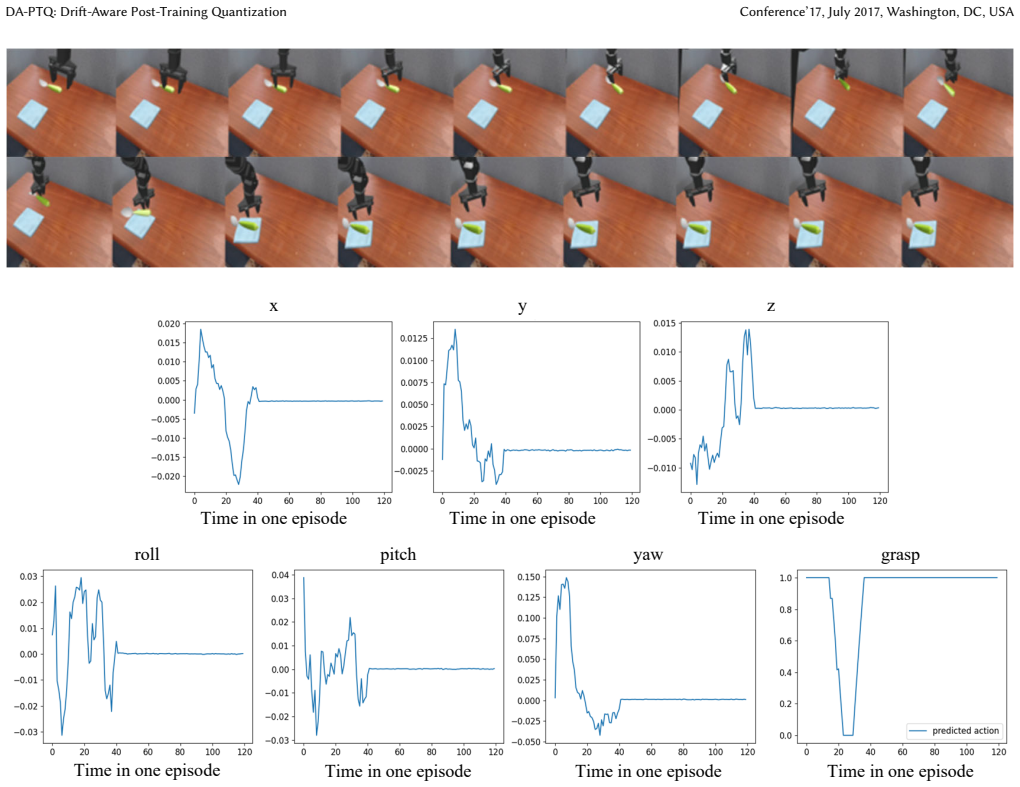


read the original abstract
Vision-Language-Action models (VLAs) have demonstrated strong potential for embodied AI, yet their deployment on resource-limited robots remains challenging due to high memory and computational demands. While Post-Training Quantization (PTQ) provides an efficient solution, directly applying PTQ to VLAs often results in severe performance degradation during sequential control. We identify temporal error accumulation as a key factor, where quantization perturbations at the vision-language-to-action interface are progressively amplified, leading to kinematic drift in executed trajectories. To address this issue, we propose Drift-Aware Post-Training Quantization (DA-PTQ), which formulates quantization as a drift-aware optimization problem over sequential decision processes. DA-PTQ consists of two components: (1) Cross-Space Representation Compensation, which mitigates structured distortions between multimodal representations and action space to improve action consistency, and (2) Motion-Driven Mixed-Precision Allocation, which assigns bit-widths by minimizing trajectory-level motion errors. Extensive experiments show that DA-PTQ significantly reduces kinematic drift and achieves comparable performance to full-precision models under low-bit settings, enabling practical deployment of VLAs on resource-limited robotic platforms.
Editorial analysis
A structured set of objections, weighed in public.
Referee Report
Summary. The paper proposes Drift-Aware Post-Training Quantization (DA-PTQ) for Vision-Language-Action (VLA) models. It identifies temporal error accumulation at the vision-language-to-action interface as causing kinematic drift in quantized sequential control, and introduces two components: (1) Cross-Space Representation Compensation to mitigate multimodal-to-action distortions, and (2) Motion-Driven Mixed-Precision Allocation that assigns bit-widths by minimizing trajectory-level motion errors. Experiments are claimed to show reduced drift and near full-precision performance at low bits, enabling deployment on resource-limited robots.
Significance. If the central claims hold with rigorous validation, the work would be significant for practical embodied AI, as it targets a key deployment barrier (drift under quantization) via a post-training approach without retraining. The emphasis on sequential processes and trajectory-level optimization distinguishes it from standard PTQ methods; reproducible code or parameter-free derivations would further strengthen it, but none are indicated here.
major comments (3)
- [§3.2] §3.2 (Motion-Driven Mixed-Precision Allocation): The method minimizes trajectory-level motion errors for bit allocation; if these trajectories are drawn from the evaluation tasks (standard practice unless stated otherwise), the allocation becomes task-dependent, requiring recomputation for new tasks/environments. This contradicts the abstract's framing of a one-time PTQ procedure for practical deployment across platforms. Provide explicit clarification and an ablation showing zero-shot transfer to unseen tasks.
- [§4] §4 (Experiments): The abstract claims 'significantly reduces kinematic drift' and 'comparable performance to full-precision models under low-bit settings,' but no equations, ablation tables, error bars, dataset details, or statistical tests are referenced. Without these, the central claim that the two components mitigate drift without new inconsistencies cannot be evaluated; include quantitative results (e.g., drift metrics, success rates) with baselines and ablations in the main text.
- [§3.1] §3.1 (Cross-Space Representation Compensation): The formulation as a 'drift-aware optimization problem over sequential decision processes' is central, yet the abstract supplies no equations or derivation showing how compensation is applied without introducing inconsistencies at the action interface. If this is load-bearing for the no-retraining claim, the optimization objective and its relation to standard PTQ losses must be derived explicitly.
minor comments (2)
- [Abstract] Abstract: Expand to include at least one key quantitative result (e.g., drift reduction percentage or bit-width vs. success rate) to ground the claims.
- Notation: Define all symbols (e.g., E_p, trajectory error metric) at first use and ensure consistency between text and any equations.
Simulated Author's Rebuttal
We thank the referee for the detailed and constructive feedback on our manuscript. We appreciate the opportunity to clarify key aspects of DA-PTQ and will revise the paper to address the concerns raised, improving its rigor and clarity.
read point-by-point responses
-
Referee: [§3.2] §3.2 (Motion-Driven Mixed-Precision Allocation): The method minimizes trajectory-level motion errors for bit allocation; if these trajectories are drawn from the evaluation tasks (standard practice unless stated otherwise), the allocation becomes task-dependent, requiring recomputation for new tasks/environments. This contradicts the abstract's framing of a one-time PTQ procedure for practical deployment across platforms. Provide explicit clarification and an ablation showing zero-shot transfer to unseen tasks.
Authors: We thank the referee for this important observation. The trajectories used in Motion-Driven Mixed-Precision Allocation are sampled from a diverse calibration set drawn from the general training data distribution of representative motions, rather than from the specific evaluation tasks. This supports the one-time PTQ framing for cross-platform deployment. We will add explicit clarification of this design choice in the revised manuscript along with an ablation study demonstrating zero-shot transfer performance on unseen tasks and environments. revision: yes
-
Referee: [§4] §4 (Experiments): The abstract claims 'significantly reduces kinematic drift' and 'comparable performance to full-precision models under low-bit settings,' but no equations, ablation tables, error bars, dataset details, or statistical tests are referenced. Without these, the central claim that the two components mitigate drift without new inconsistencies cannot be evaluated; include quantitative results (e.g., drift metrics, success rates) with baselines and ablations in the main text.
Authors: We agree that the experimental presentation requires additional quantitative detail for rigorous evaluation. The revised manuscript will include the relevant equations, ablation tables with error bars, dataset details, statistical tests, specific drift metrics, success rates, and baseline comparisons in the main text to substantiate the claims regarding drift reduction and performance comparability. revision: yes
-
Referee: [§3.1] §3.1 (Cross-Space Representation Compensation): The formulation as a 'drift-aware optimization problem over sequential decision processes' is central, yet the abstract supplies no equations or derivation showing how compensation is applied without introducing inconsistencies at the action interface. If this is load-bearing for the no-retraining claim, the optimization objective and its relation to standard PTQ losses must be derived explicitly.
Authors: Section 3.1 formulates Cross-Space Representation Compensation as a drift-aware optimization over sequential decision processes. We will revise this section to provide a more explicit, step-by-step derivation of the optimization objective, its application at the action interface to avoid inconsistencies, and its direct relation to standard PTQ losses, thereby strengthening the justification for the no-retraining approach. revision: partial
Circularity Check
No significant circularity in the derivation chain
full rationale
The paper formulates DA-PTQ as an optimization over sequential decision processes with two explicit components (cross-space compensation and motion-driven allocation) to mitigate identified drift. No equations or steps in the provided abstract reduce a claimed prediction or result to its own inputs by construction, nor do they rely on self-citations for uniqueness or load-bearing premises. The method is presented as an independent post-training procedure rather than a redefinition of the target metrics or a renaming of known patterns. This is the expected outcome for a methods paper whose central claims rest on empirical mitigation rather than tautological derivation.
Axiom & Free-Parameter Ledger
Reference graph
Works this paper leans on
-
[1]
$\pi_0$: A Vision-Language-Action Flow Model for General Robot Control
Kevin Black, Noah Brown, Danny Driess, Adnan Esmail, Michael Equi, Chelsea Finn, Niccolo Fusai, Lachy Groom, Karol Hausman, Brian Ichter, et al. 2024.𝜋 0: A Vision-Language-Action Flow Model for General Robot Control.arXiv preprint arXiv:2410.24164(2024)
work page internal anchor Pith review Pith/arXiv arXiv 2024
-
[2]
Yi-Chung Chen, Zhi-Kai Huang, and Jing-Ren Chen. 2024. Stepbaq: Stepping backward as correction for quantized diffusion models.Advances in Neural Information Processing Systems(2024), 54054–54078
2024
- [3]
-
[4]
Elias Frantar, Saleh Ashkboos, Torsten Hoefler, and Dan Alistarh. 2022. Gptq: Accurate post-training quantization for generative pre-trained transformers. arXiv preprint arXiv:2210.17323(2022)
work page internal anchor Pith review arXiv 2022
-
[5]
Edward J Hu, Yelong Shen, Phillip Wallis, Zeyuan Allen-Zhu, Yuanzhi Li, Shean Wang, Liang Wang, Weizhu Chen, et al . 2022. Lora: Low-rank adaptation of large language models.Proceedings of the International Conference on Learning Representations(2022), 1–12
2022
-
[6]
Xun Huang and Serge Belongie. 2017. Arbitrary style transfer in real-time with adaptive instance normalization. InProceedings of the IEEE International Conference on Computer Vision. 1501–1510
2017
-
[7]
Benoit Jacob, Skirmantas Kligys, Bo Chen, Menglong Zhu, Matthew Tang, Andrew Howard, Hartwig Adam, and Dmitry Kalenichenko. 2018. Quantization and training of neural networks for efficient integer-arithmetic-only inference. In Proceedings of the IEEE Conference on Computer Vision and Pattern Recognition. 2704–2713
2018
-
[8]
Moo Jin Kim, Chelsea Finn, and Percy Liang. 2025. Fine-tuning vision-language- action models: Optimizing speed and success.arXiv preprint arXiv:2502.19645 (2025)
work page internal anchor Pith review arXiv 2025
-
[9]
Moo Jin Kim, Karl Pertsch, Siddharth Karamcheti, Ted Xiao, Ashwin Balakr- ishna, Suraj Nair, Rafael Rafailov, Ethan Foster, Grace Lam, Pannag Sanketi, et al
-
[10]
Openvla: An open-source vision-language-action model.arXiv preprint arXiv:2406.09246(2024)
work page internal anchor Pith review Pith/arXiv arXiv 2024
-
[11]
Qixiu Li, Yaobo Liang, Zeyu Wang, Lin Luo, Xi Chen, Mozheng Liao, Fangyun Wei, Yu Deng, Sicheng Xu, Yizhong Zhang, et al. 2024. Cogact: A foundational vision-language-action model for synergizing cognition and action in robotic manipulation.arXiv preprint arXiv:2411.19650(2024)
work page Pith review arXiv 2024
- [12]
-
[13]
Ji Lin, Jiaming Tang, Haotian Tang, Shang Yang, Wei-Ming Chen, Wei-Chen Wang, Guangxuan Xiao, Xingyu Dang, Chuang Gan, and Song Han. 2024. Awq: Activation-aware weight quantization for on-device llm compression and accel- eration.Proceedings of Machine Learning and Systems6 (2024), 87–100
2024
-
[14]
Chenghao Liu, Jiachen Zhang, Chengxuan Li, Zhimu Zhou, Shixin Wu, Song- fang Huang, and Huiling Duan. 2026. Ttf-vla: Temporal token fusion via pixel- attention integration for vision-language-action models. InProceedings of the AAAI Conference on Artificial Intelligence. 18452–18459
2026
-
[15]
Songming Liu, Lingxuan Wu, Bangguo Li, Hengkai Tan, Huayu Chen, Zhengyi Wang, Ke Xu, Hang Su, and Jun Zhu. 2024. Rdt-1b: a diffusion foundation model for bimanual manipulation.arXiv preprint arXiv:2410.07864(2024)
work page internal anchor Pith review arXiv 2024
-
[16]
Zhenhua Liu, Yunhe Wang, Kai Han, Wei Zhang, Siwei Ma, and Wen Gao. 2021. Post-training quantization for vision transformer.Advances in Neural Information Processing Systems(2021), 28092–28103
2021
- [17]
-
[18]
William Peebles and Saining Xie. 2023. Scalable diffusion models with trans- formers. InProceedings of the IEEE International Conference on Computer Vision. 4195–4205
2023
-
[19]
Stéphane Ross, Geoffrey Gordon, and Drew Bagnell. 2011. A reduction of imi- tation learning and structured prediction to no-regret online learning. InPro- ceedings of the International Conference on Artificial Intelligence and Statistics. 627–635
2011
- [20]
-
[21]
Bruno Siciliano, Lorenzo Sciavicco, Luigi Villani, and Giuseppe Oriolo. 2009. Robotics: modelling, planning and control. Springer
2009
-
[22]
2020.Robot modeling and control
Mark W Spong, Seth Hutchinson, and Mathukumalli Vidyasagar. 2020.Robot modeling and control. Wiley
2020
-
[23]
Gemini Robotics Team, Saminda Abeyruwan, Joshua Ainslie, Jean-Baptiste Alayrac, Montserrat Gonzalez Arenas, Travis Armstrong, Ashwin Balakrishna, Robert Baruch, Maria Bauza, Michiel Blokzijl, et al. 2025. Gemini robotics: Bring- ing ai into the physical world.arXiv preprint arXiv:2503.20020(2025)
work page internal anchor Pith review arXiv 2025
-
[24]
Octo Model Team, Dibya Ghosh, Homer Walke, Karl Pertsch, Kevin Black, Oier Mees, Sudeep Dasari, Joey Hejna, Tobias Kreiman, Charles Xu, et al. 2024. Octo: An open-source generalist robot policy.arXiv preprint arXiv:2405.12213(2024)
work page internal anchor Pith review arXiv 2024
-
[25]
Homer Rich Walke, Kevin Black, Tony Z Zhao, Quan Vuong, Chongyi Zheng, Philippe Hansen-Estruch, Andre Wang He, Vivek Myers, Moo Jin Kim, Max Du, et al. 2023. Bridgedata v2: A dataset for robot learning at scale. InProceedings of the Conference on Robot Learning. 1723–1736
2023
-
[26]
Changyuan Wang, Ziwei Wang, Xiuwei Xu, Yansong Tang, Jie Zhou, and Jiwen Lu. 2024. Q-vlm: Post-training quantization for large vision-language models. Advances in Neural Information Processing Systems(2024), 114553–114573
2024
-
[27]
Guangxuan Xiao, Ji Lin, Mickael Seznec, Hao Wu, Julien Demouth, and Song Han. 2023. Smoothquant: Accurate and efficient post-training quantization for large language models. InProceedings of the International Conference on Machine Learning. 38087–38099
2023
- [28]
-
[29]
Cheng Yin, Yankai Lin, Wang Xu, Sikyuen Tam, Xiangrui Zeng, Zhiyuan Liu, and Zhouping Yin. 2025. Deepthinkvla: Enhancing reasoning capability of vision- language-action models.arXiv preprint arXiv:2511.15669(2025)
work page internal anchor Pith review Pith/arXiv arXiv 2025
-
[30]
Jingxuan Zhang, Yunta Hsieh, Zhongwei Wang, Haokun Lin, Xin Wang, Ziqi Wang, Yingtie Lei, and Mi Zhang. 2026. QuantVLA: Scale-Calibrated Post- Training Quantization for Vision-Language-Action Models. InProceedings of the IEEE Conference on Computer Vision and Pattern Recognition. 1–11
2026
- [31]
-
[32]
Brianna Zitkovich, Tianhe Yu, Sichun Xu, Peng Xu, Ted Xiao, Fei Xia, Jialin Wu, Paul Wohlhart, Stefan Welker, Ayzaan Wahid, et al. 2023. Rt-2: Vision-language- action models transfer web knowledge to robotic control. InProceedings of the Conference on Robot Learning. 2165–2183. Conference’17, July 2017, Washington, DC, USA Xu et al. A Detailed Experimenta...
2023
discussion (0)
Sign in with ORCID, Apple, or X to comment. Anyone can read and Pith papers without signing in.