Recognition: unknown
Nonlinear Characterization of Thin-Film LiNbO3 Acoustic Filters
Pith reviewed 2026-05-10 14:48 UTC · model grok-4.3
The pith
Thin-film LiNbO3 acoustic filters on sapphire show higher IIP3 and better stability than on silicon at 22 GHz.
A machine-rendered reading of the paper's core claim, the machinery that carries it, and where it could break.
Core claim
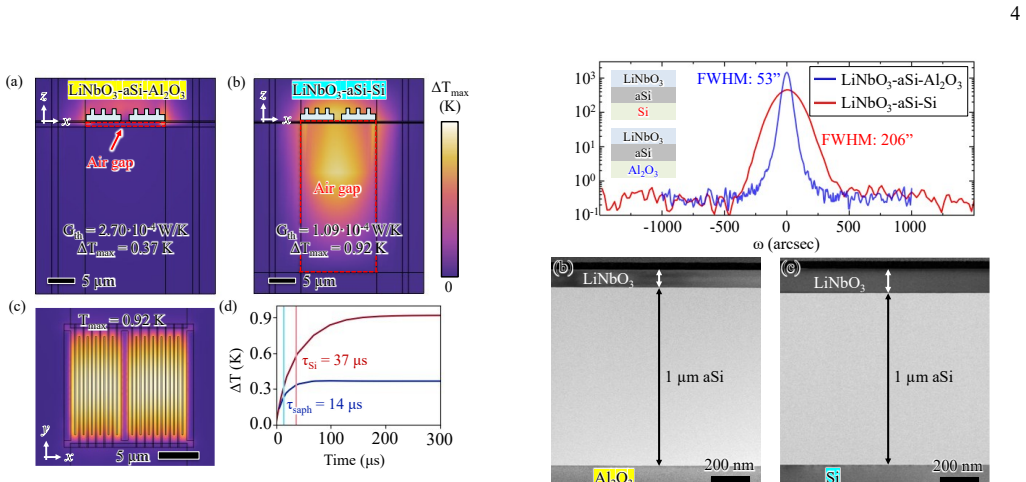
Filters fabricated on transferred single-crystal LiNbO3 films on Al2O3 substrates reach 1.48 dB insertion loss, 17.7 percent 3 dB fractional bandwidth, and 50.8 dBm in-band IIP3 at 21.8 GHz, while otherwise identical filters on silicon reach 2.47 dB loss, 18.6 percent bandwidth, and 46.5 dBm IIP3 at 21.6 GHz. Power-dependent measurements further show reduced thermal instability and less passband distortion when the substrate is Al2O3, demonstrating that substrate selection controls nonlinearity in these devices.
What carries the argument
A methodology for obtaining power-dependent S-parameters and third-order intermodulation (IMD3) data on high-frequency acoustic filters.
If this is right
- Al2O3 substrates raise in-band IIP3 by approximately 4 dBm relative to Si at 22 GHz.
- Reduced thermal drift on Al2O3 directly lowers passband distortion under power.
- Lower insertion loss on Al2O3 improves overall efficiency of the acoustic filter.
- Substrate thermal conductivity becomes a design variable for minimizing nonlinearity in mmWave acoustic modules.
Where Pith is reading between the lines
- The observed stability gain is consistent with Al2O3 having higher thermal conductivity than Si, suggesting that other high-conductivity substrates could be screened with the same measurement method.
- The methodology can be reused to compare nonlinearity across different acoustic modes or film thicknesses without changing the core test setup.
- Design rules for 5G/6G acoustic filters can now treat substrate selection as a first-order lever for power-handling limits.
Load-bearing premise
Measured differences in IIP3, thermal stability, and passband shape between the two substrates arise primarily from the substrate material itself rather than from uncontrolled variations in film transfer, electrode quality, or measurement setup.
What would settle it
Fabricating and measuring multiple sets of devices that use the same LiNbO3 film transfer process and electrode pattern but are placed on either Al2O3 or Si substrates; if the IIP3 gap and stability difference disappear, the substrate claim is falsified.
Figures




read the original abstract
Compact, high-performance components in millimeter-wave (mmWave) communication systems demand new acoustic filter technology at increasingly higher frequencies. Among various promising mmWave platforms, first-order antisymmetric (A1) mode laterally excited bulk acoustic resonators (XBARs) in thin-film lithium niobate (LiNbO3) have perhaps the most impressive linear performance. Despite these advances, there are few reports of nonlinear characterization of LiNbO3 filters at mmWaves. Here, we address this gap by developing a new nonlinear methodology for high-frequency filters. The result is a methodology for performing power-dependent S-parameters and third-order intermodulation (IMD3) measurements. To test our methodology, we fabricated filters on transferred single-crystal LiNbO3 films on sapphire (Al2O3) and silicon (Si) substrates with amorphous silicon (aSi) sacrificial layer. At 21.8 GHz, the filters on Al2O3 demonstrated an insertion loss of 1.48 dB, a 3 dB fractional bandwidth (FBW) of 17.7%, and in-band third-order input intercept points (IIP3) of 50.8 dBm. At 21.6 GHz, the filters on silicon demonstrated an insertion loss of 2.47 dB, a 3 dB FBW of 18.6%, and in-band IIP3 of 46.5 dBm. The nonlinear results conclusively show that thermal stability and passband distortion improved on the Al2O3 substrate, confirming that substrate selection plays a pivotal role in mitigating nonlinearity in acoustic front-end modules.
Editorial analysis
A structured set of objections, weighed in public.
Referee Report
Summary. The paper develops a methodology for nonlinear characterization of mmWave thin-film LiNbO3 XBAR acoustic filters via power-dependent S-parameters and IMD3 measurements. Filters fabricated on transferred LiNbO3 films on Al2O3 and Si substrates (with aSi sacrificial layer) are compared at ~21.7 GHz, with reported values of IL = 1.48 dB, FBW = 17.7%, IIP3 = 50.8 dBm on Al2O3 versus IL = 2.47 dB, FBW = 18.6%, IIP3 = 46.5 dBm on Si. The authors conclude that the nonlinear results demonstrate improved thermal stability and reduced passband distortion on Al2O3, confirming substrate selection as key to mitigating nonlinearity in acoustic front-end modules.
Significance. If the substrate-comparison results prove robust, the work fills a gap in nonlinear data for high-frequency LiNbO3 acoustic devices and supplies concrete IIP3 and stability metrics that could guide substrate choice for low-distortion mmWave filters. The measurement methodology itself is potentially reusable for other acoustic platforms.
major comments (2)
- [Abstract] Abstract: the central claim that 'nonlinear results conclusively show' improved thermal stability and passband distortion on Al2O3 (versus Si) rests on single-point IIP3 and IL values without reported statistics, error bars, multiple-device data, or matched fabrication runs. This leaves open the possibility that observed differences arise from film-transfer quality, electrode patterning variation, or measurement artifacts rather than substrate thermal/acoustic properties.
- [Abstract] Abstract and fabrication description: no details are provided on how thermal stability was quantified (e.g., temperature-dependent S-parameter sweeps, specific metrics such as frequency shift or Q degradation) or on calibration procedures for the power-dependent measurements, undermining the attribution of stability gains specifically to the Al2O3 substrate.
minor comments (1)
- [Abstract] Abstract: the two center frequencies are given as 21.8 GHz and 21.6 GHz; clarify whether these are design targets or measured values and whether the slight offset affects the direct comparison.
Simulated Author's Rebuttal
We thank the referee for the constructive comments on our manuscript. We address each major comment point by point below and outline the revisions we will make to strengthen the presentation of our results.
read point-by-point responses
-
Referee: [Abstract] Abstract: the central claim that 'nonlinear results conclusively show' improved thermal stability and passband distortion on Al2O3 (versus Si) rests on single-point IIP3 and IL values without reported statistics, error bars, multiple-device data, or matched fabrication runs. This leaves open the possibility that observed differences arise from film-transfer quality, electrode patterning variation, or measurement artifacts rather than substrate thermal/acoustic properties.
Authors: We agree that the wording in the abstract is overly strong given the presentation of single representative values. The devices on both substrates were fabricated in matched runs using the same LiNbO3 film transfer process to minimize variation, and the reported IIP3 and IL figures are from devices measured under identical conditions. However, we did not include statistics across multiple devices or error bars in the current version. We will revise the abstract to replace 'conclusively show' with 'indicate' and add a new supplementary figure or table reporting IIP3, IL, and FBW from at least five devices per substrate type, including mean values and standard deviations, to demonstrate that the observed differences are not due to fabrication artifacts. revision: yes
-
Referee: [Abstract] Abstract and fabrication description: no details are provided on how thermal stability was quantified (e.g., temperature-dependent S-parameter sweeps, specific metrics such as frequency shift or Q degradation) or on calibration procedures for the power-dependent measurements, undermining the attribution of stability gains specifically to the Al2O3 substrate.
Authors: The improved thermal stability on Al2O3 was inferred from the power-dependent S-parameter data, which showed smaller frequency shifts and less passband distortion under increasing input power compared to the Si devices, consistent with the higher thermal conductivity of sapphire. We acknowledge that the abstract and fabrication section lack explicit quantification details and calibration information. In revision we will expand the methods section to describe the calibration procedures (including de-embedding, power meter calibration, and reference plane definition) for the power-dependent S-parameter and IMD3 measurements. We will also add a paragraph clarifying the specific metrics used to assess stability (e.g., observed center-frequency shift versus input power) and note that dedicated temperature-chamber sweeps were not performed in this study. revision: partial
- Dedicated temperature-dependent S-parameter sweeps in a controlled thermal chamber were not performed; thermal stability was inferred solely from the power-dependent distortion metrics.
Circularity Check
No circularity: pure experimental characterization
full rationale
The paper reports fabrication of LiNbO3 filters on Al2O3 and Si substrates followed by direct power-dependent S-parameter and IMD3 measurements at ~21 GHz. All reported values (IIP3 of 50.8 dBm vs 46.5 dBm, insertion loss, FBW) are measured quantities, not outputs of any model, fit, or derivation. No equations, predictions, self-citations, or ansatzes appear in the abstract or claimed methodology; the central claim is an empirical comparison of measured performance. The derivation chain is therefore empty and self-contained against external benchmarks.
Axiom & Free-Parameter Ledger
Reference graph
Works this paper leans on
-
[1]
Transferre thin -film lithium niobate as millimeter - wave acoustic filter platforms,
O. Barrera et al. , “Transferre thin -film lithium niobate as millimeter - wave acoustic filter platforms,” in Proc. IEEE 37th Int. Conf. Micro Electro Mech. Syst. (MEMS) , Austin, TX, USA, 2024, pp. 23 –26, doi: 10.1109/MEMS58180.2024.10439593
-
[2]
R. Aigner, G. Fattinger, M. Schaefer, K. Karnati, R. Rothemund, and F. Dumont, “ A filters for 5G ban s,” in Proc. IEEE Int. Electron Devices Meeting (IEDM), San Francisco, CA, USA, Dec. 2018, pp. 14.5.1–14.5.4, doi: 10.1109/IEDM.2018.8614564
-
[3]
Acoustic filters for F communication,
Y. Qian, Y. Zhang, S. Bhattacharya, W. Yang, C. Liu, and Y. Zhu, “Acoustic filters for F communication,” IEEE Nanotechnol. Mag. , vol. 18, no. 1, pp. 23–33, Feb. 2024, doi: 10.1109/MNANO.2023.3340382
-
[4]
B. A. Auld, Acoustic Fields and Waves in Solids , vols. 1 –2. New York, NY, USA: Wiley-Interscience, 1973
1973
-
[5]
5 volution an — hite aper,
NTT OCO O, nc , “5 volution an — hite aper,” Jan 0 3 [Online]. Accessed: Sep. 22, 2025
2025
-
[6]
Multiphoton non-local quantum interference controlled by an undetected photon,
iribal i, L Colombo, imeoni, an inal i, “Compact an wideband nanoacoustic pass -band filters for future 5G and 6G cellular ra ios,” Nat. Commun. , vol. 15, no. 1, 2024, doi: 10.1038/s41467-023- 44038-9
-
[7]
5 A technology Challenges an solutions,
Aljoumayly, othemun , chaefer, an eeren, “5 A technology Challenges an solutions,” in Proc. IEEE Wireless and Microwave Technology Conf. (WAMICON), Clearwater, FL, USA, 2022, pp. 1–3, doi: 10.1109/WAMICON53991.2022.9786171
-
[8]
From microwave acoustic filters to millimeter-wave operation an new applications,
A. Hagelauer et al , “From microwave acoustic filters to millimeter-wave operation an new applications,” IEEE J. Microw., vol. 3, no. 1, pp. 484 – 508, Jan. 2023, doi: 10.1109/JMW.2022.3226415
-
[9]
Acoustic wave filter technology —A review,
C C uppel, “Acoustic wave filter technology —A review,” IEEE Trans. Ultrason. Ferroelectr. Freq. Control , vol. 64, no. 9, pp. 1390 – 1400, Sep. 2017, doi: 10.1109/TUFFC.2017.2690905
-
[10]
icrowave acoustic evices ecent a vances an outloo ,
ong, Lu, ang, L ao, an A assanien, “ icrowave acoustic evices ecent a vances an outloo ,” IEEE J. Microw., vol. 1, no. 2, pp. 601–609, 2021, doi: 10.1109/JMW.2021.3064825
-
[11]
33 z overmo e bul acoustic resonator,
Z chaffer, imeoni, an iazza, “33 z overmo e bul acoustic resonator,” IEEE Microw. Wireless Compon. Lett., vol. 32, no. 6, pp. 656–659, Jun. 2022, doi: 10.1109/LMWC.2022.3166682
-
[12]
illimeter wave thin -film bulk acoustic resonator in sputtere scan ium aluminum nitri e,
S. Cho et al. , “ illimeter wave thin -film bulk acoustic resonator in sputtere scan ium aluminum nitri e,” J. Microelectromech. Syst ., vol. 32, no. 6, pp. 529–532, Dec. 2023, doi: 10.1109/JMEMS.2023.3321284
-
[13]
A z all epitaxial Al0 8 c0 N casca e F A for F filtering applications,
ar , J ang, ang, Z i, an A Ansari, “A z all epitaxial Al0 8 c0 N casca e F A for F filtering applications,” IEEE Electron Device Lett., vol. 45, no. 7, pp. 1341–1344, Jul. 2024, doi: 10.1109/LED.2024.3404477
-
[14]
A K-band bulk acoustic wave resonator using periodically pole Al0 c0 8N,
Izhar et al., “A K-band bulk acoustic wave resonator using periodically pole Al0 c0 8N,” IEEE Electron Device Lett. , vol. 44, no. 7, pp. 1196–1199, Jul. 2023, doi: 10.1109/LED.2023.3282170
-
[15]
Izhar et al., “ erio ically pole aluminum scan ium nitri e bul acoustic wave resonators an filters for communications in the era,” Microsyst. Nanoeng., vol. 11, no. 1, p. 19, 2025, doi: 10.1038/s41378-024-00857-4
-
[16]
A high -selectivity 11.9 -GHz filter realized in a perio ically pole piezoelectric Al cN,
Fiagbenu et al , “A high -selectivity 11.9 -GHz filter realized in a perio ically pole piezoelectric Al cN,” IEEE Microw. Wireless Technol. Lett., early access, 2025, doi: 10.1109/LMWT.2025.3581841
-
[17]
A mm ave trilayer AlN/ cAlN/AlN higher or er mo e F A ,
Nam, eng, ang, ang, Z i, an A ortazawi, “A mm ave trilayer AlN/ cAlN/AlN higher or er mo e F A ,” IEEE Microw. Wireless Technol. Lett. , vol. 33, no. 6, pp. 803 –806, Jun. 2023, doi: 10.1109/LMWT.2023.3271865
-
[18]
5 - z epitaxial AlN F A s on iC substrates,
Zhao et al , “ 5 - z epitaxial AlN F A s on iC substrates,” IEEE Electron Device Lett. , vol. 44, no. 6, pp. 903 –906, Jun. 2023, doi: 10.1109/LED.2023.3268863
-
[19]
X –Ka band epitaxial ScAlN/AlN/NbN/SiC high -overtone bulk acoustic resonators,
J o hale, T ar y, Katzer, an owney, “X –Ka band epitaxial ScAlN/AlN/NbN/SiC high -overtone bulk acoustic resonators,” IEEE Electron Device Lett., vol. 44, no. 4, pp. 674–677, Apr. 2023, doi: 10.1109/LED.2023.3243437
-
[20]
YODAS: Youtube-Oriented Dataset for Audio and Speech
R. Vetury et al. , “A manufacturable Al cN perio ically polarize piezoelectric film bulk acoustic wave resonator (AlScN P3F BAW) operating in overtone mo e at X an Ku ban ,” in Proc. IEEE MTT-S Int. Microw. Symp. (IMS), 2023, doi: 10.1109/IMS37964.2023.10188141
-
[21]
cAlN -on-SiC Ku-band Sezawa solidly-mounted bidimensional mo e resonators,
L. Colombo, L. Spagnuolo, K. Saha, G. Giribaldi, P. Simeoni, and M. inal i, “ cAlN -on-SiC Ku-band Sezawa solidly-mounted bidimensional mo e resonators,” IEEE Electron Device Lett ., vol. 46, no. 4, pp. 660 – 663, Apr. 2025, doi: 10.1109/LED.2025.3541373
-
[22]
X-band bulk acoustic wave resonator (XBAW) using perio ically polarize piezoelectric films 3F ,
A. Kochhar et al., “X-band bulk acoustic wave resonator (XBAW) using perio ically polarize piezoelectric films 3F ,” in Proc. IEEE Int. Ultrason. Symp. (IUS) , Montreal, QC, Canada, 2023, pp. 1 –4, doi: 10.1109/IUS51837.2023.10306825
-
[23]
Compact Modeling of Emerging IC Devices for Technology -Design Co -development,
J. Kramer et al., “5 z acoustic resonator with of 3 an Q of 5 in thin -film lithium niobate,” in Proc. IEEE Int. Electron Devices Meeting (IEDM), San Francisco, CA, USA, Dec. 2022, pp. 16.4.1 –16.4.4, doi: 10.1109/IEDM45625.2022.10019391
-
[24]
i eban hybri monolithic lithium niobate acoustic filter in the K -ban ,
L ao, ang, an ong, “ i eban hybri monolithic lithium niobate acoustic filter in the K -ban ,” IEEE Trans. Ultrason., Ferroelectr., Freq. Control , vol. 68, no. 4, pp. 1408 –1417, Apr. 2021, doi: 10.1109/TUFFC.2020.3035123
-
[25]
ecent a vances in high -performance millimeter -wave acoustic resonators and filters using thin -film lithium niobate,
Lu, “ ecent a vances in high -performance millimeter -wave acoustic resonators and filters using thin -film lithium niobate,” Prog. Quantum Electron., vols. 100 –101, 2025, Art. no. 100565, doi: TABLE II SOA COMPARISONS OF ACOUSTIC FILTERS BEYOND 10 GHZ Ref. fc (GHz) IL (dB) 3 dB FBW (%) IIP3 (dBm) Size (mm2)
2025
-
[26]
17.4 1.86 3.9 36 0.6 × 0.33 17.4 3.25 3.4 40 0.6 × 0.33
-
[27]
11.9 1.5 6.6 36.7 0.43 × 0.49
-
[28]
19 8 2.4 - 1.2 × 1.2
-
[29]
23.8 1.52 19.4 - 0.85 × 0.75
-
[30]
50 3.32 2.9 - 0.74 × 0.48 This work (LiNbO3-aSi-Al2O3) 21.8 1.48 17.7 50.8 0.75 × 0.74 This work (LiNbO3-aSi-Si) 21.6 2.47 18.6 46.5 0.75 × 0.74 10 10.1016/j.pquantelec.2025.100565
-
[31]
5 z Lamb wave resonator on LiNbO3 thin crystal plate an its application,
Ka ota an T Ogami, “5 z Lamb wave resonator on LiNbO3 thin crystal plate an its application,” Jpn. J. Appl. Phys ., vol. 50, no. 7S, Jul. 2011, doi: 10.1143/JJAP.50.07HD11
-
[32]
ong an iazza, “ esign an analysis of lithium –niobate-based high electromechanical coupling RF -MEMS resonators for wideband filtering,” IEEE Trans. Microw. Theory Techn. , vol. 61, no. 1, pp. 403 – 414, Jan. 2013, doi: 10.1109/TMTT.2012.2228671
-
[33]
less y, “X A ,” in Proc. IEEE Int. Ultrason. Symp. (IUS), 2022, pp. 1–11, doi: 10.1109/IUS54386.2022.9957805
-
[34]
Thin-film lithium niobate acoustic resonator with high Q of 3 an of 5 at 50 z,
J. Kramer et al., “Thin-film lithium niobate acoustic resonator with high Q of 3 an of 5 at 50 z,” in Proc. Joint Conf. Eur. Freq. Time Forum/IEEE Int. Freq. Control Symp. (EFTF/IFCS), May 2023, doi: 10.1109/EFTF/IFCS57587.2023.10272149
-
[35]
Acoustic resonators above 100 z,
J. Kramer et al., “Acoustic resonators above 100 z,” Appl. Phys. Lett., vol. 127, no. 1, Jul. 2025, Art. no. 012204, doi: 10.1063/5.0275691
-
[36]
Thin-film lithium niobate acoustic filter at 23.5 GHz with 38 L an 8 F ,
O. Barrera et al., “Thin-film lithium niobate acoustic filter at 23.5 GHz with 38 L an 8 F ,” J. Microelectromech. Syst. , vol. 32, no. 6, pp. 622-625, Dec. 2023, doi: 10.1109/JMEMS.2023.3314666
-
[37]
S. Cho et al., “ 3 8-GHz acoustic filter in periodically poled piezoelectric film lithium niobate with 1.52 - L an F ,” IEEE Microw. Wireless Technol. Lett. , vol. 34, no. 4, pp. 391 -394, April 2024, doi: 10.1109/LMWT.2024.3368354
-
[38]
Frequency an ban wi th esign towar millimeter - wave thin-film lithium niobate acoustic filters,
O. Barrera et al , “Frequency an ban wi th esign towar millimeter - wave thin-film lithium niobate acoustic filters,” IEEE Microw. Wireless Technol. Lett. , vol. 35, no. 6, pp. 796 -799, June 2025, doi: 10.1109/LMWT.2025.3559400
-
[39]
ractical emonstrations of F 3 -band thin -film lithium niobate acoustic filter esign,
T. Anusorn et al , “ ractical emonstrations of F 3 -band thin -film lithium niobate acoustic filter esign,” IEEE Trans. Ultrason., Ferroelectr., Freq. Control , vol. 72, no. 12, pp. 1650 -1662, Dec. 2025, doi: 10.1109/TUFFC.2025.3632215
-
[40]
50 GHz piezoelectric acoustic filter,
O. Barrera, et al., “50 GHz piezoelectric acoustic filter,” arXiv preprint arXiv:2506.22549, Jun. 2025, doi: 10.48550/arXiv.2506.22549
-
[41]
ehavior of A evices at high power levels,
R. Aigner, N.-H. Huynh, M. Handtmann, and S. Marksteiner, “ ehavior of A evices at high power levels,” in Proc. IEEE MTT -S Int. Microw. Symp. Dig. , Long Beach, CA, USA, 2005, pp. 429 –432, doi: 10.1109/MWSYM.2005.1516620
-
[42]
Bhugra and G
H. Bhugra and G. Piazza, Piezoelectric MEMS Resonators . Springer, 2017
2017
-
[43]
rowth, optical an thermal properties of near - stoichiometric LiNbO 3 single crystal,
S. Yao, et al. , “ rowth, optical an thermal properties of near - stoichiometric LiNbO 3 single crystal,” J. Alloys Compd. , vol. 455, 2008, doi: 10.1016/j.jallcom.2007.02.001
-
[44]
tu y of thermal nonlinearity in lithium niobate-base resonators,
R. Lu and S. Gong, “ tu y of thermal nonlinearity in lithium niobate-base resonators,” in Proc. Transducers 2015 —18th Int. Conf. Solid -State Sensors, Actuators Microsyst. (TRANSDUCERS) , Anchorage, AK, USA, 2015, pp. 1993 -1996, doi: 10.1109/TRANSDUCERS.2015.7181345
-
[45]
A vances in nonlinear measurement and modeling of bulk acoustic wave resonators invite ,
A Fel , him, Foula i, an F ayatpur, “A vances in nonlinear measurement and modeling of bulk acoustic wave resonators invite ,” in Proc. IEEE Int. Ultrason. Symp. (IUS) , Chicago, IL, USA, 2014, pp. 264–272, doi: 10.1109/ULTSYM.2014.0067
-
[46]
Nonlinear behavior of F bul acoustic wave casca e components at high input power,
V. Chauhan, et al. , “Nonlinear behavior of F bul acoustic wave casca e components at high input power,” in Proc. Asia –Pacific Microw. Conf. (APMC) , New Delhi, India, 2016, pp. 1 –4, doi: 10.1109/APMC.2016.7931351
-
[47]
eciphering intermo ulation in AlN laterally vibrating resonators,
Lu, A ao, an ong, “ eciphering intermo ulation in AlN laterally vibrating resonators,” in Proc. IEEE 29th Int. Conf. Micro Electro Mech. Syst. (MEMS) , Shanghai, China, 2016, pp. 671 –674, doi: 10.1109/MEMSYS.2016.7421715
-
[48]
Thermal expansion of lithium tantalate an lithium niobate single crystals,
Y. S. Kim and R. T. Smith, “Thermal expansion of lithium tantalate an lithium niobate single crystals,” J. Appl. Phys. , vol. 40, no. 11, pp. 4637–4641, Oct. 1969, doi: 10.1063/1.1657244
-
[49]
O a a an To umaru, “ recise etermination of lattice parameter and thermal expansion coefficient of silicon between 300 and 1500 K,” J. Appl. Phys., vol. 56, no. 2, pp. 314–320, Jul. 1984, doi: 10.1063/1.333965
-
[50]
im an J aff, “Thermal expansion of AlN, sapphire, an silicon,” J. Appl. Phys. , vol. 45, no. 3, pp. 1456 –1457, Mar. 1974, doi: 10.1063/1.1663432
-
[51]
Thin-film lithium niobate acoustic resonator with high Q of 3 an of 5 at 50 z,
V. Chulukhadze et al. , “Frequency scaling millimeter -wave acoustic devices in thin -film lithium niobate,” in Proc. Joint Conf. Eur. Freq. Time Forum/IEEE Int. Freq. Control Symp. (EFTF/IFCS) , May 2023, doi: 10.1109/EFTF/IFCS57587.2023.10272038
-
[52]
Two -port network analyzer calibration using an un nown ’thru’,
A Ferrero an isani, “Two -port network analyzer calibration using an un nown ’thru’,” IEEE Microw. Guided Wave Lett , vol. 2, no. 12, pp. 505-507, Dec. 1992, doi: 10.1109/75.173410
-
[53]
A multiline method of network analyzer calibration,
R. B. Marks, “A multiline method of network analyzer calibration,” IEEE Trans. Microw. Theory Techn. , vol. 39, no. 7, pp. 1205 -1215, July 1991, doi: 10.1109/22.85388
-
[54]
D. C. DeGroot, J. A. Jargon and R. B. Marks, “ ultiline TRL reveale ,” in 60th ARFTG Conference Digest , Fall 2002., Washington, DC, USA, 2002, pp. 131-155, doi: 10.1109/ARFTGF.2002.1218696
-
[55]
F illiams an K al er, “ eries -resistor calibration,” in 50th ARFTG Conference Digest , Portland, OR, USA, 1997, pp. 131 -137, doi: 10.1109/ARFTG.1997.32726
-
[56]
A compact variable -temperature broadband series - resistor calibration,
N. D. Orloff et al , “A compact variable -temperature broadband series - resistor calibration,” IEEE Trans. Microw. Theory Techn., vol. 59, no. 1, pp. 188-195, Jan. 2011, doi: 10.1109/TMTT.2010.2091200
-
[57]
NIST Microwave Uncertainty Framework. (2011). National Institute of Standards and Technology. [Online]. Available: https://www.nist.gov/services-resources/software/wafer-calibration-software
2011
-
[58]
J A Jargon, F illiams an A an ers, “The relationship between switch-term-corrected scattering -parameters and wave -parameters measured with a two-port vector network analyzer,” IEEE Microw. Wirel. Compon. Lett. , vol. 28, no. 10, pp. 951 -953, Oct. 2018, doi: 10.1109/LMWC.2018.2867076
-
[59]
Nonlinear equivalent circuits of acoustic evices,
Cho an J a ita, “Nonlinear equivalent circuits of acoustic evices,” in Proc. IEEE Ultrason. Symp., Baltimore, MD, USA, 1993, pp. 867–872, doi: 10.1109/ULTSYM.1993.339667
discussion (0)
Sign in with ORCID, Apple, or X to comment. Anyone can read and Pith papers without signing in.