The Non-Optimality of Scientific Knowledge: Path Dependence, Lock-In, and The Local Minimum Trap
Pith reviewed 2026-05-10 15:37 UTC · model grok-4.3
The pith
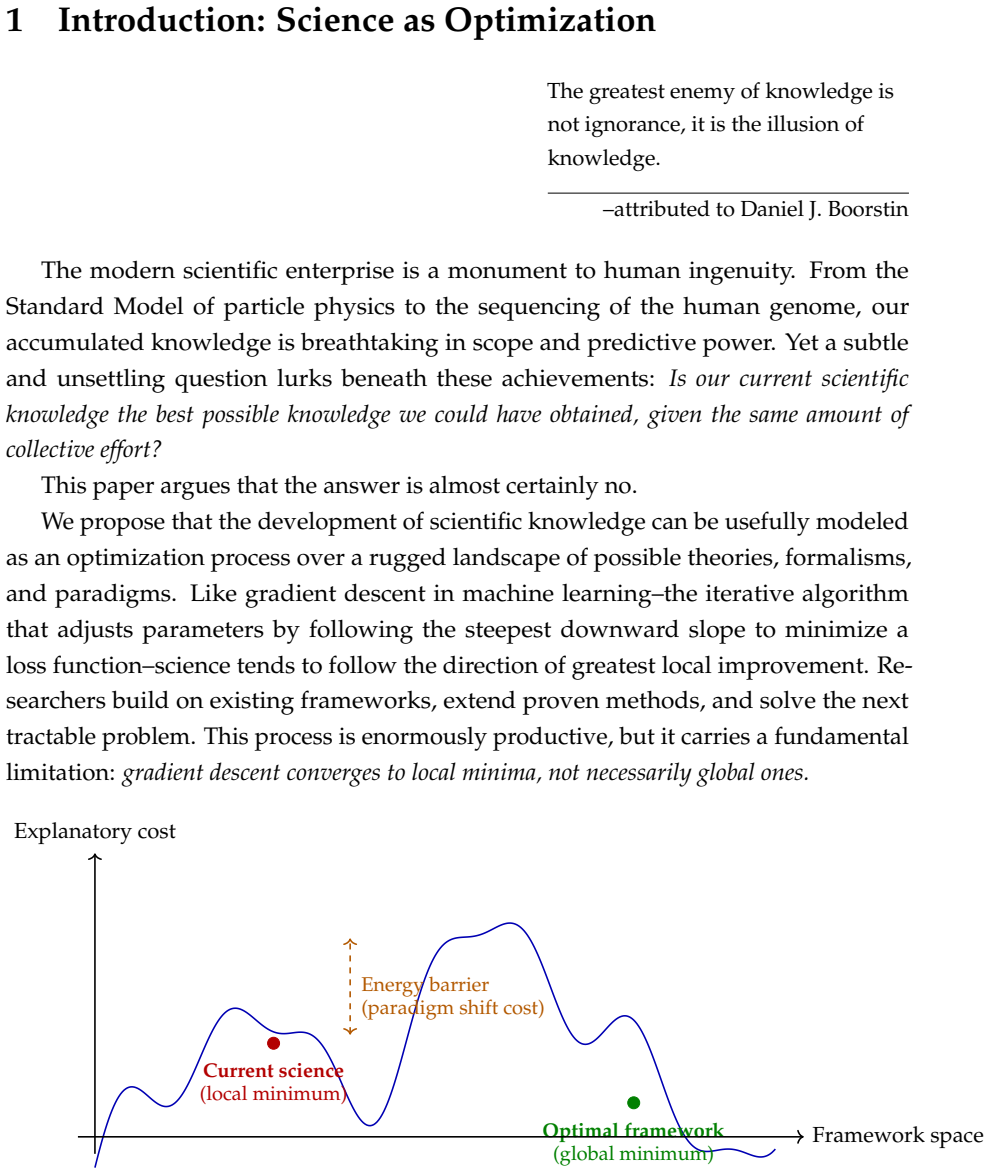
Scientific knowledge at any historical moment forms a local optimum shaped by path dependence and lock-in, not a global one.
A machine-rendered reading of the paper's core claim, the machinery that carries it, and where it could break.
Core claim
The body of scientific knowledge, at any given historical moment, represents a local optimum rather than a global one. The frameworks, formalisms, and paradigms through which we understand nature are substantially shaped by historical contingency, cognitive path dependence, and institutional lock-in. Science advances by following the steepest local gradient of tractability, empirical accessibility, and institutional reward, and in doing so may bypass fundamentally superior descriptions of nature. Three interlocking mechanisms of lock-in—cognitive, formal, and institutional—sustain these positions, and recognizing them is a prerequisite for designing strategies capable of escaping the local-0
What carries the argument
The local minimum trap maintained by three interlocking lock-in mechanisms—cognitive, formal, and institutional—that steer scientific inquiry along historically contingent paths of tractability and reward.
If this is right
- Science may continue to bypass superior descriptions of nature if it keeps optimizing for immediate tractability and institutional reward.
- Meta-scientific strategies can be designed to disrupt cognitive, formal, and institutional lock-in and encourage exploration of alternative paths.
- Epistemological assessments of current knowledge must treat it as provisionally local rather than necessarily global.
- Concrete interventions such as targeted funding for high-risk alternatives and periodic re-examination of foundational assumptions become necessary.
- The philosophy of science gains a new requirement to account for path dependence when judging the reliability of existing paradigms.
Where Pith is reading between the lines
- If lock-in operates through institutional rewards, fields that expand rapidly may entrench suboptimal models more quickly than slower-moving ones.
- The same mechanisms could apply to the development of engineering practices and technological standards that rest on scientific foundations.
- One way to test the thesis would be to reconstruct historical choice points in a specific field and simulate whether alternative formalisms would have produced measurably better predictions.
Load-bearing premise
Superior alternative descriptions of nature exist and are being systematically bypassed, and the chosen case studies demonstrate genuine lock-in without selection bias or hindsight.
What would settle it
A systematic historical analysis showing that every major scientific advance actually reached a global optimum with no evidence of bypassed superior frameworks, or a field-by-field search that finds no viable alternative formalisms despite unrestricted exploration.
Figures
read the original abstract
Science is widely regarded as humanity's most reliable method for uncovering truths about the natural world. Yet the \emph{trajectory} of scientific discovery is rarely examined as an optimization problem in its own right. This paper argues that the body of scientific knowledge, at any given historical moment, represents a \emph{local optimum} rather than a global one--that the frameworks, formalisms, and paradigms through which we understand nature are substantially shaped by historical contingency, cognitive path dependence, and institutional lock-in. Drawing an analogy to gradient descent in machine learning, we propose that science follows the steepest local gradient of tractability, empirical accessibility, and institutional reward, and in doing so may bypass fundamentally superior descriptions of nature. We develop this thesis through detailed case studies spanning mathematics, physics, chemistry, biology, neuroscience, and statistical methodology. We identify three interlocking mechanisms of lock-in--cognitive, formal, and institutional--and argue that recognizing these mechanisms is a prerequisite for designing meta-scientific strategies capable of escaping local optima. We conclude by proposing concrete interventions and discussing the epistemological implications of our thesis for the philosophy of science.
Editorial analysis
A structured set of objections, weighed in public.
Referee Report
Summary. The paper claims that scientific knowledge at any historical moment constitutes a local optimum rather than a global one, shaped by historical contingency, cognitive path dependence, and institutional lock-in. It analogizes scientific discovery to gradient descent in machine learning, where science follows local gradients of tractability and reward, potentially missing superior descriptions of nature. The argument is developed via case studies across mathematics, physics, chemistry, biology, neuroscience, and statistical methodology; three interlocking lock-in mechanisms are identified; and concrete interventions plus epistemological implications are proposed.
Significance. If substantiated, the thesis would reframe debates in the philosophy of science by emphasizing non-optimality due to path dependence and suggesting actionable meta-scientific strategies. The interdisciplinary scope and forward proposals on escaping local optima add value to discussions of scientific progress, though the interpretive nature limits immediate empirical impact.
major comments (2)
- [Abstract and Introduction] Abstract and Introduction: the central claim that science bypasses 'fundamentally superior descriptions of nature' is load-bearing but rests on the untested assumption that such alternatives were available and viable at the time; without independent criteria for identifying global optima separate from hindsight, the lock-in interpretation risks circularity.
- [Case studies] Case studies section: the historical episodes are invoked to illustrate cognitive, formal, and institutional lock-in, yet they provide no counterfactual analysis or contemporaneous evidence that superior frameworks were systematically bypassed rather than being intractable given then-available tools and data, weakening support for the non-optimality thesis.
minor comments (2)
- [Introduction] The three lock-in mechanisms (cognitive, formal, institutional) are introduced but would benefit from a concise summary table or diagram early in the text to improve readability and allow readers to track their interplay across the case studies.
- [Conclusion] The conclusion's proposed interventions are outlined at a high level; adding brief discussion of implementation challenges or pilot tests would clarify their practicality without altering the core argument.
Simulated Author's Rebuttal
We thank the referee for their thoughtful and incisive comments, which correctly identify key evidentiary challenges in substantiating our central thesis. We respond to each major comment below and indicate the revisions we will undertake.
read point-by-point responses
-
Referee: [Abstract and Introduction] Abstract and Introduction: the central claim that science bypasses 'fundamentally superior descriptions of nature' is load-bearing but rests on the untested assumption that such alternatives were available and viable at the time; without independent criteria for identifying global optima separate from hindsight, the lock-in interpretation risks circularity.
Authors: We accept that the phrasing in the abstract and introduction could be read as presupposing the existence of identifiable global optima. Our intent is to argue that path-dependent mechanisms systematically favor certain trajectories over others that were historically accessible, without claiming to specify what a global optimum would have been. We will revise the abstract and introduction to foreground the mechanisms of lock-in and the potential for overlooked alternatives, while adding an explicit discussion of the difficulties in defining independent criteria for optimality in science. This revision will reduce any appearance of circularity by shifting emphasis from outcomes to the documented processes of selection. revision: partial
-
Referee: [Case studies] Case studies section: the historical episodes are invoked to illustrate cognitive, formal, and institutional lock-in, yet they provide no counterfactual analysis or contemporaneous evidence that superior frameworks were systematically bypassed rather than being intractable given then-available tools and data, weakening support for the non-optimality thesis.
Authors: The case studies draw on primary historical sources documenting contemporaneous proposals, debates, and institutional choices in which alternative approaches were considered but deprioritized for reasons tied to the three lock-in mechanisms. We will expand the case studies section to include additional direct citations from historical actors that demonstrate awareness of viable alternatives at the time. We will also add a dedicated paragraph acknowledging the inherent limits of retrospective historical analysis and the absence of formal counterfactual modeling, which we agree would provide stronger support but exceeds the interpretive scope of the present work. revision: partial
Circularity Check
No significant circularity
full rationale
The paper presents its central thesis as an interpretive argument motivated by an analogy to gradient descent and supported by historical case studies across multiple disciplines. The abstract contains no equations, fitted parameters, self-citations, or definitional loops that would reduce the claimed local-optimum status of scientific knowledge to its own inputs by construction. The mechanisms of lock-in are introduced as explanatory categories rather than derived results, and the case studies are positioned as illustrative development of the thesis rather than as evidence that presupposes the conclusion. No load-bearing self-referential steps are identifiable from the provided text.
Axiom & Free-Parameter Ledger
axioms (2)
- domain assumption Scientific discovery can be usefully modeled as following local gradients of tractability, empirical accessibility, and institutional reward.
- ad hoc to paper Superior global descriptions of nature exist and are accessible in principle but bypassed by current paths.
Reference graph
Works this paper leans on
-
[1]
Bader, R. F. W. (1990). Atoms in Molecules: A Quantum Theory. Oxford University Press
work page 1990
-
[2]
Beniaguev, D., Segev, I., & London, M. (2021). Single cortical neurons as deep artificial neural networks. Neuron, 109(17), 2727--2739
work page 2021
-
[3]
Bloor, D. (2011). The Enigma of the Aerofoil: Rival Theories in Aerodynamics, 1909--1930. University of Chicago Press
work page 2011
-
[4]
Crutchfield, J. P. (2012). Between order and chaos. Nature Physics, 8, 17--24
work page 2012
-
[5]
Davies, A., Veli c kovi\' c , P., Buesing, L., et al. (2021). Advancing mathematics by guiding human intuition with AI . Nature, 600(7887), 70--74
work page 2021
-
[6]
Fields, R. D. (2009). The Other Brain: The Scientific and Medical Breakthroughs That Will Heal Our Brains and Revolutionize Our Health. Simon & Schuster
work page 2009
-
[7]
Frisch, U., Hasslacher, B., & Pomeau, Y. (1986). Lattice-gas automata for the N avier- S tokes equation. Physical Review Letters, 56(14), 1505--1508
work page 1986
-
[8]
Jaynes, E. T. (1957). Information theory and statistical mechanics. Physical Review, 106(4), 620--630
work page 1957
-
[9]
Kauffman, S. A. (1993). The Origins of Order: Self-Organization and Selection in Evolution. Oxford University Press
work page 1993
-
[10]
Kuhn, T. S. (1962). The Structure of Scientific Revolutions. University of Chicago Press
work page 1962
-
[11]
Lakatos, I. (1978). The Methodology of Scientific Research Programmes: Philosophical Papers Volume 1. Cambridge University Press
work page 1978
-
[12]
Maldacena, J. (1999). The large- N limit of superconformal field theories and supergravity. International Journal of Theoretical Physics, 38(4), 1113--1133
work page 1999
-
[13]
McFadden, J. (2020). Integrating information in the brain's EM field: the cemi field theory of consciousness. Neuroscience of Consciousness, 2020(1), niaa016
work page 2020
-
[14]
Noble, D. (2006). The Music of Life: Biology Beyond Genes. Oxford University Press
work page 2006
-
[15]
Pearl, J. (2009). Causality: Models, Reasoning, and Inference (2nd ed.). Cambridge University Press
work page 2009
-
[16]
Nicolis, G. & Prigogine, I. (1977). Self-Organization in Nonequilibrium Systems: From Dissipative Structures to Order through Fluctuations. Wiley
work page 1977
-
[17]
Succi, S. (2018). The Lattice Boltzmann Equation: For Complex States of Flowing Matter. Oxford University Press
work page 2018
-
[18]
Taha, H. E. & Gonzalez, C. (2022). A variational theory of lift. Journal of Fluid Mechanics, 941, A58
work page 2022
-
[19]
E., Gonzalez, C., & Shorbagy, M
Taha, H. E., Gonzalez, C., & Shorbagy, M. (2023). A minimization principle for incompressible fluid mechanics. Physics of Fluids, 35(12)
work page 2023
-
[20]
Hestenes, D. & Sobczyk, G. (1984). Clifford Algebra to Geometric Calculus: A Unified Language for Mathematics and Physics. D. Reidel Publishing Company
work page 1984
-
[21]
Wasserstein, R. L. & Lazar, N. A. (2016). The ASA statement on p -values: context, process, and purpose. The American Statistician, 70(2), 129--133
work page 2016
discussion (0)
Sign in with ORCID, Apple, or X to comment. Anyone can read and Pith papers without signing in.