Recognition: unknown
Equatorial periodic orbits and gravitational wave signatures in Euler-Heisenberg black holes surrounded by perfect fluid dark matter
Pith reviewed 2026-05-10 15:35 UTC · model grok-4.3
The pith
In Euler-Heisenberg black holes surrounded by perfect fluid dark matter, the dark matter raises stability thresholds for periodic equatorial orbits and suppresses gravitational wave amplitude while QED corrections enhance high-frequency内容近地
A machine-rendered reading of the paper's core claim, the machinery that carries it, and where it could break.
Core claim
The combined Euler-Heisenberg and perfect fluid dark matter metric supports equatorial periodic orbits that display zoom-whirl motions; perfect fluid dark matter systematically raises the thresholds for marginally bound and innermost stable circular orbits while suppressing waveform amplitude, and QED corrections enhance the high-frequency components generated near the horizon.
What carries the argument
The effective metric formed by superposing the Euler-Heisenberg nonlinear electrodynamics correction with the perfect fluid dark matter density profile, together with the effective potential that governs geodesic motion and the numerical kludge method for wave emission.
Load-bearing premise
A single effective metric can be constructed by superposing the Euler-Heisenberg and perfect fluid dark matter contributions without further interaction terms, and the numerical kludge approximation accurately reproduces the gravitational wave signals from the periodic orbits.
What would settle it
Full numerical relativity simulations of test-particle motion on the same periodic orbits that produce gravitational wave amplitudes or high-frequency spectra differing substantially from the numerical kludge predictions would show the approximation to be inadequate.
Figures



read the original abstract
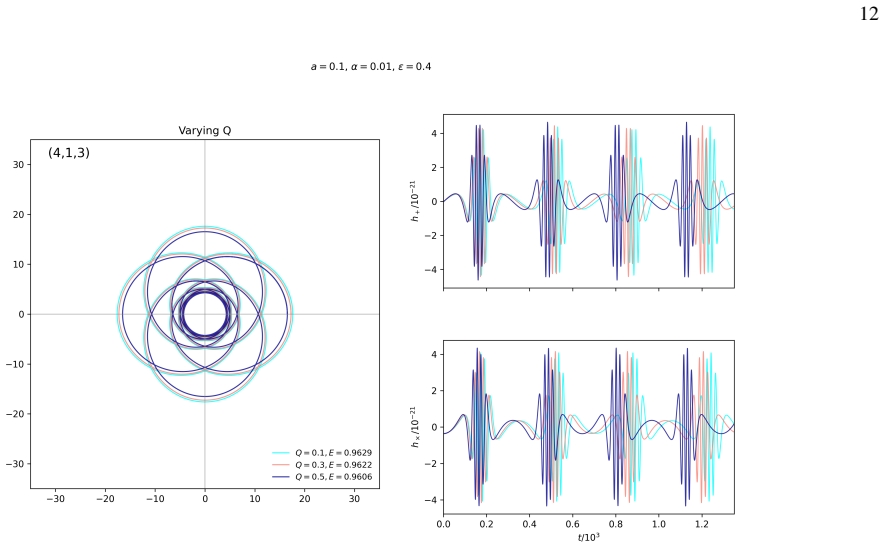
We investigate equatorial periodic orbits and their gravitational wave radiation in the spacetime of an Euler--Heisenberg (EH) black hole surrounded by perfect fluid dark matter (PFDM). The combined effects of quantum electrodynamic corrections and dark matter are incorporated through an effective metric, and the dynamics of timelike geodesics are analyzed using the effective potential formalism. We derive the conditions for marginally bound and innermost stable circular orbits, classify periodic trajectories using the rational parameter and topological indices, and identify a rich hierarchy of zoom--whirl motions in the strong-field regime. Gravitational wave signals from periodic orbits are computed using the numerical kludge method, revealing characteristic burst-like features associated with whirl phases. Our results show that perfect fluid dark matter systematically modifies the stability thresholds and suppresses the waveform amplitude, while QED corrections enhance high-frequency components generated near the horizon. These findings demonstrate that periodic orbits in the EH--PFDM spacetime provide a sensitive probe of quantum corrections and dark matter effects in strong gravitational fields.
Editorial analysis
A structured set of objections, weighed in public.
Referee Report
Summary. The manuscript examines equatorial periodic orbits and gravitational wave signatures for timelike geodesics in an effective spacetime combining Euler-Heisenberg nonlinear electrodynamics with perfect fluid dark matter. It employs the effective-potential method to locate marginally bound and innermost stable circular orbits, classifies periodic orbits via rational frequency ratios and topological indices, identifies zoom-whirl behavior, and generates waveforms via the numerical kludge approximation. The central claims are that PFDM systematically shifts stability thresholds and suppresses waveform amplitudes while EH corrections enhance high-frequency content near the horizon.
Significance. If the effective metric is a valid solution of the Einstein equations, the results would provide a concrete illustration of how quantum corrections and dark-matter halos jointly alter strong-field orbital dynamics and the associated gravitational-wave bursts. The periodic-orbit taxonomy and kludge waveforms are standard tools that allow direct comparison with Schwarzschild and Kerr cases, potentially offering falsifiable signatures for future detectors. The work therefore has moderate significance for the interface between modified gravity, dark matter, and gravitational-wave astronomy, provided the metric construction is placed on a firmer footing.
major comments (2)
- [§2 (Metric and field equations)] The effective metric is obtained by direct addition of the PFDM density term to the Euler-Heisenberg line element (presumably §2). Because the EH stress-energy is nonlinear in the Maxwell field while the PFDM is a perfect fluid, the total T_μν must be checked against G_μν; simple superposition assumes the sources commute and produce no cross terms. All subsequent effective-potential analysis, ISCO/MBO conditions, periodic-orbit classification, and kludge waveforms rest on this metric being an exact solution. Explicit verification or a derivation from the coupled Einstein-nonlinear-EM-fluid system is required.
- [§5 (Gravitational-wave computation)] The numerical-kludge waveforms are presented as capturing the characteristic burst-like features of whirl phases and the claimed high-frequency enhancement from EH corrections. However, the accuracy of the kludge in the strong-field regime near the horizon for this non-vacuum, non-Kerr metric is not quantified (e.g., by comparison with Teukolsky or full numerical-relativity benchmarks). This directly affects the reliability of the reported amplitude suppression and frequency enhancement.
minor comments (3)
- [§2] Notation for the EH parameter a and the PFDM density parameter should be introduced once with explicit physical dimensions and ranges explored in the figures.
- [Figures 4–7] Figure captions for the orbit plots and waveform spectra should state the specific values of the EH and PFDM parameters used, rather than referring only to “typical values.”
- [Introduction] A brief comparison with existing literature on EH black holes or PFDM spacetimes (e.g., ISCO shifts reported in prior works) would help situate the new combined results.
Simulated Author's Rebuttal
We thank the referee for the careful reading of our manuscript and the constructive comments, which have helped us strengthen the presentation. We address each major comment below and have revised the manuscript to improve clarity on the metric construction and the limitations of the waveform method.
read point-by-point responses
-
Referee: [§2 (Metric and field equations)] The effective metric is obtained by direct addition of the PFDM density term to the Euler-Heisenberg line element (presumably §2). Because the EH stress-energy is nonlinear in the Maxwell field while the PFDM is a perfect fluid, the total T_μν must be checked against G_μν; simple superposition assumes the sources commute and produce no cross terms. All subsequent effective-potential analysis, ISCO/MBO conditions, periodic-orbit classification, and kludge waveforms rest on this metric being an exact solution. Explicit verification or a derivation from the coupled Einstein-nonlinear-EM-fluid system is required.
Authors: We acknowledge that the metric is constructed via superposition of the PFDM term onto the EH solution. This effective approach is standard in the literature for exploring combined effects of nonlinear electrodynamics and dark matter halos, where solving the full coupled nonlinear system is analytically intractable. We have added an explicit statement in §2 that the metric is phenomenological and effective, along with references to similar constructions used in other studies of black holes immersed in dark matter. A complete derivation from the Einstein equations with the combined sources remains beyond the present scope but would be a valuable direction for future work. revision: partial
-
Referee: [§5 (Gravitational-wave computation)] The numerical-kludge waveforms are presented as capturing the characteristic burst-like features of whirl phases and the claimed high-frequency enhancement from EH corrections. However, the accuracy of the kludge in the strong-field regime near the horizon for this non-vacuum, non-Kerr metric is not quantified (e.g., by comparison with Teukolsky or full numerical-relativity benchmarks). This directly affects the reliability of the reported amplitude suppression and frequency enhancement.
Authors: We agree that the numerical kludge is an approximation whose accuracy has not been benchmarked against Teukolsky or NR for this specific metric. The method is nevertheless widely employed for geodesic-based waveforms in modified spacetimes because it reliably captures qualitative features such as burst-like signals from whirl phases. We have revised §5 to include a dedicated paragraph discussing these limitations, emphasizing that the reported trends (PFDM-induced amplitude suppression and EH-driven high-frequency enhancement) originate from the orbital dynamics themselves rather than details of the radiation formula. Full quantitative validation would require substantial additional computational effort outside the current study. revision: partial
Circularity Check
No circularity; derivation follows from posited effective metric without reduction to inputs.
full rationale
The paper posits an effective metric via direct superposition of Euler-Heisenberg and PFDM terms, then applies standard geodesic analysis (effective potential, rational parameter classification) and numerical kludge waveforms. No quoted step equates a claimed prediction or first-principles result to its own fitted parameters or self-citations by construction. All outputs (ISCO shifts, zoom-whirl hierarchies, amplitude suppression) are direct consequences of the assumed line element and do not loop back to redefine inputs. The superposition is an ansatz, not a derived theorem, and the subsequent calculations remain independent of any self-referential closure.
Axiom & Free-Parameter Ledger
free parameters (2)
- Euler-Heisenberg parameter
- PFDM density parameter
axioms (2)
- domain assumption The effective metric is obtained by combining the Euler-Heisenberg and perfect fluid dark matter contributions in the standard way for such models.
- standard math Timelike geodesics in the effective metric correctly describe test-particle motion.
Reference graph
Works this paper leans on
-
[1]
R. Kudo and H. Asada, Phys. Rev. D111, 044014 (2025), arXiv:2407.02046 [gr-qc]
- [2]
- [3]
- [4]
- [5]
-
[6]
X.-J. Wang, X.-M. Kuang, Y . Meng, B. Wang, and J.-P. Wu, Phys. Rev. D107, 124052 (2023), arXiv:2304.10015 [gr-qc]
- [7]
- [8]
-
[9]
A. ¨Ovg¨un, L. J. F. Sese, and R. C. Pantig, Annalen Phys.536, 2300390 (2024), arXiv:2309.07442 [gr-qc]
-
[10]
A. ¨Ovg¨un and R. C. Pantig, Phys. Lett. B864, 139398 (2025), arXiv:2501.12559 [gr-qc]
-
[11]
U. Uktamov, S. Shaymatov, B. Ahmedov, and C. Yuan, (2025), arXiv:2509.00460 [gr-qc]
- [12]
-
[13]
M. Alloqulov, T. Xamidov, S. Shaymatov, and B. Ahmedov, Eur. Phys. J. C85, 798 (2025), arXiv:2504.05236 [gr-qc]
-
[14]
G. Lambiase, D. J. Gogoi, R. C. Pantig, and A. ¨Ovg¨un, Phys. Dark Univ.48, 101886 (2025), arXiv:2406.18300 [gr-qc]
-
[15]
J. Rayimbaev, R. C. Pantig, A. ¨Ovg¨un, A. Abdujabbarov, and D. Demir, Annals Phys.454, 169335 (2023), arXiv:2206.06599 [gr-qc]
-
[16]
S. Capozziello, E. Battista, and S. De Bianchi, Phys. Rev. D 112, 044009 (2025), arXiv:2507.08431 [gr-qc]
-
[17]
Z.-L. Wang and E. Battista, Eur. Phys. J. C85, 304 (2025), arXiv:2501.14516 [gr-qc]
-
[18]
Mustafa, S
G. Mustafa, S. K. Maurya, T. Naseer, A. Cilli, E. G ¨udekli, A. Abd-Elmonem, and N. Alhubieshi, Nucl. Phys. B1012, 116812 (2025)
2025
-
[19]
Mustafa, P
G. Mustafa, P. Channuie, F. Javed, A. Bouzenada, S. K. Mau- rya, A. Cilli, and E. G ¨udekli, Phys. Dark Univ.47, 101765 (2025)
2025
-
[20]
Mustafa, E
G. Mustafa, E. Demir, F. Javed, S. K. Maurya, E. G ¨udekli, S. Murodov, and F. Atamurotov, Phys. Dark Univ.46, 101708 (2024)
2024
-
[21]
Mustafa, G
G. Mustafa, G. D. A. Yildiz, F. Javed, S. K. Maurya, E. G¨udekli, and F. Atamurotov, Phys. Dark Univ.46, 101647 (2024)
2024
-
[22]
M. Alloqulov, S. Shaymatov, B. Ahmedov, and T. Zhu, Eur. Phys. J. C86, 117 (2026), arXiv:2508.05245 [gr-qc]
-
[23]
A. Bragado and G. J. Olmo, Class. Quant. Grav.42, 185004 (2025), arXiv:2506.15600 [gr-qc]
- [24]
-
[25]
Consequences of Dirac Theory of the Positron
W. Heisenberg and H. Euler, Z. Phys.98, 714 (1936), arXiv:physics/0605038
work page Pith review arXiv 1936
-
[26]
J. S. Schwinger, Phys. Rev.82, 664 (1951)
1951
-
[27]
D. Magos and N. Bret ´on, Phys. Rev. D102, 084011 (2020), arXiv:2009.05904 [gr-qc]
- [28]
-
[30]
P. S. Letelier, Phys. Rev. D20, 1294 (1979)
1979
-
[31]
The Bardeen Model as a Nonlinear Magnetic Monopole
E. Ayon-Beato and A. Garcia, Phys. Lett. B493, 149 (2000), arXiv:gr-qc/0009077
work page Pith review arXiv 2000
- [32]
-
[33]
S. Rani, A. Jawad, H. Raza, S. Shaymatov, M. Muzaffar, and H. Riaz, Eur. Phys. J. C84, 904 (2024)
2024
-
[34]
R. Grossman and J. Levin, Phys. Rev. D79, 043017 (2009), arXiv:0811.3798 [gr-qc]
-
[35]
A Periodic Table for Black Hole Orbits
J. Levin and G. Perez-Giz, Phys. Rev. D77, 103005 (2008), arXiv:0802.0459 [gr-qc]
work page Pith review arXiv 2008
-
[36]
K. Glampedakis and D. Kennefick, Phys. Rev. D66, 044002 (2002), arXiv:gr-qc/0203086
-
[37]
V . Misra and J. Levin, Phys. Rev. D82, 083001 (2010), arXiv:1007.2699 [gr-qc]. 15
-
[38]
J. Levin, Class. Quant. Grav.26, 235010 (2009), arXiv:0907.5195 [gr-qc]
-
[39]
J. Levin and B. Grossman, Phys. Rev. D79, 043016 (2009), arXiv:0809.3838 [gr-qc]
-
[40]
R. Fujita and W. Hikida, Class. Quant. Grav.26, 135002 (2009), arXiv:0906.1420 [gr-qc]
- [41]
- [42]
-
[43]
M. Azreg-A ¨ınou, Z. Chen, B. Deng, M. Jamil, T. Zhu, Q. Wu, and Y .-K. Lim, Phys. Rev. D102, 044028 (2020), arXiv:2004.02602 [gr-qc]
-
[44]
Deng, Phys
X.-M. Deng, Phys. Dark Univ.30, 100629 (2020)
2020
-
[45]
Deng, Eur
X.-M. Deng, Eur. Phys. J. C80, 489 (2020)
2020
-
[46]
R. Wang, F. Gao, and H. Chen, Annals Phys.447, 169167 (2022)
2022
- [47]
-
[48]
S. Haroon and T. Zhu, Phys. Rev. D112, 044046 (2025), arXiv:2502.09171 [gr-qc]
-
[49]
C.-H. Wang, X.-C. Meng, Y .-P. Zhang, T. Zhu, and S.-W. Wei, JCAP07, 021 (2025), arXiv:2502.08994 [gr-qc]
- [50]
- [51]
-
[52]
S. Yang, Y .-P. Zhang, T. Zhu, L. Zhao, and Y .-X. Liu, JCAP 01, 091 (2025), arXiv:2407.00283 [gr-qc]
-
[53]
Jiang, M
H. Jiang, M. Alloqulov, Q. Wu, S. Shaymatov, and T. Zhu, Phys. Dark Univ.46, 101627 (2024)
2024
-
[54]
Huang, Phys
L. Huang, Phys. Rev. D111, 084038 (2025)
2025
-
[55]
T. Xamidov, S. Shaymatov, Q. Wu, and T. Zhu, (2026), arXiv:2602.09453 [gr-qc]
- [56]
- [57]
-
[58]
Science with the space-based interferometer LISA. V: Extreme mass-ratio inspirals
S. Babak, J. Gair, A. Sesana, E. Barausse, C. F. Sopuerta, C. P. L. Berry, E. Berti, P. Amaro-Seoane, A. Petiteau, and A. Klein, Phys. Rev. D95, 103012 (2017), arXiv:1703.09722 [gr-qc]
work page Pith review arXiv 2017
- [59]
-
[60]
Heisenberg and H
W. Heisenberg and H. Euler, Zeitschrift f ¨ur Physik98, 714 (1936)
1936
-
[61]
Yajima and T
H. Yajima and T. Tamaki, Physical Review D63, 064007 (2001)
2001
-
[62]
Magos and N
D. Magos and N. Breton, Physical Review D102, 084011 (2020)
2020
-
[63]
Zhang, Y
H.-X. Zhang, Y . Chen, T.-C. Ma, P.-Z. He, and J.-B. Deng, Chinese Physics C45, 055103 (2021)
2021
-
[64]
Periodic orbits and their gravitational wave radiations in $\gamma$-metric
C. Zhang and T. Zhu, (2025), arXiv:2511.14080 [gr-qc]
work page internal anchor Pith review Pith/arXiv arXiv 2025
- [65]
- [66]
- [67]
-
[68]
"Kludge" gravitational waveforms for a test-body orbiting a Kerr black hole
S. Babak, H. Fang, J. R. Gair, K. Glampedakis, and S. A. Hughes, Phys. Rev. D75, 024005 (2007), [Erratum: Phys.Rev.D 77, 04990 (2008)], arXiv:gr-qc/0607007
work page Pith review arXiv 2007
-
[69]
K. S. Thorne, Rev. Mod. Phys.52, 299 (1980)
1980
discussion (0)
Sign in with ORCID, Apple, or X to comment. Anyone can read and Pith papers without signing in.